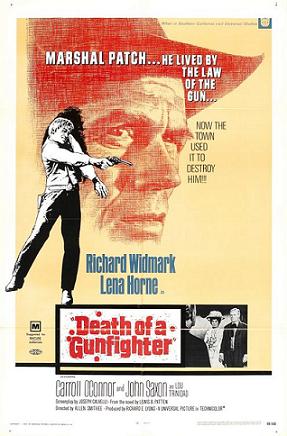
At the turn of the 20th century, the mayor and the business community of Cottonwood Springs, Texas are determined to bring their small town into the modern era. The Mayor (Larry Gates) has even purchased one of those newfangled automobiles that have been taking the country by storm. However, the marshal of Cottonwood Spings, Frank Patch (Richard Widmark), is considered to be an embarrassing relic of the past. Patch has served as marshal for 20 years but now, his old west style of justice is seen as being detrimental to the town’s development. When Patch shoots a drunk in self-defense, the town leaders use it as an excuse to demand Patch’s resignation. When Patch refuses to quit and points out that he knows all of the secrets of what everyone did before they became respectable, the business community responds by bringing in their own gunfighters to kill the old marshal.
Death of a Gunfighter is historically significant because it was the very first film to ever be credited to Allen Smithee. The movie was actually started by TV director Robert Totten and, after Widmark demanded that Totten be fired, completed by the legendary Don Siegel. Since Totten worked for 25 days on the film while Siegel was only on set for 9, Siegel refused to take credit for the film. When Widmark protested against Totten receiving credit, the Director’s Guild of America compromised by allowing the film to be credited to the fictitious Allen Smithee.
In the years after the release of Death of a Gunfighter, the Allen (or, more often, Alan) Smithee name would be used for films on which the director felt that he had not been allowed to exercise creative control over the final product. The Smithee credit became associated with bad films like The O.J. Simpson Story and Let’s Get Harrywhich makes it ironic that Death of a Gunfighter is not bad at all. It’s an elegiac and intelligent film about the death of the old west and the coming of the modern era. It also features not only one of Richard Widmark’s best performances but an interracial love story between the marshal and a brothel madame played by Lena Horne. The supporting cast is full of familiar western actors, with Royal Dano, Harry Carey, Jr., Larry Gates, Dub Taylor, and Kent Smith all making an impression. Even the great John Saxon has a small role. Though it may be best known for its “director,” Death of a Gunfighter is a film that will be enjoyed by any good western fan.
If you’re ever visiting my former hometown of Denton, Texas, you owe it to yourself to do two things.
Number one, go to Recycled Books and Records. It’s right across the street from the old courthouse and it’s perhaps the greatest used bookstore in the world. When I was going to college at UNT, I would spend hours in Recycled Books. Not only do they have three floors of books but they have some really nice apartments on the fourth floor. I attended my share of hazily remembered parties in those apartments.
The second thing that you must do is stop by the Campus Theater. The Camps Theater is located on the other side of the old courthouse and it is a true historical landmark. (It’s also the home of the Denton Community Theatre.) When you step inside of the theater, be sure to look for a plaque on the wall. The plaque will inform you that, in 1967, Arthur Penn’s Bonnie and Clyde premiered at the Campus Theater.
Bonnie and Clyde not only premiered in Denton but it was also filmed around North Texas. This was a pragmatic decision, made to minimize studio interference. Even with that in mind, that’s still the way it should have been because Bonnie Parker and Clyde Barrow are true Texas legends. In the 1930s, they were young, they robbed banks, and they killed people. Much like many of the outlaws of the era, they became folk heroes and they died in a hail of bullets.
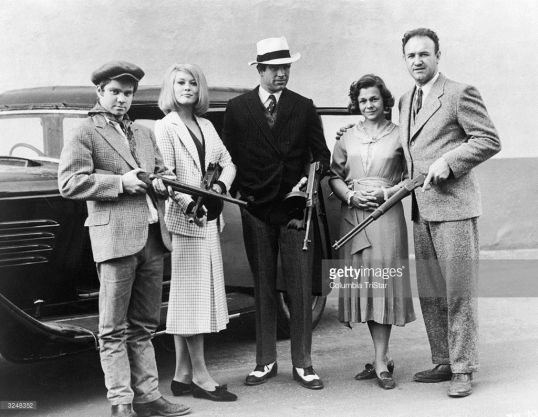
In the picture above, Clyde is short, scrawny, and slightly handsome in a class clown sort of way. Bonnie, meanwhile, is even shorter than Clyde and has the hard look of someone who has never known an easy life. Both of them have a look that should be familiar to anyone who has spent any time in the small towns that dot the North Texas landscape. They look like real people. They don’t look like film stars.
Here’s the movie’s version of Bonnie and Clyde:
In other words, Bonnie and Clyde is not a documentary. But that doesn’t matter. 50 years after it was first released Bonnie and Clyde remains a powerful and, even more importantly, extremely entertaining film. When the film was released, it was controversial for it violence and, having recently rewatched it, I have to say that the violence still makes an impression. When guns are fired, the shots seem to literally explode in your ear. When people are torn apart by bullets, they die terrible deaths and the film’s most graphic demises are reserved for its most likable characters. Towards the end of the film, with the Texas Rangers relentlessly closing in on Bonnie and Clyde, the tension becomes almost unbearable.
What makes the violence all the more disturbing is that it often interrupts scenes that, until the bullets started flying, were often humorous. A bank robbery starts out as a lark, becomes an exciting chase scene as Bonnie and Clyde attempt to escape, and suddenly turns into an act of shocking of violence when Clyde fire a gun and shoots a man point-blank in the face. Later, stopping to help an old farmer change a tire leads to a sudden ambush. Perhaps the film’s outlook is best captured in a scene in which the Barrow gang cheerfully bonds with a hostage until they suddenly find out that he’s an undertaker, a reminder that the promise of death is always present.
“Get him out of here!” Bonnie snaps.
Like many of the great gangster films, Bonnie and Clyde presents its outlaws as being folk heroes. They may rob banks and occasionally kill people but they look good doing it and they seem like they would be fun to hang out with. The thing that set Bonnie and Clyde apart from previous gangster films is that it refused to even pretend to condemn its bank robbers. The cops and the Texas Rangers are all on the side of the banks and the banks are on the side of big business. Bonnie and Clyde aren’t outlaws. They’re rebels. When they rob banks, they’re not just taking money. They’re standing up to the same establishment that was feared in the 30s, resented in the 60s, and hated today.
Clyde is played by Warren Beatty (who also produced the film) and Bonnie is played by Faye Dunaway and both of them give performances that literally define screen charisma. You never forget that you’re watching two movie stars but, at the risk of repeating myself, Bonnie and Clyde is not meant to be a documentary. At times, it almost seems as if Beatty’s Clyde and Dunaway’s Bonnie know that they’re characters in a gangster movie. They know that they’re doomed because that’s how gangster movies work so, as a result, they’re determined to live as much life as possible before that final reel. The supporting cast — Gene Hackman, Estelle Parsons, Michael J. Pollard, Gene Wilder — are all great but the film is definitely a celebration of Beatty and Dunaway.
Bonnie and Clyde went from premiering at the Campus Theater to a best picture nomination. However, it lost to In The Heat of the Night.
The Story of Suicide Sal
A Poem by Bonnie Parker
We each of us have a good “alibi”
For being down here in the “joint”;
But few of them really are justified
If you get right down to the point.
You’ve heard of a woman’s “glory”
Being spent on a “downright cur,”
Still you can’t always judge the story
As true, being told by her.
As long as I’ve stayed on this “island,”
And heard “confidence tales” from each “gal,”
Only one seemed interesting and truthful —
The story of “Suicide Sal.”
Now “Sal” was a gal of rare beauty,
Though her features were coarse and tough;
She never once faltered from duty
To play on the “up and up.”
“Sal” told me this tale on the evening
Before she was turned out “free,”
And I’ll do my best to relate it
Just as she told it to me:
I was born on a ranch in Wyoming;
Not treated like Helen of Troy;
I was taught that “rods were rulers”
And “ranked” as a greasy cowboy.”
Then I left my old home for the city
To play in its mad dizzy whirl,
Not knowing how little of pity
It holds for a country girl.
There I fell for “the line” of a “henchman,”
A “professional killer” from “Chi”;
I couldn’t help loving him madly;
For him even now I would die.
One year we were desperately happy;
Our “ill gotten gains” we spent free;
I was taught the ways of the “underworld”;
Jack was just like a “god” to me.
I got on the “F.B.A.” payroll
To get the “inside lay” of the “job”;
The bank was “turning big money”!
It looked like a “cinch” for the “mob.”
Eighty grand without even a “rumble” —
Jack was last with the “loot” in the door,
When the “teller” dead-aimed a revolver
From where they forced him to lie on the floor.
I knew I had only a moment —
He would surely get Jack as he ran;
So I “staged” a “big fade out” beside him
And knocked the forty-five out of his hand.
They “rapped me down big” at the station,
And informed me that I’d get the blame
For the “dramatic stunt” pulled on the “teller”
Looked to them too much like a “game.”
The “police” called it a “frame-up,”
Said it was an “inside job,”
But I steadily denied any knowledge
Or dealings with “underworld mobs.”
The “gang” hired a couple of lawyers,
The best “fixers” in any man’s town,
But it takes more than lawyers and money
When Uncle Sam starts “shaking you down.”
I was charged as a “scion of gangland”
And tried for my wages of sin;
The “dirty dozen” found me guilty —
From five to fifty years in the pen.
I took the “rap” like good people,
And never one “squawk” did I make.
Jake “dropped himself” on the promise
That we make a “sensational break.”
Well, to shorten a sad lengthy story,
Five years have gone over my head
Without even so much as a letter–
At first I thought he was dead.
But not long ago I discovered
From a gal in the joint named Lyle,
That Jack and his “moll” had “got over”
And were living in true “gangster style.”
If he had returned to me sometime,
Though he hadn’t a cent to give,
I’d forget all this hell that he’s caused me,
And love him as long as I live.
But there’s no chance of his ever coming,
For he and his moll have no fears
But that I will die in this prison,
Or “flatten” this fifty years.
Tomorrow I’ll be on the “outside”
And I’ll “drop myself” on it today;
I’ll “bump ’em” if they give me the “hotsquat”
On this island out here in the bay…
The iron doors swung wide next morning
For a gruesome woman of waste,
Who at last had a chance to “fix it,”
Murder showed in her cynical face.
Not long ago I read in the paper
That a gal on the East Side got “hot,”
And when the smoke finally retreated
Two of gangdom were found “on the spot.”
It related the colorful story
of a “jilted gangster gal.”
Two days later, a “sub-gun” ended
The story of “Suicide Sal.”
The Story of Bonnie and Clyde
Another Poem by Bonnie Parker
You’ve read the story of Jesse James
Of how he lived and died;
If you’re still in need
Of something to read,
Here’s the story of Bonnie and Clyde.
Now Bonnie and Clyde are the Barrow gang,
I’m sure you all have read
How they rob and steal
And those who squeal
Are usually found dying or dead.
There’s lots of untruths to these write-ups;
They’re not so ruthless as that;
Their nature is raw;
They hate all the law
The stool pigeons, spotters, and rats.
They call them cold-blooded killers;
They say they are heartless and mean;
But I say this with pride,
That I once knew Clyde
When he was honest and upright and clean.
But the laws fooled around,
Kept taking him down
And locking him up in a cell,
Till he said to me,
“I’ll never be free,
So I’ll meet a few of them in hell.”
The road was so dimly lighted;
There were no highway signs to guide;
But they made up their minds
If all roads were blind,
They wouldn’t give up till they died.
The road gets dimmer and dimmer;
Sometimes you can hardly see;
But it’s fight, man to man,
And do all you can,
For they know they can never be free.
From heart-break some people have suffered;
From weariness some people have died;
But take it all in all,
Our troubles are small
Till we get like Bonnie and Clyde.
If a policeman is killed in Dallas,
And they have no clue or guide;
If they can’t find a fiend,
They just wipe their slate clean
And hand it on Bonnie and Clyde.
There’s two crimes committed in America
Not accredited to the Barrow mob;
They had no hand
In the kidnap demand,
Nor the Kansas City depot job.
A newsboy once said to his buddy;
“I wish old Clyde would get jumped;
In these awful hard times
We’d make a few dimes
If five or six cops would get bumped.”
The police haven’t got the report yet,
But Clyde called me up today;
He said, “Don’t start any fights
We aren’t working nights
We’re joining the NRA.”
From Irving to West Dallas viaduct
Is known as the Great Divide,
Where the women are kin,
And the men are men,
And they won’t “stool” on Bonnie and Clyde.
If they try to act like citizens
And rent them a nice little flat,
About the third night
They’re invited to fight
By a sub-gun’s rat-tat-tat.
They don’t think they’re too tough or desperate,
They know that the law always wins;
They’ve been shot at before,
But they do not ignore
That death is the wages of sin.
Some day they’ll go down together;
And they’ll bury them side by side;
To few it’ll be grief
To the law a relief
But it’s death for Bonnie and Clyde.
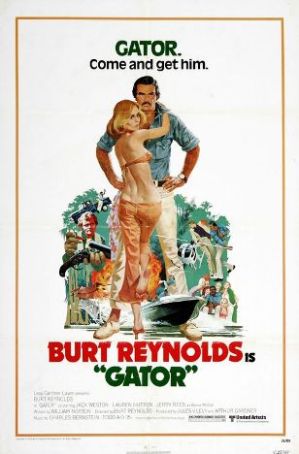
Since the events in White Lightning, Gator (Burt Reynolds) has been released from prison and he’s now living in the Okefenokee Swamp. Other than running moonshine, Gator is laying low and keeping to himself. Gator may be done with the feds but the feds are not done with him.
Gator’s old friend, Bama McCall (Jerry Reed), is now unofficial boss of Dunston County and both the Department of Justice and the Governor of Georgia (played by talk show host Mike Douglas) are determined to take him down. Federal agent Irving Greenfield (Jack Weston) is convinced that he can get Bama on charges of tax evasion. But Irving’s from New York and he does not know how to talk to the good ol’ boys. He needs someone on the inside and that’s where Gator comes in.
Gator not only starred Burt Reynolds but it was his directorial debut as well. Though it’s a sequel to White Lightning, Gator feels like a very different movie. Whereas Joseph Sargent kept White Lightning relatively serious, Reynolds take a more jokey approach with Gator. Reynolds has his famous mustache and his hairpiece in Gator and the self-amused attitude that went along with them. Gator is full of car chases, fist fights, willing women, and corny jokes. It also has Lauren Hutton, playing a familiar character who would appear in all of Reynolds’s movies, the sophisticate who cannot resist Burt’s good ol’ boy, country charm. In the 1970s, audiences couldn’t resist Burt’s good old boy charm, either. Critics hated Gator but it made a lot of money.
Gator is dumb but fun. The most interesting part of the movie is seeing Jerry Reed playing a ruthless villain. Reed is thoroughly convincing as a Dixie Mafia crime boss, the type of redneck who earlier inspired Buford Pusser to pick up a baseball bat and destroy pool halls. One year later, Jerry would play Burt Reynolds’s best friend in Smoky and the Bandit so it’s interesting to see them playing deadly rivals in Gator.
For tomorrow’s movie a day, Burt’s a football player in jail in The Longest Yard.
“Do you think we like being associated with the President of the United States? I mean, we run an honest business here!” —
Jeff (Gerrit Graham) in Used Cars (1980)
As a film lover, I’ve sat through so many disappointing commentary tracks that, when I come across one that’s actually fun and informative, it causes me to like the film even more. One of the best commentary tracks that I’ve ever heard was the one that Robert Zemeckis, Bob Gale, and Kurt Russell recorded for the DVD release of the 1980 comedy Used Cars.
The film — which was an early credit for both director Zemeckis and screenwriter Gale — tells the story of two rival used car lots. The bad guy car lot is owned by Roy L. Fuchs (Jack Warden). The good guy car lot is owned by Roy’s brother, Luke Fuchs (also played by Jack Warden). The top salesman at the good guy car lot is Rudy Russo (Kurt Russell). The film shows what happens when Luke dies and Rudy tries to prevent Roy from taking over the lot.
The commentary track is distinguished by just how much Zemeckis, Gale, and Russell seem to truly enjoy watching and talking about the film. Kurt Russell, in particular, has an incredibly engaging laugh and his sense of fun is contagious. However, for me, the most interesting part of the commentary track came when Bob Gale explicitly compared Rudy Russo and Luke’s daughter (played by Deborah Harmon) to Bill and Hillary Clinton and then even starts to do a surprisingly good imitation of Bill’s hoarse Arkansas accent.
What made it interesting was that the comparison was absolutely correct.
Politicians are salesmen. Much as politicians will say anything to get your vote, the salesmen in Used Cars will say and do anything to get your money. Politicians sell promises that are too good to be true. Rudy Russo and Roy L. Fuchs do the same thing, claiming that their used cars are just as good and safe as a car that’s never been owned before.
In fact, one of the major plotlines in Used Cars is that Rudy is plotting to make the move from selling cars to buying votes. There’s a vacancy in the state senate and Rudy is planning on running for the seat. All he has to do is come up with the $10,000 necessary to buy the nomination from the local political machine. (I imagine it would be more expensive to buy a nomination today.) Luke agrees to loan Rudy the money but, before he can, Luke goes on a test drive with a former race car driver.
The driver works for Luke’s evil brother, Roy. Roy knows that Luke has a heart condition and he specifically sends over that driver to give Luke a fatal heart attack. Just as Rudy is trying to sell a car to a costumer who is skeptical about whether or not he should pay an extra fifty dollar for something he doesn’t want (“$50.00 never killed anyone!” the customer insists), Luke staggers into the office and dies.
(The shocked customer agrees to pay the extra fifty dollars. Ever the salesman, Luke grabs the fifty before he dies.)
With Luke dead and his estranged daughter nowhere to be seen, Roy is next-in-line to take over Luke’s car lot. So, Rudy hides the body and tells everyone that Luke is down in Florida. Both he and his fellow salesman, the hilariously superstitious Jeff (Gerrit Graham), conspire to make as much money as possible before anyone discovers the truth.
How do they do it? Illegally, of course!
First off, they break into the broadcast of a football game and do an ad. Then, they use strippers to attract customers. And finally, Rudy comes up with his master plan, interrupting a televised address from the President of the United States.
“You can’t fuck with the President!” Jeff says.
“Hey, he fucks with us…” Rudy responds.
Seriously, I love Rudy.
In fact, I really liked Used Cars. It’s a good combination of broad humor and clever satire and both Kurt Russell and Gerrit Graham give such likable performances that you can ignore the fact that they’re both playing total jerks. (In fact, I would argue that one reason that we love Rudy is because he’s so honest about being so crooked.) Not every scene worked perfectly. The scene where Rudy and Jeff interrupt that football game goes on forever and, after a spokesmodel’s dress is ripped off, becomes so uncomfortable to watch that it actually takes the film a while to recover. But then, after that, you get the interruption of the President’s speech. You get Jeff freaking out over whether or not red cars or unlucky. You get some fun driving school humor. And, of course, you get a cute dog that can do tricks and helps to sell cars. The film recovers and, ultimately, Used Cars is a celebration of small businesses everywhere.
And you know what?
I really hope Rudy did make it into the state senate.
We need more Rudy Russos in government.
And we really need more commentary tracks featuring Kurt Russell!
To be honest, I really don’t like Burnt Offerings, a 1976 film about what happens when an odd family moves into an even odder house. I find it to be slow and predictable and, to be honest, the only part that really works are the flashback scenes that feature a skeletal Anthony James playing a sinister chauffeur.
However, I’ve discovered that there’s a lot of people online who disagree with me and who consider this to be one of the best haunted house movies ever! So, in the spirit of agreeing to disagree, here is Burnt Offerings…
(If nothing else, the film is worth it for the chance to see Oliver Reed, Karen Black, Bette Davis, Anthony James, and Burgess Meredith all in one film together.)
Today’s televised horror is an episode of The Twilight Zone called The Last Rites of Jeff Myrtlebank. It examines what happens when, in the middle of his funeral, Jeff Myrtlebank (played by James Best) suddenly sits up in his coffin and asks what’s going on. Jeff’s friends and family are now torn between being happy to have Jeff back and being worried as they try to figure out what exactly Jeff has come back as. I like this episode, largely because it’s a good example of country gothic and, in many ways, I’m a gothic country girl. Plus, it has a really great ending!
This episode was directed and written by Montgomery Pittman and originally aired on February 23rd, 1962.
 At the turn of the 20th century, the mayor and the business community of Cottonwood Springs, Texas are determined to bring their small town into the modern era. The Mayor (Larry Gates) has even purchased one of those newfangled automobiles that have been taking the country by storm. However, the marshal of Cottonwood Spings, Frank Patch (Richard Widmark), is considered to be an embarrassing relic of the past. Patch has served as marshal for 20 years but now, his old west style of justice is seen as being detrimental to the town’s development. When Patch shoots a drunk in self-defense, the town leaders use it as an excuse to demand Patch’s resignation. When Patch refuses to quit and points out that he knows all of the secrets of what everyone did before they became respectable, the business community responds by bringing in their own gunfighters to kill the old marshal.



 Gator McClusky is back!

 Through the Shattered Lens