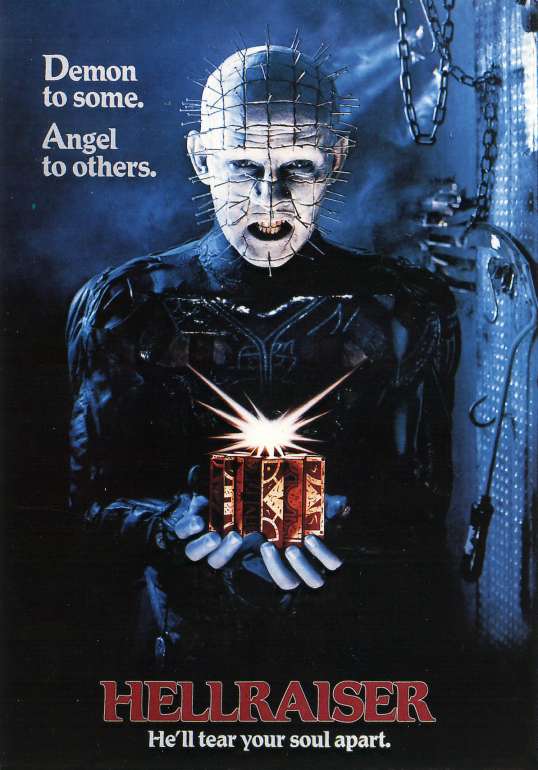
This is from the original 1987 Hellraiser. The Cenobites were probably never scarier than they were in their very first appearance. They are all the more horrifying because, rather than being stereotypically good or evil, they’re actually neutral. They’re doing their job and, if you don’t want to see them, don’t mess around with the puzzle box. Doug Bradley was brilliant in the role of the head Cenobite (who, of course, would later be known as Pinhead).
Right now, on Tubi, you can find a film that the service says is titled Bundy Reborn. It’s a horror film, one that centers on a medical student named David O’Hara (played by the film’s director, Matthan Harris) who turns into a serial killer. Struggling with the trauma of having witnessed his father (Bill Moseley) murder his younger sister, David kidnaps Melissa Daniels (Lindsay Hightower) and then disappears into the night when Melissa is rescued by Inspector Lorenzo (the one and only Giovanni Lombardo Radice). Nine months later, David comes out of hiding after Melissa gives birth to their child. David once again kidnaps Melissa and kills several other people as well.
It’s pretty much a standard serial killer film. Despite the title, it has little to do with Ted Bundy. In fact, Bundy isn’t even mentioned in the film. David, like Bundy, is a handsome serial killer who went to college. But, whereas Bundy killed because he enjoyed it, David is trying to recreate a family that was destroyed by his equally sociopathic father. There’s a germ of an interesting idea to be found in this film. For all of his crimes and his evil actions, David really is just carrying on the family tradition. Can evil be passed down genetically? Or would David be perfectly normal if he just hasn’t witnessed his father killing his sister? Those are legitimate questions that this film raises and then promptly seems to forget about. The title, however, suggests that David is literally Ted Bundy in a new body and that’s simply not the case here.
Indeed, the film was originally released under a totally different title, The Inflicted. That title worked well with this film’s portrayal of a son who inherited his murderous compulsions from his father. David has been inflicted with the same evil that his father carries in his heart. The Inflicted is an honest title but, at the same time, it’s not a title that’s going to grab the audience. It’s a title that feels a bit too generic. Bundy Reborn, on the other hand, is an acknowledgement of the fact that Ted Bundy is a particularly macabre part of the American pop cultural landscape. As evil and worthy of hate as Ted Bundy may have been, viewers just can’t get enough of him. Ted Bundy never had much of a chance to pursue his political ambitions but today, more people probably know who Ted Bundy was then know that Connecticut Senator Richard Blumenthal lied about serving in Vietnam.
As for the film, the plot is full of contrivances and moments that just don’t make much sense. For horror fans, it is a chance to see several icons in one film, though most of them have extremely small roles. That said, it’s nice to see a usually villainous actor like Sid Haig cast as a kindly psychiatrist. Bill Moseley is properly menacing as David’s father. Doug Bradley seems to be enjoying himself as an FBI agent. As for Giovanni Lombardo Radice, how can you not smile when he’s onscreen? Radice’s Italian accent may seem out of place in a film that is shot and was made in North Texas. But Radice had an undeniable screen presence and he looked good wearing a trenchcoat and holding a gun. He simply was Lorenzo.
On a persona note, this film was shot in my part of the world. Several scenes were shot in my hometown. Several other scenes were filmed in the town where I went to college. When Inspector Lorenzo gets a call about David’s activities, I immediately yelled, “Oh my God, he’s at the Shops at Legacy!” Later, my heart ached when I saw that the hospital that Melissa was taken to was the same hospital that my father was taken to immediately after his car accident back in May. I recognized almost every location in the film as some place that I had been personally and that was definitely kind of exciting.
Finally, let’s all just be happy that Bundy has not been reborn but instead was apparently cremated and dumped out over some anonymous swimming pool somewhere.
At the start of 2011’s The Reverend, the Devil (Rutger Hauer) pulls up in front of a luxurious hotel. He gets out of his limo, enters the hotel, and finds God (Giovanni Lombardo Radice) sitting at his desk, surrounded by armed priests.
God asks the Devil what he’s been doing. The Devil says he’s been traveling the world and tempting men to do evil. The Devil says that he wants permission to ruin the life of one man who is virtuous and God-fearing, saying that the man will reject his faith as things get worse and worse. God agrees, as long as the man is not killed….
Does this sound familiar? Yep, this is yet another adaptation of the Book of Job. Or, I should say, this film pretends to be an adaptation of the Book of Job. The nameless Reverend (Stuart Brennan) is a God-fearing man whose life goes downhill after he’s bitten by a vampire. That said, there’s really not much of a comparison to be made between the Reverend and Job. Job lost everything, including his land and his family and the majority of his friends. The Reverend doesn’t really have any friends to lose and he actually gets better at his job after he is turned into a vampire and proceeds to take out his village’s criminal element.
In fact, the entire prologue between God and the Devil feels as if it was tacked on at the last minute. It really doesn’t connect to the rest of the film and we certainly don’t learn whether it was God or the Devil who won the bet. Hauer and Radice only appear in that one scene and then they are never heard from again. That’s a shame because, to be honest, the only reason I watched this movie was for the chance to see Hauer and Radice together. They were both incredible character actors and tragically, both of them are no longer with us. Hauer passed away in 2019 and Radice died last year. Neither one of them looks particularly healthy in the prologue, though it is nice to see the two of them sharing the screen together, albeit for just a few minutes.
As for the rest of the film, it did have potential. There’s a lot of blood spilled and that’s always a plus when it comes to a vampire movie. Doug Bradley gives a good performance as the Reverend’s enigmatic superior. Stuart Brannen is himself likable enough as the Reverend and the scene where he’s first bitten has a kinetic energy to it that briefly gave me some hope for the rest of the film.
Unfortunately, with the exception of the aforementioned scenes, The Reverend is a rather slow movie and one that never succeeds in building up any sort of narrative momentum. (I guess that’s a polite way of saying that it’s kind of boring.) As a character, The Reverend is likable but he’s never compelling and the film ends on a rather anticlimactic note. The film had potential but sadly, most of it went unrealized.
Born in Liverpool, actor Doug Bradley is a longtime personal friend to author Clive Barker and appeared in Barker’s short film Salome, playing the role of King Herod. When Barker was making his feature directorial debut with 1987’s Hellraiserand he needed someone to play the head Cenobite, he turned once again to Bradley and the result was one of the most iconic horror characters of all time.
While the Cenobites may have all had disturbing physical features, what truly made them frightening was their arrogant disdain for anyone who was foolish enough to summon them. Bradley perfectly portrayed Pinhead’s haughty arrogance, starting with his very first appearance in Hellraiser.
When Bradley as Pinhead says, “We’ll tear your soul apart,” the viewer has no doubt that he means every word of it.
This is from the original 1987 Hellraiser. The Cenobites were probably never scarier than they were in their very first appearance. Perhaps the most interesting thing about them is that, rather than being stereotypically good or evil, they’re actually neutral. They’re doing their job and, if you don’t want to see them, don’t mess around with the puzzle box. Doug Bradley was brilliant in the role of the head Cenobite (who, of course, would later be known as Pinhead).
On Monday night, Dancing With The Stars did a horror night, in which “the stars” did dances that were inspired by horror films. One of the first to perform was a professional wrestler who is apparently known as The Miz. When the Miz performed, he was dressed in black and he had several fake pins attached to his face.
After he danced, host Trya Banks asked The Miz what scared him. Obviously seeing a chance to suck up to the judges and the audience, the Miz grandly announced, “This! Doing this every week terrifies me! Dressing up like Hellraiser and dancing terrifies me….”
Uhmmm, excuse me, Mr. Miz — the character’s name is Pinhead. The movie is called Hellraiser. You were dressed up as Pinhead.
Seriously, I felt that the Miz should have been eliminated from the competition at that exact moment but no. His sucking up worked. Everyone laughed. Everyone applauded. No one called him out on his error. It upset me a bit. I was like, “Who are you to do horror night when you don’t even know the difference between the movie and the character!?”
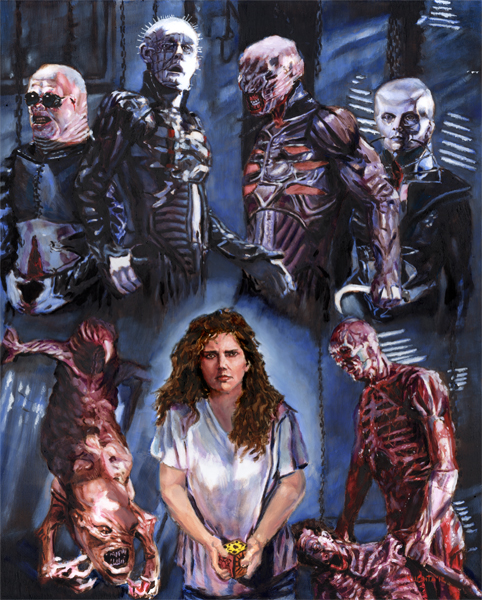
Really, they should all be forced to watch or rewatch Hellraiser. First released in 1987, the directorial debut of Clive Barker holds up pretty well as a blood-filled horror movie. It tells the story of Larry (Andrew Robinson), his daughter Kristy (Ashley Laurence), and his second wife, Julia (Clare Higgins). Larry’s ne’er-do-well brother, Frank (Sean Chapman), has died under mysterious circumstances so Larry moves into Frank’s old house and tries to renovate it. He hopes that this will somehow help his strained marriage to Julia, who was having an affair with Frank. Why Larry thinks this is a good idea is never quite clear. Larry seems to be a nice guy but it doesn’t take long for the audience to get the feeling that he might not be that smart.
Kristy, on the other hand, is much smarter than her father and she knows better than to trust Julia. In fact, Kristy refuses to even live in the same house as Julia. Still, Kristy does check in on her father occasionally and she quickly realizes that Julia is doing something strange. It turns out that Frank may be dead but his tortured, skinless spirit lives on. Julia has been picking men up in bars and bringing them back to the house so that Frank can steal their skin. On the one hand, you do have to feel kind of sorry for all of the people who die. On the other hand, Frank does look better with skin.
Frank ended up in his skinless state because he foolishly opened up a puzzle box. That’s where Pinhead (played by Doug Bradley) comes into the equation. Pinhead and the other Cenobites live in another demension and they’ve spent so much time “exploring” that they can no longer tell the difference between pain and pleasure. Pinhead’s face is covered in pins. (In fact, Pinhead started out as something of a fan nickname as Bradley is just credited with playing “the Lead Cenobite” in the film’s end credits.) The Cenobites are actually only in Hellraiser for a few minutes. The majority of the film is made up of Julia bringing strange men home and Frank attacking them. But it’s the Cenobites — and Pinhead in particular — who make the biggest impression. Beyond his bizarre appearance, Doug Bradley plays the character with such haughty arrogance that it’s hard not to be intrigued. He knows things.
Hellraiser holds up well. Andrew Robinson does his best but Larry is a bit of a moron. However, Clare Higgins has fun with her femme fatale role while Ashley Laurence is likable and sympathetic as Kristy. For the most part, the special effects hold up well and even the film’s slightly more cartoonish moments add to the feeling that the film takes place in a universe that is becoming increasingly unstable. The puzzle box is wonderful creation. It’s easy to say that you would never mess with something like that but most people would. The temptation would just be too great.
Watch Hellraiser and never get Pinhead’s name wrong again!
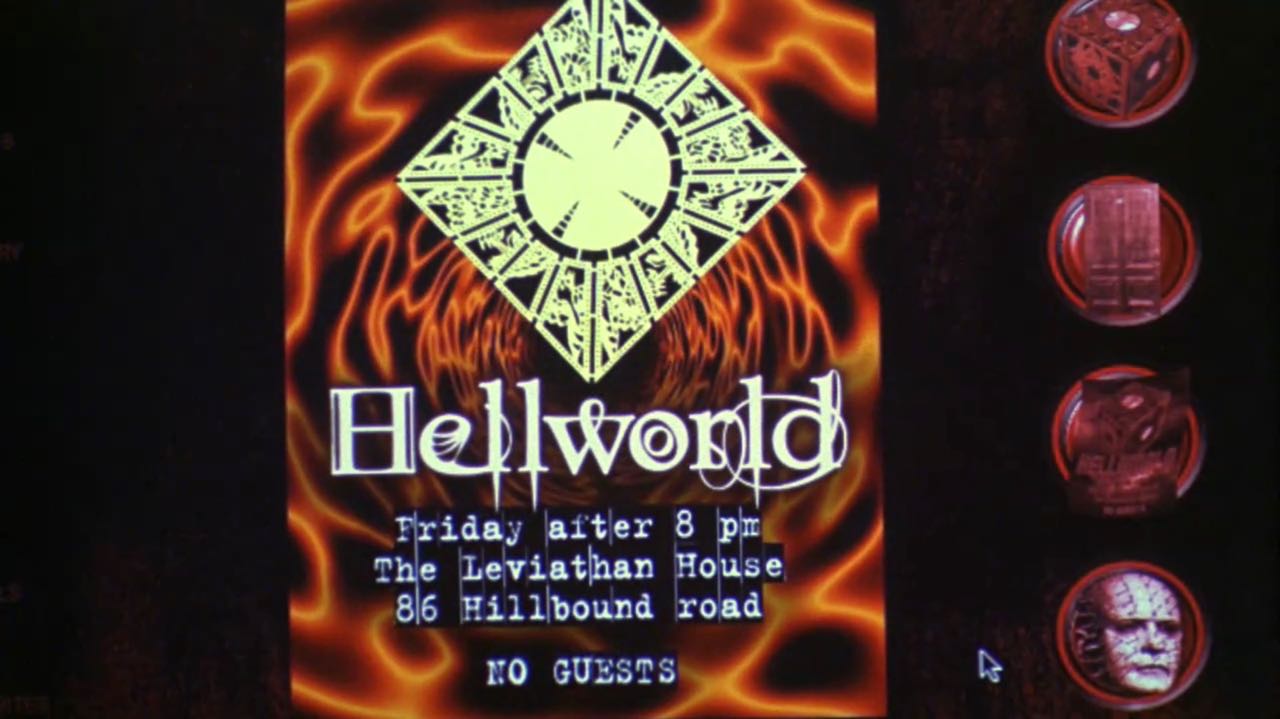
Oh, Kirsty. Yes, Hellraiser III was awful. Yes, it is sad that it’s the movie that got Motörhead’s version of Hellraiser. But it could have been worse. It could have been Hellraiser: Hellworld (2005) that got this song. That would have been truly painful.
Hellraiser: Hellworld (2005, dir. Rick Bota)
In 1992 they finally got around to making a third film in the Hellraiser franchise. It really has nothing to do with the first two films. Once you’ve seen Pinhead create a cenobite with a face made of CDs, there’s no going back. If you’ve only seen the first two films, then stop there. You can watch this music video to get one, if not the only good thing about the third film–this song.
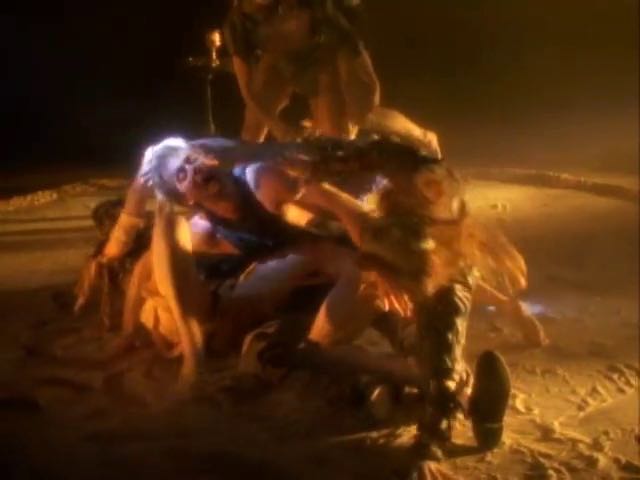
We open on Motorhead’s performance, set a large, cavernous space. Dante-esque, dimly lit with pools of light on the band members and their instruments. As the camera moves around the space, various creatures are revealed, oily bodies shining through their ragged bits of clothing, prosthetic pieces (a claw, a beak etc.,) and bandages, stylized make-up all showing that they are THE DAMNED. All of this is shot in shadowy black and white. We also see Props from “Hellraiser 3” (the baby, signage, etc.), which become match dissolves to footage from the film itself.
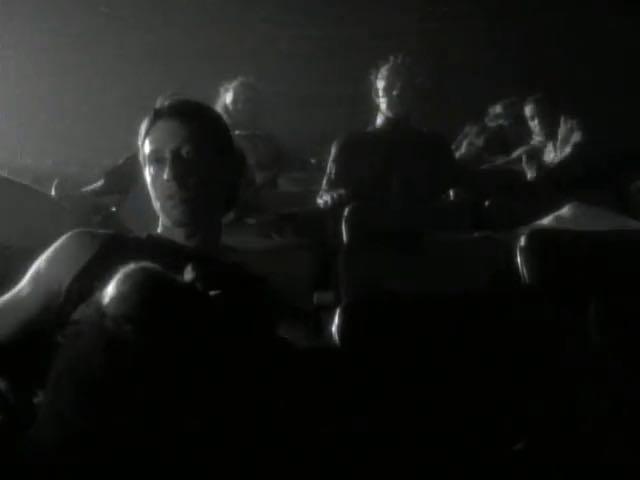
Back in our black and white cavern a roadie sits in a large Overstuffed chair toward the back of the space, smoking, watching the band’s performance. Suddenly light streams in when a door crashes open. We switch to color as Pinhead makes his grand entrance, rim-lit, a delicate presence. The demons begin to writhe madly to the music. The band’s performance builds as Pinhead moves across the floor, throwing the roadie out of his chair and out of frame. Pinhead takes the seat and gulps virgin’s blood from smoking cup. From Pinhead’s point of view we watch the band.
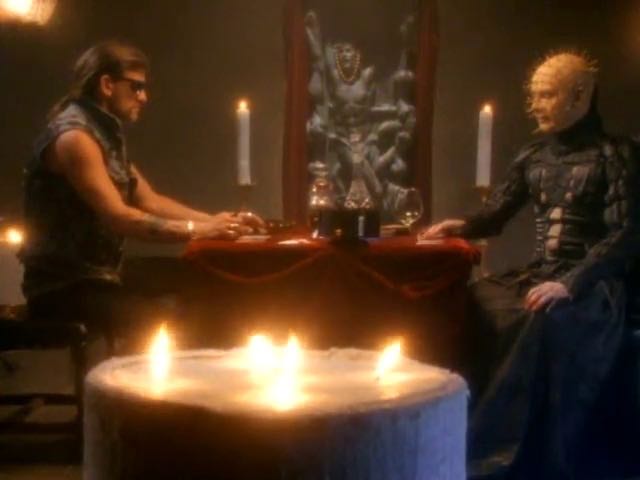
We cut to a scene of Lemmy and Pinhead in two chairs at a gaming table. Intercutting with performance footage and Hellraiser III footage, we see Lemmy and Pinhead playing cards, drinking, Serious competitors having fun. The demons writhe behind Pinhead, the band stands behind Lemmy as the tension builds between the two.
Doug Bradley added the following in 2005 concerning Lemmy:
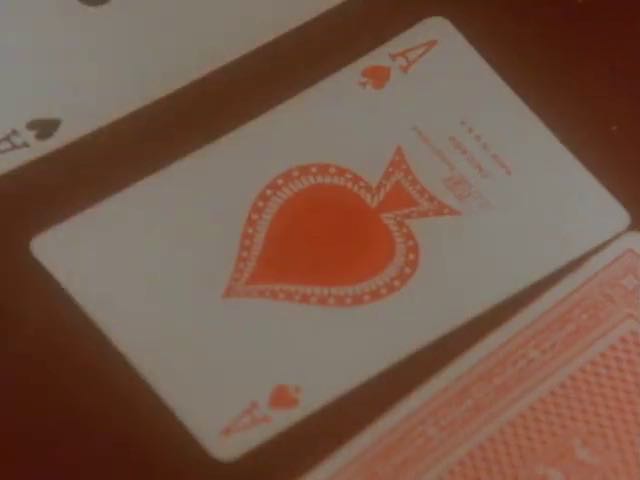
The card game finished with me getting the Ace of Spades, so the idea is that Lemmy wins the game but at the price of losing his soul. But that was funny, when we were playing that card game there was a decanter on the table, just as a prop, and Lemmy had a word with one of his people, the decanter disappeared but it came back again full of amber liquid which Lemmy proceeded to drink his way through while we shot that scene, like you and I would drink orange juice, while the dark pope of Hell sat on the other side of the table demurely sipping Evian water…
The attraction of this music video is when Lemmy and Pinhead play cards.
However, there are a few other things I enjoy about the video.
While the footage of the band playing is boring, I do like the reverse shot where Pinhead is at a Motörhead concert.
Why is this person wearing something similar to the jaw-breaking device from the Saw movies?
A bit of a Queen music video is going on here.
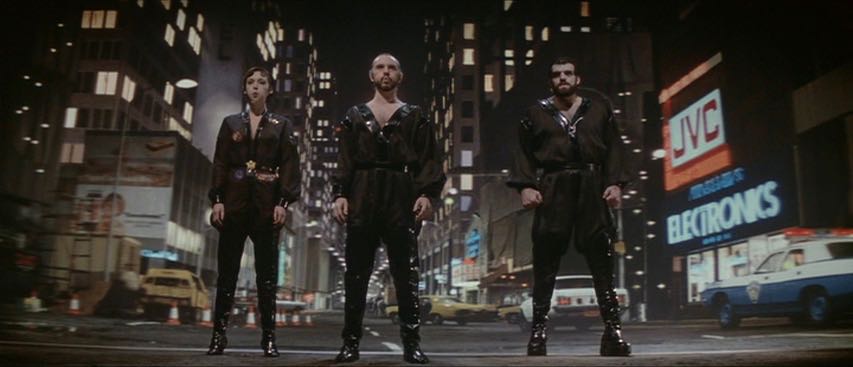
I normally don’t go for unintegrated movie footage in videos of this sort, but I appreciate that Barker left in one particular sequence from the movie. There is a scene where the cheap cenobites that Pinhead made chase Terry Farrell’s character onto a street to do a scene similar to the one from Superman II (1980).
Superman II (1980, dir. Richard Lester & Richard Donner)
And yes, Henry Cavill was in Hellraiser: Hellworld where he got killed off by Lance Henriksen, not Pinhead, since, like the other movies after IV, Hellworld was a different movie that had elements of Hellraiser grafted onto it. Pinhead doesn’t actually exist in the movie until the very end of the film.
During that street destruction scene, there are at least two places that get their signs destroyed.
Larry was a character from the first Hellraiser movie played by Andrew Robinson who would go on to be on Star Trek: Deep Space Nine with Terry Farrell in 1993–one year after this movie came out.
If you have the misfortune to watch Hellraiser III, then you might notice that the statue Pinhead is in with what I remember to be trapped souls is just a tad similar to something from A Nightmare On Elm Street 3: Dream Warriors (1987). In that movie, Freddy Krueger explains that he has gotten stronger by capturing children’s souls which he then shows as part of his flesh. I’m sure the similarities weren’t lost on the people involved in both franchises. Elm Street started back up the same year as the Hellraiser franchise started. Also, makeup artist Kevin Yagher, who did makeup on Elm Street 2, 3, and 4, would go on to direct Hellraiser IV as Alan Smithee.
Barker could have just as easily used footage from the club parts of the movie instead of Farrell running on the street. Instead, he left in those shots.
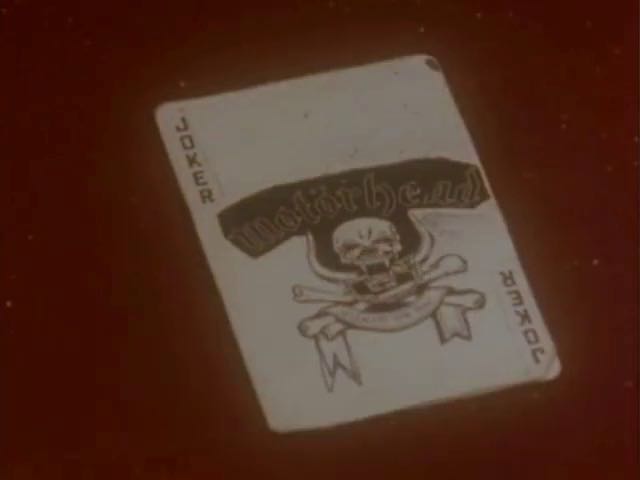
Other than those things, it’s just the song and the card playing scene, which yes, is similar to The Seventh Seal (1957) with its game of chess with Death. There’s nothing else particularly interesting. You’re watching to see Lemmy turn up a joker and the ace of spades.
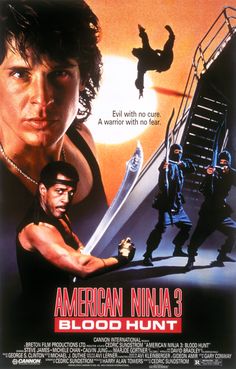
Is an American Ninja film still an American Ninja film if it doesn’t feature the American Ninja?
That is the question posed by American Ninja 3: Blood Hunt. Michael Dudikoff, who played Joe Armstrong in the first two films, is nowhere to be found. Instead, he has been replaced by Doug Bradley. Fortunately, the movie does not try to pass Bradley off as being Joe Armstrong. Instead, he is a new character, CIA agent Sean Davidson. Sean’s father was a martial arts champion who was killed by gangster while Sean watched. Sean later went to Japan where he was trained in the ways of the ninja. Sean is an American ninja, even if he’s not the American Ninja.
He also happens to be best friends with Jackson (Steve James), who previously appeared in the first two films and who never comments on the coincidence of having two best friends who both happen to be American ninjas. Jackson, along with sidekick Dexter (Evan J. Klisser) and lady ninja Chan Lee (Michele B. Chan), team up with Sean after Sean’s sensei is kidnapped by a terrorist known as The Cobra (Marjoe Gortner). The Cobra, who has a team of his own ninjas, has developed a poison that he wants to test on Sean.
The plot makes as much sense as the previous two American Ninja films and, somehow, everyone forgets about finding the sensei before the movie ends. As an actor, Doug Bradley is no Michael Dudikoff (which is saying something) but he’s good in the fight scenes and that is the only thing that really matters. The whole film is nearly worth it just to see former child evangelist Marjoe Gortner in the role of The Cobra. Dudikoff is missed but at least his absence meant that Steve James got to do more in American Ninja 3 than he did in the first two films. Sadly, just three years after this film’s release, James died as the result of pancreatic cancer. He was 41 years old.





 Is an American Ninja film still an American Ninja film if it doesn’t feature the American Ninja?
 Through the Shattered Lens