The Films of 2024: Rebel Moon Part 2 — The Scargiver (dir by Zack Snyder)


In some other galaxy, a bunch of annoying farmers are living on the moon of Veldt.  The evil army of the Motherworld, led by Atticus Noble (Ed Skrein), wants to conquer the moon and steal all of the grain for themselves.  A bunch of rebels — including a long-winded former general named Titus (Djimon Hounsou) and painfully dull former solider of the evil empire named Kora (Sofia Boutella) — are on the moon and help the farmers prepare for battle.  And then the battle happens and the movie ends and somehow, it takes more than two hours to tell this extremely thin story.

Admittedly, I have not seen the first Rebel Moon but I doubt it makes much of a difference.  I’ve seen enough science fiction movies and enough Zack Snyder films that I feel like I can follow this sequel without having seen the first film.  In fact, the only question that I have as a result of not seeing the first film is whether the absolutely ludicrous flashback to Kora’s past was lifted from the first film or was it specifically shot for the sequel?  The flashback reveals that Kora became a rebel after her mentor attempted to frame her for the murder of a good space emperor and his family. I have to admit that the overwrought, slow motion-heavy flashback did inspire a few chuckles on my part.  There was an orchestra playing in the background of the scene and they continued to play, even while the emperor and his family were being murdered.  You have to wonder just what exactly the musicians were thinking while all of that was going on.

As for Rebel Moon Part Two, it has some nice visuals but the story is a mess and there are some moments that simply leave you wondering whether to laugh or sigh with frustration.  There’s the fact that the fearsome imperial spaceships are apparently fueled by men shoveling coal into a furnace.  There’s the fact that fearsome imperial space laser gun takes forever to aim and fire, presumably to give the rebels time to sabotage the ship.  (That seems like a pretty big design flaw.)  There’s the fact that the evil empire turns out to be so inept that it’s hard to feel like the farmers really needed to spend as much time training as they did.  By the end of the film, I felt like I probably could have beaten up the evil empire single-handedly.  They just weren’t that impressive.

The main problem is that the farmers were kind of annoying and, even when they finally did fight the evil empire, it was still hard to feel that they still didn’t have any control over their own fate.  First, they were being ordered around the bad guys.  Then, they were being ordered around by Titus and the rebels.  Titus, himself, is one of those annoying characters who can’t ever say anything without turning it into a speech.  On the one hand, Titus insists that the farmers don’t have much time to get ready.  On the other hand, Titus continually wants to waste what little time they have by giving a monologue.  Kora, meanwhile, rarely speaks.  This has less to do with her being a strong, silent warrior and instead it’s all about her not really having much of a personality.

The majority of the film’s runtime is taken up with the battle and it’s hard not to notice that for all of the explosions and presumed death, most of the main characters somehow manage to survive.  It left me thinking about we were supposed to celebrate the survival of the Daily Planet staff at the end of Man of Steel, despite the fact that thousands of others undoubtedly died while Superman and General Zod were ripping apart Metropolis.

To be clear, there are quite a few Zack Snyder films that I really do like.  I am not, by any means, an anti-Snyder person.  I thought Sucker Punch was a masterpiece.  I admire and respect what he did with Watchmen.  I’m not a fan of his work with the DCEU but then again, with the exception of the first Wonder Woman, I’m not really a fan of anyone’s work with the DCEU.  The important thing is that I think that, with the right material, Zack Snyder can be brilliant and I love the fact that, even in his lesser films, he still goes all out to bring his vision to life.  As a director, Snyder is not scared to go over-the-top with sweeping, dramatic moments.  He’s someone who understands that movies — especially action films — should be big.  But Rebel Moon 2 never really works.  If anything, it sometimes feels like Snyder on auto pilot.  I’ll always be willing to take a chance of Zack Snyder but I hope that doesn’t mean having to watch Rebel Moon 3.

Icarus Files No. 1: Cloud Atlas (dir. by The Wachowskis and Tom Tykwer)


CloudAtlas

“My life amounts to no more than one drop in a limitless ocean. Yet, what is any ocean, but a multitude of drops?” — David Mitchell

Let me tell you about Icarus. He took flight with wings of feather and wax. Warned not to fly too low so as not to have the sea’s dampness clog his wings or to climb too high to have the sun melt the wax. Icarus heeded not the latter and tried to fly as close to the sun. Just as his father had warned him the wax in his wings melted as he flew too close to the sun and soon fell back to earth and into the sea.

A tale from Greek mythology that taught has taught us about ambition reaching so high that it’s bound to fail. One such ambitious failure of recent times has been the epic science fiction film Cloud Atlas directed by The Wachowskis and Tom Tykwer.

The film was adapted from the novel of the same name by author David Mitchell which looked to take six stories set in 19th-century South Pacific and right up to a distant, post-apocalyptic future. Each story’s characters and actions would connect with each other through the six different time and space. The film attempts to do what Mitchell’s novel did through several hundred dense and detailed pages.

CLOUD ATLAS

Just like Icarus The Wachowski and Tom Tykwer’s attempt to connect the lives and actions of all six stories amounts for what admirers and detractors can only agree on as an admirable and ambitious failure.

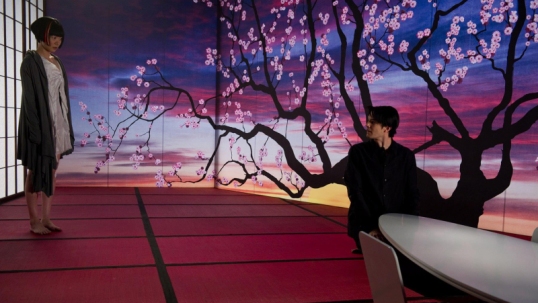
The film boasts a large ensemble cast led by Tom Hanks, Halle Berry, Jim Broadbent, Hugh Grant and Hugo Weaving. More than one of the actors in the cast would perform characters in each and every six interconnecting stories in the film which added a sense of rhythmic continuity to the whole affair, but also made for some very awkward and uncomfortable scenes of what could only amount to as “yellowface”. This was most evident in the story set in 22nd-century Neo Seoul, South Korea where actors such as James D’Arcy, Jim Sturgess, Keith David and Hugo Weaving have been heavily made-up to look Asian.

Cloud Atlas was and is a sprawling film that attempts to explore the theme that everything and everyone is connected through time and space. It’s how the action of one could ripple through time to have a profound effect on others which in turn would create more ripples going forward through time. The film both succeeds and fails in portraying this theme.

cloud_atlas_hd_movie_trailer_stills_cinemavine_144.png.scaled1000

It’s the film’s narrative style to tell the six stories not in a linear fashion from 19th-century to the post-apocalyptic future, but instead allow all six tales to weave in and out of each other. At times this weaving style and how it would seamlessly go from one time location to another without missing a beat made for some very powerful and emotional moments. But then it would also make these transitions in such a clunky manner that it brings one out of the very magical tale the three directors were attempting to weave and tell.

Yet, even through some of it’s many faults and failings the film does succeed in some way due to the performances of the ensemble cast. Even despite the awkwardness of the “yellowface” of the Neo Seoul sequence the actors in the scenes perform their roles such admirable fashion. One would think that someone like Tom Hanks who has become such a recognizable presence in every film he appears in wouldn’t be able to blend into each tale being shown and told, but he does so in Cloud Atlas and so does everyone else.

It helps that the film was held up from a very hard landing after reaching so high with an exquisite and beautiful symphonic score composed by Tom Tykwer, Reinhold Heil and Johnny Klimek. It’s a score that manages to accentuate the film’s exploration of emotions and actions rippling through time without ever becoming too maudlin and pandering to the audiences emotions.

o0800045112460141324

Cloud Atlas was hyped as the next epic science fiction film from The Wachowskis and Tom Tykwer leading up to it’s release. This hype was further built-up with thundering standing ovation during it’s screening at the 37th Toronto International Film Festival. But once the film finally was released and more critics and the general public were able to see it for themselves the reaction have been divisive. This was a film that brooked no middle-ground. One either loved it flaws and all or hated it despite what it did succeed in accomplishing amongst the failures.

Just like Icarus, Cloud Atlas and it’s three directors had high ambitions for the film. It was a goal that not many filmmakers seem to want to put themselves out on the limb for nowadays because of how monumental the failure can be if their ambitions are just too high. It’s been the reputation of The Wachowskis since they burst into the scene with their Matrix trilogy. Their eclectic and, somewhat esoteric, storytelling style have made all their films an exercise in high-risk, high reward affairs that makes no apologies whether they succeed or fail. Each of their films have a unique vision that they want to share with the world and they make no compromises in how this vision is achieved.

One could call Cloud Atlas an ambitious failure. It could also be pop, New Age psychobabble wrapped up in so-called high-art. Yet, what the two siblings and Tom Tykwer were able to achieve with the film has been nothing less by brave and daring. If more filmmakers were willing to allow their inner Icarus to fly then complaints of Hollywood and the film industry not having anymore fresh new ideas would fade.

Trailer: Cloud Atlas (Extended Trailer)


We’ve been getting quite a bit of hype for the fall and holiday releases of 2012 but for some reason one film that should’ve been on more people’s radar seem to have gone unnoticed until this week when an extended trailer for the film was released to the public. It’s the film adaptation of David Mitchell’s epic sci-fi novel Cloud Atlas.

The film is directed by Lana Wachowski (formerly Larry Wachowski), Andy Wachowski and German-filmmaker Tom Tykwer. It’s a film that has a cast which includes Tom Hanks, Halle Berry, Jim Broadbent, Jim Sturgess and Susan Sarandon for starters. The story looks to stay faithful to the original novel source which interweaves six different stories spanning time from the 19th-century all the way to a post-apocalyptic far future.

It’s going to be interesting whether the Wachowskis and Tykwer will be able to keep these six stories from becoming too confusing for the general audience to follow. Most important of all will be if these filmmakers will be able to create an entertaining film out of a novel heavy on themes and ideas. One thing the trailer sure points out is that the Wachowskis haven’t lost their touch when it comes to the visual side of filmmaking.

Cloud Atlasis set for an October 26, 2012 release date.