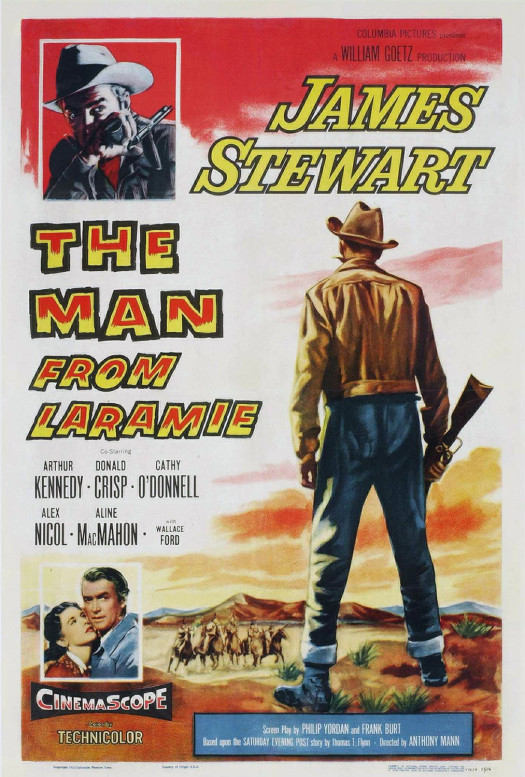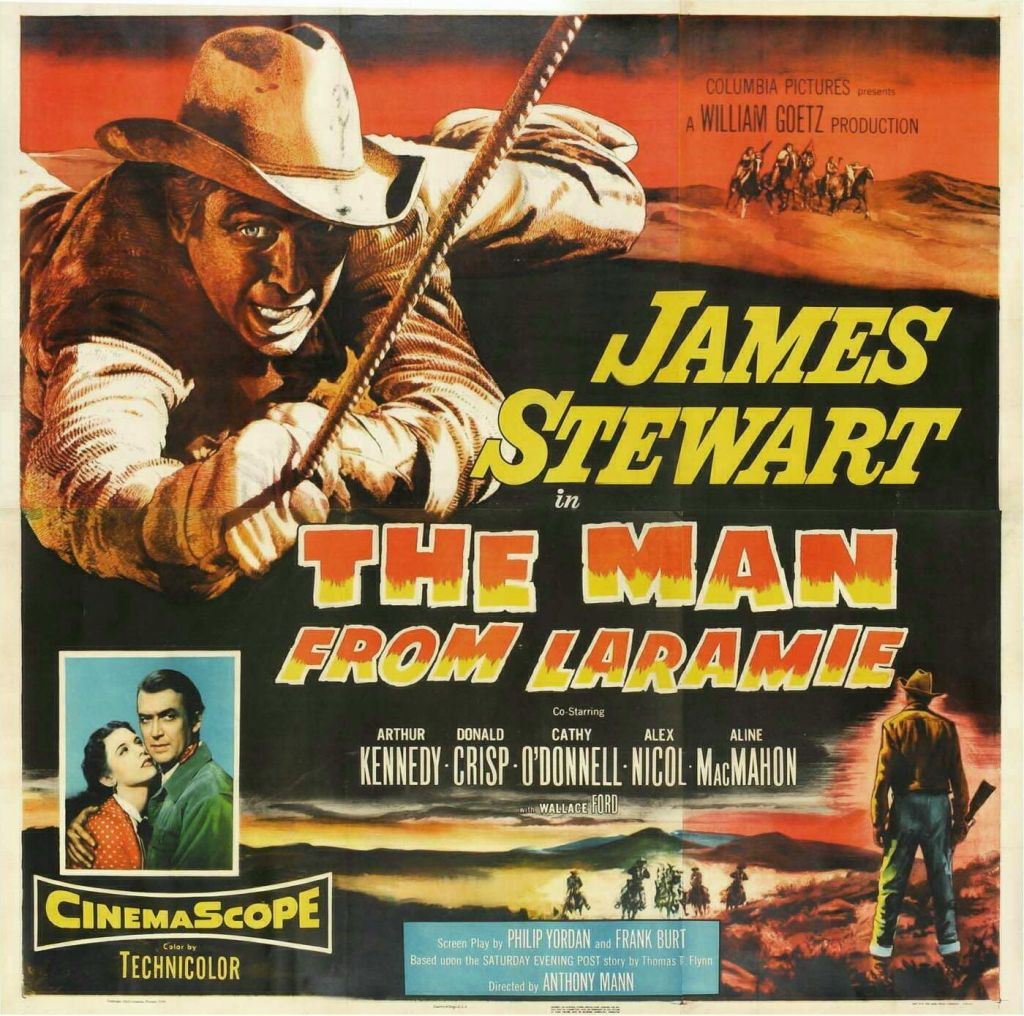
I review THE MAN FROM LARAMIE (1955), starring James Stewart!


Happy Birthday, Jimmy Stewart!

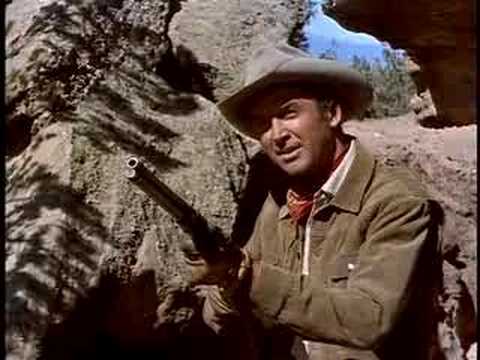
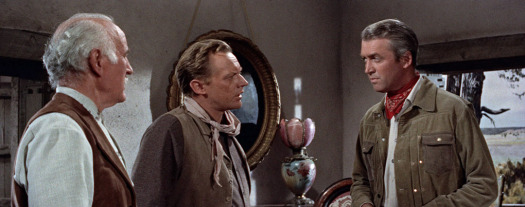
I’m celebrating Jimmy Stewart’s birthday by watching his western THE MAN FROM LARAMIE! Stewart plays Will Lockhart, a man who has run into some bad luck. His brother, a U.S. cavalryman, was recently killed in an attack by Apaches using repeating rifles outside of the town of Coronado, New Mexico. In an attempt to track down the man who sold the rifles to the Indians, Lockhart has come to Coronado from Laramie, WY, to snoop around. He’s welcomed to town by Dave Waggoman (Alex Nicol), we’ll call him “Crazy Dave,” the son of powerful local rancher Alec Waggoman (Donald Crisp). Accusing Lockhart of stealing salt off of their land, Crazy Dave proceeds to drag him with a rope, burn his wagons and shoot his mules. Before he can do even more damage to Lockhart, the foreman of the Waggoman ranch Vic Hansbro (Arthur Kennedy) comes along and stops him. Vic seems like a reasonable man, but he does ask Lockhart to move on down the trail before there’s any more trouble. Lockhart isn’t leaving until he finds out more about those rifles so he politely declines by going back into town, finding Crazy Dave, and kicking his ass. He then goes to see Alec and asks to be paid back for the wagons and mules that crazy Dave destroyed. Alec pays Lockhart back and then calls Vic in to come see him. Here’s where we start to get a feel for Waggoman family dynamics. You see, Alec loves his son no matter how crazy he is, and he expects Vic to keep him out of trouble. He even takes the cost of the destroyed wagons and dead mules out of Vic’s pay instead of Crazy Dave’s. We find out that Crazy Dave is jealous of Vic, and that Vic feels underappreciated by a man he has treated like a father for many years. Against this backdrop of family jealousy and insanity, Lockhart will continue to dig around until he finds out who sold the rifles that killed his brother. Could it be Vic or Crazy Dave?

THE MAN FROM LARAMIE is the last of five westerns that Stewart worked on under the direction of Anthony Mann. Their work is legendary, including the western classics WINCHESTER ‘73 (1950), BEND OF THE RIVER (1952), THE NAKED SPUR (1953), and THE FAR COUNTRY (1954). In my opinion, they may have saved their best for last. Jimmy Stewart gives a masterful performance in the role of Will Lockhart. Stewart was very smart in the way he played his parts in westerns. Tall and gangly, he would never have been a believable western star if he had played his roles more like a John Wayne or Gary Cooper. Rather, his character here is driven by an uncontrollable desire for revenge, so no matter what happens to him, outside of being killed, he’s going to keep on coming. In this movie, he’s dragged, beaten and even has his hand shot from point blank range, but that doesn’t stop him. And every so often he flashes that Jimmy Stewart smile and you can’t help but have complete sympathy for him. The supporting performances are good as well, especially from Donald Crisp as Alec Waggoman and Arthur Kennedy as Vic Hansbro. Neither are completely bad men, but they make bad decisions based on emotions that most of us can completely understand. They’re so good in the roles that we can’t help but kinda like them in spite of those bad decisions. One of the things I love about old westerns is the way they deal with honest emotions and universal truths. At one point in the film, after discovering that Vic has lied to him about something, Alec tells him, “Once you start lying, there’s no way to stop!” If you’ve ever lied about something before, you know that one lie always leads to another, and then to another. The drama in THE MAN FROM LARAMIE centers around what happens to the characters when the truth finally comes to light. In my opinion it’s great stuff, and produces one of my very favorite westerns! 

On a side note, I love this movie so much that I demanded that my wife and I stop and eat in Laramie a couple of years ago when we were visiting family in Wyoming. Here’s a pic from that wonderful day. I wanted to make sure we got the sign in the back that said Laramie!

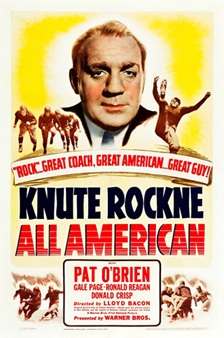
Knute Rockne, All American (1940, directed by Lloyd Bacon)


The son of a Norwegian carriage builder who immigrated to the United States in 1892, Knute Rockne (Pat O’Brien) attends Notre Dame, revolutionizes football as both a player and a coach, and leads Notre Dame to upset victory after upset victory.  Other coaches look to Rockne and see how to build and inspire a team and learn the importance of taking chances when the game is on the line.

This rah-rah biopic of real-life coach Knute Rockne elevates the character to near sainthood.  I was surprised that he didn’t heal any sick children or single-handedly end World War I.  Pat O’Brien is just the right age to play Rockne as an aging, veteran coach but the movie also has him playing Rockne as a college student.  It’s strange to see Rockne telling his father that he’s decided to go into coaching and that he hopes he won’t be a disappointment to his family when both the father and the son appear to be the same age.

If there is one thing about this movie that really works, it’s the performance of future President Ronald Reagan as George Gipp, a college baseball player who is recruited to the football team after Rockne sees how far and how high he can kick the ball.  Gipp becomes a surrogate son to Rockne and Ronald Reagan’s innate likability is put to good use.  As an actor in forgettable B-movie, Reagan could seem stiff and uncomfortable but, as George Gipp, he seems surprisingly relaxed and natural.  It’s easy to see why this film temporarily made him a star.  The scene when George Gipp, on his death bed, tells Knute to tell the team to “win one for the Gipper” is a classic tear-jerker moment and Reagan’s image as being the selfless Gipper, the man who was all about inspiring the team at even the worst of moments, served him well when he went into politics.

(It also served the makers of Airplane! well when Leslie Nielsen needed to give Robert Hays an inspiring speech to get Hays back into the cockpit of that plane.  Win one for the Zipper!)

Ronald Reagan’s performance is the only thing about Knute Rockne, All American that has aged well.  The movie made me want to win one for the Gipper.

Lisa Reviews An Oscar Winner: The Life of Emile Zola (dir by William Dieterle)


The Life of Emile Zola, the winner of the 1936 Oscar for Best Picture of the Year, opens with two French artists living in a drafty apartment.

Emile Zola (Paul Muni) is destined to become one of France’s most popular and important writers.  Paul Cezanne (Vladimir Sokoloff) will eventually become one of the most important artists of the post-impressionist movement.  But for now, they’re just two struggling artists who have sworn that they will never sell out their principles.  They are poor but they’re happy.  That changes for Zola after he meets a prostitute named Nana (Erin O’Brien-Moore) and he uses her life story as the inspiration for a novel.  The book is controversial and its frank content scandalizes France.  The public censor comes close to banning it.  But it also becomes a best seller.  It’s the book everyone secretly owns but claims to have never read.

Zola writes several more books, all about the conditions of the working class in France.  Eventually, he becomes what he claimed he would never be, a wealthy man living in a mansion and having little contact with the poor and oppressed.  Cezanne sees Zola one last time, calling him out for having sold his talent for money.  Cezanne explains that, on general principle, he can no longer be Zola’s friend.

Meanwhile, a quiet and rather meek family man named Captain Alfred Dreyfus (Joseph Schildkraut) has been arrested and accused of being a spy for Germany.  There’s little evidence that Dreyfus is a spy.  Indeed, most of the evidence seems to point to a Major Walsin-Esterhazy (Robert Barrat).  But, because Dreyfus is considered to be an outsider, he is convicted in a show trial and exiled to Devil’s Island.

(In real life, it’s generally agreed that Dreyfus was a victim of anti-Semitism.  As the only Jewish member of the army’s General Staff, Dreyfus was viewed with suspicion by his colleagues even before anyone knew that there was a German spy.  The Life of Emile Zola doesn’t specifically state that Dreyfus was a victim of anti-Semitism, with the exception of a brief moment when one of his accusers looks at his personnel file and says, “He’s not one of us,” while pointing at the word “Jew.”  Otherwise, the fact that Dreyfuss was Jewish is never mentioned in the film.  It’s as if the film is going out of its way to avoid offending the very people that the movie is criticizing.)

After speaking to Dreyfus’s wife (played by Gale Sondergaard, who would later become the victim of a show trial herself when she was blacklisted as a suspected communist), Zola decides to take up Dreyfus’s case.  He publishes an open letter — J’Accuse — in which he states that Dreyfus was not given a fair trial and that Dreyfus is innocent of the charges against him.  Zola finds himself in court, accused of libel.  Zola uses his trial to give Dreyfus the hearing that he never received.  While the army boos his every utterance, the people of France rally to his side.

The Life of Emile Zola is an early example of the type of prestige production that today is often referred to as being an “Oscar picture.”  It tells a true story.  As a film that condemns the treatment of Alfred Dreyfus but avoids stating the obvious reason why Dreyfus was targeted in the first place, it’s political without being radical.  And it features a performance from the most acclaimed actor of the era, Paul Muni.  Muni gives a powerful performance as Zola, holding the viewer’s attention even during the lengthy trial scenes that take up most the second half of the film.  That said, the true star of the film is Joseph Schildkraut, who plays Dreyfus as being a kind and trusting soul who finds himself caught up in a Kafkaesque nightmare.  At one point, Dreyfus is given a gun and told that there’s one way that he can avoid being put on trial for treason.  Schildkraut played the scene so well that I wanted to cheer when he refused to surrender.

The Life of Emile Zola is a big and, at times, self-consciously important production.  It was clearly designed to win a bunch of Oscars and it certainly managed to do that.  Compared to some of the other films nominated that year — The Awful Truth, Dead End, A Star is Born, Lost Horizon, Stage Door, In Old Chicago — The Life of Emile Zola can seem a bit stodgy.  However,  the performances of Muni and Schildkraut continue to make the film worth watching.

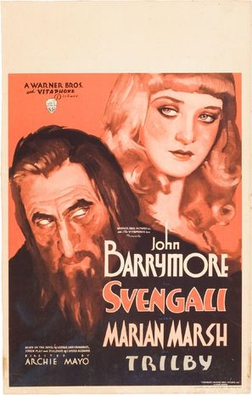
Horror on the Lens: Svengali (dir by Archie Mayo)


In this atmospheric film from 1931, sinister singing teacher Svengali (John Barrymore) used hypnotism to not only turn Trilby O’Ferrall (Marian Marsh) into the most popular singer in Europe but he also takes control of her mind.  Trilby’s former boyfriend, Billie (Bramwell Fletcher) attempts to break Svengali’s hold over her, with results that are …. well, you’ll have to watch the movie.

And really, you should watch the movie!  There are moments of dream-like beauty to be found in Svengali, with my favorite being an extended sequence in which the camera seems to float above the streets of Paris.  John Barrymore gives one of his best performance as Svengali, playing the role with a mix of menace and sly humor.  The film keeps you guessing as to how much of Trilby’s actions are of her own free will and how many of them are due to Svengali’s influence.

(Interestingly enough, Barrymore’s Svengali is a dead ringer for the infamous Rasputin.)

With its dark humor and its “arty” style, Svengali struggled with audiences but it has since been recognized as one of the best of the early psychological thrillers.

Enjoy!

End of the Trail: James Stewart in Anthony Mann’s THE MAN FROM LARAMIE (Columbia 1955)


gary loggins's avatarcracked rear viewer

I’ve covered several of the  Anthony Mann/James Stewart Western collaborations here. Their final sagebrush outing together THE MAN FROM LARAMIE was shot in Cinemascope and gorgeous Technicolor, features a bunch of solid character actors, has beautiful New Mexico scenery… yet felt like a letdown to me. Maybe it’s because Mann and Stewart set the bar so high in their previous Westerns, but THE MAN FROM LARAMIE is an anti-climactic climax to the director/star duo’s pairings.

Stewart’s good as always, playing bitter Will Lockhart, whose brother was killed by Apaches and whose mission is to find out who’s selling the guns to them. But the film came off flat, feeling like just another routine Western – good, but not in the same category as WINCHESTER ’73 or BEND OF THE RIVER. Those Mann film noir touches are nowhere to be found, replaced by (dare I say it!)… soap opera elements!

Cathy…

View original post 356 more words

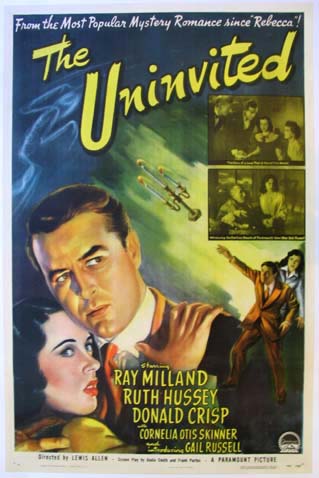
Horror Film Review: The Uninvited (dir by Lewis Allen)


the_uninvited_1944_film

If you want to see a really good haunted house movie, allow me to recommend that you track down the 1944 film, The Uninvited.  The Uninvited may not have been the first movie about a haunted house but it’s definitely one the best and one of the most influential.  None other than Guillermo Del Toro has regularly cited The Uninvited as an inspiration and, as I watched the film last night, I could definitely see where the film had influence Del Toro’s Crimson Peak.

The Uninvited tells the story of Rick Fitzgerland (Ray Milland) and his sister, Pamela (Ruth Hussey).  They’ve just purchased a long-empty seaside house and, incredibly, they were able to get it at an amazingly low cost!  The house’s owner, the frail Commander Beech (Donald Crisp, alternating between being menacing and sympathetic), was apparently desperate to get rid of it.

Far less happy about the selling of the house is Beech’s granddaughter, the mysterious Stella (Gail Russell).  As Stella explains it, she grew up in the house, her mother died in the house, and Stella is still attached to the house.  Beech has ordered Stella to stay away from the house but, with Rick falling in love with her, Stella is soon visiting on a regular basis.

Of course, Stella isn’t the only unexpected visitor that the Fitzgeralds get to know.  It quickly becomes obvious that there’s something strange about the house.  Rick and Pamela discover an artist’s studio that is always cold.  They both hear the sound of a woman crying.  Beech claims that it’s nothing to worry about.  Old house make weird noises, he informs them.  However, Rick and Pamela start to become convinced that the house is haunted.

Stella not only agrees that the house is haunted but she also informs them that she knows the identity of the ghost.  It’s Stella’s mother!  But if that’s true, why does the ghost constantly seem to be encouraging Stella to put her life at risk?  Why does Stella go into a trance and, much as her mother did 16 years earlier, attempt to jump over the side of a cliff?

Is Stella’s mother trying to manipulate her daughter into joining her in death?  Or is there something even more sinister happening?

Well-acted and perfectly paced, The Uninvited is an effectively creepy film, one that remains memorable even 72 years after it was initially released.  Visually, The Uninvited resembles a film noir and, if not for a brief scene towards the end of the film, viewers would be justified in wondering if the house really is haunted or if everyone in the film is just letting the isolation and the shadowy atmosphere get to them.  It’s that hint of ambiguity that elevates The Uninvited and makes it a truly thought-provoking haunted house story.


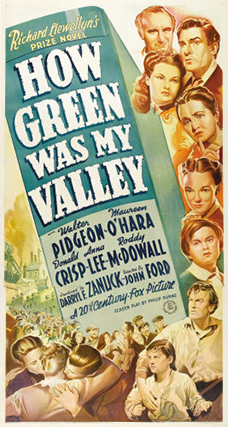
Cleaning Out The DVR #18: How Green Was My Valley (dir by John Ford)


(For those following at home, Lisa is attempting to clean out her DVR by watching and reviewing 38 films by this Friday.  Will she make it?  Keep following the site to find out!)

How_Green_Was_My_Valley_poster

Before I really get into this review, I should admit that I watched How Green Was My Valley with a bias.

Before the movie started, I was expecting to be disappointed with it.  I think that a lot of film lovers would have felt the same way.  How Green Was My Valley won the 1941 Oscar for best picture.  In doing so, it defeated three beloved films that have only grown in popularity and renown since they were first released: Citizen Kane, The Maltese Falcon, and The Little Foxes.  (As well, just consider some of the 1941 films that weren’t even nominated for best picture: Ball of Fire, The Devil and Daniel Webster, Dr. Jekyll and Mr. Hyde, High Sierra, The Lady Eve, Never Give A Sucker An Even Break, The Sea Wolf, The Wolf Man, and Sullivan’s Travels.)  Because it defeated so many great films and since we’re all used to the narrative that the Academy always screws up, there’s a tendency to assume How Green Was My Valley was really bad.

Well, after years of assumptions, I finally actually watched How Green Was My Valley?  Was it bad?  No, not really.  Was it great?  No, not all.  If anything, it felt rather typical of the type of films that often win best picture.  It was well-made, it was manipulative enough to be a crowd-pleaser while serious enough to appeal to highbrow critics, and, perhaps most importantly, it never really challenged the viewer.  Unlike Citizen Kane and The Maltese Falcon, How Green Was My Valley is a film that doesn’t require that you give it too much thought and, as such, it really shouldn’t be surprising that it was named the best picture of the year.

How Green Was My Valley was directed by John Ford and, as you might expect from Ford, it deals with a changing way of life and features good performances and a few impressive shots of the countryside.  Taking place in the late 1800s, How Green Was My Valley tells the episodic story of the Morgans, a large family of Welsh miners.  The film is narrated by Huw (Roddy McDowall), a youngest member of the family.  Though Huw’s eyes, we watch as his once idyllic and green village is transformed by the growing mining industry and blackened with soot, poverty, and death.

The film starts out as a fairly even mix of sentiment and drama.  Huw has a crush on his brother’s fiancee.  His sister, Angharad (Maureen O’Hara), has a flirtation with the new preacher, Mr. Gruffydd (Walter Pidgeon).  Much emphasis is put on communal gatherings.  There is a wildly joyful wedding celebration.  We often see the villagers in church and hear them singing both hymns and folk songs.  In their isolate village, they are are united against a changing world.

Or, at least, they think they are.  As the mining industry grows, that united front and sense of community starts to vanish.  A strike sets family members against each other, as each miner is forced to decide whether to side with management or with his fellow workers.  Each year, the wages become lower.  When management realizes that its cheaper to just continually hire new miners, several of the veteran workers are fired and end up leaving the village to seek a living elsewhere.  As new people come to the village, even Mr. Gruffydd finds himself the subject of gossip.

As for Huw, he grows up.  He goes to school, deals with a sadistic teacher, and learns how to defend himself against bullies.  And eventually, like everyone in his family, he is sent down into the mines and soon, his once innocent face is covered in soot.

And, of course, there’s a big tragedy but you probably already guessed that.  How Green Was My Valley is not a film that takes the viewer by surprise.

For the most part, it’s all pretty well done.  The big cast all inhabit their roles perfectly and Roddy McDowall is extremely likable as Huw.  Maureen O’Hara shows why she eventually became a star and even Walter Pidgeon gives a surprisingly fiery performance.  How Green Way My Valley is a good film but it’s too conventional and predictable to be a great film, which is why its victory over Citizen Kane and The Maltese Falcon will always be remembered as a huge Oscar injustice.

But, taken on its own terms and divorced from the Oscar controversy, How Green Was My Valley may be a conventional but it’s not a bad film.  It’s just no Citizen Kane.

Embracing the Melodrama Part II #12: Jezebel (dir by William Wyler)


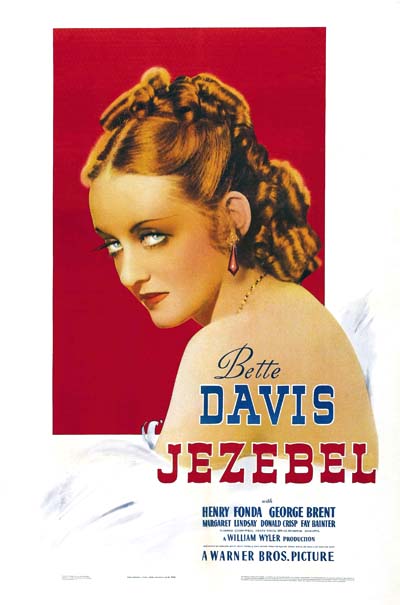
Jesebel_movieposterWe started out this day by taking a look at Bette Davis in Of Human Bondage so it seems only appropriate that today’s final entry in Embracing the Melodrama should be another film in which Bette Davis plays a potentially unlikable character who is redeemed by being the most interesting person in the film.

The 1938 best picture nominee Jezebel stars Bette Davis as Julie Marsden, a strong-willed Southern belle who lives in pre-Civil War New Orleans.  Julie is looking forward to an upcoming ball but is frustrated when her fiancée, boring old Pres (Henry Fonda), says that he has to work and declines to go shopping for a dress with her.  Impulsively, Julie does exactly what I would do.  She buys the most flamboyant red dress that she can find.

Back in the old South, unmarried women were expected to wear white to formal balls, the better to let everyone know that they were pure and innocent and waiting for the right man.  When Julie shows up in her red gown, it’s a scandal and, upon seeing the looks of shock and disdain on everyone’s faces, Julie wants to leave the ball.  However, Pres insists that Julie dance with him and he continues to dance with her, even after the orchestra attempts to stop playing music.

And then he leaves her.  At first, Julie insists to all who will listen that Pres is going to return to her but it soon becomes obvious that Pres has abandoned both Julie and Southern society.  Julie locks herself away in her house and becomes a recluse.

Until, a year later, Pres returns.  At first, Julie is overjoyed to see that Pres is back and she’s prepared to finally humble herself if that means winning back his love.  But then she discovers that the only reason that he’s returned to New Orleans is to warn people about the dangers of Yellow Fever.

Oh, and he’s also married.

To a yankee.

For the most part, Jezebel is a showcase for another fierce and determined Bette Davis performance.  It’s easy to be judgmental of a character like Julie Marsden but honestly, who doesn’t wish that they could be just as outspoken and determined?  It helps, of course, that the film surrounds Julie with a collection of boring and self-righteous characters, the type of people who you love to see scandalized.  Henry Fonda gives one of his more boring performances in the role of Pres while Margaret Lindsay, in the role of Pres’s Northern wife, is so saintly that she reminds you of the extremely religious girl in high school who would get offended whenever you came to school wearing a short skirt.  In a society as rigid, moralistic, and judgmental as the one portrayed in Jezebel, it’s impossible not to cheer for someone like Julie Marsden.

Add to that, I totally would have worn that red dress too!  In a world that insisted that all women had to act a certain way or look a certain way and think a certain way, Julie went her own way and, regardless of what boring old Pres may have thought, there’s a lesson there for us all.

When watching Jezebel, it helps to know a little about film history.  Bette Davis very much wanted to play Scarlett O’Hara in Gone With The Wind and was reportedly very disappointed when the role went to Vivien Leigh.  Depending on the source, Jezebel is often described as either being Davis’s audition for the role of Scarlett or as being a consolation gift for losing out on the role.  Either way, Jezebel is as close as we will ever get to seeing Bette Davis play Scarlett.  Judging from the film, Davis would not have been an ideal Scarlett.  (Whereas Gone With The Wind works because Leigh’s Scarlett grows stronger over the course of the film, Davis would have started the film as strong and had nowhere left to go with the character.)  However, Davis was a perfect Julie Marsden.


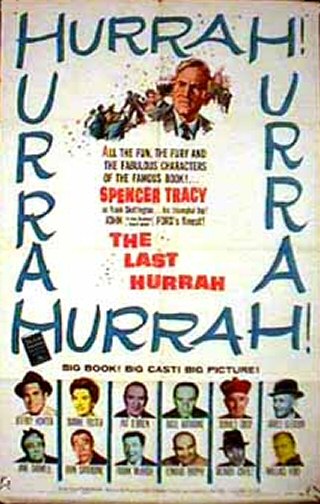
Shattered Politics #14: The Last Hurrah (dir by John Ford)


Last_Hurrah

Down here in Dallas, we have a county commissioner named John Wiley Price.  Even if you don’t live in Texas, you might have heard about him.  A few years ago, Price stormed out of a commissioners meeting while shouting, “All of you are white!  Go the Hell!”  It was a popular YouTube video for a while and attracted all of the usual type of comments that you see online.  It even made the national news.

Nobody down here in Dallas was surprised by Price’s outburst.  To us, that was just John Wiley being John Wiley.  For that matter, nobody was particularly surprised when it was reported that he was being investigated by the FBI.  Everyone always took it for granted that John Wiley Price was taking bribes and receiving kickbacks.  That’s just the way that things are done down here in Dallas, by politicians both white and black.  (Of course, most of the white politicians who do it don’t get publicly investigated by the FBI.)

Now, if you ask the majority of people in Dallas county what they think about John Wiley Price and they’ll probably say something negative.  I’ll admit that I would probably be among them.  But the thing is — John Wiley Price’s constituents love him.  John Wiley Price was first elected to the commissioner’s court before I was even born and, as long as he’s on the ballot, he will be reelected.  Even if Price is convicted on corruption charges, he will still be reelected.

I can still remember the night that it was announced that John Wiley Price was on the verge of being arrested by the FBI.  All across his district, emergency meetings were held in churches and ministers stood behind the pulpit and, while the TV cameras rolled, they called upon everyone to pray for John Wiley Price.  In Price’s district, he’s known as “our man downtown,” the idea being that John Wiley Price is standing up to the rich and white Dallas establishment and, if he makes some money for himself in the process, so be it.  As long as he’s doing right for the people who elected him, who cares how he does it?

And, as much as we may want to judge the John Wiley Prices of the world, the fact that of the matter is that he’s a part of a long American political tradition.  That political tradition is also the driving force behind today’s final entry in Shattered Politics.

First released in 1958 and directed by John Ford, The Last Hurrah tells the story of Frank Skeffington (Spencer Tracy), the mayor of an unnamed city in New England that’s obviously meant to be Boston.  Skeffington is the flamboyant head of a large and powerful (but, as the film makes clear, aging) Irish-American political machine.  He’s preparing to run for his fifth term for mayor, a campaign that he says will be his last.

Whether Frank Skeffington is a good mayor or not depends on who you ask.  The poor and the disenfranchised love him.  Skeffington, after all, is the son of Irish immigrants.  He was born poor.  His mother worked as a maid and was even fired by a member of the wealthy and influential Force family.  They know that Skeffington has had to cut corners and that he’s gone out of his way to reward his cronies but they also know that Skeffington is on their side.  Though the phrase is never used in the film, Skeffington is “their man downtown.”

Meanwhile, the wealthy and the upper class see Frank Skeffington as being a crook, a man who has run a corrupt administration and who uses class warfare to keep the city divided against itself and to make himself and his cronies rich.  Newspaper editor Amos Force (John Carradine) has thrown his considerable influence between Skeffington’s opponent, a wealthy but dull man named Kevin McCluskey.

Reporter Adam Caulfield (Jeffrey Hunter) is in an interesting position.  On the one hand, he is Skeffington’s nephew.  On the other hand, as a journalist, he works for Amos Force.  Skeffington invites Adam to follow and record his final campaign for posterity.

It’s interesting to compare The Last Hurrah to films like The Boss or All The King’s Men.  Whereas those two films came down squarely on the sides of the reformers, The Last Hurrah is firmly on the side of Frank Skeffington.  It presents Skeffington as being a sentimental figure, the type of old-fashioned, populist politician who won office by going out and meeting the people face-to-face and personally giving them a reason to vote for him.  As Skeffington himself points out, he’s the type of politician that will soon be made obsolete by television and modern campaigning.

And it’s impossible not to enjoy The Last Hurrah‘s refusal to pass judgment on its lead character.  It helps, of course, that Spencer Tracy plays Skeffington with a twinkle in his eye while all of his opponents are played by villainous and aristocratic character actors like John Carradine and Basil Rathbone.  Yes, the film says, Skeffington may have been corrupt but at least he wasn’t boring!

Finally, I enjoyed the film because all of the “good” guys were Irish Catholic and all of the bad guys most definitely were not.

So, with that last hurrah, we conclude Shattered Politics for today.  We’ll be back tomorrow, when we’ll start to get into the 1960s.

Sláinte!