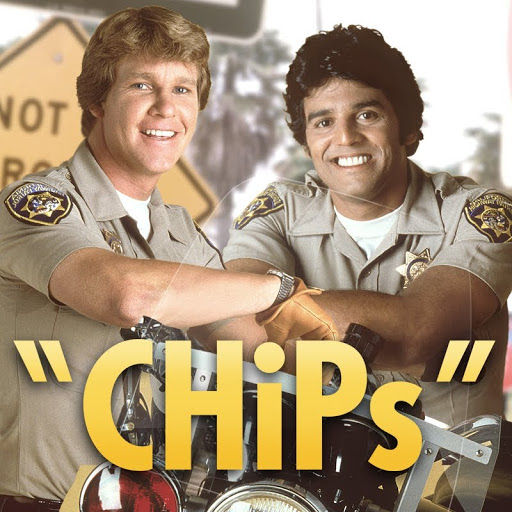
Welcome to Late Night Retro Television Reviews, a feature where we review some of our favorite and least favorite shows of the past! On Mondays, I will be reviewing CHiPs, which ran on NBC from 1977 to 1983. The entire show is currently streaming on Prime!
It’s a holiday week so tonight’s review is going to be a mini-review. Let’s quickly talk about the time two highway patrolmen ended up in jail!
But first….
Episode 3.16 “Jailbirds”
(Dir by Bruce Kessler, originally aired on January 12th, 1980)
Ponch and Baker go to jail!
Actually, Baker goes to jail twice. Ponch is only sent to jail once. It’s all because they refuse to reveal the name of the confidential informant that allowed them get the drop on and arrest a smuggler named Nick Ferris (Ray Duke). Getraer calls the Attorney General’s office. Officer Turner drops by to check on Baker. The Judge (Allan Rich) says that he sympathizes with the cops but unless they’re willing to name their informant, he’ll have to dismiss the charges and let Ferris go free due to insufficient evidence.
The idea of Ponch and Baker in jail has a lot of possibilities. Ponch is always going on and on about how he used to be a juvenile delinquent so I was half-expecting him to run into an old friend in the holding tank. That didn’t happen, though. Instead, CHiPs gave us a jail that was remarkably clean, well-run, and full of friendly prisoners and nice cops. I’ve often felt that CHiPs was essentially a commercial for Los Angeles tourism and the theme of this episode appeared to be, “L.A. …. even our jails are wonderful!”
Anyway. Getrear and the guys not in jail work to get more evidence so that they can put Ferris behind bars without revealing the name of Baker’s informant. Good for them! Teamwork, it’s what CHiPs is all about!
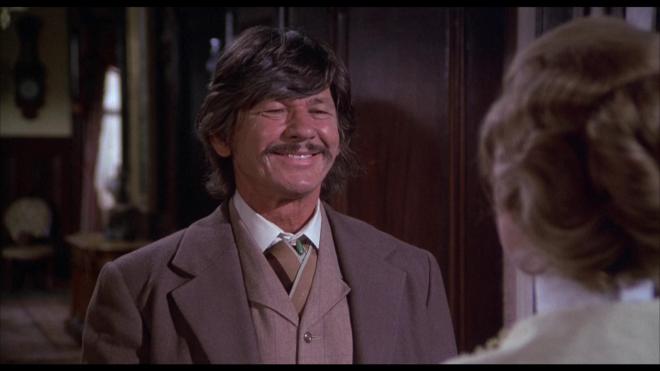
During the height of his popularity in 1976, Charles Bronson tried something quite different with this romantic comedy costarring his wife Jill Ireland. And to be honest, he’s darn funny in the role. This movie has grown on me over the years.
Bronson plays Graham Dorsey, a bank robber who spends an afternoon with the lonely widow Amanda Starbuck (Ireland) while his gang is robbing a bank in town. After his gang is all killed during the robbery, Dorsey must take off and go into hiding, eventually being arrested for impersonating a quack dentist. While he’s in jail, and through a variety of circumstances, a book is written about their afternoon together and it becomes an international sensation. As soon as Dorsey gets out of jail, he goes back to Starbuck’s home to rekindle their affair. Unfortunately for Dorsey, the book has created such a legend of him and their affair that Ms. Starbuck doesn’t even recognize the man he really is. His method of convincing her that he’s the “real” Graham Dorsey is the funniest moment in Bronson’s entire filmography.
Charles Bronson & Jill Ireland are clearly having a wonderful time making this movie together, which is one of the main reasons I enjoy the film. He may not have done it often, but Bronson could play comedy and he’s excellent in this film cast completely against his normal type. Jill Ireland is also very good as the widow Starbuck and her rendition of the song “Hello and Goodbye” was even nominated for a Golden Globe for Best Song. We had the privilege of interviewing Jill Ireland’s niece, Lindsay Ireland, and she told us of singing this song with her aunt Jill and her cousin when she would spend summers with them in Vermont in the 70’s. It’s so fun for me to hear firsthand about those times when the Bronson’s were one of the biggest celebrity couples of the world! The best part, Bronson valued his time with his family over anything else. They were everything to him.
**BONUS CONTENT** – I’ve included a link to the “This Week in Charles Bronson” podcast episode where Lindsay Ireland describes her time with her aunt Jill Ireland, and how they would sing “Hello & Goodbye,” the song that was in FROM NOON TILL THREE, while they were driving down the roads in Vermont. It’s a really nice insight into Jill Ireland.
Welcome to Late Night Retro Television Reviews, a feature where we review some of our favorite and least favorite shows of the past! On Mondays, I will be reviewing CHiPs, which ran on NBC from 1977 to 1983. The entire show is currently streaming on Freevee!
This week, Jon Baker takes on …. THE REPO MAN!
Episode 2.14 “Repo Man”
(DIr by Alex Grasshoff, aired on January 6th, 1979)
This week features a truly memorable villain.
Doyle Ware (Mills Watson) is a repo man. When people fall behind on their car payments, Doyle is the guy who shows up to repossess the vehicle. That he’s a sleaze shouldn’t come as a surprise. I mean, who likes a repo man, right? But, as Baker and Ponch discover, Doyle is more than just a repo man.
He’s a criminal mastermind!
He steals cars and then informs the owner that the car has been destroyed in an accident. Doyle offers to buy what little is left of the vehicle. However, the truth is that the car hasn’t been destroyed. And once Doyle gets the title, he proceeds to sell the car under the original owner’s name. Then, once the buyer falls behind on their payments, he repossesses the car and sells it again. What a sleazy guy!
When Baker and Ponch prevent Doyle from repossessing an old couple’s trailer, Doyle reacts by trying to destroy their credit. He plants false reports that Baker and Ponch owe money. Baker tries to buy an expensive saddle, just to be humiliated when the clerk (played by future playwright Terrence McNally) informs him that his credit score is awful. Ponch starts to get notices at the police station, telling him that he owes money. Getraer offers to help Baker but not Ponch. Getraer can’t stand Ponch.
While dealing with his bad credit, Baker also becomes a local celebrity when he jumps, from a bridge, onto an out-of-control school bus. Baker’s face appears on the local news and soon, people are demanding his autograph. Baker is mortified. Ponch is thrilled because, for some reason, people want his autograph too. “Oh my God, you’re his partner!” someone says as they rush up to Ponch’s motorcycle. Seriously, Ponch didn’t do anything!
Meanwhile, Grossman (who, as played by Paul Linke, is the most consistently likable member of the show’s supporting cast) gets an article published in a magazine. Everyone at the station pretends like they haven’t read and enjoyed the article. Poor Grossie! Don’t worry, though. A news crew films Grossie putting out a fire and he soon replaces Baker as everyone’s favorite local hero. Baker’s happy to have both his good credit and his anonymity restored.
(This is actually a pretty big episode for Baker. He also gets a subplot in which a watchmaker, played by Ned Glass, destroys Baker’s watch after he bring it in to get the wrist band fixed.)
This was a good episode. The school bus rescue was genuinely exciting and Doyle Ware was a villain who was so sleazy that it was a lot of fun watching him get taken down. CHiPs did a good job with Repo Man.
Welcome to Late Night Retro Television Reviews, a feature where we review some of our favorite and least favorite shows of the past! On Mondays, I will be reviewing CHiPs, which ran on NBC from 1977 to 1983. The entire show is currently streaming on Freevee!
This week, Ponch gets to be a hero! Take that, Baker!
Episode 1.19 “Crash Diet”
(Dir by Don McDougall, originally aired on February 23rd, 1978)
There’s a madman on the freeway and his name is Leonard!
Leonard (Herman Poppe) is a veteran who suffered a traumatic brain injury while serving in Vietnam. He returned home and was making good progress until his wife was killed in a car accident. (Leonard was the one driving.) Leonard now hates cars and, after running away from both his sister’s house and the VA hospital, Leonard sets up camp off the highway. Occasionally, he’ll jump out of the shadows and throw dirt at a motorist. Leonard isn’t trying to hurt anyone but those big clumps of dirt take people by surprise. When he throws a clump of dirt at Ponch, the cops get involved.
Ponch makes it his mission to find Leonard and help him get the help that he needs. And, for once, Ponch manages to do just that. Yay Ponch! Yet, it seems odd that Baker would not be more involved with this case, as it has previously been established that Baker is also a vet and that he also served in Vietnam. One would think that Baker would be somewhat invested in helping Leonard but, in this episode, Baker is mostly along for the ride.
Maybe Baker is preoccupied with the nude volleyball team that he met at the start of the episode. When he and Ponch pulled over a van to give the driver a ticket, they were shocked to discover that the van was full of naked women. It turns out that the local naturalist community has their own volleyball league and the women are all players. Later, Baker and Ponch come across the now-clothed women playing in the park. Ponch and Baker play a game and totally get their asses kicked. That was satisfying to watch.
Meanwhile, Division wants each precinct to lost a total of 1,000 pounds by the end of the week. (It’s like the Weight Loss episode of The Office.) Officer Grossman (Paul Linke) worries that he won’t be able to lose 18 pounds in time. Baker and Ponch each agree to lose an extra five pounds so Grossman will only have to lose 8. Awwww! Then they pull a prank that makes Getraer think that he’s gained 10 pounds. That was kind of mean but I guess Getraer deserved it for …. for what? Trying to make everyone eat healthy and take care of their bodies?
This episode was a mixed bag. The show’s trademark chases were pretty lackluster this week. But I thought Leonard’s story was well-handled, well-intentioned, and sensitively acted. (Yes, even by Erik Estrada.) As well, Paul Linke had some funny moments as Grossman. This episode may not have been CHiPs at its best but it was still an entertaining 40 minutes.
On tonight’s episode of Ghost Story, a rodeo is terrorized by a series of cougar attacks. Could it have anything to do with the cat-like wife of rodeo star Doug McClure?
This episode originally aired on November 24th, 1972 and it is kind of silly but …. hey, it’s Doug McClure. It doesn’t get more early 70s than Doug McClure.
Though the Academy of Motion Picture Arts and Sciences claim that the Oscars honor the best of the year, we all know that there are always worthy films and performances that end up getting overlooked. Sometimes, it’s because the competition too fierce. Sometimes, it’s because the film itself was too controversial. Often, it’s just a case of a film’s quality not being fully recognized until years after its initial released. This series of reviews takes a look at the films and performances that should have been nominated but were, for whatever reason, overlooked. These are the Unnominated.
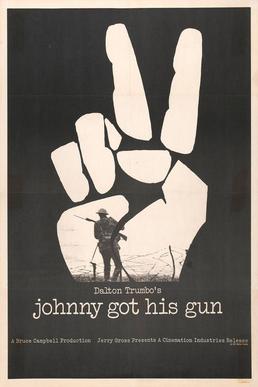
The 1971 anti-war film, Johnny Got His Gun, tells the story of Joe Bonham (played by Timothy Bottoms). When America enters World War I, Joe enlists in the Army. He leaves behind his small-town life. He leaves behind his patriotic father (Jason Robards) and his loving girlfriend (Kathy Fields). As he leaves, everyone tells him that he is doing the right thing to protect democracy. Joe’s a hero!
Joe expects war to be a glorious affair, one that will make a true man out of him. Instead, he’s hit by an artillery shell while huddled in a muddy trench. Though he survives the explosion, he loses his arms and his legs. He loses his face. He’s taken to a field hospital, where the doctors say that, though he’s alive, he’s incapable of feeling or thinking. He’s left alone in a room and is occasionally checked on by a sympathetic nurse (Diane Varsi).
The doctors are wrong. Joe can think. Even if he can’t see where he is now, he can still remember the life that he once had and the events that led him to the hospital. The film switches back and forth, from the black-and-white imagery of the hospital to the vivid color of Joe’s memories and fantasies. In his mind, Joe remembers his father, who encouraged him to go to war and perhaps was not the all-knowing figure that Joe originally assumed him to be. (The film makes good use of Jason Robards’s natural gravitas. Like Joe, the viewer initially assumes that Robards is correct about everything.) Joe also imagines several conversations with Jesus (a stoned-looking Donald Sutherland), who turns out to be surprisingly mellow and not always particularly helpful. Jesus suggest that Joe may just be naturally unlucky and he also suggests that Joe perhaps keep his distance from him because, sometimes, bad luck can rub off. Joe, meanwhile, wonders if he could be used as a traveling exhibit to portray the futility of war. When Joe finally realizes that a nurse has been checking on him, he tries to figure out a way to send a message to both her and the military that is keeping him alive in his captive state. S.O.S. …. help me….
Johnny Got His Gun is based on a novel by Dalton Trumbo. The novel was first published in 1939, at a time when the debate over whether the the U.S. should get involved in another war in Europe was running high. At the time, Trumbo was a Stalinist who opposed getting involved because Germany and Russia had signed a non-aggression pact. After the Germans invaded Russia in 1941, Trumbo and his publishers suspended reprinting of the book until the war was over with. Needless to say, this was all brought up in the 50s, when Trumbo was one of the more prominent writers to be blacklisted during the Red Scare. On the one hand, Dalton Trumbo does sound like he was more than a bit of a useful idiot for the Stalinists. On the other hand, if you’re going to suspend the printing of your anti-war polemic, it should definitely be because you want to help defeat the Nazis. In the end, what really matters is that Johnny Got His Gun is an undeniably well-written and effective book, one that works because it eschews the vapid sloganeering that one finds in so many works of left-wing literature and instead focuses on the emotions and thoughts of one human being.
The book was later rediscovered by the anti-war protestors of the 60s, which led to Dalton Trumbo directing a film adaptation. The film is a bit uneven. Dalton Trumbo was 65 years old when he directed the film and there are a few moments, especially in the scenes with Sutherland as Jesus, where he seems like he’s trying a bit too hard to duplicate the younger directors who were a part of the anti-war moment. However, the scenes in the military hospital are undeniably moving. The hospital scenes are shot in a noirish black-and-white and they effectively capture the stark horror of Joe’s situation. Left alone in his dark and shadowy room, Joe becomes the perfect symbol for all the war-related horrors that people choose to ignore. He becomes the embodiment of what war does to those who are scarred, both physically and mentally, by it. The scenes where Diane Varsi realizes that Joe is aware of what’s happened to him and that he can still feel are powerful and emotional. In fact, they work so well that it’s hard not to wish that the film could have done away with the fantasies and the flashbacks, despite the fact that Timothy Bottoms gives an appealing performance as the young and idealistic Joe.
Johnny Got His Gun didn’t receive any Oscar nominations. Should it have? The 1971 Best Picture line-up was a strong one, with the exception of Nicholas and Alexandra. Johnny Got His Gun was definitely superior to Nicholas and Alexandra. However, Dirty Harry is definitely superior to Johnny Got His Gun. (For that matter, Two-Lane Blacktop also came out in 1971 as well.) But, even if Johnny Got His Gun didn’t deserve to be one of the five Best Picture nominees, it did deserve some consideration for its cinematography and Diane Varsi’s performance. If the flashbacks and the fantasies were handled a bit more effectively, I would suggest that Jason Robards and Timothy Bottoms were worthy of consideration as well.
In conclusion, I should note that 1971 was a good year for Timothy Bottoms. Not only did he star in this film but he was also the star of The Last Picture Show.
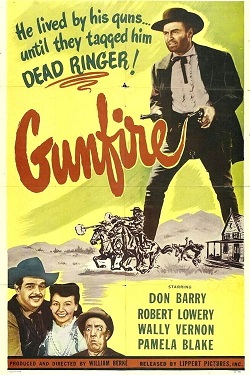
Years after the death of his brother Jesse, Frank James (Don “Red” Barry) has settled down in Colorado and is living a peaceful life as a rancher. He is even friends with the town’s sheriff, John Kelly (Robert Lowery). Unfortunately, it’s not always so easy to escape the past, especially when you are one of the few surviving members of one of the Old West’s most notorious gangs. A former member of the James Gang, Mundy (Claude Stroud), shows up at Frank’s cabin and tries to talk Frank into joining up with him, the Ford brothers (Gaylord Pendleton and Roger Anderson), and their new leader, Bat Fenton (Don “Red” Barry, playing a second role). When Frank refuses and makes clear that he still wants revenge on the Ford brothers for the murder of Jesse James, the gang goes on a crime spree. Because he and Fenton look exactly alike, the entire town thinks that Frank is responsible. Can Frank clear his name and avenge the death of his brother?
There were a lot of poverty row B-westerns produced in the early 1950s and most of them are pretty bad. However, occasionally you come across a diamond in the rough and that’s the case with Gunfire. Gunfire tells an interesting story, it has exciting gunfights, and it also features not one but two good performances from Don “Red” Barry! Barry is equally convincing as both the good Frank and the bad Fenton and the movie uses the double plot as a way to illustrate how difficult it is to escape the sins of the past. Frank has been “born again” but every time he sees Fenton, he sees not only who he used to be but also who many will always believe him to be. Gunfire is a good western that shows that you don’t need a huge budget to tell an engaging story.
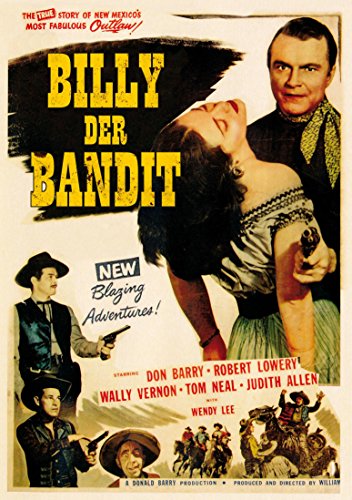
Sheriff Pat Garrett (Robert Lowery) tells the story of his friendship and later pursuit of Billy the Kid (Don “Red” Berry). As Garrett explains it, Billy could be a charming and likable outlaw but he just refused to go straight. After Billy rescued Garrett from an Indian attack, Garrett even tried to arrange for Billy to get a pardon from New Mexico’s governor, Lew Wallace (Claude Stroud), but when the pardon didn’t arrive in time, Billy felt had been betrayed and continued his life as an outlaw. Eventually, it fell upon Garrett to track down and put his old friend out of commission.
This film really should have been called I Shot Billy The Man because Don Berry was nearly 40 when he played Billy and he looked like he was closer to 50. Berry makes the mistake of wearing hair piece, which just makes it seem as if George Constanza somehow got cast as a notorious western outlaw. As was true in even his worst westerns, Berry is a convincing gunslinger but he’s just not a very convincing kid. Meanwhile, Robert Lowery is a boringly upright Pat Garrett. There’s none of the moral ambiguity that’s present in some of the better retellings of the life of Billy the Kid.
Tom Neal, an authentic tough guy who is best remembered for starring in Detour and for sabotaging his own career by nearly beating actor Franchot Tone to death, appears as a member of Billy’s gang. Neal was almost as old as Berry but it still seems like the film would have worked better if Neal has played Billy, Berry had played Pat, and Lowery would have taken the less important role of Charlie. Neal would have brought some authentic toughness to the role while Berry’s onscreen charisma would have countered how boring the film’s version of Pat Garrett comes across as being. As it is, with Berry miscast and Lowery giving a bland peformance and the entire movie limited by its low budget (it was produced by Robert Lippert, who made Roger Corman seem extravagant by comparison), I Shot Billy The Kid is one of the more forgettable films about the life of William Bonney.
After annoying his editor one too many times, Carl Kolchak has been assigned to write obituaries. However, you can’t keep a good reporter down and, when Kolchak comes across the mysterious death of a scientist, Kolchak decides to investigate on his own. Kolchak’s defeated vampires, werewolves, Cajun demons, and serial killers. How will he do against something made by the government?
This episode originally aired on January 10th, 1975.

 Through the Shattered Lens