Late Night Retro Television Review: Highway to Heaven 1.13 “Another Song For Christmas”


Welcome to Late Night Retro Television Reviews, a feature where we review some of our favorite and least favorite shows of the past!  On Thursdays, I will be reviewing Highway to Heaven, which aired on NBC from 1984 to 1989.  The entire show is currently streaming on Tubi and several other services!

It’s time for a Christmas episode!

Episode 1.13 “Another Song For Christmas”

(Dir by Michael Landon, originally aired on December 19th, 1984)

Oh, that Fast Eddie!

Played by the familiar character actor Geoffrey Lewis, Fast Eddie is a wealthy used car salesman.  He knows how to turn on the charm.  He knows how to close the sale.  Fast Eddie may have grown up poor but now he’s rich and he’s determined to not sacrifice one cent.  It’s the day before Christmas but Fast Eddie has no problem refusing to give money to charity.  He has no problem ripping off an elderly couple looking for an affordable car.  He has no problem firing Dave Ratchett (Jeff Doucette) when Dave refuses to roll back a car’s mileage.  Fast Eddie doesn’t care that Dave’s son is sick and Fast Eddie certainly doesn’t care that it’s Christmas Eve.  He even orders his butler (Ivor Barry) to work on Christmas Day.

Jonathan and Mark stop by Fast Eddie’s car lot but they don’t buy a car.  They just observe Fast Eddie at work.  After they leave, Mark watches as Jonathan has a brief conversation with Santa Claus (Don Beddoe).  It turns out that, like Fast Eddie, Mark doesn’t really have the Christmas spirit.  Jonathan suggests that Mark should re-read A Christmas Carol.  Mark starts to read it but falls asleep after the first page.

Meanwhile, at his mansion, Fast Eddie also falls asleep but is soon awakened by Jonathan who takes him to the past and shows Eddie how his poor childhood led him to grow up to become overly obsessed with money.  Mark then appears and shows Eddie what’s happening in the present.  Eddie’s lawyers are trying to shut down a charity so that Eddie can buy their headquarters.  Poor Dave Ratchett is having to explain to his family that he lost his job.  Eddie is moved by the sight of Dave’s wheelchair-bound son, who will die unless he gets the operation that Dave will now never be able to afford.  Finally, Jonathan takes him to the future and shows Eddie that no one will visit his grave after he dies.

Eddie wakes up infused with the spirit of Christmas and soon, he’s running around town and giving people, including Dave, all of his money and other gifts.  Interestingly enough, Mark also wakes up and he tells Jonathan that he had a dream in which he was the Ghost of Christmas Present.  Just like Eddie, Mark wakes up with a new appreciation for the Christmas holidays.

I’ve lost track of how many different version of A Christmas Carol that I’ve seen.  The idea of turning Scrooge into a used car salesman is an interesting one and I liked the fact that Eddie and Mark apparently both had the same dream.  This may be the only time in which one of the “ghosts” learned a lesson as well as Scrooge.  That said, Geoffrey Lewis — who was good in so many different films — goes a bit overboard as Fast Eddie.  He’s so desperate and twitchy that it’s easy to believe him as a used car salesman but not as a successful one.

Next week, Jonathan and Mark search for a missing friend.
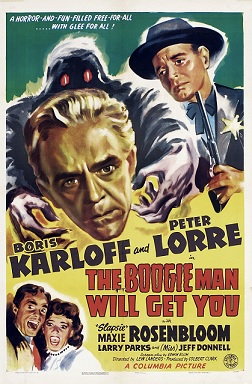
Horror on the Lens: The Boogie Man Will Get You (dir by Lew Landers)


Today’s horror on the lens is a short horror comedy from 1942.  In The Boogie Man Will Get You, Winnie Slade (Miss Jeff Donnell) buys an old house from Prof. Billings (Boris Karloff) with plans to covert it into a hotel.  However, one of the conditions of the sale is that Prof. Billings and his servants be allowed to live on the property.  What Winnie doesn’t know is that Prof. Billings had been conducting experiments on traveling salesman.  He hopes to turn them into supermen who, much like Captain America, can then be sent overseas to fight the Nazis.  However, his experiments have yet to be successful and have mostly just resulted into a lot of salesman being buried out in the rose garden.

However, things start to look up for Prof. Billings when he meets Dr. Lorencz (Peter Lorre), who is not only a doctor but also a mayor, sheriff, and dog catcher.  Seriously, Dr. Lorencz can do it all!

The Boogie Man Will Get You is a fun little time capsule of the time in which it was made.  For horror fans, it is mostly interesting because it features both Boris Karloff and Peter Lorre.  Both Karloff and Lorre appear to be having a lot of fun parodying their usual screen images.

Enjoy!

30 Days of Noir #26: Behind Green Lights (dir by Otto Brower)


The 1946 film, Behind Green Lights, takes over the course of one night at one police station.

When tough-but-fair Police Lt. Sam Carson (William Gargan) shows up for work, he discovers that a car has been haphazardly parked in front of the station.  Inside the car is bullet-ridden body of Walter Bard, a somewhat notorious private investigator.  If the brazenness of the crime wasn’t already enough to indicate that there’s more going on here than just a detective following the wrong lead, it is soon discovered that Bard was acquainted with Janet Bradley (Carole Landis), the daughter of a reform-minded mayoral candidate.  As Janet explains it to Lt. Carson, Bard was blackmailing a friend of hers.  Janet admits that she had a gun with her the last time that she saw Bard but she swears that she didn’t murder him.

Corrupt newspaper publisher Max Calvert (Roy Roberts) views Janet’s father as being a potential rival and he immediately starts to pressure Lt. Carson to make an arrest in the case.  Not convinced of Janet’s guilt, Carson refuses.  Meanwhile, the crooked coroner (Don Beddoe) comes across evidence that could change the entire case but, as a favor to Calvert, tries to cover it up….

But that’s not all.  It’s a very busy night at the precinct.  Not only does Carson have to deal with the murder and all of the political fallout, he also has to deal with an escapes prisoner and a collection of snarky crime reports who spend all of their hanging out at the station house and waiting for a big story to drop.

Largely set in one location and featuring a cast made up of fast-talking, quick-witted cynics, Behind Green Lights sometimes feel more like a play than a film.  (One could easily imagine it taking place in the same cinematic universe as The Front Page.  Call it the MacArthur/Hecht Cinematic Universe, or MHCU for short.)  Though the film only has a running time of 64 minutes, it manages to pack a lot of twists and turns into that hour.  For the most part, it all works.  The mystery is intriguing, the cast is made up of properly tough character actors, and the tragic Carole Landis is well-cast as a character who could be an innocent victim or a dangerous femme fatale.  The film and her performance will keep you guessing.  (It has been written that Landis, a talented actress who never quite got the roles that roles that she deserved, was heart-broken when Rex Harrison refused to divorce his wife and marry her.  Two years after the release of Behind Green Lights, she was found dead at the age of 29.  The official ruling was suicide, though members of Landis’s family dispute that.)

Behind Green Lights may be a minor noir but it’s still an entertaining one.  And it can be viewed for free on YouTube!  Just remember, when doing an online search, that the film is called Behind Green Lights and not Behind the Green Door.  Don’t make the same mistake that I did!


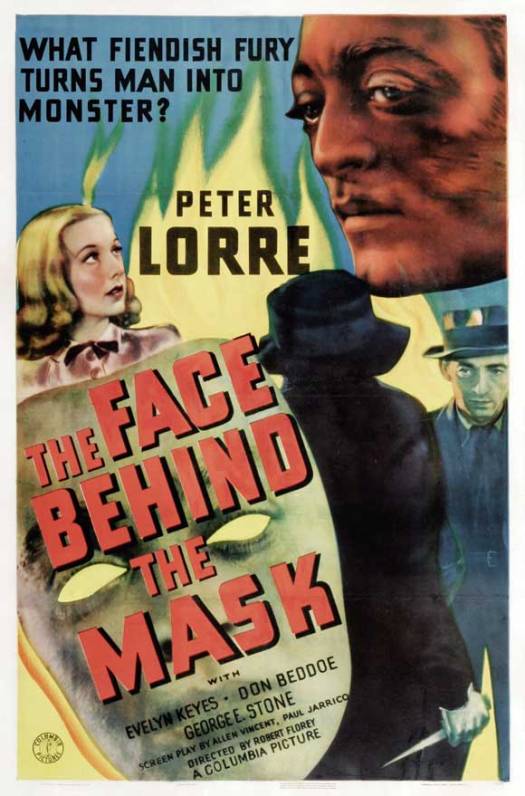
Happy Birthday Peter Lorre: THE FACE BEHIND THE MASK (Columbia 1941)


gary loggins's avatarcracked rear viewer

In honor of Cracked Rear Viewer’s second anniversary, I’m re-presenting my first post from June 26, 2015. I’ve re-edited it and added some pictures, something I didn’t know how to do at first. My, how times change! Anyway, I hope you enjoy this look at an early noir classic. (Coincidentally, this is also Mr. Lorre’s birthday!)

The sinister star Peter Lorre was born in Hungary on June 26, 1904. He became a big screen sensation as the child killer in Fritz Lang’s German classic M (1931), and like many Jews in Germany at the time, fled the Nazi regime, landing in Britain in 1933. Lorre worked with Alfred Hitchcock there in the original THE MAN WHO KNEW TOO MUCH, then immigrated to America, starring in films like MAD LOVE  , CRIME AND PUNISHMENT, and the Mr. Moto series. In 1940, the actor starred in what many consider the first film noir, STRANGER ON THE…

View original post 836 more words

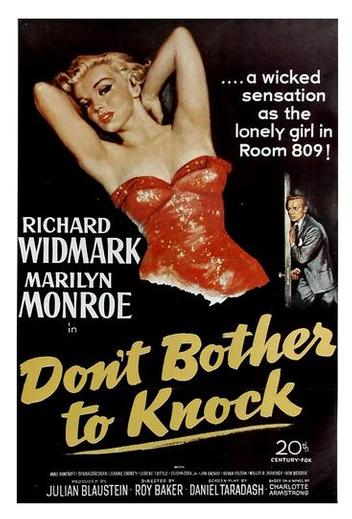
Lisa Cleans Out Her DVR: Don’t Bother To Knock (dir by Roy Ward Baker)


(I am currently attempting to clean out my DVR.  I recorded the 1952 film Don’t Bother To Knock off of FXM on April 3rd.)

Welcome to the McKinley Hotel in New York City!  The McKinley is a nice place, though it’s no Grand Budapest Hotel.  Presumably, the McKinley was named after the late President William McKinley.  While I’m sure that McKinley would have appreciated the gesture, I don’t know how he would feel about all the melodrama that’s occurring behind closed doors.

For instance, there’s Lyn Lesley (Anne Bancroft, making her screen debut).  Lyn sings in the hotel bar and, though she might seem to be cynical and tough, she actually has a big heart.  In fact, she cares so much about humanity that she broke up with her longtime boyfriend, Jed Towers (Richard Widmark), because he doesn’t seem to have a heart at all.  Of course, she broke up with Jed by sending him a letter.  When Jed checks into the hotel and tracks her down in the bar, he has questions about their breakup and he wants answers that won’t require any reading.  She tells him that he’s not capable of caring about anyone so why should she waste her time on him?  Then she sings a love song because that’s her job.

As for Jed, he’s kind of a jerk in the way that most men tend to be in movies from the 1950s.  He’s an airline pilot who served overseas during World War II and spent a year living in England.  He’s tough and he’s cynical and now, he’s single.  He’s also got a room in a hotel for the night.

And then there’s Peter and Ruth Jones (Jim Backus and Lurene Tuttle), who have a function to attend in the hotel ballroom but who don’t have anyone to look after their ten year-old daughter, Bunny (Donna Corcoran).  Fortunately, the hotel’s elevator operator, Eddie (Elisha Cook, Jr.), has a niece named Nell (Marilyn Monroe).  Nell is quiet and shy and needs the money.  She’ll be more than willing to babysit!

Of course, the only problem with Nell is that she’s a little unstable.  This becomes obvious when she’s left alone with Bunny and promptly says that, if Bunny isn’t careful, something bad might happen to one of her toys.  Inside the apartment, Nell is impressed by all the pretty things owned by Ruth.  She tries on her jewelry.  She sprays her perfume in the air.  She puts on Nell’s negligee and looks at herself in the mirror.  Eddie is not amused when he discovers what Nell’s been doing.  If she wants all of this stuff, he tells her, she needs to marry someone rich.  That’s not bad advice but the only problem is that Nell is currently single.  She’s been single ever since her boyfriend died in a plane crash.  In fact, Nell was so upset by his death that she even tried to commit suicide afterward.

From his room, Jed has a direct view of Nell trying on Ruth’s clothes.  When he and Nell spot each other, Nell invites him over.  She tells Jed that she’s a guest at the hotel and that Bunny is her daughter.  Jed can immediately tell that there’s something strange about Nell.  Nell, meanwhile, thinks that Jed is her dead boyfriend.  Meanwhile, Bunny is helpless in her room…

Clocking in at a brisk 72 minutes, Don’t Bother To Knock feels less like a movie and more like a one-act play or maybe even an adaptation of an old television production.  (After watching the movie, I was shocked to discover that it was based on neither.)  Seen today, it’s mostly memorable for featuring Marilyn Monroe’s first true starring role.  After appearing in small roles in several films (including All About Eve), Don’t Bother To Knock was not only Marilyn’s shot at stardom but also her first dramatic performance.  Reportedly basing her performance on her troubled mother, Marilyn is sympathetic and almost painfully vulnerable.  Her scenes with Elisha Cook, Jr. are especially charged, full of a subtext that will probably be easier for modern audiences to spot than it was for audiences in 1952.  Marilyn gave an incredibly poignant performance and she is the main reason to watch Don’t Bother To Knock.

Halloween Havoc!: Boris Karloff in THE MAN THEY COULD NOT HANG (Columbia 1939)


gary loggins's avatarcracked rear viewer

maddoc1

Bela Lugosi ( see yesterday’s post ) wasn’t the only horror icon who starred in a series of low-budget shockers. Boris Karloff signed a five picture deal with Columbia Pictures that was later dubbed the “Mad Doctor” series and, while several notches above Lugosi’s “Monogram Nine”, they were cookie-cutter flicks intended for the lower half of double feature bills. The first of these was THE MAN THEY COULD NOT HANG, which sets the tone for the films to follow.

maddoc2

Karloff plays Dr. Henry Savaard, inventor of a new surgical technique that requires the patient to die, then reviving him with a mechanical heart after performing the operation. This later became standard operating procedure during open-heart surgery, but back in 1939 was considered science fiction! Anyway, Savaard’s young assistant Bob agrees to go through the experimental procedure, but his girlfriend freaks out and calls the cops, claiming Savaard is about to murder…

View original post 519 more words

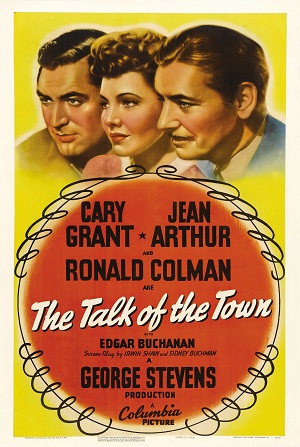
Cleaning Out The DVR, Again #4: The Talk of the Town (dir by George Stevens)


The_Talk_of_the_Town_dvd_cover

The fourth film on my DVR was the 1942 film, The Talk of the Town.  The Talk of The Town originally aired on TCM on March 20th and I recorded it because it was a best picture nominee.  As some of our regular readers undoubtedly know, it’s long been a goal of mine to watch and review every single film nominated for Oscar’s top prize.

The Talk of The Town is an odd little hybrid of comedy, melodrama, and a civics lecture.  Michael Lightcap (Ronald Colman) is a brilliant attorney and legal professor.  He’s been shortlisted for the Supreme Court and he’s also a widely read author.  In fact, he’s even rented a house for the summer, so that he may work on a book.  The owner of the house — teacher Nora Shelley (Jean Arthur) — will also be acting as his secretary.

As well-read as Prof. Lightcap may be, he’s also rather stuffy and out-of-touch with what’s going on outside of the world of academia.  He knows how the law should work but he has little understanding of how the law actually does work.  Fortunately, he gets a lesson in reality when he arrives at the house and eventually meets the gardener, Joseph (Cary Grant).  Joseph turns out to be surprisingly intelligent and very passionate about politics.  Lightcap and Joseph have many debates about whether or not the American legal system actually protects the working man.

What Lightcap doesn’t know is that Joseph is actually Leopold Dilg.  Leopold is a labor activist, the type who you always see in old documentaries, standing on a street corner and preaching about unions.  Leopold is also a fugitive.  He was accused of setting fire to a mill, a fire that apparently led to the death of the foreman.  Despite the fact that he loudly proclaimed his innocence, Leopold was arrested and prosecutors announced that they would seek the death penalty.  Convinced that he would never get a fair trial, Leopold escaped from jail and fled to Nora’s house.

Nora and Leopold went to school together.  They love each other, even though circumstances — mostly his political activism — conspired to keep them apart.  When Lightcap moves into the house, Nora and Leopold’s attorney, Sam (Edgar Buchanan), hope that they can convince him to take on Leopold’s case.  However, they also have to not only convince Leopold to reveal his true identity but also convince Lightcap to put his supreme court appointment at risk by defending a politically unpopular defendant.  Their solution is to trick Lightcap into falling in love with Nora and then convince him to take on the case for her.

However, Nora soons finds herself falling in love with Lightcap for real.  Who will she choose in the end?  Cary Grant or Ronald Colman?  Today, it seems like a pretty easy decision but apparently, in 1942, Columbia Pictures actually shot two different endings for the movie.

The Talk of The Town is an odd little movie.  For the most part, it’s a drama.  But it also has plenty of comedic elements, mostly dealing with the attempts to keep Leopold’s identity a secret.  In the end, it’s a little bit too preachy to really work as either a drama or a comedy.  That said, I still liked The Talk Of The Town because it made a strong case for the importance of due process, which is a concept that a lot of people take for granted.

(At the same time, The Talk of the Town was made in 1942 so you never have any doubt that Lightcap’s belief in the American legal system will eventually be vindicated.  With America having just entered World War II, 1942 was not a time for cynicism.  If Talk of the Town has been made in the 30s, it probably would have been a very different movie.)

Probably the best thing about Talk of the Town is the cast.  It may not be a great film but, when you’ve got Cary Grant and Jean Arthur in a scene together, it almost doesn’t matter.

The Talk of the Town was nominated for best picture but it lost to Mrs. Miniver.

Lisa Watches An Oscar Winner: The Best Years Of Our Lives (dir by William Wyler)


The_Best_Years_of_Our_Lives_film_poster

I’ve seen The Best Years Of Our Lives on TCM a few times.  There’s a part of me that always wishes that this film was dull, in the way that many best picture winners can be when watched through modern eyes, or in any other way overrated.  The Best Years Of Our Lives won the Academy Award for Best Picture of 1946 and in doing so, it defeated one of my favorite films of all time, It’s A Wonderful Life.  A part of me would love to be able to say that this was one of the greatest injustices of cinematic history but, honestly, I can’t.    The Best Years Of Our Lives is an excellent film, one that remains more than worthy of every award that it won.

Best_Years_of_Our_Lives_01_bar

The film deals with veterans returning home from World War II and struggling to adjust to life in peacetime.  That’s a topic that’s as relevant today as it was back in 1946.  If there’s anything that remains consistent about human history it’s that there is always a war being fought somewhere and the man and women who fight those wars are often forgotten and abandoned after the final shot has been fired.  The returning veterans in The Best Years Of Our Lives deal with the same issues that our soldiers have to deal with today as they return from serving in Iraq and Afghanistan.

The Best Years Of Our Lives follows three veterans as they return home to Boone City, Ohio.  As they try to adjust to civilian life, their loved ones struggle to adjust to them.

 Teresa Wright and Dana Andrews

Teresa Wright and Dana Andrews

Fred Derry (played by Dana Andrews) is a self-described former soda jerk.  (To be honest, I’m really not sure what a soda jerk was but it doesn’t sound like a very fun job.)  During the war, he was a captain in the air force.  He returns home with several decorations and few marketable skills.  During the war, he was good at bombing cities but there’s not much that can be done with that skill during peacetime.  Nearly penniless, Fred takes a job selling perfume at a department store.  He spends his days trying to control her temper and not give into his frustration.  At night, he’s haunted by nightmares of combat.

Teresa Wright and Virginia Mayo

Teresa Wright and Virginia Mayo

Meanwhile, his wife, Marie (Virginia Mayo), finds herself resenting the fact that Fred has come home.  She married him while he was in flight training and, as quickly becomes obvious, she’s less enamored of Fred now that he’s just another civilian with a low-paying job.  (She continually begs him to wear the uniform that he can’t wait to take off.)  The Best Years Of Our Lives is a film full of great performances but Virginia Mayo really stands out.  I have to admit that, whenever I watch this film, I find myself envious of her ability to both snarl and smile at the same time.

Teresa Wright, Myrna Loy, Fredric March, and Michael Hall

Teresa Wright, Myrna Loy, Fredric March, and Michael Hall

Al Stephenson (Fredric March) was a bank loan officer who served as an infantry sergeant.  (It’s interesting to note that the educated and successful Al was outranked by Fred during the war.)  Al returns home to his loving wife, Milly (Myrna Loy), his daughter Peggy (the beautiful Teresa Wright), and his son, Rob (Michael Hall).  At first, Al struggles to reconnect with his family and he deals with the tension by drinking too much.  Rehired by the bank, he approves a risky loan to a fellow veteran.  After the bank president (Ray Collins, a.k.a. Boss Jim Gettys from Citizen Kane) admonishes Al, Al gives a speech about what America owes to its returning veterans.

Meanwhile, Peggy has fallen in love with Fred.  When Milly and Al remind her that Fred is (unhappily) married, Peggy announces, “I am going to break that marriage up!”  It’s a wonderful line, brilliantly delivered by the great Teresa Wright.

Harold Russell

Harold Russell

Marriage is also on the mind of Homer Parrish (Harold Russell).  A former high school quarterback, Homer was planning on marrying Wilma (Cathy O’Donnell) as soon as he finished serving in the Navy.  During the war, he lost both his hands and now he’s returned home with metal hooks.  Homer locks himself away from the world.  When he finally does talk to Wilma, it’s to show her how difficult life with him will be.  Wilma doesn’t care but Homer does.

Harold Russell won an Academy Award for his performance here.  Russell was not a professional actor.  Instead he was a veteran and a real-life amputee.  Watching his performance today, it’s obvious that Russell was not an experienced actor but the natural charm that enchanted the Academy still shines through.

Harold Russell, Dana Andrews, and Fredric March

Harold Russell, Dana Andrews, and Fredric March

It’s been nearly 70 years since The Best Years Of Our Lives was first released but it remains a powerfully honest and surprisingly dark film.  All three of the veterans deal with very real issues and, somewhat surprisingly, the film refuses to provide any of them with the type of conventional happy ending that we tend to take for granted when it comes to movies made before 1967.  As the film concludes, Fred is still struggling financially.  Homer is still adjusting to life as an amputee.  Al is still drinking.   All three have a long road ahead of them but they’re all making progress.  None of them will ever be the same as they were before the war but, at the same time, they’re all working on making new lives for themselves.  They haven’t given up.  They haven’t surrendered to despair and, the film suggests, that is triumph enough.

The Best Years Of Our Lives is a great film and a great best picture winner.  It’s just a shame that it had to be released the same year as It’s A Wonderful Life.

http://www.youtube.com/watch?v=o_TJuLRjQCM

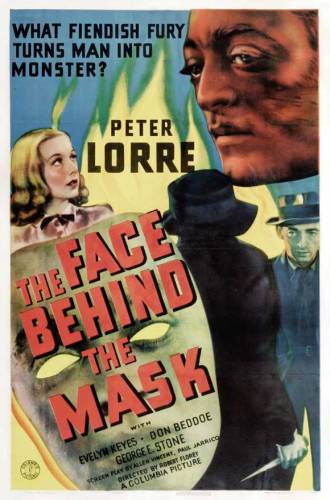
Revisiting an Old Fiend: THE FACE BEHIND THE MASK


the-face-behind-the-mask-1941-dvd-peter-lorre-evelyn-keyes-1189-p

Recently I switched from cable to DirecTV. As part of my package, I’ve officially joined the DVR generation. This is like being in heaven for an old movie buff like myself. Now I can record films of interest no matter what time they’re on and enjoy them at my leisure. Especially those older black & white gems that air mainly in the wee-wee hours. I can catch up with some classics I’ve only read about over the years but never had the opportunity to view, and those I only have vague memories of watching decades ago on snowy looking UHF channels.

THE FACE BEHIND THE MASK falls into the latter category. This 1941 Columbia film was directed by the criminally underrated Frenchman Robert Florey and stars everybody’s favorite madman Peter Lorre. The movie’s a very early example of 40s film noir, as was another Lorre vehicle, 1940’s  STRANGER ON THE THIRD FLOOR.

Lorre plays Janos Szabo, a newly arrived Hungarian immigrant watchmaker, come to America to find work and live the American dream. He’s befriended by police Lt. O’Hara (Don Beddoe), who buys the naïve newcomer a five dollar lunch and directs him to the Excelsior Palace, a low rent hotel. When another border’s negligence causes the joint to go up in flames, Janos is trapped inside, and suffers a horrible disfigurement.

O’Hara feels responsible for the poor guy’s plight and writes a message on one of his calling cards for Janos to contact him when he’s released from the hospital. Now unable to find work due to his terribly scarred visage, Janos goes to the waterfront, contemplating suicide. He meets up with a petty crook named Dinky, who takes a liking to Janos. Dinky has a safe job lined up but falls ill, and asks Janos to take his place. The Hungarian, good with his hands, takes care of business, When Dinky’s former comrades Benson and Watts show up wanting to know why they weren’t in on the score, the four decide to form a crime gang, with Janos (now nicknamed Johnny) as the ringleader. A crime wave ensues, baffling the police, and putting O’Hara under pressure to end the larcenous spree quickly as possible.

Janos wants the illicit dough so he can have plastic surgery and restore his features. A rubber mask is made from his passport photo for him to wear until the doctor returns. When the doc (an uncredited cameo by Frank Reicher, KING KONG’s Captain Englehorn)  finally does see Janos, he informs him that the facial nerves have suffered too much damage, and it would take fifteen years before any progress could be made!

Disheartened, Janos leaves the doctor’s office, where he (literally) bumps into Helen Williams. Helen is blind, but she can sense the goodness still inside the scarred master criminal. Eventually, Janos comes clean to her about his face, but not his illegal activities. Helen is played by the beautiful Evelyn Keyes, best known as Scarlet O’Hara’s Younger Sister (the name of her autobiography) in GONE WITH THE WIND.

Now in love with Helen, and with plenty of money stashed away, Janos decides to leave his life of crime behind and settle down in the country. This doesn’t sit well with his former cronies, especially Jeff, the gang’s new leader. When the cop’s calling card (remember?) is found in Janos’s old desk, they fear their former boss has turned stool pigeon. The gang beats and tortures Dinky, the only one who knows Janos’s whereabouts. Dinky spills the beans, and Jeff and company pay a visit to Janos and his new bride. While Jeff delivers a warning, the gang plants a bomb in his car, connected to the radio. Dinky gets dumped to the side of the road, badly beaten and shot, but manages to get to a phone and warn Janos. But it’s too late. While Helen’s unpacking the car, she wants to hear some music, turns on the radio, and KA-BOOM! She sadly dies in Janos’s arms.

Dinky’s still alive though, and tells Janos the gang has chartered a plane and are going on the lam. They take to the air and head west, unaware that Janos has ambushed the pilot and is flying the plane. He lands them smack in the middle of the Arizona desert and tells them he’s stranding them all there to die a slow, painful death. Soon after, O’Hara gets a hot tip (pun intended!)and flies west to discover a gruesome tableau. The gang members are all dead, including Janos, who’s been tied to the plane’s wing. O’Hara finds an explanation note in his little friend’s pocket, along with the five bucks for the lunch O’Hara bought him long ago.

Lorre is superb as a man trapped in circumstances beyond his control, showing a wider range of emotion beyond his standard pop-eyed psychopath roles. Keyes is also good as the doomed Helen, proving she could’ve been a much bigger star with better roles. FACE BEHIND THE MASK features plenty of familiar faces from the Mighty Columbia Arts Players brigade (Beddoe, George E Stone, Cy Schindell, John Tyrell, George McKay). The film’s a brisk 75 minutes of entertainment for lovers of 40s cinema in general, and Lorre in particular. The name Janos, by the way, was obviously inspired from the Roman god Janus, always depicted with two faces!

I’m glad I got to rewatch this movie and enjoy it without all that UHF snow.. I’ve got plenty more lined up in the DVR, and look forward to sharing my impressions of them with you, dear reader. So get that popcorn ready and let’s go to the show!

Horror on the Lens: The Boogie Man Will Get You (dir by Lew Landers)


Today’s horror on the lens is a short horror comedy from 1942.  In The Boogie Man Will Get You, Winnie Slade (Miss Jeff Donnell) buys an old house from Prof. Billings (Boris Karloff) with plans to covert it into a hotel.  However, one of the conditions of the sale is that Prof. Billings and his servants be allowed to live on the property.  What Winnie doesn’t know is that Prof. Billings had been conducting experiments on traveling salesman.  He hopes to turn them into supermen who can then be sent overseas to fight the Nazis.  (Kind of like Capt. America, when you think about it…)  However, his experiments have yet to be successful and have mostly just resulted into a lot of salesman being buried out in the rose garden…

However, things start to look up for Prof. Billings when he meets Dr. Lorencz (Peter Lorre), who is not only a doctor but also a mayor, sheriff, and dog catcher.  Seriously, Dr. Lorencz can do it all….

The Boogie Man Will Get You is a fun little time capsule of the time in which it was made.  For horror fans, it is mostly interesting because it features both Boris Karloff and Peter Lorre.  Both Karloff and Lorre appear to be having a lot of fun parodying their usual screen images.

Enjoy!

http://www.youtube.com/watch?v=MWEvKYhKc2U