The Unnominated: Johnny Got His Gun (dir by Dalton Trumbo)


Though the Academy of Motion Picture Arts and Sciences claim that the Oscars honor the best of the year, we all know that there are always worthy films and performances that end up getting overlooked.  Sometimes, it’s because the competition too fierce.  Sometimes, it’s because the film itself was too controversial.  Often, it’s just a case of a film’s quality not being fully recognized until years after its initial released.  This series of reviews takes a look at the films and performances that should have been nominated but were, for whatever reason, overlooked.  These are the Unnominated.

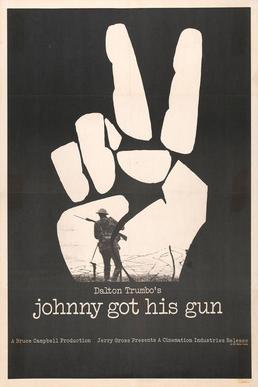
The 1971 anti-war film, Johnny Got His Gun, tells the story of Joe Bonham (played by Timothy Bottoms).  When America enters World War I, Joe enlists in the Army.  He leaves behind his small-town life.  He leaves behind his patriotic father (Jason Robards) and his loving girlfriend (Kathy Fields).  As he leaves, everyone tells him that he is doing the right thing to protect democracy.  Joe’s a hero!

Joe expects war to be a glorious affair, one that will make a true man out of him.  Instead, he’s hit by an artillery shell while huddled in a muddy trench.  Though he survives the explosion, he loses his arms and his legs.  He loses his face.  He’s taken to a field hospital, where the doctors say that, though he’s alive, he’s incapable of feeling or thinking.  He’s left alone in a room and is occasionally checked on by a sympathetic nurse (Diane Varsi).

The doctors are wrong.  Joe can think.  Even if he can’t see where he is now, he can still remember the life that he once had and the events that led him to the hospital.  The film switches back and forth, from the black-and-white imagery of the hospital to the vivid color of Joe’s memories and fantasies.  In his mind, Joe remembers his father, who encouraged him to go to war and perhaps was not the all-knowing figure that Joe originally assumed him to be.  (The film makes good use of Jason Robards’s natural gravitas.  Like Joe, the viewer initially assumes that Robards is correct about everything.) Joe also imagines several conversations with Jesus (a stoned-looking Donald Sutherland), who turns out to be surprisingly mellow and not always particularly helpful.  Jesus suggest that Joe may just be naturally unlucky and he also suggests that Joe perhaps keep his distance from him because, sometimes, bad luck can rub off.  Joe, meanwhile, wonders if he could be used as a traveling exhibit to portray the futility of war.  When Joe finally realizes that a nurse has been checking on him, he tries to figure out a way to send a message to both her and the military that is keeping him alive in his captive state.  S.O.S. …. help me….

Johnny Got His Gun is based on a novel by Dalton Trumbo.  The novel was first published in 1939, at a time when the debate over whether the the U.S. should get involved in another war in Europe was running high.  At the time, Trumbo was a Stalinist who opposed getting involved because Germany and Russia had signed a non-aggression pact.  After the Germans invaded Russia in 1941, Trumbo and his publishers suspended reprinting of the book until the war was over with.  Needless to say, this was all brought up in the 50s, when Trumbo was one of the more prominent writers to be blacklisted during the Red Scare.  On the one hand, Dalton Trumbo does sound like he was more than a bit of a useful idiot for the Stalinists.  On the other hand, if you’re going to suspend the printing of your anti-war polemic, it should definitely be because you want to help defeat the Nazis.  In the end, what really matters is that Johnny Got His Gun is an undeniably well-written and effective book, one that works because it eschews the vapid sloganeering that one finds in so many works of left-wing literature and instead focuses on the emotions and thoughts of one human being.

The book was later rediscovered by the anti-war protestors of the 60s, which led to Dalton Trumbo directing a film adaptation.  The film is a bit uneven.  Dalton Trumbo was 65 years old when he directed the film and there are a few moments, especially in the scenes with Sutherland as Jesus, where he seems like he’s trying a bit too hard to duplicate the younger directors who were a part of the anti-war moment.  However, the scenes in the military hospital are undeniably moving.  The hospital scenes are shot in a noirish black-and-white and they effectively capture the stark horror of Joe’s situation.  Left alone in his dark and shadowy room, Joe becomes the perfect symbol for all the war-related horrors that people choose to ignore.  He becomes the embodiment of what war does to those who are scarred, both physically and mentally, by it.  The scenes where Diane Varsi realizes that Joe is aware of what’s happened to him and that he can still feel are powerful and emotional.  In fact, they work so well that it’s hard not to wish that the film could have done away with the fantasies and the flashbacks, despite the fact that Timothy Bottoms gives an appealing performance as the young and idealistic Joe.

Johnny Got His Gun didn’t receive any Oscar nominations.  Should it have?  The 1971 Best Picture line-up was a strong one, with the exception of Nicholas and AlexandraJohnny Got His Gun was definitely superior to Nicholas and Alexandra.  However, Dirty Harry is definitely superior to Johnny Got His Gun.  (For that matter, Two-Lane Blacktop also came out in 1971 as well.)  But, even if Johnny Got His Gun didn’t deserve to be one of the five Best Picture nominees, it did deserve some consideration for its cinematography and Diane Varsi’s performance.  If the flashbacks and the fantasies were handled a bit more effectively, I would suggest that Jason Robards and Timothy Bottoms were worthy of consideration as well.

In conclusion, I should note that 1971 was a good year for Timothy Bottoms.  Not only did he star in this film but he was also the star of The Last Picture Show.
Previous entries in The Unnominated:
  1. Auto Focus 
  2. Star 80
  3. Monty Python and The Holy Grail

Cleaning Out The DVR, Again #24: Bloody Mama (dir by Roger Corman)


(Lisa is currently in the process of trying to clean out her DVR by watching and reviewing all 40 of the movies that she recorded from the start of March to the end of June.  She’s trying to get it all done by July 11th!  Will she make it!?  Keep visiting the site to find out!)

BloodyMama

The 24th film on my DVR was the 1970 Roger Corman-directed gangster film, Bloody Mama.  I recorded it off of TCM on May 27th.

Bloody Mama opens with a cheerful song that goes, “Maaaaaama…Bloody maaaaama….” and it’s such an unapolegetically over the top song that it perfectly sets the tone for what’s to follow.  Bloody Mama is violent, occasionally perverse, and totally unashamed.  It doesn’t pretend to be anything that it isn’t.  It’s bloody and it’s about a mother and, in the best Corman tradition, it makes no apologies!

The film tells the heavily fictionalized story of the Barkers, a group of brothers who robbed banks and killed people in the 1920s and 30s.  The majority of them were killed in a gunfight with the FBI.  Also killed in the gunfight was their mother, Kate Barker.  Always aware of the danger of bad publicity, the director of the FBI, J. Edgar Hoover, announced that Ma Barker was actually the mastermind of the Barker gang and that she was even more dangerous than her sons.  Ever since, historians have debated whether Ma Barker was the criminal mastermind described by Hoover or if she was just the innocent woman described by … well, by everyone who actually knew her.

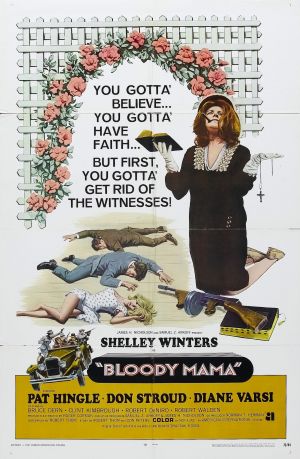
Bloody Mama, of course, leaves no doubt.  From the minute that we discover that Shelley Winters will be playing Ma Barker, we know that she’s the most dangerous woman alive.  As played by Winters, Ma Barker is a ruthless bank robber, one who has no fear of gunning down innocent bystanders and who never lets her love for her sons get in the way of ordering them to kill a witness.  As opposed to a lot of gangster films made in the late 60s and early 70s, the film never attempts to portray its title character as being a heroic or particularly sympathetic character.  Instead, what makes the character compelling is just how thoroughly Winters commits to the role.  It doesn’t matter what Ma Barker is doing or saying, Shelley Winters totally sells it.  When the gang is cornered by the police and one associate makes the mistake of yelling that he’s not a Barker, Ma reacts by gunning him down herself and you can’t help but appreciate the lengths that Ma will go to defend her family’s name.

As for her sons, they are an interesting group of perverts and drug addicts and they’re played some of the best character actors of the 1970s.

Herman Barker (Don Stroud) is a sadist but he’s also one of Ma’s favorites.  He travels with a prostitute (played by Diane Varsi), who quickly tires of the Barkers’s violent way of life.

Arthur Barker (Clint Kimbrough) is the most practical of the Barkers and therefore, he’s also the least interesting.

Fred Barker (Robert Walden) is bisexual, which is a fact that the film handles with all the sensitivity that we’ve come to expect from a film made in 1970 (which is to say, not much at all).  Fortunately, Fred’s lover is Kevin and Kevin is played by Bruce Dern and Bruce Dern is always a lot of fun to watch, especially when he’s appearing in a Corman film.

And then there’s Lloyd who sniffs glue and shoots heroin and who is played by an obscure young actor named Robert De Niro and … wait, Robert De Niro!  That’s right!  One of the pleasures of Bloody Mama is getting to see De Niro at the start of his career.  Unfortunately, he doesn’t really get to do much, though he does occasionally flash the same unhinged smile that would later show up in Taxi Driver.

Roger Corman has repeatedly cited Bloody Mama as being one of his favorites of the many movies that he directed over the course of his long career.  I don’t blame him.  It’s a thoroughly shameless and totally entertaining film!

Keep an eye out for Bloody Mama!

Just remember, the real-life Ma Barker was probably innocent.

Rockin’ in the Film World #4: WILD IN THE STREETS (AIP 1968)


gary loggins's avatarcracked rear viewer

max1

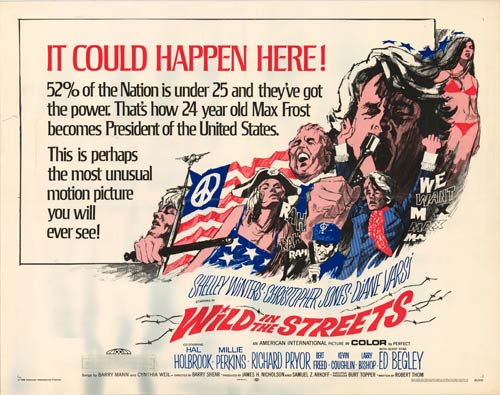
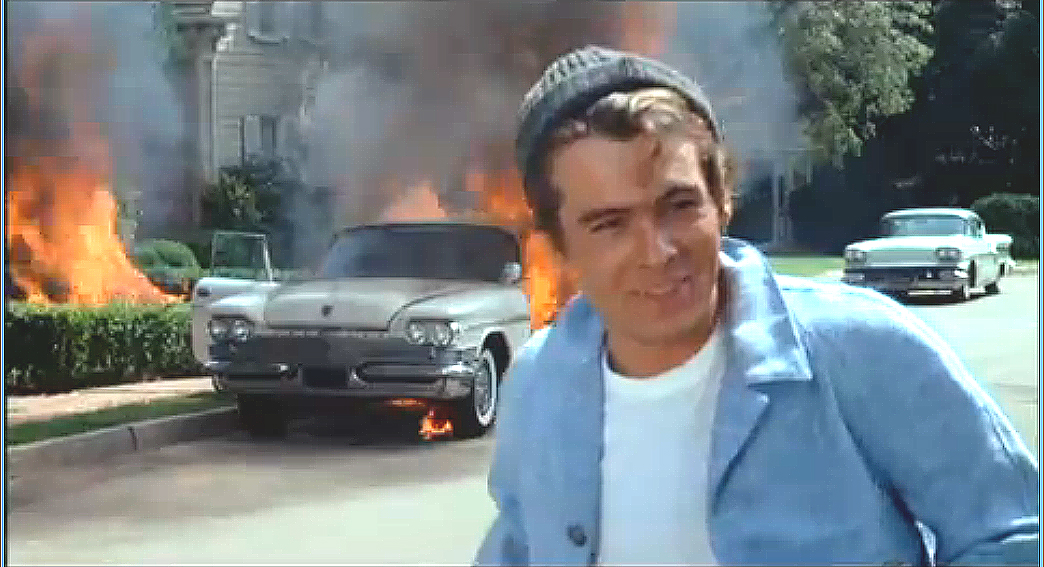
If you think today’s political climate is tumultuous and crazy, wait’ll you get a load of WILD IN THE STREETS. Filmed in the chaotic year 1968, this satirical look at the counter-culture vs the establishment revolves around a power-mad rock star whose call to lower the voting age to 14 results in him becoming President of the good ol’ USA, and sticking it to the over 30 crowd by interring them in concentration camps loaded with LSD-spiked water supplies!

max2

Christopher Jones is Max Frost, née Flatow, the charismatic leader of rock band Max Frost and the Troopers. Pre-credits flashbacks show Max’s unhappy childhood with an overbearing mother (Shelley Winters at her over-the-top best) and abrasive dad (Bert Freed). Max learns to hate all adults and dabbles in making LSD and bombs. After he blows up dad’s car, the rebellious Max leaves home and winds up becoming a mega rock star rivaling the…

View original post 945 more words

Shattered Politics #26: Wild In The Streets (dir by Barry Shear)


Wild_in_the_streets_dvd_cover

I am really not looking forward to turning 30.

Seriously, the great thing about being in your 20s is that everything is set up to specifically appeal to you.  Everyone wants your attention, your money, your tweets, your ideas, you love, and everything else.  And, yes, I understand that most people neither like nor respect my generation but oh well and whatever.  Trust me, the generation coming up behind mine is a hundred times worse.

2008 was a great time to be a politically knowledgeable millennial.  Everyone running for President was desperate to get our vote and they were willing to promise us anything.  And, since my age group voted overwhelmingly for Obama, all of the old elitists in the national media briefly fell in love with us.  (The genius of Obama’s 2008 campaign was to tell us that we were the people that we were waiting for.  Technically, it’s a bit nonsensical but never doubt what you can accomplish by appealing to the ego of the electorate.)

Of course, over the past few years, my generation has essentially been fucked over by both political parties and, since we dared to complain about it, nobody likes us anymore.  But, oh well and whatever.  American culture is basically built around our whims so we really don’t need anyone else’s love.

And, if all this sounds a little bitter or angry, I would point that young people and old people have been at war since time began.  Generational conflict is nothing new.  And if you need proof of that, I suggest watching a film from 1968 called Wild In The Streets.

Wild in the Streets tells the story of Max Frost (Christopher Jones), a rock star who lives in a gigantic mansion with his band and his groupies.   When Max is asked to perform at a campaign appearance for senate candidate Johnny Fergus (Hal Holbrook), he agrees to do so because Fergus supports lowering the voting age.  (When Wild In The Streets was made, you had to be 21 to vote.  So, if your birthday fell on election day, you could cast your first vote and then go have your first legal drink.)  However, at the rally, Max announces that he wants 14 year-olds to have the vote and then performs a song called “14 or fight!”

Max’s song is such a sensation and leads to so many protests that, in a compromise, the voting age is lowered to 15.  Johnny Fergus is elected to the Senate and, before you can say “Blue dog,” promptly starts to ignore the will of the people who supported him.  So, Max arranges for his girlfriend Sally (Diane Varsi) to be elected to the U.S. House.  After spiking the water supply of Washington D.C. with LSD, Sally gets a bill passed and the age requirement for holding political office is lowered to 14!

Of course, in the next election, 24 year-old Max Frost is elected President of the United States.  Soon, anyone over the age of 35 is being sent to re-education camps where they are force-fed LSD.  Max is so ruthless that he even sends his own mother (Shelley Winters) off to re-education.

And, with all the old people gone, everything is perfect for Max.  Except for that fact that 10 year-olds are now demanding the vote…

In many ways, Wild in the Streets feels like a film that could have only been made in 1968.  From the psychedelic direction to the costumes to the hair to music, everything about this movie screams late 60s.  But, at the same time, it’s still a genuinely amusing satire, largely because generational conflict is timeless.  We all think that those older than us are clueless and that those younger are spoiled.  There’s a lot of things in your life that can control.  Sadly enough, getting older is not one of them.

Wild in the Streets is a fun and amusing time capsule.  See it now before the younger generation comes of age and totally fucks up the world.

http://www.youtube.com/watch?v=gs-xc1CKnzY

Embracing The Melodrama #13: Peyton Place (dir by Mark Robson)


Poster - Peyton Place_04

“Just remember: men can see much better than they can think. Believe me, a low-cut neckline does more for a girl’s future than the entire Britannica encyclopedia.” — Betty (Terry Moore), speaking the truth in Peyton Place (1957)

Sex!  Sin!  Secrets!  Scandal!  It’s just another day in the life of Peyton Place, the most sordid little town this side of Kings Row!  It’s also the setting of the 1957 best picture nominee, Peyton Place.

Peyton Place is a seemingly idyllic little village in New England.  The town is divided by railroad tracks and how your fellow townspeople views you literally depends on which side of the tracks you live on.  As the film itself shows us, the right side of tracks features pretty houses and primly dressed starlets.  The wrong side of the tracks features shacks and a bunch of people who look like the ancestors of the cast of Winter’s Bone.  The difference in appearance is not particularly subtle (but then again, the same thing could be said for the entire film) but, regardless of which side of the tracks live on, chances are that you’re keeping a few secrets from the rest of the town.

On the right side of the tracks, you can find Constance McKenzie (played by Lana Turner, who is just about as convincing as a New England matron as you would expect a glamorous Hollywood star to be), a dress shop owner who is so prim and proper that she literally flies into a rage when she comes across her daughter kissing a boy.  Could it be the Constance’s repression is the result of her once having been a rich man’s mistress?  And will the new high school principal, the progressive and rather dull Mr. Rossi (Lee Phillips), still love her despite her sordid past?

Constance’s daughter is Allison (Diane Varsi) and poor Allison just can not understand why her mother is so overprotective.  Will Allison ever find true love with the painfully shy Norman Page (Russ Tamblyn) or will she be forced to settle for someone like the rich and irresponsible Rodney Harrington (Barry Coe)?

Rodney, for his part, is in love with Betty (Terry Moore), a girl from the wrong sides of the tracks.  Rodney’s father (Leon Ames) is the richest man in town and makes it clear that he will not allow his son to marry someone with a “reputation.”  Will Rodney get a chance to redeem himself by going off to fight in World War II?

And what will happen when Rodney and Betty go skinny dipping and are spotted by a local town gossip who promptly mistakes them for Norman and Allison?  Reputations are at stake here!

Meanwhile, over on the bad side of the tracks, Lucas Cross (Arthur Kennedy) sits in his shack and drinks and thinks about how the world has failed him.  His long-suffering wife (Betty Field) works as housekeeper for the McKenzie family.  Meanwhile, his abused daughter Selena (Hope Lange, giving the film’s best performance) is Allison’s best friend.  When Lucas’s attempt to rape Selena leads to a violent death, the sins and hypocrisy of Peyton Place are revealed to everyone.

Peyton Place is a big, long  movie, full of overdramatic characters, overheated dialogue, and over-the-top plotting and, for that reason, I absolutely love it!  Apparently, the film was quite controversial in its day and the scenes where Arthur Kennedy attacks Hope Lange still have the power to disturb.  However, the main reason why I enjoy Petyon Place is because anything that could happen in Peyton Place does happen in Peyton Place.

Seriously, how can you not love a film this sordid and melodramatic?