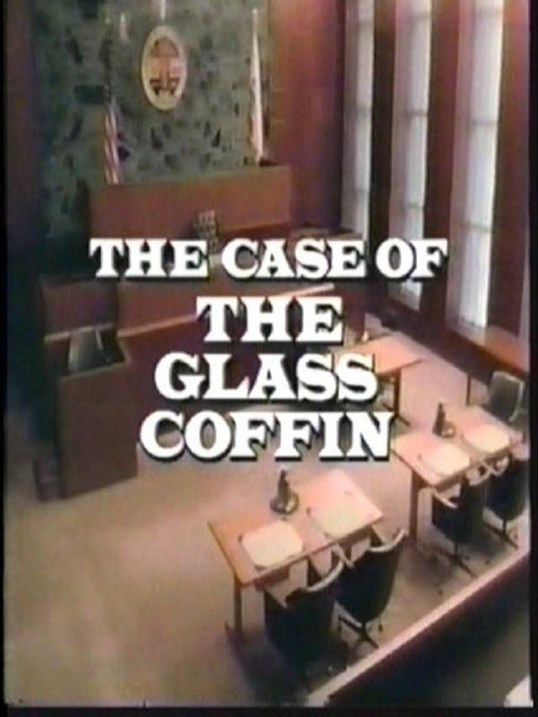
World famous magician David Katz (Peter Scolari) is accused of murdering his assistant (Nancy Lee Grahn) while performing a trick at a charity show. The prosecution says that David killed her to cover-up a pregnancy that was the result of a drunken, one-night stand. However, Perry Mason (Raymond Burr) and Ken Malansky (William R. Moses) discover that there were many people who might have a motive for killing the victim.
After the previous emotionally-charged Perry Mason movie, this entry felt pretty bland. I liked Peter Scolari as the accused magician but otherwise, this was a little boring. I guessed who would be playing the murderer as soon as I saw their name during the opening credits. I did find it amusing that Perry and the prosecutor (played by Bob Gunton) seemed to sincerely dislike each other. That added some bite to the courtroom scenes but I really do miss David Ogden Stiers’s as Perry’s regular courtroom opponent.
At the end of the movie, Perry took the jury to the theater where the murder occurred and then cross-examined the witnesses in the theater. I guess the movie’s producers were trying to do something new but it just didn’t feel right for Perry to get his confession anywhere other than in a courtroom.
David Hall (Matthew Faison) is an obnoxious horror writer who invites a group of associates and former friends to spend the night at a “haunted” hotel. He’s invited them because all of them are on the verge of suing him for writing about them in his latest book, The Resort. Over the course of the night, he plays cruel practical jokes on all of them. Finally, someone gets fed up and tosses him over a railing. The police arrest publisher Jordan White (Robert Stack) and charge him with the murder. It’s a good thing that Jordan’s best friend is Perry Mason (Raymond Burr).
Perry uses a cane in this movie and is not that active outside of the courtroom. That means that it’s up to Paul Drake, Jr. (William Katt) to do most of the investigating. As usual, Paul falls for an attractive, younger woman, in this case the hotel’s owner, Susan Warrenfield (Kim Delaney). Every movie features Paul falling for someone and then we never hear about them again. Does Paul have commitment issues?
I enjoyed this Perry Mason mystery. The hotel was a great location and I appreciated that the movie tried to add some horror elements to the story. The Perry Mason movies can be predictable so I always like it when they at least try to do something a little bit different. This was a fun entry in Perry Mason’s career.
“This is Lawrence. This is Lawrence, Kansas. Is anybody there? Anybody at all?”
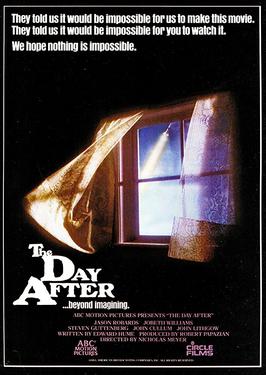
The words of Joe Huxley (John Lithgow) hang over the ending of The Day After, a 1983 film that imagines what the aftermath of a nuclear war would be like not on the East or the West Coasts but instead in the rural heartland of America. Huxley is a professor at the University of Kansas and, as he explains early on in the film, Kansas would be an automatic target in any nuclear war because it houses a number of missile silos. When he explains that, it’s in an almost joking tone, largely because the missiles haven’t been launched yet. Instead, the only thing we’ve heard are a few barely noticed news stories about growing tensions between America and Russia. About halfway through The Day After, the bombs go off and there are suddenly no more jokes to be made.
When the bombs drop over Kansas, we watch as cities and field and people burst into flames. In a matter of minutes, several thousands are killed. I’m almost ashamed to admit that I was probably more upset by the image of a horse being vaporized than I was by the death of poor Bruce Gallatin (Jeff East), the college student who was planning on marrying Denise Dahlberg (Lori Lethin). I guess it’s because horses — really, all animals — have nothing to do with the conflicts between nations. Humans are the ones who take the time to build bigger and better weapons and The Day After is one of the few films about war that’s willing to acknowledge that, when humans fight, it’s not just humans that die.
The bombing sequence is lengthy and I have to admit that I was a bit distracted by the fact that I recognized some of the footage from other movies. A scene of panicked people running through a building was taken from Two-Minute Warning. A scene of a building exploding and a construction worker being consumed by flames was lifted from Meteor. As well, there’s some stock footage which should be familiar to anyone who has ever seen a documentary about the early days of the Cold War. Still, despite that, it’s an effective sequence simply because it’s so relentless. Some of the film’s most likable characters are vaporized before our eyes. Steve Guttenberg, of all people, is seen ducking into a store.
Guttenberg plays Stephen Klein, a pre-med student who manages to survive the initial attack and takes shelter with the Dahlberg family at their ranch. At first, it’s a bit distracting to see Steve Guttenberg in a very serious and very grim film about the nuclear apocalypse but he does a good job. The sight of him losing both his teeth and his hair carries a punch precisely because he is reliably goofy Steve Guttenberg.
If the film has a star, it’s probably Jason Robards, the doctor who witnesses the initial blast from the safety of his car and then treats the dying in Lawrence, Kansas. He does so, despite the fact that he doesn’t know if his wife, son, and daughter are even still alive. He continues to do so until he also falls ill with radiation poisoning. Knowing that he’s dying, he heads home just to discover that there is no home to return to.
Home is reccuring theme throughout The Day After. Everyone wants to return to their home but everyone’s home has been wiped out. “This is my home,” Jim Dahlberg (John Cullum) tries to explain before he’s attacked by a group of feral nomads. Home no longer exists and trying to pretend like life can go back to the way it once was is an often fatal mistake.
Real happy film, right? Yeah, this isn’t exactly a film that you watch for fun. I have to admit that I made a joke about how I wouldn’t want to die while wearing the unfortunate blue jumpsuit that Jason Robards’s daughter chooses to wear on the day of the nuclear attack and I felt guilty immediately. (Well, not that guilty. Seriously, it was a terrible fashion choice.) The Day After is a film that gives audiences zero hope by design. It was made at a time when it was generally assumed that nuclear was inevitable and it was designed to scare the Hell out of everyone watching. And while I can’t attest to how audience may have reacted in 1983, I can say that, in 2020, it’s still a powerful and disturbing film.
“Is anybody there? Anybody at all?” Joe Huxley asks and by the end of the film, the answer doesn’t matter. The damage has already been done.
If you thought Tom Cruise nearly started a war in Top Gun, you should see what Matthew Broderick did three years earlier in Wargames!
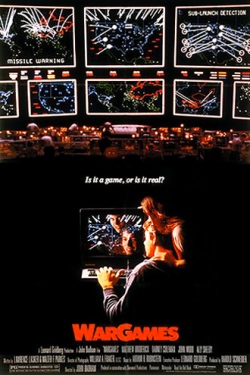
In Wargames, Broderick plays David Lighter, a dorky but likable teenager who loves to play video games and who spends his spare time hacking into other computer systems. (Of course, since this movie was made in 1983, all the computers are these gigantic, boxy monstrosities.) Sometimes, he puts his skills to good use. For instance, when both he and Jennifer (Ally Sheedy) are running the risk of failing their biology class, he hacks into the school and changes their grades. (At first, Jennifer demands that he change her grade back but then, a day later, she asks him to change it again. It’s kind of a sweet moment and it’s also probably the way I would have reacted if someone had done that for me in high school.) Sometime, David’s skills get him into trouble. For instance, he nearly destroys the world.
Now, keep in mind, David really didn’t know what he was doing. He was just looking for games to play online. He didn’t realize that he had hacked into NORAD and that Global Thermonuclear War was actually a program set up to allow a gigantic computer named WOPR to figure out how to properly wage a thermonuclear war. David also doesn’t know that, because humans have proven themselves to be too hesitant to launch nuclear missiles, WOPR has, more or less, been given complete control over America’s nuclear arsenal.
(Wargames actually starts out with a chilling little mini-movie, in which John Spencer and Michael Madsen play two missile technicians who go from joking around to pulling guns on each other during a drill. Of course, Madsen’s the one ready to destroy the world.)
Of course, the military folks at NORAD freak out when it suddenly appears as if the Russians have launched a nuclear strike against Las Vegas and Seattle. (Not Vegas! Though really, who could blame anyone for wanting to nuke Seattle?) In fact, the only thing that prevents them from launching a retaliatory strike is David’s father demanding that David turn off his computer and take out the trash. However, WOPR is determined to play through its simulation, which pushes the world closer and closer to war. (One of the more clever — and disturbing — aspects of the film is that, even after the military learns that the Russians aren’t planning the attack them, they still can’t go off alert because the Russians themselves are now on alert. Once the war starts, it can’t be stopped even if everyone knows that the whole thing was the result of a mistake.)
With the FBI looking for him, David tries to track down the man who created WOPR, Dr. Stephen Falken (John Wood). However, Falken is not easy to find and not as enthusiastic about saving the world as one might hope….
Watching Wargames was an interesting experience. On the one hand, it’s definitely a dated film. (Again, just look at the computers.) At the same time, its story still feels relevant. In Wargames, the problem really isn’t that WOPR wants to play a game. It’s that men like Dr. John McKittrick (well-played by Dabney Coleman) have attempted to remove the human element and have instead put all of their faith in machines. The appeal of a machine like WOPR is that it has no self-doubt and does whatever needs to be done without worrying about the cost. But that’s also the reason why human beings are necessary because the world cannot be run on just algorithms and cold logic. That’s a theme that’s probably even more relevant today than it was in 1983.
Wargames is also an exceptionally likable film. In fact, it’s probably about as likable as any film about nuclear war could be. On the one hand, you’ve got everyone at NORAD panicking about incoming missiles and then, on the other hand, you’ve got David and Jennifer having fun on his computer and trading flirty and silly quips. Matthew Broderick and Ally Sheedy are both likable in the two main roles. Broderick brings a lot of vulnerability to the role of David. (David Lightner is a far more believable teenager than Ferris Bueller.) He handles the comedic scenes well but he’s even better as David grows increasingly desperate in his attempts to get the stubborn adults around him to actually listen to what he has to say. When it appears the only way to save the world is to swim across a bay, David is forced to admit that he’s never learned how to swim because he always figured there would be time in the future. Yes, it’s a funny scene but the way Broderick delivers the line, you understand that David has finally figured out that there’s probably not going to be a future. It’s not that he doesn’t know how to swim. It’s that he’ll never get the chance to learn or do anything else for that matter.
Wargames is definitely a film of its time but its themes are universal enough that it’s a film of our time as well.
Set during World War II, 1984’s A Soldier’s Story opens with a murder.
On a rural road outside of a segregated army base in Louisiana, someone has gunned down Sergeant Vernon Walters (Adolph Caesar). At the time, Walters was staggering back to the base after a night of heavy drinking. Both the local authorities and Watlers’s fellow soldiers assume that the murder was the work of the Ku Klux Klan. Captain Richard Davenport (Howard Rollins) isn’t so sure.
Captain Davenport is the officer who has been assigned to investigate the murder. From the minute that he arrives at the base, the soldiers stare at him. As Cpl. Ellis (Robert Townsend) explains it, the enlisted men are shocked because they’ve never seen a black officer before. Some of the soldiers admire Davenport while other view him with suspicion, wondering what Davenport must have done or who he must have sold out to earn his commission.
Meanwhile, the other officers (who are all white) view Davenport with a combination of condescension and hostility. Col. Nivens (Trey Wilson) only allows Davenport three days to wrap up his investigation and assigns the polite but skeptical Capt. Taylor (Dennis Lipscomb) to work with him. Taylor suspects that Walters may have been murdered by the openly racist Lt. Byrd (Wings Hauser!). Davenport, however, isn’t so sure. Even though the official story is that Walters was a tough but fair sergeant who was respected by his company, Davenport suspects that one of them may have killed him.
Davenport and Taylor start to interview the soldiers who actually had to deal with Walters on a daily basis. Through the use of flashbacks, Walters is revealed to be a far more complex man than anyone knew. We see that Walters was a man who was bitterly aware of the fact that, even after a lifetime of military service, he was destined to always be treated as a second-class citizen by the nation that he served. Unable to strike out at the men who the army and society had placed over him, Walters instead struck at the men serving underneath him. While the man in Walters’s company wait for word on whether or not they’ll be allowed to serve overseas, Davenport tries to determine if one or more of them is a murderer.
A Soldier’s Story was adapted from a play but director Norman Jewison is careful to prevent the material from becoming stagey. Effortlessly transitioning from the film’s present to flashbacks of the events that led to Walters’s murder, Jewison crafts both an incendiary look at race relations and a compelling murder mystery. He’s helped by a strong cast of predominately African-American actors. In one of his earliest roles, Denzel Washington plays Pfc. Peterson with a smoldering intensity. David Alan Grier and Robert Townsend, two actors known for their comedic skills, impress in dramatic roles. Seen primarily in flashbacks, Adolph Caesar turns Walters into a complex monster.
And yet, with all the talent on display, it is Howard Rollins who ultimately steals the movie. As a character, Captain Davenport has the potential to be a rather thankless role. He spends most of the movie listening to other people talk and, because of his status as both an officer and a black man in the rural south, he’s rarely allowed to show much anger or, for that matter, any other emotion. However, Rollins gives a performance of such quiet intelligence that Davenport becomes the most interesting character in the movie. He’s the ultimate outsider. Because of his higher rank and his role as an investigator, he can’t fraternize with the enlisted men but, as an African-American, he’s still expected to remain separate from and differential to his fellow officers. As the only black officer on a segregated base, Davenport is assigned to stay in an empty barrack. One of the best scenes in the film is Davenport standing alone and surveying the stark layout of his temporary quarters. The expression on his face tells you everything you need to know.
(Towards the end of the film, when Davenport finally gets a chance to drop his rigid facade and, if just for one line, be himself, you want to cheer for him.)
A Soldier’s Story was nominated for best picture but it lost to another theatrical adaptation, Milos Forman’s Amadeus.
My sixth and (to date, anyway) final home state is Louisiana, where my family called Shreveport home from December of 1996 to May of 1998. Louisiana was the last state I lived in before moving back to Texas, where I’ve remained ever since.
Whenever people find out that I used to live in Louisiana, they always seem to automatically assume that means that I either lived in New Orleans or next door to the family from Duck Dynasty. They always seem to be somewhat disappointed to learn that I lived in Shreveport, which has a lot more in common with East Texas than with the things that most people visualize when they think about Louisiana. However, I will always have good memories of Shreveport and let me tell you why. For most of my childhood, I had a really bad stutter and, as a result, I was extremely shy. However, shortly after my 12th birthday, my stutter went away. Whether it was the result of spending hours with speech therapists or if it’s just something that I outgrew, Shreveport will always be the city where I stopped stuttering. (And, it should be noted, Shreveport may not be New Orleans but it still celebrates Mardi Gras. It’s just that the celebrations in Shreveport are a bit more …. sedate.) So, seriously — don’t say a word against Shreveport.
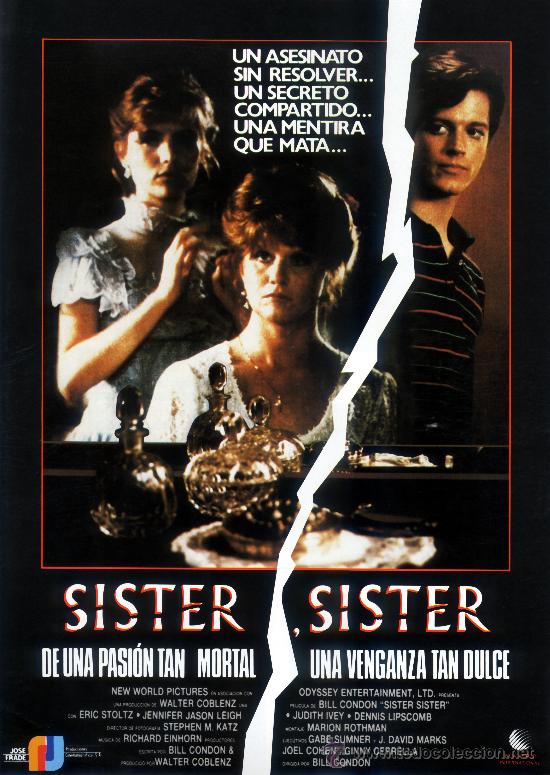
Besides, Shreveport has a wonderful atmosphere all of its own. In fact, the same thing can be said about all of Louisiana. With its long history and unique culture, Louisiana is perhaps the most atmospheric state in the union and that atmosphere is perfectly displayed in Sister, Sister, an effective little thriller from 1987.
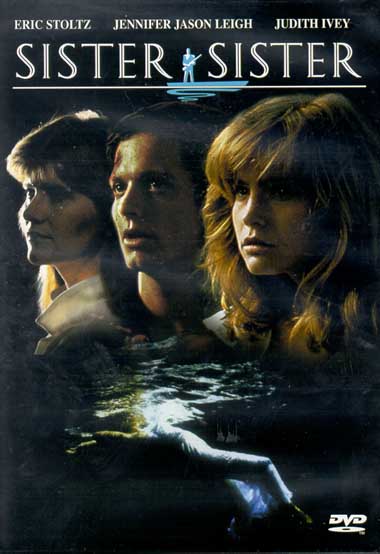
Sister, Sister tells the story of two sisters living in a dilapidated mansion on the bayous. The older sister, Charlotte (Judith Ivey) is in love with Sheriff Cleve Doucet (Dennis Lipscomb) but she knows she can never marry him because she has to watch and protect her younger sister, Lucy (Jennifer Jason Leigh). Lucy is mentally unstable and claims that she can communicate with the ghosts that live in the bayous.
Charlotte and Lucy have turned their mansion into the boarding house and they rent a room to Matt (Eric Stoltz), a congressional aide who is taking his vacation in the bayous. Matt takes an interest in Lucy, which raises the suspicions of Etienne (Bejamin Mouton), a sinister handyman who appears to be obsessed with Lucy himself. As you can probably guess, nobody in this film is quite who he or she appears to be and it all leads to the uncovering of dark secrets from the past.
So, let’s just start with the obvious. The plot of Sister, Sister doesn’t make much sense. If you think about it, you’ll find a lot of improbabilities. So, my suggestion is that you just don’t think about it. Instead, watch the film for the performances of Judith Ivey and Jennifer Jason and the atmosphere of the bayous. Making his directorial debut here, future Twilight director Bill Condon captures a lot of haunting images of the bayou and his direction emphasizes mood over cheap thrills. The end result is a horror film that might not be scary but it certainly is creepy and stays with you after it’s over.
If nothing else, Sister, Sister is an effective B-movie. It’s also a nice showcase for my former home state of Louisiana.


 Through the Shattered Lens