Horror Film Review: The Strange Case of Dr. Jekyll and Mr. Hyde (dir by Charles Jarrott)


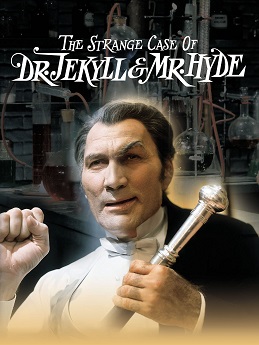
First released in 1968, The Strange Case of Dr. Jekyll and Mr. Hyde is a somewhat loose adaptation of the famous novella by Robert Louis Stevenson.

Jack Palance stars as Dr. Henry Jekyll, a mild-mannered and respected doctor who lives in Victorian-era London and who is convinced that there is a good and dark side lurking in every single person.  The dark side is what forces people to break the law and fight with each other.  Jekyll feels that his experiments will allow people to get closer to their dark side and, in doing so, defeat it.  When Dr. Jekyll explains his theories to a medical association, he is violently jeered and booed.  Jekyll returns to his home, enters his laboratory, and takes a drink of the serum that he’s been developing.

The next morning, Dr. Jekyll wakes up with a hangover and no memory of how he spent the previous night.  Trying to retrace his steps, Jekyll finds himself in a dance hall where everyone is talking about a well-dressed but ugly man named Edward Hyde.  Hyde showed up the previous night, spent a lot of money on a woman named Gwyn (Billie Whitelaw), and then got into a fight with two men.  Hyde broke a window to make his escape.  Jekyll, sensing what must have happened, pays for the window on behalf of his “friend,” Edward Hyde.

Jekyll continues to drink the serum and he continues to indulge in all of the forbidden vices as Edward Hyde.  Eventually, we get to see Palance as Hyde.  Unlike a lot of other actors who have played the role, Palance uses a minimum of makeup to suggest his transformation.  Instead, he hunches over, scrunches up his face, and he has a unibrow.  One of the stranger things about this production is that we are continually told that Hyde looks nothing like Jekyll but we know that’s not true.  Instead, Hyde looks exactly like Jekyll making a funny face.

Palance gives one of his more eccentric performances as Jekyll and Hyde.  Somewhat surprisingly, he’s far more convincing as the kindly and troubled Dr. Jekyll than as the villainous Mr. Hyde.  (As Hyde, Palance is often trying to so hard to maintain his facial paralysis that it’s hard to understand exactly what it is that he’s saying.)  With each drink of the serum, Jekyll becomes a bit more confident in himself.  However, he also finds himself losing the ability to control the transformations.  One morning, he wakes up in his bed and is shocked to discover that he is still Hyde.  That same morning, he learns that Hyde is suspected of committing a senseless and brutal murder.  Jekyll has no memory of it but he knows that Hyde is guilty.  And if Hyde is guilty, so is Jekyll.  (Those who make the argument that Dr. Jekyll and Mr. Hyde is ultimately about drug addiction will find plenty to back up that argument in this production,)  Jekyll’s anguish as he realizes what he has become is rather poignant to watch.

Produced by horror impresario Dan Curtis, The Strange Case of Dr. Jekyll and Mr. Hyde can seem a bit creaky today.  It was apparently highly acclaimed when it first aired but, seen today, it can feel rather stagey and talky.  That said, the film has a strong supporting cast, with Denholm Elliott especially giving a good performance as Jekyll’s best friend.  Jack Palance’s performance is so bizarre that it transcends the usual standards used to determine good and bad.    It’s definitely a film worth watching.

Horror On TV: Hammer House Of Horror Episode #3: Rude Awakening (dir by Peter Sasdy)


In the third episode of Hammer House of Horror, Denholm Elliott plays an estate agent who finds himself having a series of nightmares about his wife (Pat Heywood) and his secretary (Lucy Gutteridge) and a murder that may or may not have happened on Friday the 13th.  This episode is an enjoyably surreal trip into the subconscious.

In the UK, Rude Awakening originally aired on September 27th, 1980.

Trading Places (1983, directed by John Landis)


It all starts with a bet.

As Christmas approaches, Mortimer (Don Ameche) and Randolph Duke (Ralph Bellamy) make a bet to determine whether it’s nature or nurture that shapes someone’s future.  The fabulously wealthy owners of Duke & Duke Commodity Brokers, the brothers casually frame their director, Louis Winthrope III (Dan Aykroyd), for everything from dealing drugs to sealing money to cheating on his girlfriend (Kirstin Holby).  After Louis is kicked out of both his job and his mansion, the Dukes hire a street hustler named Billy Ray Valentine (Eddie Murphy) to take his place.  Earlier Winthrope tried to get Valentine arrested for approaching him in the street.  Now, Valentine is living in Winthrope’s mansion, with Winthrope’s butler and Winthrope’s job.

While Winthrope tries to survive on the streets with the help of a outwardly cynical but secretly kind-hearted prostitute named Ophelia (Jamie Lee Curtis, in her first non-horror starring role), Billy Ray surprises everyone by using his street smarts to become a successful, suit-wearing businessman.  The Dukes, of course, have no intention of keep Billy Ray Valentine on as their director.  Not only are the Dukes snobs but they’re racists as well.  Once their one dollar bet has been settled, they start planning to put Billy Ray back out on the streets with Winthrope.

Trading Places was Eddie Murphy’s follow-up to 48 Hrs and he again showed himself to be a natural star while playing the type of role that could have been played by Dan Ayrkroyd’s partner, John Belushi, if not for Belushi’s early death.  (Jim Belushi has a cameo as a party guest.)  Murphy gets to show off a talent for physical comedy and Trading Places is one of the few films to really take advantage of Dan Aykryod’s talents as both a comedian and actor.  Winthrope goes from being a coddled executive to being as streetwise as Valentine.  This is probably Aykroyd’s best performance and he and Eddie Murphy make for a good team.

But the real stars of the film are four actors who weren’t really thought of as being comedic actors, Denholm Elliott, Don Ameche, Ralph Bellamy, and especially Jamie Lee Curtis.  Ophelia is a much edgier character than the “final girls” that Curtis was playing in horror films and Curtis steals almost every scene that she’s in.  Ameche and Bellamy are great villains and it’s fun to watch them get their comeuppance.  What screwball comedy would be complete without a sarcastic butler?  Denholm Elliot fills the role of Coleman perfectly.

Trading Places was a box office success when it was released and it’s now seen as being one of the new Christmas classics, a film for the adults to enjoy while the kids watch Rudolph and Frosty.  I think the movie ends up going overboard towards the end with the gorilla and Dan Aykroyd wearing blackface but, for the most part part, it’s still a very funny and clever movie.

Film Review: Voyage of the Damned (dir by Stuart Rosenberg)


In 1939, an ocean liner named the MS St. Louis set sail from Hamburg.  Along with the crew, the ship carried 937 passengers, all of whom were Jewish and leaving Germany to escape Nazi persecution.  The ship was meant to go to Havana, where the passengers had been told that they would be given asylum.  Many were hoping to reunite with family members who had already taken the voyage.

What neither the passengers nor Captain Gustav Schroeder knew was that the entire voyage was merely a propaganda operation.  No sooner had the St. Louis left Hamburg than German agents and Nazi sympathizers started to rile up anti-Semitic feelings in Cuba.  The plan was to prevent the passengers from disembarking in Cuba and to force the St. Louis to then return to Germany.  The Nazis would be able to claim that they had given the Jews a chance to leave but that the rest of the world would not take them in.  Not only would the Jews be cast as pariahs but the Germans would be able to use the world’s actions as a way to defend their own crimes.

Captain Schroeder, however, refused to play along.  After he was refused permission to dock in Cuba, he then attempted to take the ship to both America and Canada.  When both of those countries refused to allow him to dock, Schroeder turned the St. Louis toward England, where he planned to stage a shipwreck so that the passengers could be rescued at sea.  Before that happened, Belgium, France, the Netherlands, and the United Kingdom jointly announced that they would accept the refugees.

Tragically, just a few days after the passengers disembarked, World War II officially began and Belgium, France, and the Netherlands all fell to the Nazi war machine.  It is estimated that, of the 937 passengers on the St. Louis, more than 600 of them subsequently died in the Nazi concentration camps.

The journey of the St. Louis was recreated in the 1976 film, Voyage of the Damned, with Max von Sydow as Captain Schroeder and a collection of familiar faces playing not only the ship’s passengers and crew but also the men and women in Cuba who all played a role in the fate of the ship.  In fact, one could argue that there’s a few too many familiar faces in Voyage of the Damned.  One cannot fault the performances of Max von Sydow, Malcolm McDowell, and Helmut Griem as members of the crew.  And, amongst the passengers, Lee Grant, Jonathan Pryce, Paul Koslo, Sam Wanamaker, and Julie Harris all make a good impression.  Even the glamorous Faye Dunaway doesn’t seem to be too out-of-place on the ship.  But then, in Havana, actors like Orson Welles and James Mason are awkwardly cast as Cubans and the fact that they are very obviously not Cuban serves to take the viewer out of the story.  It reminds the viewer that, as heart-breaking as the story of the St. Louis may be, they’re still just watching a movie.

That said, Voyage of the Damned still tells an important true story, one that deserves to be better-known.  In its best moments, the film captures the helplessness of having nowhere to go.  With Cuba corrupt and the rest of the world more interested in maintaining the illusion of peace than seriously confronting what was happening in Germany, the Jewish passengers of the St. Louis truly find themselves as a people without a home.  They also discover that they cannot depend on leaders the other nations of the world to defend them.

Defending the passengers falls to a few people who are willing to defy the leaders of their own country.  At the start of the film, Nazi Intelligence Chief Wilhelm Canaris (Denholm Elliott) explains that Captain Schroeder was selected specifically because he wasn’t a member of the Nazi Party and could not be accused of having ulterior motives for ultimately returning the passengers to Germany.  Canaris and his fellow Nazis assume that anti-Semitism is so natural that even a non-Nazi will not care what happens to the Jewish passengers.  Instead, Schroeder and his crew take it upon themselves to save the lives of the passengers.  It is not Franklin Roosevelt who tries to save the passengers of St. Louis.  Instead, it’s just a handful of people who, despite unrelenting pressure to do otherwise, step up to do the right thing.  Max von Sydow, who was so often cast in villainous roles, gives a strong performance as the captain who is willing to sacrifice his ship to save his passengers.

Flaws and all, Voyage of the Damned is a powerful film about a moment in history that must never be forgotten.

The Strange Case Of The End Of Civilization As We Know It (1977, directed by Joseph McGrath)


It should have been so much funnier.

After someone is obviously meant to be Henry Kissinger (played by Ron Moody) is assassinated when he loses his diary and extends the wrong greeting to a welcoming party in the Middle East, someone claiming to be a direct descendant of the infamous Prof. Moriarty sends a letter to the U.S. President (Joss Ackland) taking responsibility and claiming that it’s the first step in a plan to control the world.

Who better to stop the descendant of Moriarty than the descendant of Moriarty’s greatest enemy?  Arthur Sherlock Holmes (John Cleese) operates out of Baker Street with Dr. Watson (Arthur Lowe), who is bionic, and their housekeeper, Miss Hudson (Connie Booth).  Holmes solution to bringing out Moriarty is to host a gathering of the world’s greatest detectives and to dare Moriarty to try to take them out with one fell swoop.  Soon, everyone from Sam Spade to Columbo to McCloud is showing up at Baker Street.

This is a joke-a-minute comedy.  The jokes that work are funny but, unfortunately, there aren’t many of them.  Some bits, like Joss Ackland’s impersonation of Gerald Ford, start off well and then go on for too long.  Other bits, like the famous TV detectives showing up at Baker Street, have potential but fail due to poor execution.  Unfortunately, much of the humor is just not that clever to begin with, which is not something that anyone would expect from a script co-written by John Cleese.  As an actor, John Cleese is funny but underused, playing Sherlock Holmes as being an even denser version of Basil Fawlty.  Arthur Lowe’s comedic befuddlement is consistently amusing but I wish the script has done more with the idea of him being bionic.  Connie Booth is both funny and sexy and the best reason to watch this misfire.

The Unnominated: Saint Jack (Dir by Peter Bogdanovich)


Though the Academy of Motion Picture Arts and Sciences claim that the Oscars honor the best of the year, we all know that there are always worthy films and performances that end up getting overlooked.  Sometimes, it’s because the competition too fierce.  Sometimes, it’s because the film itself was too controversial.  Often, it’s just a case of a film’s quality not being fully recognized until years after its initial released.  This series of reviews takes a look at the films and performances that should have been nominated but were, for whatever reason, overlooked.  These are the Unnominated.

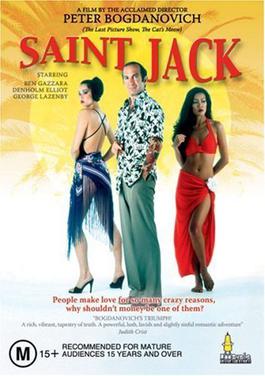
In 1979’s Saint Jack, Ben Gazzara stars as Jack Flowers.  Jack was born in Brooklyn in 1931, a first-generation Italian-American.  Though Jack himself prefers to keep his past something of a mystery, it’s implied that his family had less-than-savory “connections.”  Jack served in the Korean War.  After the war, he served in the Merchant Marine and spent a while trying to pursue a career as a writer.  Now, in the early 1970s, Jack lives in Singapore.

What does Jack do in Singapore?  He seems to know everyone and everyone seems to like him, with the exception of a few members of a Chinese triad who view Jack as being their competition.  Jack is friendly and he knows how to talk to people.  With the Vietnam War waging, Singapore is full of American soldiers on R&R and Jack is always willing to help set them up with companionship during their stay.  He does the same thing for the businessmen who stop off on the island.  At the same time, if someone just wants to play a game of squash, Jack can direct them to nearest health club.  Whatever someone needs, Jack know how to get it.

This episodic film is largely a character study, following Jack over three eventful years of his life.  We learn a lot about Jack just from watching his interactions with his friend William (Denholm Elliott), an alcoholic accountant who visits Singapore once a year and who is one of the few people with whom Jack is comfortable just being himself around.  For all of his friendliness and good humor, Jack never quite lets anyone get too close to discovering who he really is.  In many ways, Jack feels trapped in Singapore.  He’s getting older and the world around him is changing and becoming less safe.  Jack’s true goal is to open his own brothel, make a fortune, and eventually return to Brooklyn a rich man.  At times, with the help of the CIA and a shady businessman (played by the film’s director, Peter Bogdanovich), it appears that Jack is going to do just that.  But when his business associates put pressure on Jack to help them blackmail a gay U.S. Senator (played by George Lazenby, of On Her Majesty’s Secret Service fame), Jack is forced to finally decide how far he’s willing to go to achieve his dream.

The film works best as a showcase for Ben Gazzara, the character actor who may be best remembered for his over-the-top villainous turn in Roadhouse but who also gave excellent performances in films that rarely got the appreciation that they deserved.  Starting his career as the accused killer in Anatomy of a Murder, Ben Gazzara brought his trademark intensity to several independent and mainstream films.  He was a favorite of John Cassavetes.  Over the course of his long career, Gazzara was never nominated for a single Oscar, though he certainly deserved to be nominated for one here.  I would rate his work in Saint Jack as being superior to the performance that won that year’s Oscar, Dustin Hoffman’s rather self-satisfied turn in Kramer vs. Kramer.  From the minute that Gazzara appears onscreen, he simply is Jack.  The film was shot on location in Singapore and Gazzara walks through the streets with the an appealing confidence.  As Jack, he’s a likable raconteur but, in the film’s quieter moments, Gazzara allows us to see just how alone Jack actually is.  Jack may know every corner of Singapore but he also knows that it will never truly be where he belongs.  There’s a particular poignance to Gazzara’s scenes with Denholm Elliott.  Jack and Bill are two very different men but they share a desire to return to their homes.

Saint Jack should have been a comeback for Peter Bogdanovich, the film critic-turned-director who got off to a strong start with Targets and The Last Picture Show but whose career floundered as the 70s moved on.  Following the Oscar-nominated Last Picture Show and Paper Moon, Bogdanovich directed three big budget films — Daisy Miller, At Long Last Love, and Nickelodeon — that all failed at the box office.  Finding himself a sudden pariah in Hollywood, Bogdanovich returned to his low-budget roots with Saint Jack, getting funding from Roger Corman and directing the film in a gritty, cinéma vérité-style.  Roger Ebert loved the film, declaring that it proved that Bogdanovich was still a director worthy of appreciation.  Unfortunately, the film was never widely distributed and it proved to be another box office disappointment for Bogdanovich.  Sadly, the film was also ignored by the Academy, despite award-worthy performances from both Gazzara and Elliott.

Bogdanovich, who was born 84 years ago on this date, would often be cited as a cautionary tale for other directors who peaked early and spent the rest of their career on a downward slope.  That’s not quite fair to Bogdanovich, who did continue to direct good films like Saint Jack, Mask, and The Cat’s Meow.  Before he passed away in 2022, Bogdanovich found new popularity as both a character actor and as a frequent guest on TCM.  And, fortunately, his films have come to be better appreciated with age.  Saint Jack may not have gotten the attention it deserved in 1979 but it has since been rediscovered and rightfully acclaimed.

Previous entries in The Unnominated:

  1. Auto Focus 
  2. Star 80
  3. Monty Python and The Holy Grail
  4. Johnny Got His Gun

Lisa Reviews An Oscar Nominee: Alfie (dir by Lewis Gilbert)


alfie_original

One night, in the UK, in 1965…

In a London flat, a phone rings.  Up-and-coming actor Terrence Stamp answers.  On the other end, the producers of an up-coming film called Alfie ask Stamp if he would be interested in playing the lead role.  In many ways, Stamp seems like the obvious choice.  After all, he already starred in the stage version of Alfie.  He knows the character and everyone knows that he’s going to be a big star…

And that’s why Stamp turns down the role.  The character of Alfie is an irresponsible and self-centered womanizer who, over the course of the play, has numerous affairs, arranges for one illegal abortion, treats almost everyone terribly, and, at the end of the movie, ends up alone.  Not only will the film’s risqué subject matter provide a challenge, even if it is being made in “swinging London,” but Alfie just isn’t a heroic figure.  He has some good lines.  He makes a few good jokes and, after arranging an abortion for one of his girlfriends, he realizes just how empty his life really is.  But, as written, Alfie is hardly sympathetic.

Stamp says he’s not interested in playing Alfie on screen and then he hangs up.

Two minutes later, the phone rings again.  Stamp answers.  It’s the producers of Alfie.  They ask to speak to his roommate, a cockney actor who was born Maurice Micklewhite but who, at the start of his acting career, changed his name to Michael Caine.

And that’s how Michael Caine came to star in the 1966 film, Alfie.

Alfie not only made Michael Caine a star, it also landed him his first Oscar nomination.  It was especially a popular film in the States, where it tapped into a youth culture that was obsessed with all things British and a desire, on the part of many filmgoers, to see films that deal with “adult” topics that American films, at that time, wouldn’t dare touch.  Though Alfie may seem rather tame by today’s standards (for a film about a man obsessed with sex, there’s actually not much of it to be found in Alfie), one can still see why it would have taken American audiences by surprise in 1966.  At a time when American films still starred Doris Day and Bob Hope, here was a British film about a working class cockney who screws almost every woman he meets, both figuratively and literally.

And really, it’s fortunate that Michael Caine accepted that role.  Along with Stamp, Alfie‘s producers also tried to interest Richard Harris and Laurence Harvey in the role.  All three of them would have brought a harder edge to the character.  However, Michael Caine has just enough charm to make Alfie likable, even when his actions are not.  Since a good deal of the film is made up of Alfie breaking the fourth wall and talking straight to the audience (and, often times, not exactly saying that most charitable of words), that charm is essential to the film’s success.  Michael Caine’s Alfie is self-centered but, at the same time, you never doubt that there’s a better man lurking underneath the surface.  You forgive Alfie a lot because, thanks to Caine’s performance, you can see the man that he’s capable of being.

Alfie is pretty much Michael Caine’s show but he’s ably supported by the rest of the cast, especially Jane Asher as a poignantly insecure hitchhiker and Shelley Winters as a cheerfully promiscous American.  And then there’s Denholm Elliott, who plays an abortionist with a seedy intensity that catch you off-guard and drives home the dark reality lurking underneath Alfie‘s charm.

For a film that is often described as being very much a product of its time, Alfie holds up surprisingly well.  It was nominated for best picture but it lost to something far more sedate, A Man For All Seasons.


Halloween Havoc!: THE HOUSE THAT DRIPPED BLOOD (Amicus 1971)


gary loggins's avatarcracked rear viewer

drip1

Hammer Films wasn’t the only British company cranking out the horrors back in the 60’s and 70’s. American ex-pats producers Milton Subotsky and Max Rosenberg formed Amicus Films in 1962 and after a couple of films aimed at the teen audience (with American rockers like Chubby Checker, Del Shannon, Freddy Cannon, and Gene Vincent) began concentrating on horror. The team specialized in the anthology genre, or “portmanteau” as the intelligentsia call them. I’ll stick with anthologies!

THE HOUSE THAT DRIPPED BLOOD was a 1971 effort written by Robert Bloch, forever known as “The Guy Who Wrote PSYCHO”. The nail to hang Bloch’s four tales on concerns the disappearance of famous horror actor Paul Henderson, who was last seen at the old house in the countryside. Inspector Holloway (John Bennett) of Scotland Yard (where else?) arrives on the scene and speaks with the local constable, who warns Holloway about mysterious doings past:

drip2

In “Method for Murder”…

View original post 690 more words

Cleaning Out The DVR #37: A Room With A View (dir by James Ivory)


(For those following at home, Lisa is attempting to clean out her DVR by watching and reviewing 38 films by the end of today!!!!!  Will she make it?  Keep following the site to find out!)

Room_with_a_View

Poor Cecil Vyse.

The 1986 film A Room With A View is a love story.  It’s about a young woman who meets a young man in Florence, Italy and then, upon returning to England, she discovers that the same young man and his father are now her neighbors.  From the minutes they meet, it’s obvious that the young man and the young woman are destined to be together.  The only thing that’s standing in their way is the strict culture of conformity of Edwardian England.  That and the fact that the young woman is engaged to Cecil Vyse.

Cecil represents the establishment.  He comes from a good family.  He’s well-educated.  He talks about the right subjects.  He holds all the right opinions.  He’s not an exciting man but he’s a good man who is destined to have successful but not very interesting life.  From the minute that we meet him, we know that our heroine is not meant to stay with Cecil.

And it’s heart-breaking because the film goes out of its way to show that Cecil is not a bad person.  In his own befuddled way, he’s one of the most likable people in the entire film.  He may not have an interesting mind but he does have a good heart.  When the moment comes that Cecil’s heart is broken, the film treats him with respect.

Of course, it helps that Cecil was played, in one of his first roles, by Daniel Day-Lewis.  Day-Lewis plays the role with a quiet dignity.  Instead of just turning Cecil into a mere nuisance that has to be pushed out of the way in the name of love, Day-Lewis emphasizes Cecil’s humanity.  There’s a quiet scene where the recently heart-broken Cecil ties his shoes that is an example of truly great acting.

As for the two young lovers, Lucy Honeychurch is played by Helena Bonham Carter while George Emerson is played by Julian Sands.  Both of them are achingly beautiful and, even more importantly, they both look as if they belong in Edward England and with each other.  Still, seeing this film today, it takes a little while to adjust to seeing both Bonham Carter and Sands playing such … normal characters.  We’re so used to seeing Helena killing people in Tim Burton movies that it’s nice to see her getting to rather sweetly fall in love for once.

The entire film is full of great British actors, all at their best.  Denholm Elliott plays George’s father and gets to deliver a rousing defense of both true love and free thought.  Maggie Smith plays Lucy’s overprotective aunt while Rosemary Leach is Lucy’s supportive mother.  And then you’ve got Simon Callow as an eccentric vicar.  (Because every British film needs an eccentric vicar.)  Lucy’s younger brother is played by an actor named Rupert Graves and he’s so adorable that I kind of found myself wishing that he could have had a spin-off movie of his own.

A Room With A View is a wonderfully romantic film, one that I could easily see myself spending days just watching over and over again.  A Room With A View was nominated for best picture but it lost to the far less romantic Platoon.

(For those following at home, I now have one more review to go to reach my goal of reviewing 38 films in 10 days!)