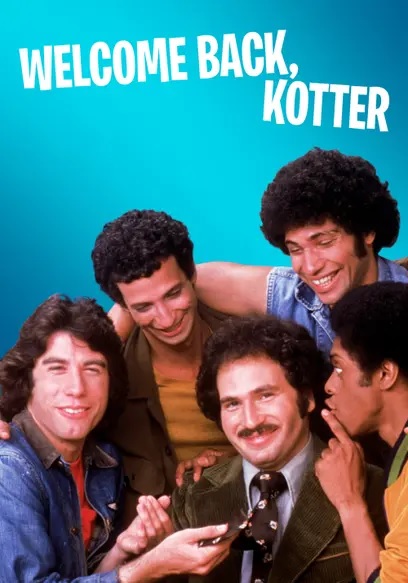
Welcome to Retro Television Reviews, a feature where we review some of our favorite and least favorite shows of the past! On Saturdays, I will be reviewing Welcome Back Kotter, which ran on ABC from 1975 to 1979. The entire show is currently streaming on Tubi!
This week, it’s Welcome Back, Rosalie!
Episode 3.24 “The Return of Hotsy Totsy”
(Dir by Bob Claver, originally aired on May 11th, 1978)
Using fakes IDs provided by Epstein, the Sweathogs go to a strip club and are shocked to see their former classmate from season one, Rosalie “Hotsy” Totsy (Debralee Scott), dancing on stage. Rosalie is not particularly happy to see them either, especially when Horshack keeps calling out her name and saying “hi” while she’s performing.
At first, almost all of the Sweathogs are very judgmental of their former classmate, never mind the fact that 1) she has a baby to support and 2) they were the ones who went through all the trouble of getting fake IDs so that they could illegally go to the club to the first place. Only Horshack refrains from judging Rosalie. Instead, he gets an extra job so that can give the money to Rosalie and her baby. Awwwwwww!
Fear not. Gabe eventually finds out that his former student has fallen on hard times and with the help of Woodman, he finds employment for her as a receptionist. That made me smile a little bit. Being a receptionist is harder than a lot of people realize but I have faith in Rosalie.
This episode deserves some credit for explaining what happened to Rosalie, who was a fairly prominent character during the first half of season one before disappearing without an explanation. I liked the fact that the episode was clearly on Rosalie’s side and not afraid to call out the Sweathogs on their misogyny. Debralee Scott gave a heartfelt performance as Rosalie, reminding us of how edgy Gabe’s students used to be.
At the same time, it’s hard not to feel this episode would have worked better during the second season, before the Sweathogs became caricatures and, even more importantly, when Robert Hegyes, Lawrence Hilton-Jacobs, and Ron Pallilo could still convincingly pass for being young enough to need fake IDs to get into a bar. (Travolta, who was the youngest of them all, was the only one who still made for a convincing teenager during season 3.) Watching this episode, it was hard not to regret how the show transformed Horshack from just being slightly eccentric to being someone who appeared to come from a totally separate planet. Ron Palllilo, it must be said, still managed to give a good performance in this episode but the character was still so broadly drawn that it was hard to believe that the Sweathogs would have invited him to the strip club to begin with. Still, his interactions with Rosalie were undeniably sweet. Horshack may be annoying but he’s a good person.
Interestingly, this episode was written by Gabe Kaplan. Perhaps that explains why Marcia Strassman’s Julie only gets a few seconds of screentime and only one line of dialogue.
Welcome to Retro Television Reviews, a feature where we review some of our favorite and least favorite shows of the past! On Saturdays, I will be reviewing Welcome Back Kotter, which ran on ABC from 1975 to 1979. The entire show is currently streaming on Tubi!
This week, Freddie wants to get married and Epstein loses his confidence.
Episode 1.7 “Classroom Marriage”
(Dir by Bob LoHendro, originally aired on October 21st, 1975)
In their cluttered little apartment, Julie is shocked to discover that Gabe is not only awake at midnight but that he’s also sitting out on the fire escape with a basketball. Gabe explains that he’s depressed. He knows that there’s something going on with the Sweathogs but none of them trust him enough to come to him. In a perfect example of “Be careful what you wish for,” the phone rings.
Julie answers the phone and tells Gabe, “It’s Boom Boom.”
“Boom Boom who?” Gabe replies.
Of course, it’s Freddie “Boom Boom” Washington. Freddie says that he and his girlfriend need Gabe’s advice and that they’re on their way over. No sooner has the call ended then someone knocks on the door. Julie answers it and Vinnie, wearing a trench coat, rushes into the apartment.
After explaining that he can’t afford to be seen talking to a teacher, Vinnie explains that Freddie is planning on getting married. Suddenly, someone else knocks on the door. Vinnie hides in the bathroom.
Rosalie Tosty (Debralee Scott) enters the apartment, wearing a trench coat because she doesn’t want anyone to see her talking to a teacher. She explains that Freddie is getting married. Someone knocks on the door. Rosalie says she’ll hide in the bathroom.
“Vinnie’s in there!” Julie says.
Rosalie smiles and says that’s fine before joining him.
Kotter opens the door and Epstein, wearing a trench coat and a fake mouth on the back of his head, enters the apartment. Epstein says that Freddie is getting married and Vinnie is driving everyone crazy with his attempts to talk Freddie out of it. Someone knocks on the door. Epstein hides in a closet.
Again, Kotter opens the door. Horseshack enters, wearing a gorilla mask. He explains that he’s fine with Freddie getting married because he thinks it’s very romantic. Someone knocks on the door. Horseshack ducks out the window and hides on the fire escape.
Once again, the door is opened. Freddie enters, accompanied by his girlfriend Vernajean (Vernee Watson). Freddie explains that they’re getting married because Vernajean’s father is moving to Staten Island and Freddie can’t stand the thought of her living in a different borough. Gabe attempts to talk them out of getting married by talking about how difficult it would be for them to even find someone in New York City to marry them. “I mean,” Gabe says, “you could lie about your age and go to Maryland but….”
Freddie smiles. “We could lie about our age and go to Maryland!” Freddie thanks Gabe for the advice and then leaves.
This whole sequence is an example of the first season of Welcome Back, Kotter at its best. Yes, it’s very busy and frantic but the entire cast shows off perfect comedic timing, from John Travolta and Debralee Scott to Robert Hegyes and Ron Palillo. Robert Hegyes is especially funny as he captures Epstein’s mix of earnest eccentricity. And, to top it all off, the expression of Gabe’s face when he realizes that he’s accidentally convinced Freddie to get married is simply priceless.
Fear not. The next day in class, Gabe has Freddie and Vernajean do an exercise where they pretend to be married. They’re able to handle having Horseshack as their son but the pretend marriage pretty much falls apart as soon as Gabe shows up and demands that they pay him the rent. In the end, Freddie admits that he only asked Vernajean to marry him because he was afraid that she would forget about him after she moved to Staten Island. Vernajean assures him that could never happen. Awwwwww!
This was a sweet and funny episode. When Gabe ended the episode with a corny joke about his astronaut uncle, Buzz Kotter, you couldn’t help but feel that Gabe had earned the right to make his little joke. He did a good job.
Episode 1.8 “One Of Our Sweathogs Is Missing”
(Dir by Bob LoHendro, originally aired on October 28th, 1975)
Gabe tells Julie a rather macabre joke about his uncle who is marrying his fourth wife. Julie asks about the other three wives. Gabe explains that the first and second wives died from eating poisoned mushrooms and the third died from a fractured skull “because she wouldn’t eat the poisoned mushrooms.” Yikes! It’s hard not to feel that Gabe was warning Julie about rolling her eyes at any more of his jokes.
Meanwhile, at the school, the Sweathogs are excited when Todd Ludlow (Dennis Bowen) challenges Epstein to a fight. However, they are shocked when Epstein — voted most likely to take a life — is easily beaten by Ludlow. After Vinnie, Freddie, and Horseshack have a good laugh over Epstein and his black eye, Epstein runs off and disappears for three days.
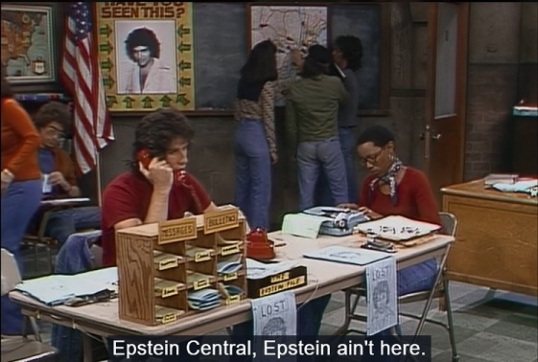
Feeling guilty, Barbarino sets up Epstein Central in the classroom:
Mr. Woodman comes by, searching for his red phone. When the phone rings, Woodman insists on answer it himself.
It turns out that Julie is calling for Gabe, in order to tell him that Epstein has shown up at their apartment and locked himself in the bathroom. While Gabe heads home, Julie asks Epstein if he wants anything to drink. Epstein replies that he’s not worthy of anything good to drink but he would happily accept a flat and warm beverage.
Fortunately, Gabe shows up. Epstein agrees to come out of the bathroom as long as Gabe promises not to look at him. While Gabe stares at the lamp, Epstein explains that he only came by the apartment to say goodbye. He feels that his fearsome reputation was the only thing that Epstein had going for him. (Awwwww! Poor Epstein!) Gabe finally looks away from the lamp and tells Epstein that he’s a smart and energetic young man with a lot of potential. Seriously, this scene was so achingly sincere and well-acted by Gabe Kaplan and Robert Hegyes that it was impossible not to be touched by it.
Anyway, it all works out in the end. The other Sweathogs show up on Gabe’s fire escape and they declare their friendship for Epstein. Epstein agrees not to run away. He calls home and tells his mother that he’s okay. His mother tells him to have dinner with the Kotters because his family has already eaten that day. The audience laughs but that’s actually one of the saddest things I’ve ever heard.
With everything resolved, Gabe tells Julie a story about his Uncle Bernie, who never took a bath.
Like the one that preceded it, this was a funny and surprisingly sweet episode. Welcome Back, Kotter is turning out to be a lot better than I was expecting.
Welcome to Retro Television Reviews, a feature where we review some of our favorite and least favorite shows of the past! On Saturdays, I will be reviewing Welcome Back Kotter, which ran on ABC from 1975 to 1979. The entire show is currently streaming on Tubi!
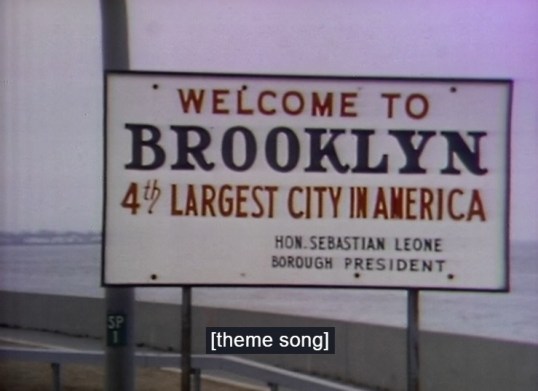
Well, let’s check in with Brooklyn….
Episode 1.3 “Welcome Back”
(Dir by James Komack, originally aired on September 23rd, 1975)
“I remember my first day….” Gabe Kotter narrates as the viewer watches him and Mr. Woodman walk down the distressingly dirty hallways of James Buchanan High.
It’s a flashback episode! Well, kind of. The third episode of Welcome Back, Kotter was actually the show’s pilot. As Kotter’s voice-over only makes one appearance at the start of the episode, it’s pretty obvious that it was a last minute addition to explain why the third episode featured Kotter meeting the Sweathogs for the first time. Apparently, the folks at ABC felt that The Great Debate episode worked better as an introduction to the show than the pilot. I’m not sure why, as the pilot does a perfectly serviceable job of introducing everyone.
Kotter is not particularly enthused about returning to the high school from which he graduated ten years prior. Mr. Woodman isn’t happy to see Kotter again, either. As they walk down the hallway, Mr. Woodman is still accusing Kotter of having started a food fight in the cafeteria. (Woodman insists that it was a riot.) Woodman says that since he doesn’t have any choice about Kotter being assigned to his school, he’s going to assign Kotter to teach the worst kids in school, the Sweathogs!
Entering his classroom, Kotter asks the students to introduce themselves. Not surprisingly, only four of them actually do so. Vinnie Barbarino stands up and shows off the smile that made John Travolta a superstar. Epstein is introduced as being the student who is “most likely to off someone.” Epstein explains how his ancestors were the first Epsteins to land in Puerto Rico. Freddie says, “Hi there.” And Horseshack laughs in that grating way of his. Kotter attempts to teach his class by allowing them to sit wherever they want and then engaging in a game of the Dozens with Barbarino.
“Up your nose with a rubber hose,” Barbarino says and the audience goes crazy.
Kotter insults Barbarino’s family.
“Off my case, Toilet Face,” Barbarino replies and the audience goes crazy, again.
Kotter starts to mention Barbarino’s mother.
“My mother is a saint!” Barbarino explodes.
Woodman suddenly shows up in the classroom. When he demands to know what Kotter is doing, Kotter looks to his class to back him up. When none of them do, Kotter decides to quit his teaching job.
Oh hey, I guess the show is over, right?
No, it’s not. Later, back at the apartment that he shares with Julie, Kotter is shocked when Barbarino and Freddie crawl through the window. He’s even more surprised when Epstein, Horseshack, and Rosalie Totsie (Debralee Scott) show up at the front door. Epstein explains that they stole a cab so they could visit Kotter’s apartment. They want to see how “the original Sweathog” turned out. Though Kotter pretends like he isn’t happy to see them, it soon becomes apparent that he knows he’s right where he belongs. Plus, Julie likes them because …. well, I’m not sure why. To be honest with you, if I was in her situation, I wouldn’t like for my husband’s students to come climbing in through the apartment window. That would be a deal-breaker for me. Freddie and Barbarino do attempt to steal Kotter’s TV but Horseshack returns it. Awwww!
And Kotter returns to the classroom. Yay!
As far as pilots go, it’s easy to see why this one was a success. John Travolta’s smile could light up a room. Actually, all of the actors playing the Sweathogs do a good job in this episode. Travolta dominates because he’s Travolta but the entire cast has a nice comedic chemistry. At the end of the episode, Kotter says, “Welcome back,” to himself and he sincerely seems happy to be there. He’s made peace with being a Sweathog forever.
Episode 1.4 “Whodunit?”
(Dir by Robert LaHendro, originally aired on September 30th, 1975)
In their tiny apartment, Gabe tells Julie a joke about his aunt’s parrot and a dead butcher.
Meanwhile, at the school, Gabe sees Rosalie Totsy (nicknamed “Hotsy” by the Sweathogs) crying in the hallway. After a game of charades, Gabe figures out that Rosalie is pregnant! Who could the father be!? Sebastian Leone, perhaps?
No, according to Rosalie, the father was a Sweathog. Or, as Gabe calls them, the Marx Brothers….
This leads to a rather sweet scene in which Horseshack goes down on one knee and offers to marry Rosalie, even though he knows he’s not the father. He says that he wants to give her baby a good name and that Horseshack means “The cattle are dying.” Though touched by his sincerity, Rosalie turns him down. Gabe then invites Rosalie to come to his apartment so that she can talk to Julie. I’m not really sure if it’s a good idea for any teacher to invite a student to come to their apartment but whatever.
The important thing is that it leads to Rosalie demanding that the father of her baby marry her. All the Sweathogs are forced to admit that, despite all of their boasting, none of them have actually had sex with Rosalie. Rosalie then announces that she was lying about being pregnant. She just wanted to get all of the Sweathogs to go on record that she wasn’t a slut. “I ain’t easy!” Rosalie explains.
And …. yes, that’s one way to do that, I guess. I mean, I could understand where Rosalie was coming from because I went through the same thing when I was in high school. But I would have been happier if the episode had ended with a message that it really wasn’t anyone’s business whether Rosalie was having sex or not. Instead, the audience specifically applauded Rosalie for not being a slut, which felt just as judgmental as the audience previously laughing at the idea that she was. I kept waiting for someone to point out just how ridiculous it was that Rosalie had to pretend to be pregnant to get the Sweathogs to stop talking about her behind her back but apparently, that didn’t occur to anyone in the writer’s room.
After everything’s been resolved and Gabe is back home, Julie interrupts Gabe’s comic book time to tell him that maybe they should start a family. Gabe’s like, “Hell no!” He then says that Julie is all the family he needs at this point in his life. “I love you, honey,” Julie swoons. “Good,” Gabe says, “Tomorrow, call my mother and explain to her why you’re not pregnant.” The audiences applauds and Julie beats up on Gabe.
I wasn’t a huge fan of this episode but I’ll give credit to Ron Pallilo. That proposal scene was really sweet and nicely performed.
Next week: Barbarino enters politics! Sebastian Leone better watch out!
Welcome to Retro Television Reviews, a feature where we review some of our favorite and least favorite shows of the past! On Saturdays, I will be reviewing Welcome Back Kotter, which ran on ABC from 1975 to 1979. The entire show is currently streaming on Tubi!
Well, I don’t have anyone but myself to blame.
Ever since I started doing these retro television reviews, people have been suggesting that I should review an old 70s sitcom called Welcome Back, Kotter. I only knew a few things about Welcome Back, Kotter. I knew that it was the show that made John Travolta a star. I knew that it was Marcia’s favorite show on The Brady Bunch Hour. I knew that Gabe Kaplan played Gabe Kotter, a teacher who returned to his old Brooklyn neighborhood to teach a bunch of students known as the “Sweathogs.” (Bleh! What an unappealing nickname.) It didn’t sound like something I wanted to watch but, being the polite person that I am, I always said, “If it’s ever streaming somewhere, I will.” The unspoken assumption, of course, was that the show would never be streaming anywhere.
Then, one day, I looked at Tubi and….
Again, I have no one to blame but myself.
As for the show, it was based on the stand-up routines of its star, Gabe Kaplan. It followed former Sweathog Gabe Kotter (played, of course, by Kaplan) as he tried to teach a new generation of Sweathogs at James Buchanan High in Brooklyn. Gabe was married to Julie (Marica Strassman). They lived in a small Brooklyn apartment and Gabe was constantly forcing his wife to listen to corny jokes about his family. At the school, Gabe’s principal was Mr. Woodman (John Sylvester White), a former history teacher who disliked the Sweathogs.
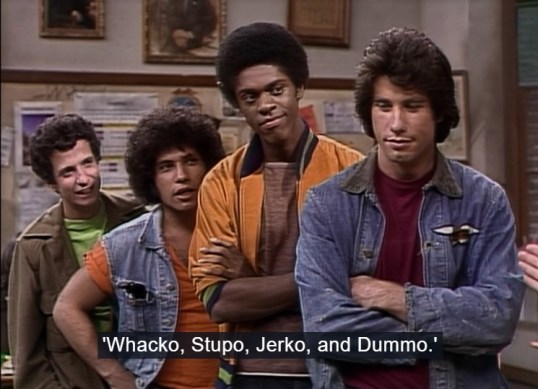
As for the Sweathogs themselves, there were several but only four were really important.
Vinnie Barbarino (John Travolta) was the handsome but dumb one.
Freddie Washington (Lawrence Hilton-Jacobs) was the cool basketball player who would often say, “Hi, there” in a very deep voice.
Juan Epstein (Robert Hegyes) was the one most likely to kill someone.
Arnold Horseshack (Ron Pallilo) was the nerdy one with the high-pitched voice. In Kaplan’s original stand-up routine, his nickname was Arnold Horseshit but I doubt that was ever mentioned on the show.
And, of course, there was the theme song. Welcome Back, Kotter was written and performed by John Sebastian, whose previous claim to fame was appearing on the stage at Woodstock while stoned out of his mind.
Okay, let’s do this thing.
Episode 1.1 “The Great Debate”
(Dir by Bob LaHendro, originally aired on September 9th, 1975)
The very first episode of Welcome Back, Kotter opens with teacher Gabe Kotter (Gabe Kaplan) making out with his wife, Julie (Marcia Strassman), on the couch in their little Brooklyn apartment. Kotter suddenly stops kissing his wife so that he can tell her a joke about the time his uncle slept in the same bed as his secretary and told her that if she wanted to be “Mrs. Kotter for the night,” then she should get out of bed and close the bedroom window herself. Julie laughs. Personally, if my romantic partner stopped kissing me specifically so he could tell an adultery joke, I don’t know if I would laugh. I’d probably be more like, “What are you trying to tell me with that?”
Fortunately, the theme song starts up and rescues the audience from that awkward moment.
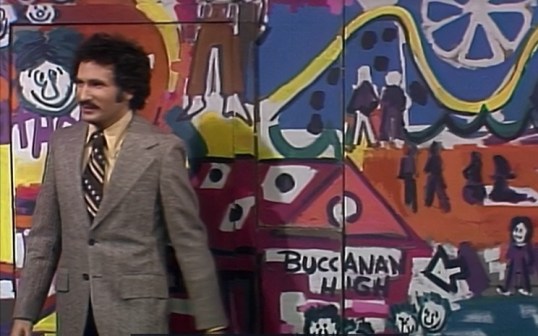
The next day, Gabe goes to work at James Buchanan High School. He teaches the remedial class, which is populated by underachieving students who have been nicknamed “the Sweathogs.” Gabe discovers that the Sweathogs have painted a rather garish mural on the wall of the classroom.
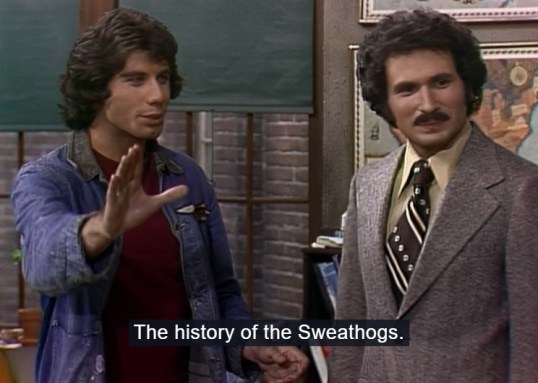
Vinne Barbarino (John Travolta) gets up and explains what the mural’s about.
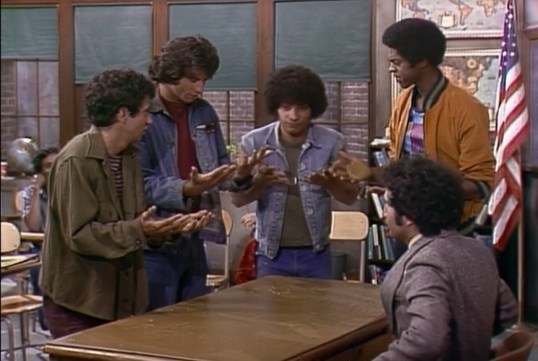
Gabe is impressed by the fact that young John Travolta is a hundred times better looking and charismatic than anyone else in the school. But Gabe still insists that the Sweathogs wash off the mural. The Sweathogs agree, before revealing that they also painted the top of Gabe’s desk.
In the teacher’s lounge, Alex (James Woods) makes fun of Gabe’s stupid students. Gabe make fun of Alex for writing plays with names like “Fiddler On My Sister.” Alex says that his debate class can defeat Gabe’s class. Gabe accepts the challenge and….
Wait a minute! JAMES WOODS!?
Yes, that is indeed a youngish James Woods playing Alex, the school’s pretentious drama teacher. Woods is okay in the role. There’s not a whole lot to be done with the character as he’s pretty much just an uptight strawman who is there to be humiliated by Kotter and his class.
As for the debate itself, the resolution is that “Humans are naturally aggressive.” Alex’s class argues in the negative while Kotter’s class argues in the positive. Alex’s class is uptight and wears sweaters. The Sweathogs show up in garish costumes. With the help of Epstein (Robert Hegyes), Barbarino argues that Jack the Ripper and Atilla the Hun prove that people are naturally aggressive. When Mr, Woodman (John Sylvester White), who is moderating the debate, says that they need a timekeeper, Sweathog Arnold Horschack (Ron Pallilo) enthusiastically volunteers.
“Can he tell time, Mr. Kotter?” a flustered Woodman asks and I’ll admit that I did laugh. John Sylvester White delivered the line perfectly.
Sweathog Freddie Washington (Lawrence Hilton-Jacobs) then makes his case but, because his only experience with public speaking is in church, he gives a sermon. “He isn’t following the rules!” one of Alex’s students shouts.
While Alex’s star debater makes his case, the Sweathogs heckle him so aggressively that the student has a nervous breakdown and starts screaming, “SHUT UP!” at them. As Kotter points out, this proves that humans are naturally aggressive. Woodman announces that “This debate is called on account of dumbness.”
Back at the apartment, Gabe tells Julie a joke about Larry and his pet toad.
I have to admit that I enjoyed this episode quite a bit more than I was expecting to. Lawrence Hilton-Jacobs, John Travolta, Ron Pallilo, and Robert Hegyes had a lot of comedic chemistry as the main Sweathogs and Gabe Kaplan did a good job of projecting a much needed sincerity in the role of Mr. Kotter. He seemed to truly care about his students. This was definitely a good episode to start the series off with.
Episode 1.2 “Basket Case”
(Dir by Bob LaHendro, originally aired on September 16th, 1975)
At the apartment, Gabe tells Julie a joke about how his childhood bully beat up his father.
At school, it’s time for the Sweathogs to take a history exam. Barbarino has all the answers written on his arm but, fortunately, Gabe shows up with water and a paper towel. Horseshack tries to distribute the tests in another classroom but Gabe stops him. Epstein shows up with a note excusing him from the exam because of his bursitis but Gabe tosses the note away as soon as he notices that it is signed “Epstein’s Mother.” Freddie, meanwhile, doesn’t think that grades matter because he’s made the basketball team. In fact, he draws a picture of himself as “Stilt Man” on his test paper.
When Gabe fails Freddy, the basketball coach and Mr. Woodman ask him to reconsider. The Sweathogs ask him to reconsider. And Freddie tells Kotter that he’s not going to take a makeup exam. Kotter challenges Freddie to a basketball game. If Freddie win, he passes. If Kotter, who was basketball star in high school, wins, Freddie retakes the test. Freddie agrees and….
Well, it turns out that a game between a middle-aged, out-of-shape teacher and a high school star athlete goes about as well as you might expect. We don’t see the game but we do see Mr. Woodman and the basketball coach carrying a delirious Kotter into the teacher’s lounge. Freddie apparently destroyed Kotter on the court but he’s so impressed by Kotter’s determination that he agrees to retake the test anyway.
Back at the apartment, Kotter tells Julie a joke about why he never wears hats. Apparently, he felt his head was too big. Poor guy.
Again, this was not a bad episode. I was worried that Kotter would somehow beat Freddie at basketball while the audience went wild but, instead, the episode got laughs by being honest. There was no way Gabe was going to win that game. Interestingly enough, this episode was as much about Gabe dealing with the fact that he was getting older than it was about getting Freddie to take his grades seriously. Lawrence Hilton-Jacobs was particularly strong in this episode. It may have been a comedy but Lawrence Hilton-Jacobs played it like a drama and, as a result, the stakes felt real.
So, the first two episodes of Welcome Back Kotter took me by surprise. Will the rest of the show be this good? We’ll find out over the weeks to come!
Welcome to Retro Television Reviews, a feature where we review some of our favorite and least favorite shows of the past! On Wednesdays, I will be reviewing the original Love Boat, which aired on ABC from 1977 to 1986! The series can be streamed on Paramount Plus!
Beware the Inspector! Read on and find out more about this week’s cruise of the Pacific Princess….
Episode 1.19 “A Very Special Girl / Until the Last Goodbye / The Inspector”
(Dir by Roger Duchovny, originally aired on February 11th, 1978)
Captain Stubing starts the cruise by giving the crew some potentially frightening news. The company has sent an inspector to take the cruise and observe how everyone is doing their job. The catch is that the inspector is disguised as a passenger and the crew now has to figure out who it could be!
Marvin Waterman (Jim Backus) seems like a good suspect. He’s stuffy. He always wears a suit. He carries around a notepad. He’s always asking questions about the ship. It must be Marvin! Nope, sorry. It turns out that Marvin is just a children’s book author and he’s doing research.
Could it be eccentric Mrs. Corwin (played by Gavin MacLeod’s wife, Patti MacLeod)? She acts like she’s spacey and not always sure where she is but maybe that’s just a cover! She does make a lot of calls back to the mainland! Nope, it’s not Mrs. Corwin. It turns out that she’s just an eccentric widow who likes to call her daughter and let her know what’s going on in her life. Fortunately, Mrs. Corwin meets and inspires Marvin and they fall in love. Unfortunately, that doesn’t bring the crew any closer to finding the inspector.
Surprise! The inspector wasn’t actually on the ship. He arrived late and wasn’t able to board. However, his father (Jack Bernardi) did get on board and he spend the entire cruise wandering about and asking people questions in Russian. As far as I could tell, none of the crew made much of an effort to help the confused old man out so I’m guessing they’re all out of a job now. I wonder what next week’s episode will be like….
While the crew was looking for the inspector, Mike Andrews (Bob Seagren) was looking for Melanie Taylor (Laurette Sprang). Mike arranged for his goofy sidekick, Doug (Sal Viscuso), to spend all of his time with Melanie’s best friend, Jane (Debralee Scott). Fortunately, Doug and Jane fell in love. Meanwhile, Mike abandoned Melanie as soon as the cruise ended. Booooooo!
Finally, the crew was fascinated by an older man (Paul Burke) who was traveling with a younger woman (Susan Blanchard). For the majority of the episode, everyone assumed the man and the woman were lovers. But then the man collapsed and it turned out that he was the woman’s father and he also terminally ill. This cruise was their long goodbye. This was a sweet story, even if it was kind of icky that everyone assumed that the father was carrying on an affair with his daughter. But, really, that mistaken assumption is the fault of the crew. I’m surprised they didn’t mistake the older man for being the Inspector.
Anyway, this was a fairly typical episode of The Love Boat. It got the job done with a minimum of complications and, if nothing else, it looked like a fun vacation. The Love Boat always works best as wish-fulfillment. It’s the type of show you watch and think, “What would I do if I was on that cruise?” I enjoyed this episode. The whole thing with the inspector was silly but the other two stories were well-handled. I hope things worked out for Doug and Jane!
Police Academy 3 opens with a state in the middle of a fiscal crisis. Money has to be saved somewhere and the governor (Ed Nelson) has decided that it’s not necessary for the state to have two police academies. I am not sure why the governor would be the one to make that determination since the previous two Police Academy films established that the academies are run by the city but I guess I should remember that I’m watching a Police Academy film and not ask too many questions.
Which academy is going to be closed down? Will it be the academy run by Commandant Lassard (George Gaynes) or the one run by Commandant Mauser (Art Metrano, returning from the second film)? Mauser is willing to use any dirty, under-handed trick to keep his academy open. Meanwhile, Lassard has his most recent graduating class returning to instruct his latest batch of recruits. Can Mahoney (Steve Guttenberg) and Michael Winslow’s human sound effects machine save the academy?
When I watched Police Academy 3 this weekend, I was surprised to discover that it wasn’t as bad as I remembered. Maybe it’s because I watched it immediately after the first two films and my senses were dulled but Police Academy 3 turned out to be an amiable and enjoyably stupid comedy. It helped that two of the new recruits were played by Tim Kazurinsky and Bobcat Goldthwait. Returning to the roles that they first played in the second movie, Kazurinsky and Goldthwait make for a good comedic team. As for the rest of the Police Academy regulars, they all do their usual comedy bits like pros and without any fuss. It’s predictable and sometimes, funny.
Police Academy 3 was the first Police Academy film to have a PG-rating and, as a result, the jokes were still as juvenile and crude as the first two movies but, at the same time, Police Academy 3 seems to have made peace with the fact that it’s target audience was a bunch of adolescent boys dropped off at the theater by their mothers. Mauser is still regularly humiliated but no one gets a blow job while standing in front of a podium. This is a Police Academy for the entire family, assuming that your family is easily amused and not too demanding.
Police Academy 3 is a dumb movie and the recurring joke about policemen accidentally entering the Blue Oyster Bar is even less funny the third time that it’s used. There’s also a Japanese recruit who only seems to be included because, back in the 80s, American films were obsessed with making fun of Japan. Despite all that, Police Academy 3 is still not as bad as the usual Police Academy sequel.
But what about Police Academy 4? Check in tomorrow to find out if it’s also better than I initially remembered.
God help us, it has come to this. After a month and a half being locked down, Lisa and I watched the first two Police Academy movies last night.
The first Police Academy takes place in an unnamed city that appears to be in California. Due to a shortage of officers, the mayor has announced that the police academy will now accept anyone who wants to apply, regardless of their physical or mental condition. Naturally, this leads to a collection of misfits applying. Martinet Lt. Harris (G.W. Bailey) is determined to force all of them to drop out of the academy and he has a point because I wouldn’t trust Michael Winslow’s human sound effects guy to investigate any crimes that were committed in my neighborhood. What’s he going to do? Make silly noises while I’m trying to figure out who stole my car?
The leader of the recruits is Carey Mahoney (Steve Guttenberg). Mahoney is being forced to attend the academy because otherwise, he’ll have to go to jail for disturbing the peace. Police Academy is a film that asks you to believe that a character played by Steve Guttenberg has not only frequently been in trouble with the law but would also make a good cop. Guttenberg doesn’t really do a bad job as Mahoney. He’s a likable actor, even if his filmography has more duds than hits. But he’s still miscast in a role that demands someone like Bill Murray, who could be both tough and funny.
The other recruits include Bubba Smith as Hightower and David Graf as the insane gun nut, Tackleberry. Kim Cattrall is the rich girl who wants to be a cop and who falls in love with Mahoney. George Gaynes is Commandant Lassard, who is out-of-it but not as out-of-it as he would be in the sequels.
You have to wonder how many parents, in the late 80s and early 90s, allowed their children to rent the R-rated Police Academy from the local video store without realizing the the first Police Academy is considerably more raunchy than the later sequels. How did mom and dad react when they walked into the room and discovered their children watching Georgina Spelvin giving George Gaynes a blow job from underneath a podium? Or how about the scene where recruit George Martin (Andrew Rubin) is spied having a threesome in the girl’s dorm? The first Police Academy film is definitely made from the same mold as Animal House, Caddyshack, and Stripes. It’s just not as funny as any of those films.
However, it is funnier than every Police Academy film that followed it. There’s enough solid laughs to make the first Police Academy fun in a stupid way. For instance, just about every scene involving accident-prone Cadet Fackler (Bruce Mahler) was funny. Bubba Smith gets a lot of laughs just by being Bubba Smith in a stupid movie. It’s also hard not to love it when Cadet Hooks (Marion Ramsey) yelled, “Don’t move, Dirtbag!” Hell, I even laughed at the sound effects guy once or twice.
All of the Police Academy films are now on Netflix. Tomorrow, we’ll take a look at Police Academy 2: Their First Assignment.
Well, this is certainly intimidating. I know I’ve said this many time before but it deserves to be repeated: it’s often a hundred times more difficult to review a great film than it is to review a merely mediocre one. When a film fails, it’s usually easy to say why. The acting was bad. The directing was uninspired. The plot didn’t make any sense. Or maybe the film has been so overpraised that you, as a reviewer, are almost obligated to be tougher on it than you would be with any other film. However, it’s never as easy to put into words just what exactlyit is that makes a movie great.
Take the 1973 Best Picture nominee American Graffiti for instance. I could tell you that this is a very well-acted film and that it features an ensemble of very likable performers, many of whom subsequently went on to become stars and celebrated character actors. Then again, you can say the same thing about countless other films.
I could say that director George Lucas does such a good job putting this film together that it’s hard to believe that he’s the same man who would later be responsible for all three of the Star Wars prequels. Then again, I could also say the same thing about how odd it is that the same man who directed the entertaining Final Destination 5was also responsible for the far less enthralling Into The Storm.
I could tell you that the film serves as a valuable time capsule in that not only does it feature a loving recreation of small town America in the early 60s but that it’s also a chance to see what Richard Dreyfuss, Ron Howard, and Charles Martin Smith all looked like when they still had hair. But then again, I also praised The Young Graduates for being a time capsule as well.
Let’s face it — it’s difficult to define the intangible qualities that make a film great. Often times, it’s a case of simply knowing it when you see it. I’ve seen American Graffiti a few times. The last time I saw it was at a special Sunday showing at the Alamo Drafthouse. And, on that early Sunday afternoon, the theater was packed with people who had paid for the chance to see the 40 year-old film on the big screen. I’m 28 years old and it’s significant that, while the majority of the audience was older than me, there were quite a few people who were younger. American Graffiti is one of those films that obviously spoke to audiences when it was first released and continues to speak to audiences today.
As I mentioned in my review of Rebel Without A Cause, films about teens tend to age quickly and, often times, one generation’s masterpiece will turn out to be a later generation’s joke. When a film like Rebel or American Graffiti survives the test of time, it’s because the film has managed to capture a universal truth about what it means to be young and to have your entire life ahead of you.
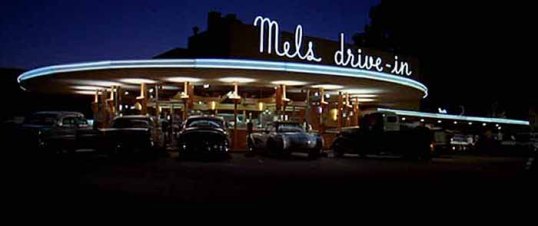
American Graffiti takes place over the course of one long night in Modesto, California in 1962. The film follows several different characters, the majority of whom have just graduated from high school. What these characters all have in common is that one phase of their life has ended and a new one is about to begin. Over the course of that one night, all of them are forced to say goodbye to their past identities and, in some instances, are forced to face their future.
For instance, there’s Curt (an amazingly young Richard Dreyfuss), a neurotic intellectual who spends the night trying to decide whether or not he actually wants to leave for college in the morning. Complicating Curt’s decision is a mysterious blonde who mouths “I love you” at him before driving away. While searching for her, Curt finds himself unwillingly recruited into the Pharoahs, a somewhat ludicrous small town gang that’s led by Joe (played, in hilariously clueless fashion, by Bo Hopkins.) Curt, incidentally, is my favorite character in the film. He’s just adorable, which admittedly is not a reaction that one often has to Richard Dreyfuss.
(Curt is also featured in one of my favorite scenes, in which he smokes a cigarette with a lecherous teacher named Mr. Wolf.)
Curt’s sister (Cindy Williams) is dating Steve Bolander (Ron Howard). Steve is the former class president and, unlike Curt, he’s very excited about leaving home. Ron Howard gives such a likable performance that it actually takes a few viewing to realize just how big of a jerk Steve really is.
And then there Terry (Charles Martin Smith) who wears big glasses and has bad skin. Terry gets to spend the night driving around in Steve’s car and manages to pick up a girl named Debbie (Candy Clark). For Terry, this is his night to actually be somebody and what makes it all the more poignant is just how obvious it is that Terry will probably never get another chance. Though he may not realize it, those of us watching understand that this is literally going to the be the best night of Terry’s life.
(Incidentally, much like Ron Howard, Charles Martin Smith would go on to become a film director and gave the world the amazingly sweet Dolphin Tale.)
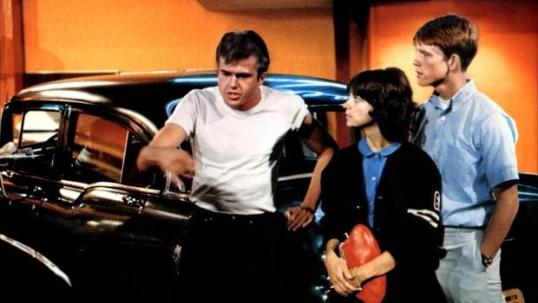
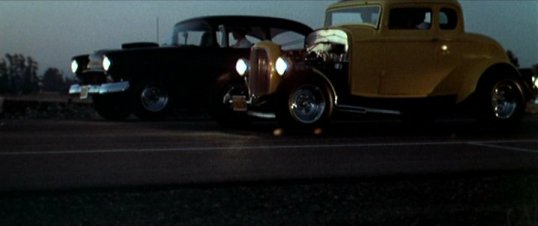
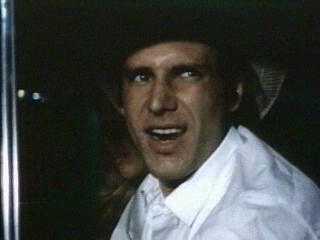
And finally, there’s John Milner (Paul Le Mat). John is a little older than the other main characters. He spends most of his time in his car, driving around and getting challenged to race. He’s the epitome of late 50s/early 60s cool, with an attitude and a look that he obviously borrowed from James Dean and Marlon Brando. Over the course of the night, he is forced to deal with a bratty 13 year-old stowaway (MacKenzie Phillips) and a mysterious challenger named Bob Falfa (played by a youngish Harrison Ford, who wears a cowboy hat and speaks with a country twang).
The film follows these characters through the night and then, at the end of it, we get the famous epilogue where we discover that all of the male characters have pretty much ended up exactly how we thought they would. In some cases, that’s a good thing. And in other cases, it’s not. It’s a good ending that’s kept from being great by the fact that none of the film’s female characters rate so much as even a mention.
So, what else can be said about American Graffiti?







 Through the Shattered Lens