Retro Television Review: Miami Vice 5.2 “Redemption In Blood”


Welcome to Retro Television Reviews, a feature where we review some of our favorite and least favorite shows of the past!  On Mondays, I will be reviewing Miami Vice, which ran on NBC from 1984 to 1989.  The entire show can be purchased on Prime!

This week, Sonny Burnett continues his reign of terror!

Episode 5.2 “Redemption in Blood”

(DIr by Paul Krasny, originally aired on November 11th, 1988)

When last we checked in with Miami Vice, Sonny thought he was a drug lord named Sonny Burnett and he was firing his gun at Tubbs, who he had just recognized as a cop.  This episode reveals that Sonny didn’t shoot Tubbs.  Instead, he aimed at a wall, firing while Tubbs made his escape.

Working with the psychotic Cliff King (Matt Frewer), Sonny takes over his late boss’s drug empire and continue to fight a war against El Gato (Jon Polito).  El Gato is meant to be a “flamboyant” drug dealer, which is a polite way of saying that Polito overacts through the entire episode.

The show hedges its bets by having Cliff commit all of the murders while Sonny rises to power.  In fact, when Sonny catches Cliff torturing two of El Gato’s men, Sonny orders Cliff to stop and then offers them jobs in the Burnett operation.  Amazingly, over the course of the entire three-episode Burnett arc, Sonny manages to get through the whole thing only killing people in self-defense.  Even the cop that he killed at the end of the previous season was a dirty cop who had been sent to kill him.  I get that the show couldn’t take Sonny totally over to the dark side but it’s still hard to believe that Burnett took over the Miami underworld without getting his hands a bit more dirty than he did.

A car bomb (courtesy of El Gato) knocks Sonny unconscious and, when he wakes up, he suddenly starts to remember who he actually is.  Finally realizing that his name is Crockett, Sonny turns himself into the Vice Squad and is promptly arrested while Kate Bush sings, “Don’t give up.”  Sonny tells Castillo, Switek, and Tubbs that he’s ready to acccept the consequences of whatever he did during his previous bout of amnesia.  But then Sonny escapes custody and sets up both Cliff and El Gato for a great fall so I guess he wasn’t totally ready to turn himself in and head off to prison.

Tubbs, who now trusts Sonny, helps him take out Cliff King and the Burnett organization.  Sonny shoots Cliff to save Tubbs.  With Tubbs dangling off of a walkway, Sonny pulls him back up to safety.  Sonny then goes back to his mansion where he and his girlfriend (Debra Feuer) are taking hostage by a gun-wielding El Gato.  “Where is the safe?” El Gato demands.  Sonny tricks El Gato into thinking the safe is in the room where he keeps his pet panther.  (Apparently, all drug lords were given either a tiger, a panther, a cheetah, or a leopard.)  El Gato gets mauled to death as the episode ends.

This episode suggests that Sonny is going to be let off the hook because he finally remembered he was.  I don’t really think that it would really work like that.  Sonny has multiple warrants out and he also killed a cop, albeit a corrupt one.  If Sonny isn’t on trial in next week’s episode, I’m going to be a little annoyed.

This episode ended the Burnett trilogy about as well as it could be ended.  The idea that all Sonny needed was to survive a second near-fatal explosion made me smile.  What if El Gato hadn’t tried to blow him up?  I guess it’s a good thing that he did!  While Polito went overboard, Matt Frewer gave a very good performance as the villainous Cliff King.  It’s a bit of a shame that he died so dramatically because Cliff would have made a good recurring villain.

This episode was definitely better than anything from season 4.  It’ll be interesting to see how the rest of season 5 plays out.
Retro Television Review: Miami Vice 5.1 “Hostile Takeover”


Welcome to Retro Television Reviews, a feature where we review some of our favorite and least favorite shows of the past!  On Mondays, I will be reviewing Miami Vice, which ran on NBC from 1984 to 1989.  The entire show can be purchased on Prime!

This week, we start the fifth and final season of Miami Vice.

Episode 5.1 “Hostile Takeover”

(Dir by Don Johnson, originally aired on November 4th, 1988)

The fifth and final season of Miami Vice gets off to a good start with this episode.  After opening with some appropriately glitzy scenes of the drug-fueled Miami nightlife, the episode then shows us that Sonny Crockett is still convinced that he’s Sonny Burnett.  He has now returned to Miami and, along with Cliff King (Matt Frewer), he is one of the key advisors to drug lord Oscar Carrera (Joe Santos).

Carrera is at war with El Gato (Jon Polito), the brother of Sonny Burnett’s former employer, Miguel Manolo.  El Gato, who wears gold lamé, cries over the body of one of his henchmen, and flinches when forced to deal with direct sunlight, is a flamboyant figure.  In fact, he’s so flamboyant that it’s initially easy to overlook how determined he is to get revenge for the death of his brother.  That means taking down the Carreras family and Sonny Burnett as well.

The Vice Squad knows that Sonny is moving up in the drug underworld but Castillo is firm when asked what they should do about it.  Sonny has an active warrant out for murdering a corrupt cop.  “Sonny’s not Sonny anymore,” Tubbs says at one point and Castillo seems to agree.

Tubbs goes undercover, making contact with the Carreras cartel.  When Sonny meets Tubbs, Tubbs introduces himself as “Ricardo Cooper” and starts speaking in his terribly unconvincing Jamaican accent and that was when I said, “Miami Vice is back!”  Sonny doesn’t trust Cooper from the start.  “Maybe you’re a cop,” Sonny says.  “Not I, mon,” Tubbs replies.

People are dying and, while Sonny doesn’t have a problem with that, the show is also careful to show that Sonny only shoots in self-defense.  (It appears the most of the cold-blooded murders are farmed out to Cliff King.)  When Oscar Carreras dies, it’s because his poofy-haired son (Anthony Crivello) accidentally shot him when Oscar discovered him with his stepmother.  When the son dies, it’s because he was about to shoot Sonny after he caught Sonny with …. his stepmother, again.  The Carreras family is so dysfunctional that it shouldn’t come as a surprise that Sonny steps up to take it over.

After promising Castillo that he’ll take out Sonny if necessary, Tubbs meets up with Sonny at beach-side tower.  Tubbs looks at Sonny and suddenly says, “Sonny, it’s me, Rico.”  Sonny stare at Tubbs.  “Do you remember me?” Tubbs asks.

“Sure,” Sonny suddenly says, “You’re Tubbs.”

Three gunshots ring out as the episode ends.

OH MY GOD, DID SONNY KILLS TUBBS!?

We’ll find out next week.  For now, I’ll say that — after a disappointing fourth season — this was exactly how Miami Vice needed to start things off for Season 5.  Seriously, if you’re going to have Sonny get hit with amnesia, you might as well just go for it and take things to their logical extreme.

Next week …. is Tubbs dead?  I hope not, mon.


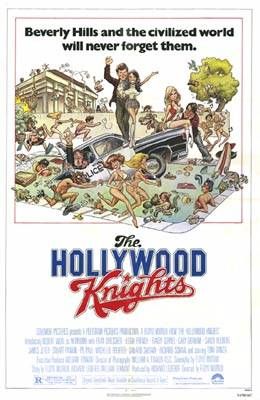
The Hollywood Knights (1980, directed by Floyd Mutrux)


Halloween Night, 1965.  While the high school holds a pep rally and the Beverly Hills Homeowners Association debate the best way to tackle the problem of juvenile delinquency, the Hollywood Knights hang out at Tubby’s Drive-In, their favorite burger joint.  The Hollywood Knights are a car club and a group of fun-loving rebels, determined to have a good time and to always humiliate Officers Clark (Sandy Helberg) and Bimbeau (Gailard Sartain).  In practice, this amounts to a lot of jokes about flatulence and Newcomb Turk (Robert Wuhl) mooning the cops every chance the he gets.  I’m hoping a stunt butt was used for the mooning shots.  If I had known watching Hollywood Knights would mean seeing Robert Wuhl’s bare ass a dozen times over 91 minutes, I wouldn’t have started the movie.

The humor is crude but the movie has a serious side, one that was cribbed from American Graffiti.  Duke (Tony Danza), a senior member of the club, is upset that his girlfriend (Michelle Pfeiffer, in her film debut) is working as a car hop.  He’s also sad that his buddy, Jimmy Shine (Gary Graham), is leaving in the morning for the Army.  Jimmy’s not worried about being sent to Vietnam because Americans are only being sent over there as advisors.  Hollywood Knights doesn’t end with a Graffiti-style epilogue but if it did, Jimmy would be the one who never came home.  The serious scenes work better than the comedy, due to the performances of Gary Graham, Michelle Pfeiffer, and Tony Danza.  I can’t believe I just said that either.  Danza, though he’s way too old to be playing a high school student, is actually really good in this movie.  Pfeiffer doesn’t get to do much but, from her first scene, it’s easy to see why she became a star.  The camera loves her and she brings her character to life, despite not having much screen time.

Unfortunately, the drama takes a back seat to a lot of repetitive humor.  The problem isn’t that the humor is crude.  One thing that has always been true is that, regardless of the year, teenage boy humor is the crudest humor imaginable.  Even back in prehistorical times, teenage boys were probably drawing dirty pictures on the walls of their caves.  The problem is that the humor is boring and Robert Wuhl is even more miscast as a high school student as Tony Danza was.  Fran Drescher plays a high school student with whom Turk tries to hook up.  Drescher, like Pfeiffer, comes across as being a future star in the making.  Robert Wuhl comes across as being the future creator of Arli$$.

The Hollywood Knights has a bittersweet ending, the type that says, “It’ll never be 1965 again.”  This movie made me happy that it will never be 1965 again.  1965 should have sued The Hollywood Knights for slander.  Hollywood Knights tried to mix the nostalgia of American Graffiti with the raunchiness of Animal House but it didn’t have the heart or creativity of either film.  At least some of the member of the cast went onto better things.


April Noir: To Live And Die In L.A. (dir by William Friedkin)


Some people love money so much that they make their own.

In 1985’s To Live And Die In L.A., Williem DaFoe is magnetically evil as Rick Masters, a genius at counterfeiting who has gotten rich by selling other people fake money.  The film features a lengthy sequence showing how Masters makes his money and the viewer really is left feeling as if they’ve just watched an artist at work.  Masters has a talent and he’s a professional.  He’s good at what he does.  Unfortunately, he’s also a sociopath who is willing to kill just about anyone who he comes across.  There have been a lot of movies made about sympathetic counterfeiters.  They’re often portrayed as being quirky and rather likable individuals.  This is not one of those films.  DaFoe’s charisma makes it impossible to look away from Rick but he’s still not someone you would ever want to have to deal with for a prolonged period of time.  One gets the feeling that Rick eventually kills everyone that he does business with.

Secret Service agents Richard Chance (William Petersen) and John Vukovich (John Pankow) are investigating Masters.  They’re a classic crime movie partnership.  Vukovich is youngish and, when we first meet him, goes by-the-book.  Chance is a veteran member of the Secret Service, an impulsive loose cannon whose last partner was killed by Masters.  Chance is now obsessed with taking Masters down and he’s willing to do whatever it takes.  If that means threatening his lover and informant, the recently paroled Ruth (Darlanne Fluegel), so be it.  If that means defying the lawyers (represented by Dean Stockwell), so be it.  If that means committing crimes himself and nearly getting Vukovich killed in the process, so be it.  At first, Vukovich is horrified by Chance’s techniques but, as the film progresses, Vukovich comes to embrace Chance’s philosophy of doing whatever it takes.

What sets To Live and Die in L.A. apart from some other films is that, even as it concludes, it leaves us uncertain as to whether or not Chance and Vukovich’s actions were really worth it.  This is not a standard cops-vs-robbers film.  This is a William Friedkin film and he brings the same moral ambiguity that distinguished The French Connection to this film’s portrait of the Secret Service.  (When Chance isn’t chasing after a counterfeiter, he’s foiling an assassination attempt against the president.)

Like The French Connection, To Live and Die In L.A. features an pulse-pounding car chase, one that occurs as Chance and Vukovich make an escape from robbing a man who they believe to be a criminal.  (The man turns out to have been an FBI agent.)  This chase involves Chance and Vukovich driving the wrong way down a crowded freeway, desperately tying not to crash into any of the cars that are swerving out of the way.  It’s such an exciting scene that it’s easy to forget that Chance and Vukovich are actually escaping from committing a crime.  In The French Connection, Gene Hackman was chasing the man who tried to assassinate him.  In To Love and Die In L.A., Chance is fleeing the consequences of his own actions.

To Live and Die In L.A. holds up well.  DaFoe and Petersen both give charismatic performance but, for me, it really is John Pankow who carries the film.  Vukovich’s transformation from being a straight-laced member of law enforcement to being a doppelganger of his partner is both exciting and a little disturbing,  To Live and Die In L.A. is a crime film that leaves you wondering how far one can go battling the bad guys before becoming one of them.