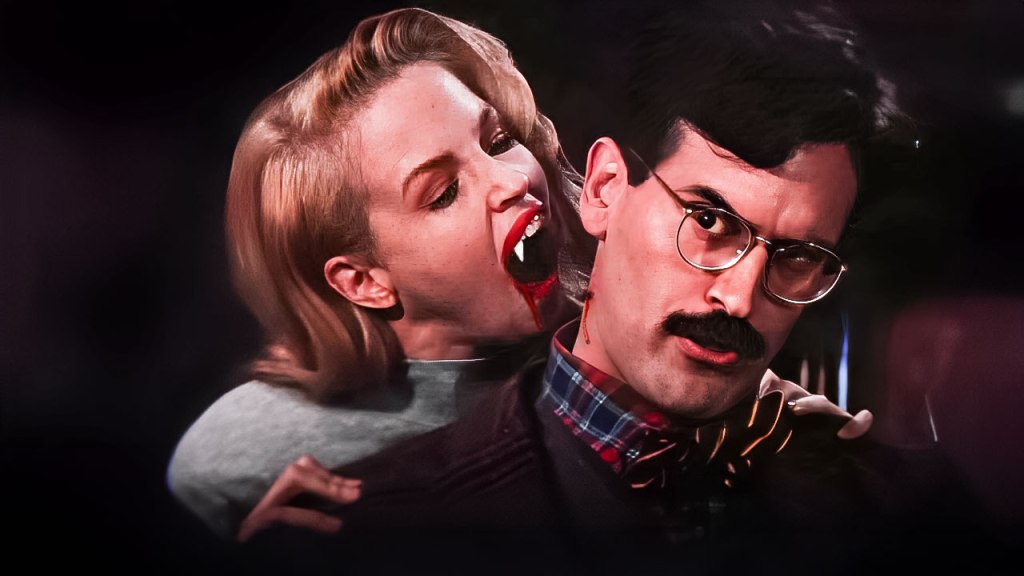
Brad reviews SUNDOWN: THE VAMPIRE IN RETREAT (1989), starring David Carradine and Bruce Campbell!


In honor of Bruce Campbell’s 67th birthday, I decided to watch a movie he’s featured in that I’ve never seen before. I thought the horror-comedy SUNDOWN: THE VAMPIRE IN RETREAT looked like it might be fun so I went for it! 

In the desert town of Purgatory, a colony of vampires led by Count Mardulak (David Carradine) want to live in peace, abstaining from human blood, and instead, drinking a blood substitute called “Necktarine,” which is produced in a local factory. They also use high powered sunscreen that allows them to go out in the day time as long as they wear thick sunglasses, big hats or umbrellas, and gloves. Unfortunately, the blood factory begins experiencing production issues, so Mardulak asks David Harrison (Jim Metzler), the unsuspecting human who designed the production process, to come to town and fix their problems. Harrison brings his family with him, including his wife Sarah (Morgan Brittany), and their two daughters. The Harrison family soon find themselves in the middle of an other worldly war as Jefferson (John Ireland) and Shane (Maxwell Caulfied), rebellious local vampires, plot to overthrow Mardulak so they can return to their murderous ways. Meanwhile, Robert Van Helsing (Bruce Campbell), the great grandson of the famed vampire hunter, walks into town, ready to romance the local vampire beauty Sandy (Deborah Foreman) and drive stakes into the hearts of as many bloodsucking freaks as possible!

As far as I’m concerned, SUNDOWN is a blast as a completely absurd horror-comedy that puts an interesting spin on traditional vampire legend, with its endless sunscreen slathering and a growing local weariness over “Necktarine” adding to the good times. It’s campy and silly, with purposely terrible stop motion bat effects, over-the-top family drama, and lots of cheesy one-liners, but of course that’s all part of the charm. 

The B-movie dream cast is what I enjoyed the most about SUNDOWN. David Carradine plays it pretty straight as the town leader Count Mardulak, which is effective when you consider all of the craziness going on around him. Bruce Campbell, and his mustache, steals all of his scenes with his goofy charm and misguided heroics. And, of course, the inimitable M. Emmet Walsh is perfect as old man Mort, a vampire who loses his temper and beheads a disrespectful city slicker. He just can’t help himself. Throw in other veteran character actors like Bert Remsen and John Ireland and it’s easy to enjoy the movie no matter how silly it all gets.

On a personal note, I did want to point out a couple of performances in SUNDOWN that have Arkansas connections. First, Jim Metzler had a solid part a couple of years after this movie in the crime thriller ONE FALSE MOVE (1991), which was co-written by Billy Bob Thornton and partially filmed in Eastern Arkansas. It’s a great movie and Metzler is good in it. Second, Elizabeth Gracen has a small part in the film. Gracen, whose actual name is Elizabeth Ward, won the title of Miss Arkansas in 1981 and then went on to win Miss America in 1982. My uncle Billy was her hair stylist as she made her run to beauty pageant immortality. Other notable Gracen life events include her affair with Arkansas Governor Bill Clinton in 1983, her appearance in Steven Seagal’s MARKED FOR DEATH in 1990, and her Playboy spread in 1992. Interestingly, 18 years old at the time, I saw the layout when my girlfriend’s mom bought the issue and let me look at it! 

Overall, SUNDOWN lets us know right off the bat the kind of absurd movie we’re dealing with, so you’ll either be into it or want to just move on. I was into it, mainly due to its strong cast. It’s not perfect, and it overstays its welcome by a good 15 minutes, but SUNDOWN is a fun watch for fans of silly horror-comedies and the excellent cast. I had a great time with it!
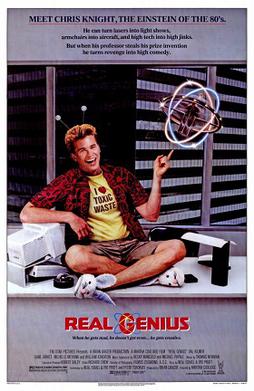
Real Genius (1985, directed by Martha Coolidge)


Mitch Taylor (Gabriel Jarrett) is a teenage genius who is recruited by Prof. Jerry Hathaway (William Atherton) to study at Pacific Tech University.  The real reason why Hathaway has recruited Mitch is because Chris Knight (Val Kilmer), another genius, has been slacking on developing the power source for an experimental laser called “crossbow.”  Hathaway hopes that Mitch can get Chris to take his work seriously and to focus on the project.  Instead, Chris teaches Mitch that he has to learn how to enjoy life or his great intelligence will become a burden and he’ll end up burned out and living in the tunnel underneath the university.  That’s what happened to Laszlo Holyfield (Jon Gries).  That’s what nearly happened to Chris.  Chris is determined not to let it happen to Mitch.

Real Genius combines college hijinks with a serious examination of the pressures of being a “real genius.”  Mitch knows everything about laser physics but he still misses his parents and cries after getting yelled at by Prof. Hathaway.  He’s just a kid, no matter how smart he is.  Chris proves himself to be a good friend, encouraging Mitch to relax and enjoy life.  Just because you’re a genius doesn’t mean that you can’t have fun.  As played by Val Kilmer, Chris Knight is the best friend that everyone wishes they could have, whether they’re a genius or not.  Even when the film gets sophomoric, Kilmer plays his role seriously and never loses sight of Chris’s humanity or why it’s so important to Chris that Mitch not become consumed by the pressure of being smarter than almost everyone else in the room.  This is one of the early Val Kilmer performances that showed just how good an actor he truly was.  With Chris’s encouragement, Mitch pursues a romance with Jordan Cochran (Michelle Meyrink) and gets revenge (more than once) on the arrogant Kent (Robert Prescott).

Eventually, Chris and Mitch realize that their research is being used to construct a weapon for the CIA and this leads to the film’s famous ending.  Ever since this movie came out, there’s been a debate over whether or not a laser could be used to make popcorn and, even more importantly, whether or not a gigantic amount of popcorn could actually destroy someone’s house.  I don’t know the answers to those questions but I’d like to think that Real Genius got it right and I have no interest in any evidence that suggests otherwise.  Sometimes, you owe it yourself to believe in the power of lasers and popcorn.  The next person who takes advantage of your hard work, destroy his house with popcorn and then sing Everybody Wants To Rule The World.  Learn the lessons of Real Genius.

Finally, when I was growing up, Real Genius was one of those films that seemed to be on HBO all the time.  Somehow, I always turned it on right when the popcorn started popping.  That popcorn-filled house, followed by Everybody Want To Rule The World, was a huge part of my childhood.  Real Genius will always bring back good memories for me.

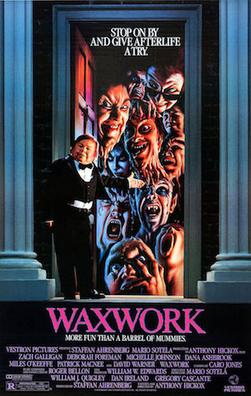
Horror Film Review: Waxwork (dir by Anthony Hickox)


First released in 1988, Waxwork asks the audience with a very important question.

Let’s say that you and your best friend were walking to school one day when you suddenly noticed a gigantic mansion that you had never seen before, sitting in the middle of your neighborhood.  And what if a tall, somewhat sinister Englishman (played by David Warner, none the less) suddenly appeared out of nowhere and told you that the mansion was actually a waxwork.  And what if that Englishman than invited you to come to the waxwork at midnight and specifically asked you to come in a group of 6.  Would you do it?

Now, I know that your first instinct is to say, “Of course, I wouldn’t!”  That’s the type of answer that we’ve been conditioned to give because no one wants to admit that they can be as dumb as a character in a horror movie.  But really, I would go.  Especially if, like the characters in Waxwork, I was a teenager.  (Actually, most of the characters in Waxwork are described as being college students but they all act like high school students and their college appears to be a high school so draw your own conclusions.)  When you’re a certain age, you feel like you’re immortal and an invitation to hang out in a creepy building with a bunch of strangers at midnight feels totally reasonable.

Anyway, four rich kids — Mark (Zach Galligan), China (Michelle Johnson), Sarah (Deborah Foreman), and Tony (Dana Ashbrook, a year before he was cast as Laura Palmer’s boyfriend in Twin Peaks) — visit the waxwork at midnight.  What they discover is that the building is full of macabre exhibits that recreate various moments from horror history.  There’s werewolves, vampires, and Jack the Ripper.  There’s also the Marquis de Sade, a figure that the seemingly innocent Sarah becomes fascinated with.  And, as two of the visitors discover, stepping past the red rope and entering an exhibit transports them into an alternate world where they become the victim of the star of each display.

Not surprisingly, the film is at its best when imagining the world inside each exhibit.  Each exhibit has its own backstory and its own set of guest stars.  John Rhys-Davies shows up as a werewolf.  Miles O’Keeffe is a properly urbane Count Dracula.  J. Kenneth Campbell plays the Marquis de Sade, who the film imagines as a swashbuckling sadist.  That said, I think the most effectively frightening exhibit was one that featured no special guest stars but a very determined and very strong mummy.

What’s going on at the waxwork!?  As explained by Sir Wilfred (Patrick Macnee, bringing some welcome wit and style to the film), it’s all a part of a scheme to bring the most evil beings ever back into existence so that they can conquer the world.  It’s important that none of the waxworks be allowed to enter the real world and soon, Sir Wilfred and his ragtag army are laying siege to the waxwork and bringing things to an apocalyptic conclusion.  The final battle is a bit haphazardly edited and it’s impossible to really keep track of who is fighting on which side.  (Indeed, I’m still not sure where Sir Wilfred even found his army.)  But it does feature plenty of in-jokes for horror fans, including a cameo appearance by the carnivorous plant from Little Shop of Horrors.

Waxwork is entertaining film.  It doesn’t take itself particularly seriously and, indeed, Mark, China, Sarah, Tony, and all of their friends feel as if they could just as easily have been found in the pages of a Bret Easton Ellis novel about pretty but vapid alcoholics.  Mark is the type who gets his maid to write his term papers.  Tony just wants to drink (but, because he’s played by the adorable Dana Ashbrook, he’s still the most likable character in the film).  China says, “I do what I want, when I want,” when confronted about cheating on her boyfriend.  Sarah is the “innocent” one but just seeing the words “Marquis de Sade” causes her to swoon.  Dropping these four idiots into a situation where the fate of the world is at stake feels like a wonderfully sardonic cosmic joke.

In the end, the true pleasure of Waxwork is watching old pros like David Warner, Patrick Macnee, and the exhibit guest stars hamming it up.  Macnee, in particular, seems to enjoy leading the final charge against the forces of evil and, indeed, it’s hard not to wish that he had even more screen time than he did.  David Warner, meanwhile, rolls his eyes at just how difficult it can be to bring the 18 most evil figure in history back to life.  It’s hard work but I guess someone has to do it!

A Movie A Day #268: Destroyer (1988, directed by Robert Kirk)


A year and a half ago, serial killer Ivan Mosser (Lyle Alzado) was sent to the electric chair for murdering 23 people.  On the night that he was electrocuted, the worst prison riot in American history broke out.  The prison was closed and abandoned.  A year and a half later, a film crew has entered the prison to make a women in prison film.  Robert Edwards (Anthony Perkins) is the sleazy director.  David Harris (Clayton Rohner) is the screenwriter who fights to maintain the integrity of his script and who is an expert on the prison’s history.  Susan Malone (Deborah Foreman) is a stuntwoman and David’s girlfriend.  And Ivan is the murderer who is still half-alive and full of electricity.

Watching a forgettable, direct-to-video movie like Destroyer, it is impossible not to feel sorry for Anthony Perkins, who went from getting nominated from Oscars and working with Hitchcock to appearing in films like this.  According to the Perkins biography, Split Image, Perkins was brought in at the last minute to replace Roddy McDowall and was miserable during most of the shoot.  Since Perkins spent a good deal of his later career working with directors like the one he plays in Destroyer, it’s not surprising that he gives one of the two good performances in Destroyer and he also gets the movie’s only memorable death scene.  The other good performance comes from Lyle Alzado, a former football player who had exactly the right look for his role and who plays Ivan like a ghost who is in the throes of roid rage.  Unfortunately, both Alzado and Perkins would die within months of each other in 1992, four years after co-starring in Destroyer.

The TSL’s Grindhouse: April Fool’s Day (dir by Fred Walton)


(Because of the nature of the 1986 pseudo-slasher film, April Fool’s Day, it’s impossible to really talk about the film without talking about the film’s ending.  As a result, this review will have spoilers.  The ending will be revealed.  The entire plot will be spoiled.  Do not read on if that’s going to be an issue for you.)

(Did you read the warning above?)

If not for the way that the film ends, April Fool’s Day would probably be a forgotten film.  It’s a slasher film that doesn’t feature much blood, sex, or any particularly flamboyant kills (though there’s a good reason for that).  Compared to most low-budget slasher films from the mid-80s, April Fool’s Day does have a surprisingly charismatic and likable cast but it’s rare that anyone watches a holiday-themed slasher film for the acting.  Up until the final ten minutes or so, April Fool’s Day is professionally done but somewhat generic…

But then you hit that ending and it totally changes the whole film.  It’s not a perfect ending.  In many ways, it’s probably one the most imperfect endings that I’ve ever seen.  It requires a massive suspension of disbelief.  It makes no logical sense. But dammit, I love it.  Almost despite itself, it’s a great ending and it confirms that April Fool’s Day is meant to be a satire and not a straight horror film.

For the first 80 minutes or so, April Fool’s Day plays out like the 100th variation on And Then There Were None.  Heiress Muffy St. John (Deborah Foreman, giving a wonderfully odd performance) invites a group of college friends to her island mansion.  They arrives on April Fool’s Day and they spend the first night dealing with Muffy’s strange sense of humor.  (Actually, Muffy and I both find the same things funny but I’ve been told that I have a strange sense of humor so, therefore, I assume that Muffy must have one too.)  Harvey, who prefers to be called Hal (Jay Baker), smokes an exploding cigar and discovers his bedroom has been decorated with newspaper articles about a car accident that he was involved in.  Jock Arch Cummings (Thomas F. Wilson) finds steroids hidden away in a medicine cabinet.  Nikki (Deborah Goodrich) comes across handcuffs in a dresser.  Nan (Leah Pinset), a serious-minded drama student, hears a baby crying in the distance and is reminded of her abortion, something that she believes that only Muffy knows about.

The next day, Muffy is now wandering around in a daze and her brother, Skip (Griffin O’Neal), has vanished.  Kit (Amy Steel, playing a similar role to her character in Friday the 13th Part Two) and Rob (Ken Olandt) think that they see Skip’s decaying body floating under the boathouse.  As the day progresses, Arch and Nan vanish and later turn up at the bottom of a well.  Harvey is found hanging from a rope.  Chaz (Clayton Rohner) is castrated and, while we’re not quite sure what exactly happens to Nikki, we do see that it involves a large puddle of blood.  Kit and Rob discover Muffy’s head in the basement and realize that they are being stalked by Muffy’s crazy twin, Buffy.

(Deborah Foreman is great in both of the roles.  As Muffy, she delivers all of her lines with just a hint of sarcasm and constantly seems to be silently laughing at a private joke that only she understands.  And when she’s Buffy — well, she’s totally batshit crazy.)

Being pursued by a knife-wielding Buffy, Kit runs through the mansion and finds herself in the drawing room.  And who is waiting for her but all of Buffy’s victims?  No, they’re not dead!  Instead, they’re alive and they’re all in a very good mood.  And Buffy is not Buffy.  She’s Muffy and she’s been Muffy all along.

That’s right, it’s all a huge elaborate joke!  Muffy does spend a few minutes explaining how the whole weekend was a dry run for her plan to turn her estate into a resort, one that will offer a weekend of fake horror.  But, ultimately, it all comes down to the entire movie being an elaborate joke.  I know, just from perusing some of the comments at the imdb, that there are some horror fans who hate the ending of April’s Fool’s Day.   But, really, that’s the only “honest” way that a film like April Fool’s Day could end.  If the movie was called Thanksgiving, I could understand being upset.  But this is an April Fool’s Day movie!  It has to be a joke.

Of course, if you think about it too much, the ending makes no sense.  Muffy specifically states the no one was in on the joke until the last minute.  Whenever one of her friends would wander off on their own, Muffy would grab them, explain the joke, and get them to play along.  When you consider the size of the island and where, at various points, the victims are in relation to the other characters, Muffy must be a very fast explainer, as well as being very persuasive.  (As well, Harvey brings a gun with him to island.  Muffy jokes about nearly getting shot by him but imagine if he had been successful?)  Even if you accept that all of the friends — even Arch and Harvey, who are both kinda dumbasses — would be able to play along without screwing things up, you have to wonder why Muffy thought it would be a good idea to use dark secrets from everyone’s past.

If you search far enough online, you can find all sorts of rumors about the film that April Fool’s Day was originally meant to be.  In the finished film, Skip is a bit of a cipher but, in the original script, he was a much more complex character.  While Muffy was busy playing her elaborate prank, Skip was planning on killing Muffy and claiming their parent’s inheritance for himself.  The crying baby, the drugs, the incriminating newspaper articles; all of them were originally meant to be the work of Skip.  While Skip’s subplot was dropped, the dark secrets of the past were not.  As a result, Muffy comes across as being a lot more cruel than was originally intended.

Originally, the film was also meant to end with Skip killing Muffy but the ending was apparently changed at the last-minute.  (Reports differ on whether or not the original ending was ever filmed.)  Instead, the film now ends with Muffy stumbling into her bedroom, playing with a jack-in-the-box, and then getting a knife drawn across her throat by Nan.  It’s just another elaborate practical joke and, once Muffy realizes that she’s not dying, Nan gives her a quick kiss and smiles enigmatically.

(A lot of imdb commenters — mostly males — have read a lot into that kiss, obsessing on a subtext that really isn’t there.  As opposed to being the homage to Blue Is The Warmest Colour that many commenters appear to believe it to be, it’s really just a friendly kiss, a way of saying, “I got you.”  Sorry, guys, that’s all there is to it.)

It’s an ending that would never be done today.  Today, all horror films have to end with the promise of a sequel.  Muffy might still get away with pulling an elaborate prank but Nan would definitely have killed her at the end of the film.  Her little smile would have said, “Wait for the sequel.”  And the modern version of that ending definitely would not be as effective.  In fact, it would be so expected that it would be damn near infuriating.  Instead, the ending of April Fool’s Day is good-natured and likable, which is appropriate because April Fool’s Day is a surprisingly good-natured and likable film.

After Nan’s final joke, April Fool’s Day ends with a song.  And here it is!  Enjoy and I hope everyone had a great April Fool’s Day!