October True Crime: Too Close To Home (dir by Bill Corcoran)


The 1997 film Too Close To Comfort tells the disturbing story of the Donahues.

Nick Donahue (Rick Schroder) is a young attorney, a law school grad who has just joined the bar and who is still making a name for himself as a defense attorney.  He’s good at his job and if you have any doubts, his mother Diane (Judith Light) will be there to tell you why you’re incorrect.  Diane and Nick still live together.  They have the type of relationship where Diane casually walks into the bathroom to talk to Nick while he’s in the shower.

In short, they have a very creepy relationship.

Nick talks about needing to get a place of his own but his mother says that it’s too soon for him to spend all that money.  Nick wants to fall in love and marry a nice girl and start a family.  Diane doesn’t want Nick to have a life separate from her.  When Nick does end up marrying the sweet-natured Abby (Sarah Trigger), Diane snaps.  One night, Abby is abducted and is later found murdered.  Nick sobs and Diane holds her son and she doesn’t mention the fact that she’s the one who arranged for Abby to be killed.

The police figure it out, of course.  Diane wasn’t that clever.  When Diane is arrested and put on trial for murder, Nick is shocked.  With his mother facing the death penalty for murdering his wife, Nick steps forward to defend his mother in court.

Agck!  This movie!  Admittedly, this is a made-for-TV movie but it’s still creepy as Hell.  If anything, the fact that it was made for television make it even creepier than if it was a uncensored feature film.  Held back by the rule of television, the film has to hint at what would probably otherwise be portrayed as explicit.  That makes all of the little moments that indicate Diane’s madness all the more disturbing and frightening because they could be read several different ways.  This is a film where every line is full of a very icky subtext.  Diane is more than just an overprotective mother.  Her feelings for Nick are on a whole other level.

Fortunately, Judith Light is one of those actresses who excels at communicating subtext.  She delivers every line with just enough of an inflection that we know what she’s saying even if she doesn’t actually say it.  From rolling her eyes when Nick asks her to turn around when he gets out of the shower to the scene where she flirts with Nick’s new landlord, Light leaves little doubt as to what really going through Diane’s mind.  Rick Schroder has a far more simpler role as Nick but he still does a good job with the role.  He’s sympathetic, even when he’s refusing to accept the truth about his mother.

This film is all the more disturbing due to being loosely based on a true story.  The real Diana Donahue was named Elizabeth Ann Duncan and she was convicted of killing her son’s wife in the 1950s.  (Too Close To Home is set in the 90s.)  Her son really did defend her, all the way until her execution.  In real life, her son continued to practice law until 2023, when he was disbarred by the state of California.

As for the film, it’s a classic true crime made-for-TV movie that features Judith Light at her disturbing best.
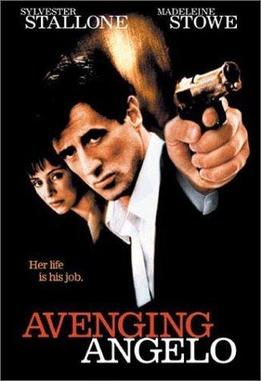
Avenging Angelo (2002, directed by Martyn Burke)


When mob boss Angelo (Anthony Quinn) is assassinated on the orders of the son of a former rival, bodyguard Frankie Delano (Sylvester Stallone) takes it upon himself to protect Angelo’s daughter, Jennifer (Madeleine Stowe).  The problem is that Jennifer, who was adopted by a normal couple, doesn’t know that she is the daughter of a mobster.  Her life and her marriage are already falling apart even before Frankie reveals the truth to her.  All she wants to do is disappear into the pages of a romance novel written by her favorite writer, Marcello (Raoul Bova) but Marello is not quite what he seems.

Sylvester Stallone has had a long career, full of high points (Rocky, First Blood, The Expendables, Creed) and low points (too many to list).  Avenging Angelo, made at a time when it was assumed that the aging Stallone would never again play Rocky Balboa or John Rambo, is a moderate low point.  It’s no Rocky but it’s still better than Stop!  Or My Mom Will Shoot!  Overall, it’s not very good and a lot of the humor falls flat but Stallone and Madeleine Stowe are both likable and they have a few moments that display what seems like genuine chemistry.  It’s still a slow movie that awkwardly mixes comedy and action but it was not the disaster that I was expecting it to be when I first found it on Tubi.  It’s more forgettable than bad.  If there is anything to really regret when it comes to Avenging Angelo, it’s that Anthony Quinn did not get a more memorable swan song.

Avenging Angelo was Stallone’s second movie to go straight to video.  It’s easy to forget not but the conventional wisdom in 2002 really was that Stallone was washed up.  There were jokes about whether or not he would follow Schwarzenegger’s lead and go into politics.  Stallone, however, proved all the naysayers wrong, proving that he could still throw punches as Rocky Balboa and John Rambo while The Expendables revealed a Stallone who could finally laugh at himself.  Avenging Angelo turned out to be not the end of Stallone’s career but instead just a detour.  Say what you will about the man and his movies, Sylvester Stallone is an American institution.

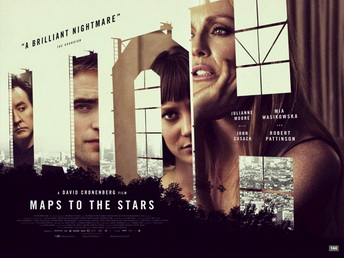
Embracing the Melodrama #124: Maps to the Stars (dir by David Cronenberg)


Maps_to_the_Stars_posterI have to admit that, for the most petty of reasons, I was dreading the 2014 release of David Cronenberg’s Maps to the Stars.  

This was despite the fact that I happen to be a big fan of just about everyone in the cast and David Cronenberg as a director.  (I still say that Cosmopolis is one of the best films of the decade and I don’t care who disagrees.)

My initial issue with Maps to the Stars — and again, I admit this is really petty — was that Sasha Stone, over the Awards Daily web site, was so damn fanatical about singing the film’s praises.  I have a theory that Sasha tends to overpraise certain films specifically so she can have an excuse to get angry and go off on a rant when they don’t receive any Oscar nominations.  Ever since Sasha went batshit crazy over The King’s Speech beating The Social Network, Awards Daily has pretty much gone from being a site about the Oscars to being a site about Sasha screaming in the wilderness like a biblical prophet (and not one of the interesting biblical prophets, like Elijah.  We’re talking about Haggai here.)  From what I had read about Maps To The Stars and judging from the response that it got at Cannes (where, despite mixed reviews, it did win an award when Julianne Moore was named best actress), this film seemed like the epitome of another deliberate lost cause.

Fortunately, the release date of Maps To The Stars was moved to 2015 and civilization was spared from having to deal with a thousand “If Cronenberg doesn’t get an Oscar, society is doomed!” rants.  Instead, we had to deal with a thousand “If Hillary Swank doesn’t win for The Homesman, society is doomed!” rants.

“Okay,” you’re saying, “that’s great Lisa.  Thank you for whatever all that was.  But what about the movie itself!?  Is it any good?”

Eh … I guess.

I mean, Maps to The Stars isn’t a bad movie.  It’s not bad at all.  It’s just maddeningly uneven.

One of my favorite up-and-coming stars, Mia Wasikowska, has a great role in it.  She plays a schizophrenic, named Agatha, who comes to Hollywood.  Agatha’s arms and the back of her neck are covered with burn scars and she is always taking pills.  She is also obsessed with a vile teen star named Benjie Weiss (Evan Bird).  There’s more to her obsession than you might originally think.

Benjie, meanwhile, has just gotten out of rehab and he is literally one of the worst characters ever.  The film does try to build up some sympathy for him by revealing just how fucked up his home life is.  His fragile mother (Olivia Williams) always seems to be on the verge of collapse.  His father (John Cusack) is a glib and shallow psychologist.  Benjie serves as a stand-in for every child star who has been destroyed by Hollywood.  Unfortunately, the film devotes so much time to Benjie being a monster that it never really allows us to see why Benjie’s a star in the first place.  Evan Bird gives such a boring, uninteresting, and flat performance that you never really buy the idea of Benjie could be a success.  (Say what you will about Justin Bieber, he does at least have a cute smile.  Evan Bird can’t even claim that.)

Agatha meets a lot of people in Hollywood, including a limo driver (Robert Pattinson) who is an aspiring screenwriter.  She eventually gets a job working for actress Havana Segrand (Julianne Moore).  Havana, herself the daughter of a legendary and self-destructive actress, is a monster but — unlike, Benjie — she’s a sympathetic monster.  She’s a talented actress who grew up in Hollywood and now, because she’s no longer in her 20s, is being discarded by Hollywood.  Havana is as much a victim as a victimizer.

Anyway, the film kinda wanders about.  Along with all the other stuff going on, the characters are regularly visited by ghosts.  Secrets are revealed.  Hearts are broken.  Lives are lost.  And yes, relevant points about Hollywood are made but … well, so what?   There’s nothing in Maps to the Stars that you couldn’t learn from rewatching Sunset Boulevard and Sunset Boulevard is a lot less pretentious.  Plus, William Holden was a much better actor than Evan Bird.

As for Cronenberg’s direction — well, Maps to the Stars is definitely David Cronenberg on autopilot.  It’s filled with identifiable Cronenberg touches.  The emphasis placed on Agatha’s scars, for instance, is trademark Cronenberg.  But still, Cronenberg’s direction often just seems to be going through the motions.  Unlike his work in the far more interesting and challenging Cosmopolis (not to mention Eastern Promises), Cronenberg doesn’t really seem to care that much about the story that he’s telling.

Maps to the Stars is worth watching for the performances of Julianne Moore and Mia Wasikowska.  Otherwise, it’s just another well-made but only occasionally interesting Hollywood melodrama.