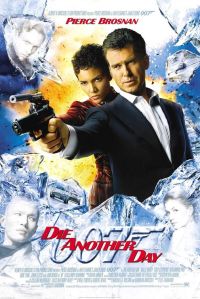
James Bond Review: Die Another Day


Leading up to the North American release of the latest James Bond feature film, Skyfall, The Shattered Lens is reviewing each and every James Bond film in the history of the franchise. Today’s film is the controversial Die Another Day, the twentieth film in the James Bond franchise, and the final such film to feature Pierce Brosnan in the titular role as 00-agent James Bond. Despite launching to mixed reviews – particularly overseas, where it generated significantly negative reaction in North and South Korea – it was at the time the highest grossing Bond film of all time.

Our cold open for this film has us in North Korea. There, 007 is assuming the identity of a diamond smuggler who is assisting a North Korean Colonel, Tan-Sun Moon, in laundering blood diamonds as part of an ongoing search for advanced military hardware. In order to bypass the landmines of the Korean Demilitarized Zone, the good Colonel has constructed an entire army of hover vehicles which can cross the region without triggering the mines, allowing for a land invasion of South Korea. Bond proceeds with the exchange, but is identified by Zao (Rick Yune), Colonel Moon’s right hand man. Bond triggers an explosion which badly disfigures Zao’s face, which becomes embedded with dozens of diamonds. Colonel Moon attempts to escape on a hovercraft, and Bond pursues him, eventually chasing the Colonel off the edge of a waterfall, apparently killing him. Afterward, Bond is captured by General Moon, the Colonel’s father, and is imprisoned.

After over a year of imprisonment and torture, Bond is traded during a prisoner exchange for Zao. Upon returning to MI6, M (Dame Judi Dench) tells Bond that his 00-status has been suspended. Both she and the Americans believe that Bond cracked under torture and revealed classified information, necessitating the prisoner exchange that brought him back. However, the release of Zao leaves both M and Bond extremely bitter. Determined to recapture Zao, Bond evades MI6’s security and disappears. He travels to Hong Kong, seeking a way back into North Korea, but his contact there informs him that Zao has attempted to disappear in Cuba and provides him with the necessaries to travel there instead.

After he arrives in Havana, Cuba, Bond investigates a clinic there which specializes in gene therapy that is virtually unknown in the first world. Bond’s local contact describes it as prolonging the lives of their leading citizens, and the richest folks in the West, but Bond also learns that the gene therapy would allow a person to totally restructure their appearance and assume a whole new identity. During his investigation, he meets a woman who introduces herself as Jinx (Halle Berry) who, initially unknown to Bond, is an NSA agent on a similar investigation, albeit one with presumably very different goals. Bond locates Zao inside the clinic, and a chase ensues. Although Zao ultimately manages to escape by helicopter (and Jinx in dramatic fashion by diving off the sea wall and boarding a waiting boat which drives her off), Bond recovers a pendant left behind by Zao. Upon unscrewing it, Bond discovers a cache of diamonds. Upon inspection, the diamonds are chemically identical to diamonds found in Sierra Leone, but they bear the identifying mark of a diamond mine owned by a British billionaire and thrill seeker, Gustav Graves (Toby Stephens). Bond is determined to investigate.

This forms the basis of the remaining plot. Our set pieces this time aren’t quite so varied, as much of the remaining story plays out in Iceland, where Graves’ diamond mine is situated, and where he has constructed a special ice hotel for the purpose of a technology convention. Eventually, we return to Korea, for a final showdown that seems somehow empty, despite the increasingly high stakes in terms of both explosions and technology.

The truth, ultimately, is that Die Another Day is a bit of a mess. It has a seemingly incessant procession of action sequences, but they raise the stakes primarily through CGI and improbable wizardry, in a way that threatens our suspend disbelief. I know that this is Bond, and that in 80s-early 00s Bond very much fell into the trap (who didn’t?) of ‘bigger and better’. However, this film takes things a bit too far in my estimation. Its villains aren’t quite as fun as the ones in the past two films (well, Mr. Stamper is kind of a drag I suppose), and don’t really fit the Bond mold. The story is pretty straightforward, but probably doesn’t receive quite the treatment that it deserves to get us established in it. The interactions between Bond and M are a bit too stiff, and I say that even keeping in mind tomorrow’s review piece, Casino Royale. There’s something about Die Another Day that made me think everyone involved was just going through the motions, like a sense of fatigue just hung over the proceedings. It was a bit of a bummer.

As for the women of Bond, Die Another Day actually has a lot to recommend. Breaking convention, this section is heavy with spoilers, but I’m going to risk it just this once. Don’t read on if you’re new to this film and planning to watch it!

Die Another Day continues to feature Dame Judi Dench as a pleasantly strong and uncompromising intelligence chief (I probably haven’t made enough of how much I enjoy her in the role of M in my reviews up to this point). In addition, we’re treated to Halle Berry as Jinx, an ass-kicking NSA agent who seems to do a lot of getting outmaneuvered and captured for being so adept. I didn’t care for Berry’s performance in this film, and I’d be lying if I said she stacked up well against Tomorrow Never Dies’ Michelle Yeoh as a Chinese intelligence agent. Still, compared to some of the other Bond girls, Berry is definitely a warrior. The other major female character, however, is Miranda Frost (Rosamund Pike), a frigid and beautiful MI6 agent… actually, a double agent, who betrayed Bond in the cold open. Pike’s character definitely gives off the edge of competence and deadliness that I, for one, am rooting for in female characters in any Bond movie, and she sells it well. Unfortunately, she’s not nearly as fun as Elektra King, as her motivations are completely unexplored and she just feels like an add-on to the existing plot surrounding some dangerous North Koreans.

Overall, this is probably not one of the better Bond films, though I’d argue that it doesn’t deserve the bad rap that some have given it either. It’s not a terrible film, just overwrought in a kind of Michael Bay way that undermines the characters and concepts. This is a common complaint of all four Pierce Brosnan films, especially, as well as some of the Roger Moore and Timothy Dalton efforts. However, this is the one that I most agree with that assessment of. This film really gets out of control with effects and gadgetry.

That’s it for today’s review. I leave you with the theme from Die Another Day, performed by Madonna. Tomorrow’s review will be of 2006’s Casino Royale.

James Bond Review: Goldeneye (dir. by Martin Campbell)


After License to Kill, there was darkness.

The Bond Franchise would hit the longest lull in the series history, a break of about 6 years before Goldeneye came into fruition. I remember seeing the poster for Goldeneye in a subway station and the shock of both finding out there was finally a Bond film and that they managed to pick one of my favorite Bond choices at the time in Pierce Brosnan.

Albert “Cubby” Broccoli was upset with the response of License to Kill after its release. In the process, he decided to try something new and perhaps go with a different writer / director pairing. John Glen did a number of the Bond films leading up to this, and like a change in coaching, Broccoli may have felt it wasn’t going where it should. MGM, who was in the process of dying (and let’s face it, MGM was like that for some time), were in a deal that would allow the new owners to publish the Bond movies on TV without any consent or control from EON Productions. It was basically a fight to hold on to the ownership of the entire Bond Library, from what I’m finding. I could be wrong there, but it’s how I read into it.

Additionally, Dalton was supposed to do a third Bond film, but the issues between MGM and EON lasted so long that he eventually decided to bow out. Brosnan was approached to play Bond right after Moore finished A View to A Kill, but was unable to do so due to the success of Remington Steele. It was only after License to Kill (and Dalton’s departure) that the offer came back again and this time he jumped right on it.

One of the challenges for Goldeneye was to come up with a story for Bond. With the Cold War ending around the beginning of the decade, they couldn’t use General Gogol and the other angles that worked well in previous 007 files. The story that was made was seemingly tailored to work around that. Goldeneye deals with a joint mission with James and Alex Trevelyan (Sean Bean), who is also 006. During the mission, 006 is believed killed and Bond is able to both complete the job and escape. Bond later discovers that Trevelyan is alive and is behind a plot to fire an orbital EMP that would let him rob all of the banks in London via an electronic transfer. The film concentrates on how Bond doesn’t exactly fit in, considering that so much has changed around him.

One thing that Goldeneye really failed at was the music. Instead of the traditional Orchestra like tones from John Barry, they went with The Professional’s Eric Serra. The music was a mixture of electronic sounds and beats, a major departure from everything that Bond fans up until that point knew. For a number of Bond fans, the music just didn’t work for the film in any way (or only marginally made sense). This would be later rectified in Tomorrow Never Dies and a composer change. Here’s a bit of trivia: The end song of Goldeneye, “The Experience of Love” is actually a song made for The Professional, and an instrumental version of that song can be heard in that film’s soundtrack. Not the first time that’s happened musically – A James Horner track for James Cameron’s Aliens can be heard in the movie Die Hard – but it is a first for a Bond film, as far as I can tell.

Martin Campbell took over the directing for Goldeneye. While he doesn’t have a perfect track record (see Green Lantern and The Legend of Zorro), he was able to pull an action film together. He did so well with Goldeneye that he was actually brought on to film Casino Royale, possibly because both films were different kinds of reboots.

Another notable difference in Goldeneye is the introduction of Dame Judi Dench as “M”. It marks the first time that M is played by a woman. Her candor towards James is that he is “a relic of the Cold War” and a “misogynist dinosaur”. The chemistry between Brosnan and Dench is a bit rough when compared to her work with Daniel Craig, but the change also lends to an interesting dynamic. For someone who is considered a ladies man, here 007 is having to answer to a woman. Not terrible by any means, but it’s a shake up in the scheme of things. A younger Moneypenny (Samantha Bond) is also introduced, whose attitude is similar to M’s, but not as venomous. Desmond Llewelyn returns as Q, providing Bond with a BMW, outfitted with all of the regular gear. Although an Aston Martin DB5 was used in the beginning of the movie, it’s not the same car that Bond uses for the rest of the film. Where Moore was a Lotus driver and Dalton an Aston Martin one, Brosnan would be found behind BMW’s for the span of his 007 career.

For the Bond girls, two are better than one, and for Goldeneye we were given Izabella Scorupco as Natalia Simonova, a programmer with knowledge of how to stop the Goldeneye and a witness to the attack and theft of the device. The other is Xenia Onatopp, a former Soviet helicopter pilot and assassin, played by X-Men’s Famke Janssen. Jansen’s character is a bit cliche in that she kills with her thighs, but one has to wonder if that was just a carry over from what EON had to work with in previous films.

I thought Sean Bean was a great choice for a Bond Villain. At the time, he was young and dynamic, so  his character was able to hold his own with Bond in the fighting scenes and had a great plan with what he wanted to do with Goldeneye. I wouldn’t mind seeing more Bond guys be of the actual fighting type, rather than ones who let their henchmen do it for them. Speaking of henchmen, Alan Cumming’s hacker was more funny than fearsome to me, providing a comic relief to the film. Robbie Coltrane also adds a bit of humor as a contact of Bond’s that leads him to Trevelyan.

Goldeneye is also the first Bond movie to have it’s very own console based video game, and the impact of that game as a first person console shooter was huge at the time. We leave you with Tina Turner’s theme to the movie, with the assistance of Bono and the Edge. Tomorrow, we take on Tomorrow Never Dies.

Trailer: Skyfall (dir. by Sam Mendes)


We finally get the return of Britain’s deadliest and world-renowend “Double-O” agent with Sam Mendes’ Skyfall.

It’s been quite a long time since Marc Foster’s underwhelming Quantum of Solace with MGM’s subsequent bankruptcy being one of the major causes for the delay of this film being made. With the MGM bit now out of the way James Bond finally returns to the big screen with Daniel Craig once again donning the Walther and the tuxedo to play the debonair and ruthless killer agent that Ian Fleming made famous through his spy novels.

This teaser doesn’t show much other than some bits of action (one of which looks like it might’ve been lifted out of a level of Modern Warfare 3) and Bond being coldly ominous about people coming to get him and “M”. I’ve always been a huge fan of the Bond films and even when they don’t go over so well I still enjoy myself. They also tend to have a different director with each and every film which gives each film a different take on the character of Bond. This time around we have Sam Mendes in the director’s chair and it’ll be interesting to see how well he handles the thriller genre and action.

Skyfall is set for an October 26, 2012 release date.