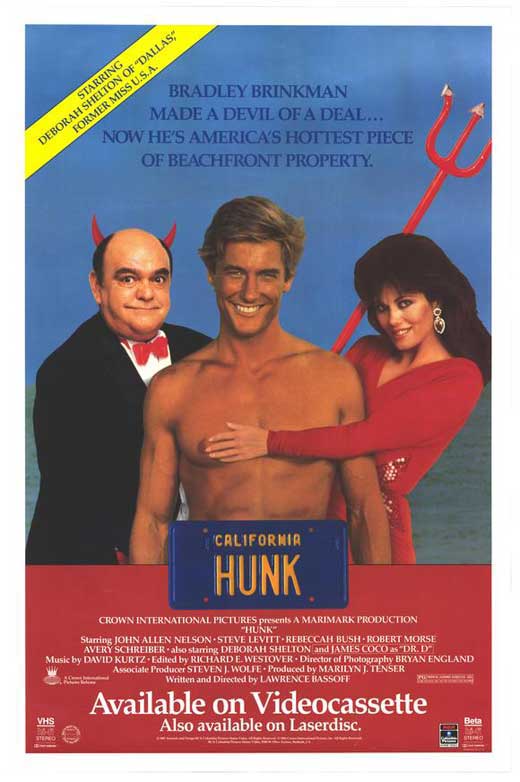
Spring Breakdown: Hunk (dir by Lawrence Bassoff)


https://www.youtube.com/watch?v=_tBgb_kUjho

Released in 1987, Hunk tells the story of Hunk Golden (John Allen Nelson).

At first glance, Hunk seems to have everything.  He lives in a huge house on the beach and he’s good-looking and muscular enough that he can actually pull off the rainbow speedo look.  Women want to be with Hunk and men want to be Hunk.  He’s rich.  He can eat all the food in the world without putting on a single pound.  He’s got a great smile and wonderful tan and he even knows karate!  Hunk drives a red convertible that has a personalized license plate, one that reads: HUNK.  If anyone else did it, it would seem narcissistic but Hunk can pull it off.

However, Hunk is deeply dissatisfied with his life.  As he explains to his psychiatrist, Dr. Sunny Graves (Rebecca Bush), he wasn’t always Hunk Golden.  He used to be a nerdy writer named Brady Brinkman (played by Steve Levitt).  After Brady’s girlfriend left him for an aerobics instructor, he somehow managed to write a guide to how to become rich.  Brady’s wasn’t sure where his inspiration came from but he was still able to make a fortune off of it.  After Brady moved to the beach to work on his next project, he discovered that being wealthy didn’t mean anything unless he also had the right look.

That’s when he was approached by O’Brien (Deborah Shelton), an emissary of the devil (James Coco).  O’Brien turned Brady Brinkman into Hunk Golden and taught him how to be …. well, how to be a hunk.  The only condition was that, after a number of months, Hunk would have to give up his soul to the devil.  Hunk agreed but now, with the deadline approaching, Hunk isn’t so sure that he wants to condemn his soul to eternal damnation.  Is being the hottest guy on the beach really worth an eternity of burning in fire and being poked with those little pitchfork things?

Now, it probably won’t come as a surprise to our regular readers to discover that this film was produced and distributed by Crown International Pictures.  From the 70s through the 80s, Crown International specialized in low-budget exploitation films, with a surprisingly large number of them taking place on the beach.  Nowadays, of course, the Crown International filmography can be found in countless Mill Creek boxsets.  Hunk can be found in several.  I own enough Mill Creek boxsets that I’ve probably got a dozen copies of Hunk in my DVD and Blu-ray collections.

That said, while the film’s low budget is obvious in every frame, Hunk is actually slightly better than the typical Crown International beach film.  While it seems to take forever for Brady to become Hunk, the film has got a likable cast and it actually delivers its message about self-acceptance with a surprising amount of sincerity.  This is the rare Crown International Film with a heart and, for every joke that falls flat (and there’s several), there’s at least a few unexpectedly clever moments.  The film takes an especially strange turn once Hunk becomes a celebrity and starts to wonder if he should accept the devil’s invitation to become a demon and help start a world war.  Steve Levitt and John Allen Nelson both do a good job playing Brady and his alter ego, though all of Nelson’s dialogue appears to have been dubbed.  James Coco delivers his evil lines with a properly devilish glee.  Incidently, this was also Brad Pitt’s first movie.  While he had no dialogue and went uncredited, he can be easily spotted as an extra in one of the beach scenes.
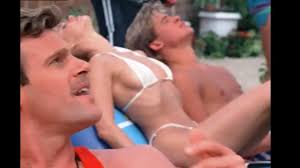
See him?

If you’re looking for silly and occasionally strange 80s beach movie, you could do worse than to check your Mill Creek boxsets for a copy of Hunk.
Six Other Films From Crown International Pictures That Deserved An Oscar Nomination!


An hour ago, I told you about the only Oscar nomination that was ever received by Crown International Pictures, one of the most prolific B-movie distributors of the 70s and 80s.  That nomination was for Best Original Song for Crown’s 1972 film, The Stepmother.

Here are 6 more films from Crown International Pictures that I think deserved some Oscar consideration:

The Teacher (1974)

“She corrupted the youthful morality of the entire school!” the poster screamed but actually, The Teacher was a surprisingly sensitive coming-of-age story about a relationship between a younger man and an older woman.  Jay North and Angel Tompkins both give excellent performances and Anthony James shows why he was one of the busiest character actors of the 70s.

2. The Sister In Law (1974)

John Savage has been acting for several decades.  He’s appeared in a number of acclaimed films but he’s never received an Oscar nomination.  One of his best performances was in this melancholy look at love, betrayal, and ennui in the early 70s.

3. Best Friends (1975)

One of the strangest films ever released by Crown International, Best Friends is also one of the best.  A road trip between two old friends goes terribly wrong when one of the friends turns out to be a total psycho.  This well-acted and rather sad film definitely deserves to be better-known than it is.

4. Trip With The Teacher (1975)

Zalman King for Best Supporting Actor?  Hell yeah!

5. Malibu High (1979)

Surely Kim Bentley’s performance as a high school student-turned-professional assassin deserved some sort of consideration!

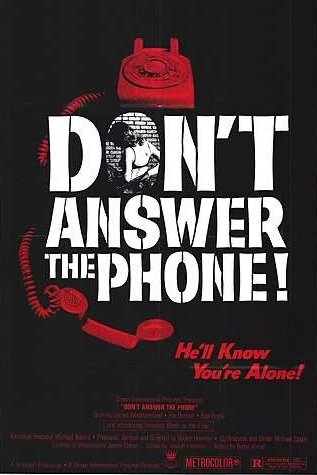
6. Don’t Answer The Phone (1980)

Don’t Answer The Phone is not a particularly good movie but it certainly is effective.  It made me want to go out and get a derringer or some other cute little gun that I could carry in my purse.  That’s largely because of the performance of Nicholas Worth.  Worth plays one of the most perverse and frightening murderers of all time and Worth throws himself into the role.  It’s one of the best psycho performances of all time and certainly worthy of a Best Supporting Actor nomination.

Crown International Pictures’s Only Oscar Nomination


If you’re fan of old movies that used to play in the grindhouses or at the drive-ins, you’re familiar with the Crown International Picture logo.

This logo appeared at the start of some of the most entertaining and cheaply made exploitation films of all time.  These were movies with titles like Malibu Beach, The Teacher, Cavegirl, They Saved Hitler’s Brain, The Sidehackers, My Tutor, Trip With The Teacher, Best Friends, and The Sister-in-Law.  These films may have never been critically acclaimed but they’re still being discovered and loved by viewers today.

Crown International Pictures was founded in 1959 and ceased operations in 1992.  Over the course of 43 years, the studio only received one Oscar nomination.  That was in 1972, for Best Original Song.  Written by Sammy Fain and Paul Francis Webster, Strange Are The Ways Of Love played over the credits for The Stepmother.

In honor of both the Oscars and Crown International Picture, here is Strange Are The Ways Of Love

Cleaning Out the DVR #14: SEX & VIOLENCE, 70’S STYLE!


Lisa’s not the only person who needs to clean out their DVR around here!!

gary loggins's avatarcracked rear viewer

Groundbreaking 60’s films like BONNIE & CLYDE, THE GRADUATE, THE WILD BUNCH, and MIDNIGHT COWBOY led to the complete obliteration of the Production Code, and by the sizzling 70’s it was anything goes! Low budget exploitation filmmakers benefitted most by this loosening of standards as the following quintet of movies illustrates, filled with bouncing boobs, bloody action, pot smoking, beer drinking, and hell raising:

THE MUTHERS (Dimension 1976; D; Cirio H. Santiago) – A Filipino-made “Women in Prison” Blaxploitation actioner? Yes, please! Former Playboy Playmates Jeanne Bell and Rosanne Katon, future NFL TODAY commentator Jayne Kennedy, and ex-Bond girl Trina Parks are all trapped on a coffee plantation run by the sadistic Monteiro with no chance of escape… until there is! Loaded with gore, torture, kung-fu fighting, bare breasts, a funky score, pirates (that’s right, pirates!), and a slam-bang run through the jungle – what more could you ask for?…

View original post 717 more words

Waterlogged: CATALINA CAPER (Crown International 1967)


gary loggins's avatarcracked rear viewer

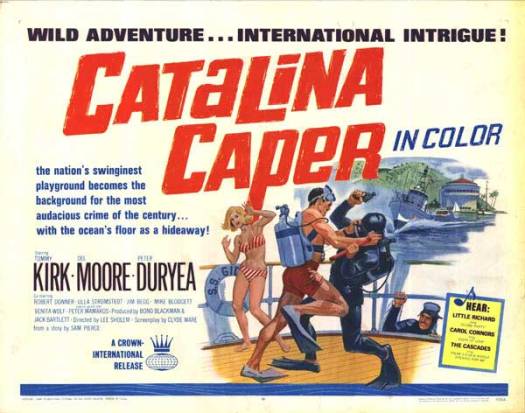
Beach Party movies had run their course by 1967, as AIP released their final entry in the surf cycle, THE GHOST IN THE INVISIBLE BIKINI, with Tommy Kirk  and Deborah Walley replacing Frankie and Annette , and nary a beach in sight. Crown International Pictures, AIP ‘s impoverished cousin (if one can imagine!), produced what is considered the last of the genre, CATALINA CAPER, also starring Kirk and a cast of dozens.

CATALINA CAPER is basically an lame excuse to get a bunch of young hardbodies on the beach and let ’em dance around to some dated rock music. Believe it or not, there’s a plot (though not a very good one) involving the theft of an ancient Chinese scroll masterminded by one of the teen’s con artist parents (Del Moore, Sue Casey) and a gangster trying to get ahold of it. There’s also a subplot (imagine that!) about Kirk torn between his bud’s sister (Venita Wolf) and a…

View original post 400 more words

The TSL’s Daily Horror Grindhouse: Don’t Answer The Phone (dir by Robert Hammer)


Nicholas Worth in Don't Answer The Phone

Nicholas Worth in Don’t Answer The Phone

AGCK!

As a self-described lover of grindhouse and exploitation films, I have seen my share of truly icky films.  But Don’t Answer The Phone, a 1980 mix of police procedural and serial killer horror, is in a class all by itself.  It is not only exceptionally icky but it’s distressingly effective as well.

After I watched Don’t Answer The Phone, I actually checked to make sure all the doors were locked.  Before I got into bed, I searched all the closets to make sure there wasn’t anyone hiding in there.  And, as I fell asleep, I found myself thinking that maybe I should follow the advise of both Arleigh and my sister.  Maybe it was time for me to finally get a gun of my own and learn how to use it.

Seriously, Bowman, I thought as I waited for sleep to come, you live in Texas.  It’s totally legal to carry a gun down here so you need to take advantage of the law and make you’re ready to blow any pervert losers away!  Even if you shot the wrong person, you’re cute.  The jury would never convict…

That’s the type of effect that Don’t Answer The Phone had on me.  It’s not necessarily a good film.  With one notable (and important) exception, most of the acting is terrible.  The film’s few attempts at intentional humor largely fall flat.  Even with a running time of only 94 minutes, Don’t Answer The Phone feels overlong and full of unneeded padding.  And yet, this is a very effective film.  It did freak me out, largely because it was so crude and heartless.  It strikes at the most primal fears of the viewer, that feeling that — even within the security of our own home — we may not truly be safe.

As Don’t Answer The Phone opens, Los Angeles is a city being stalked by a madman.  That, in itself, is not surprising.  Just taking a quick look at Wikipedia will reveal that Los Angeles has been home to a large number of serial killers.  In fact, if there is anything shocking about Don’t Answer The Phone, it’s the suggestion that Kirk Smith (played by Nicholas Worth) is the only serial killer in town.

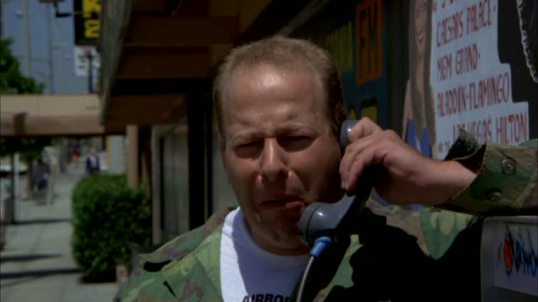
Who is Kirk Smith?  He’s an overweight, bald photographer who always wears an army jacket and is obsessed with candles, body building, and strangulation.  He also enjoys calling up a local talk show host, Dr. Linsday Gale (Flo Gerrish).  (One wonders if Dr. Gale’s name was specifically meant to make the viewer think of The Wizard of Oz.)  “Hello,” he says in an outrageously fake accent, “this Ramon!”  He tells Dr. Gale that he has frequent headaches and bad urges.  When he’s not pretending to be Ramon, Kirk can usually be found staring at himself in a mirror and yelling, “Do I measure up, Dad!?”

Kirk is killing women across Los Angeles and it looks like he might never be caught because Don’t Answer The Phone features some of the most incompetent cops ever!  These are the type of cops who smirk at the victims and shoot anyone who doesn’t get on the ground fast enough.  These are the type of cops who open fire and then say, “Adios, creep.”  Civil liberties!?  BLEH, THESE COPS DON’T HAVE TIME FOR YOUR RIGHTS!  Of course, they do end up shooting and killing the only witness who can identify Kirk Smith as the murderer.  Whoops!

If there’s anything that sets Don’t Answer The Phone apart from all the other serial killer films, it’s the performance of Nicholas Worth.  Far more than the slick and erudite serial killers who dominate contemporary thrillers, Nicholas Worth is a frighteningly believable lunatic.  He’s scary because we’ve all seen his type wandering the streets.  We’ve all felt his stare linger for a few seconds too long and we’ve all had the same feeling of dread when we saw him approaching us.  Reportedly, Worth did a lot of research on actual serial killers before taking on the role of Kirk Smith and his performance is terrifying because it is so real.

It’s icky to watch but, at the same time, it do serve to remind us that there are real life Kirk Smiths out there.

Agck!  Seriously, it makes me shake just thinking about it.

I’m getting a gun…

DAtP

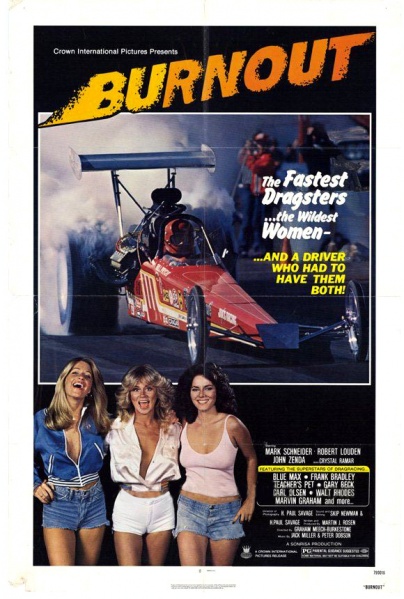
Embracing the Melodrama Part II #60: Burnout (dir by Graham Meech-Burkestone)


404px-BurnoutLe sigh.

In the future, when I decide to do a HUGE and impractical series of reviews, I’m going to make sure that I only include films that I’ve already seen.  Because, seriously, I added Burnout without knowing much about the film, other than it was a Crown International Film.  Eventually, I hope to be able to say that I’ve reviewed every single film released by Crown International.  I knew that I’d have to watch and review Burnout some time so why not now?

CIP_Logo

Before adding the film to my list of films to review, I did at least read a synopsis of the film’s plot.  Here’s what it says on the back of Mill Creek’s Savage Cinema box set:

“A trouble teenager, whose sole desire is to become a great drag racer, almost ruins his own dreams when he spurns his dad’s racing advice.  But support from his girlfriend enables him to prove his abilities to the racing world.”

Hey, that sounds really melodramatic, doesn’t it?  (In fact, it sounds kinda like the plot of the film At Any Price…)  That’ll be perfect for a series called Embracing the Melodrama, Part II.  Let’s watch it right now…

Well, don’t bother.  Burnout is basically 75 minutes of stock footage with 15 minutes of bad actors mouthing really bad dialogue.  Whenever we watch the races, we hear an announcer saying stuff like, “This is really exciting!” or “This is his first time to race!” or “OH MY GOD!  THIS IS REALLY FREAKING EXCITING!” (okay, I may have imagined that last one) and you have to be thankful for the announcer because otherwise, you’d never know who actually won anything.  This is one of the worst acted, worst edited, worst directed, worst written films that I’ve ever seen.  And, after countless posts in which I’ve defended their films, I have to announce that this is probably a strong contender for the worst film to ever be released by Crown International.

Bleh!  Enough of this review.  Burnout is 90 minutes of my life that I will never get back.  I refuse to spend any more time thinking about it.


Embracing the Melodrama Part II #52: Best Friends (dir by Noel Nosseck)


best-friends-lobby-3So, this is kind of a weird one.

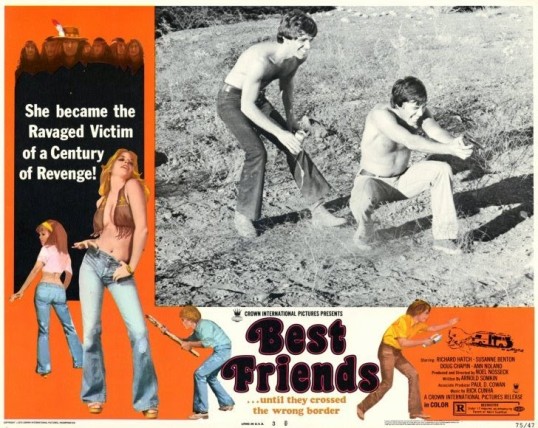
If the 1975 film Best Friends is known for anything, it’s probably the poster above.  As you can see, it features two women, being watched over by a shadowy group of Native Americans.  That tagline reads: “She became the ravaged victim of a century of revenge!”

Now, it’s often said that the above image has absolutely nothing to do with the actual film.  That’s actually not quite true.  There is a very brief scene where a woman and her boyfriend are at a bar and the boyfriend goads her into doing an impromptu striptease.  Sitting in the audience are some glowering American Indians.  There is a minor confrontation but otherwise, that’s it.  Nobody becomes “the ravaged victim of a century’s revenge.”  Instead, it was simply a marketing plot, used to draw audiences to a film that might otherwise have struggled to have been seen.

Perhaps not surprisingly, Best Friends is a Crown International Production.

CIP_LogoAs for what Best Friends actually is — well, it’s not easy to say.  It’s a very odd and very dark film, one that deals with characters who are ambiguous in more ways than one.  It’s one of those films that would be forgotten if it hadn’t, by chance, been included in a few dozen Mill Creek box sets and yet, from what I can tell, it has made an impression on just about everyone who has seen it.

In many ways, it’s a film that could only have been made in the 1970s.  Pat (Doug Chapin) and Jesse (Richard Hatch) served in Vietnam together and have remained close friends in America.  Jesse is serious and centered.  Pat is wild and impulsive.  Jesse has rented an RV and plans to drive across America with his fiancée, Kathy (Susanne Benton).  Pat suddenly announces that he’s engaged to and maybe he and Jo Ella (Ann Noland) could join Jesse and Kathy on their trip.  Even though Kathy would probably rather not have to share the RV with Pat’s old air force friend and his overly unstable girlfriend, Jesse readily agrees.

Now, I know this all sounds like the setup for a celebration of bromance but Best Friends actually has something else on its mind.  From the minute that Jesse and Pat get in that RV, it becomes obvious that they don’t have as much in common as they once did.  Jesse has matured.  He’s looking forward to the future and he wants to spend his time with Kathy.  Pat, however, is still obsessed with the past and wants to spend all of his time with Jesse.

As they drive across the country, Pat’s behavior starts to become more and more obsessive.  He cruelly breaks off his engagement with Jo Ella and then appears to be personally insulted when Jesse doesn’t do the same with Kathy.  He even buys a motorcycle so that he can ride behind, in front of, or next to the RV, as if the idea of even being inside of Jesse’s domesticated world would contaminate him.

And, since this is a Crown International Picture, Pat isn’t hesitant about using violence to try to keep Jesse and Kathy apart…

So, what is Pat’s problem?  A lot of reviewers have suggested that Pat is in love with Jesse and they’re probably right.  What’s interesting is that, consider that he’s the film’s nominal hero, Jesse isn’t that sympathetic of character.  If anything, he comes across as being a wimp, a guy who says he loves his fiancée but still won’t stand up for her.  As the film progresses, Jesse’s inherent impotence becomes both more obvious and more annoying.  By the end of the film, after all of the tragedy has played out, you can’t help but feel that Jesse and Pat don’t deserve any better than each other.

Best Friends is a deliberately paced and rather haunting little film.  It’s definitely one of the best of the many films to come out of Crown International Pictures.

Embracing the Melodrama #47: The Sister-in-Law (dir by Joseph Ruben)


The_Sister-in-Law(SPOILERS BELOW)

After watching enough old movies, I’ve become convinced that the early 1970s must have been the darkest and most cynical time in American history.  It seems like almost every film released from roughly 1970 to 1977 was required to end on a down note.  Even the happy endings were full of ambiguity.  (American Graffiti, a feel-good film according to the reviews that were written at the time of its initial release, ends with one of the characters dying in a car accident and another one MIA in Vietnam.)  I’m not complaining, of course.  I love a sad ending.

Maybe that’s why I so love the 1973 film The Sister-in-Law.  The film starts out as a typical melodrama from Crown International Pictures but it has one of the darkest endings that I’ve ever seen.  In fact, the ending is so dark that it’s pointless to review The Sister-in-Law without telling you how the movie ends.  So, consider this to be your final SPOILER WARNING:

CIP_LogoOkay, ready?

Robert Strong (played by John Savage) is a genuinely likable musician who has spent the last year or so hitchhiking across America.  He decides to visit his wealthy older brother, Edward (Will MacMillan).  It quickly becomes apparent that Robert and Edward are almost insanely competitive with each other.  A friendly day of fun in the pool ends with Edward nearly downing his younger brother.

Robert gets back at Edward by having an affair with Edward’s wife, Joanna (Anne Saxon).  However, Robert eventually breaks things up with Joanna and starts sleeping with Deborah (Meredith Baer), who happens to Edward’s former mistress.

Edward, however, has problems beyond dealing with his wife and his mistress.  It turns out that he’s made all of his money by smuggling drugs into America from Canada.  Now, the Mafia is demanding that Edward bring in a huge shipment of heroin.  Edward, however, convinces his brother to do it for him.

Robert and Deborah drive up to Canada and pick up the heroin.  However, as they do so, they talk about how sick they are of being used by Edward.  So, Robert and Deborah pull over next to a waterfall and, in a surprisingly lyrical scene, they dump all the heroin into the water supply.

And then they make love in the forest.

Well, the mafia wants to know what happened to their heroin.  So, Edward and Joanna get on an airplane and flee the country.  Meanwhile, Robert and Deborah are pulled over by two gangsters.  Robert is pulled out of the car and executed in the middle of the street.  The gangsters drive away.  Deborah collapses to her knees and sobs over Robert’s dead body.

The end.

Seriously, that’s how the movie ends.  The gangsters get away with it.  Hateful Edward and his self-centered wife escape the country.  Deborah is in tears.  And Robert, the one truly likable person in the entire film, lays dead in the street.

Not even David Fincher could make a film this dark.  And, honestly, the darkness at the heart of The Sister-in-Law feels considerably more potent and tragic than anything you could find in any Fincher film.  As played by a very young John Savage (who, just last year, played the President in Bermuda Tentacles), Robert is such a likable guy that you’re glad you got to spend a little bit of time with him before he was brutally murdered in the middle of the street.  Robert’s violent death sticks with you.

(Savage also sung several of the surprisingly catchy songs on the film’s soundtrack.)

Despite or perhaps because of the ultra-dark ending, The Sister-in-Law is one of my favorite Crown International films.  If nothing else, it proves that 1973 was apparently even darker than 2015.

Embracing the Melodrama Part II #43: The Stepmother (dir by Howard Avedis)


stepmotherJust looking at the poster for the 1972 film The Stepmother, I bet you think it’s a pretty scandalous and sordid film.  I mean, there’s a picture of a woman wearing a black bra and there’s a tagline that reads, “She forced her husband’s son to commit the ultimate sin!”

CIP_Logo

Well, perhaps not surprisingly considering that this is a Crown International film, The Stepmother‘s poster and tagline have very little do with the actual film.  Yes, the film does feature a stepmother and, during the final 20 or so minutes of the film, her stepson does finally show up and she does end up sleeping with him.  It’s consensual.  There’s no forcing involved.  And, as far as the ultimate sin part is concerned — well, her husband has been doing a lot worse.

The film itself is actually about the husband.  Frank Delgado (Alejandro Rey) is a wealthy architect who is also insanely jealous of his new wife, Margo (Katherine Justice).  Whenever he suspects that Margo is cheating on him, he ends up killing someone.  And, as a matter of fact, even when he doesn’t think Margo is cheating on him, he ends up killing someone.  Frank, of course, has to find a way to cover up all of his various murders.  It doesn’t help that Inspector Darnezi (John Anderson) is constantly snooping around.  And then, once he discovers that his stepson actually has slept with Margo (as opposed to all the people he killed just because he assumed they had slept with Margo), Frank is forced to decide whether or not to kill his own son.

The Stepmother is available in about a dozen Mill Creek boxsets and it’s fun in a 1972 sort of way.  Frank and all of his friends are decadent rich people so you could argue that the film is meant to be a portrait of the immorality of the 1%.  (That would actually be a pretty stupid argument but it’s one that you could make if you’re trying to impress someone who hasn’t read this review.)  Director Howard Avedis tries to liven up the plot by including a lot of artsy touches that don’t really add up to much but which are still fun to watch.  Occasionally, he’ll toss in a freeze frame for no particular reason.  As well, Frank has a habit of hallucinating.  He continually sees his first victim running across the beach in slow motion.  Make a drinking game out of it.  Every time it’s obvious that The Stepmother was trying to fool people into thinking it was a European art film, take a drink.

To be honest, the most interesting thing about The Stepmother is that it is the only Crown International film to have received an Oscar nomination!  That’s right!  The Stepmother was nominated for Best Original Song.  The name of the song was Strange Are The Ways Of Love.  You can listen to it below if you want.  Feel free to dance.

Anyway, that’s The Stepmother for you.  It’s not my favorite Crown International film but, as a historical oddity, it’s still worth watching.

http://www.youtube.com/watch?v=lKO-U5J4Vrs