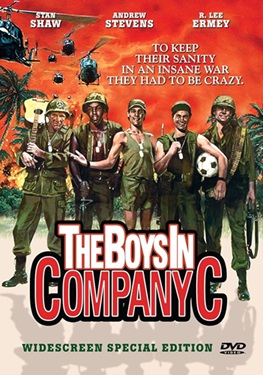
The Boys In Company C (1978, directed by Sidney J. Furie)


In 1967, a group of young men arrive at the Marie Corp. Recruit Depot in San Diego.  Tyrone Washington (Stan Shaw) is a drug dealer from Chicago who tells everyone not to mess with him and who soon emerges as a natural born leader.  Dave Brisbee (Craig Wasson) is a long-haired hippie who tried to feel to Canada and who shows up for induction in handcuffs.  Vinny Fazio (Michael Lembeck) is a cocky and streetwise kid from Brooklyn.  Billy Ray Pike (Andrew Stevens) is a country boy from Texas.  Alvin Foster (James Canning) is an aspiring writer who keeps a journal of his experiences.  Sgt. Loyce (R. Lee Ermey, making his film debut) molds them into a combat unit before they leave for Vietnam, where they discover that all of their training hasn’t prepared them for the reality of Vietnam.

The Boys In Company C has the same basic structure as Stanley Kubrick’s Full Metal Jacket, right down to R. Lee Ermey playing the tough drill sergeant.  The sharp discipline of basic training is compared to the chaos of Vietnam.  Ermey always said that he was playing a bad drill sergeant in Full Metal Jacket because he tore down the recruits but never bothered to build them back up.  In The Boys In Company C, Ermey plays a good drill sergeant, one who is tough but fair and who helps Washington reach his potential.  It doesn’t make any difference once the company arrives in Vietnam, though.  Both The Boys In Company C and Full Metal Jacket present the war in Vietnam as being run by a collection of incompetent officer who have no idea what it’s like for the soldiers who are expected to carry out their orders.

Of course, The Boys In Company C is nowhere near as good as Full Metal Jacket.  Full Metal Jacket was directed by Stanley Kubrick and it’s a chilling and relentless look at the horrors of combat.  The Boys In Company C was directed by Sidney J. Furie, a journeyman director who made a lot of movies without ever developing a signature style.  The basic training scenes are when the film is at its strongest.  When the company arrives in Vietnam, Furie struggles with the story’s episodic structure and it can sometimes be difficult to keep track of the large ensemble cast.  The Vietnam sequences are at their best when the emphasis is on the soldiers grumbling and bitching as their officers send them on one pointless mission after another.  The soccer game finale tries to duplicate the satire of the football game that ended Robert Altman’s M*A*S*H but it does so with middling results.  The Boys in Company C is a collection of strong moments that never manage to come together as a cohesive whole.

The movie is still important as one of the first major films to be made about the war in Vietnam.  However, it’s since been overshadowed by The Deer Hunter, Apocalypse Now, Platoon, and, of course, Full Metal Jacket.


The TSL’s Grindhouse: Schizoid (dir by David Paulsen)


The 1980 film, Schizoid, is all about the things you can do with scissors.

For instance, in the days before email, text messages, and social media, scissors could be used to cut words out of a magazines.  Those words could then be carefully pasted onto construction paper and then sent to an advice columnist like Julie Caffret (Marianna Hill).  Julie is pretty upset when she starts getting the notes, largely because they promise an anonymous reign of terror and murder.  The police, however, say that the notes probably don’t meant anything.  They’re probably just a hoax.  I mean, it’s true that several members of Julie’s therapy group have recently been murdered but the letters all talk about committing murder with a gun.  Whereas the members of the therapy group are being murdered by someone wielding …. SCISSORS!  (Cue that dramatic music.)

Of course, Julie has other things to worry about.  For instance, her ex-husband, Doug (Craig Wasson), is still in her life.  He’s putting up wallpaper in her office.  Or, at least, that’s what he says he’s doing.  It’s hard not to notice that he doesn’t seem to be making much progress with the job.  Plus, he apparently sleeps in the office, which just seems odd.  Then, there’s the building’s creepy maintenance man, Gilbert (Christopher Lloyd), who specializes in making people uncomfortable on elevators.  And then there’s the fact that Julie’s therapist, is played by Klaus Kinski!

Seriously, if you were looking for a therapist, would you go to Klaus Kinski?

From the minute Klaus shows up, it’s pretty obvious that the film wants us to assume that he’s the killer and really, it’s hard not to make that assumption.  We’re so used to seeing Klaus Kinski play evil and villainous characters and, even 30 years after his death, there are so many stories out there about how difficult Klaus Kinski could be to work with in real life that our natural reaction is to believe any character he plays must have a sinister motivation.  In this film, Klaus’s character has an out-of-control teenage daughter (Donna Wilkes) who tries to commit suicide by locking herself in the garage with a running car.  When Klaus takes an axe to the garage door, we’re left to seriously wonder if he’s planning on killing her or if he’s actually trying to save her life.  That said, Schizoid actually makes good use of Kinski’s menacing persona and Kinski himself gives a performance that elevates the entire film.  Kinski actually does manage to keep you guessing as to whether or not the therapist is a monster or if he’s just kind of a jerk.

Schizoid is usually classified as a slasher film, though it actually has more in common with the classic Italian giallo films that it does with any of the Friday the 13th sequels.  The killer’s identity is masked through POV shots and, in typical giallo fashion, the killer wears black gloves while committing his crimes.  We spend a good deal of the film following the police investigation, which is a typical element of the giallo genre but which is usually treated as an afterthought in post-Friday the 13th slasher films.  Much like Fulci’s The New York Ripper, Schizoid is a violent journey into the heart of darkness, a look at a world with no morality and no safety.  Also like Fulci’s film, it’s so shamelessly sleazy that it’s easy to miss the fact that it’s actually rather well-directed and acted.

Schizoid turned out to be a better film that I was expecting.  That said, I still have to wonder why anyone would select Klaus Kinski to be their therapist.

A Movie A Day #305: Go Tell The Spartans (1978, directed by Ted Post)


One of the best films ever made about Vietnam is also one of the least known.

Go Tell The Spartans takes place in 1964, during the early days of the Vietnam War.  Though the Americans at home may not know just how hopeless the situation is in South Vietnam, Major Barker (Burt Lancaster, in one of his best performances) does.  Barker is a career military man.  He served in World War II and Korea and now he’s ending his career in Vietnam, taking orders from younger superiors who have no idea what they are talking about.  Barker has been ordered to occupy a deserted village, Muc Wa.  Barker knows that occupying Muc Wa will not make any difference but he is in the army and he follows orders.

Barker sends a small group to Muc Wa.  Led by the incompetent Lt. Hamilton (Joe Unger), the group also includes a drug-addicted medic (Dennis Howard), a sadistic South Vietnamese interrogator (Evan C. Kim) who claims that every civilian that the men meet is actually VC, a sergeant (Jonathan Goldsmith) who is so burned out that he would rather commit suicide than take command, and Cpl. Courcey (Craig Wasson).  Courcey is a college-educated idealist, who joined the army to do the right thing and is now about to discover how complicated that can be in South Vietnam.  At Muc Wa, the soldiers find a cemetery containing the graves of French soldiers who died defending the hamlet during the First Indochina War.  The inscription as the cemetery reads, “Go tell the Spartans, stranger passing by, that here, obedient to their laws, we lie.”  

Because the film strives for realism over easy drama, Go Tell The Spartans has never gotten the same attention as some other Vietnam films.  Unlike The Deer Hunter, Platoon, Coming Home, and Born on the 4th of July, Go Tell The Spartans received no Oscar nominations.  It is still a brilliantly acted and powerful anti-war (but never anti-soldier) film.  It starts out as deceptively low-key but the tension quickly builds as the soldier arrive at Muc Wa and discover that their orders are both futile and impossible to carry out.  Vastly outnumbered, the Americans also find themselves dealing with a land and a culture that is so unlike their own that they are often not even sure who they are fighting.  Military discipline, as represented by Lt. Hamilton, is no match for the guerilla tactics of the VC.  By the film’s end, Vietnam is revealed to be a war that not even Burt Lancaster can win.

Horror Film Review: Ghost Story (dir by John Irvin)


ghoststory

A Fred Astaire horror movie!?

Yes, indeed.  Ghost Story is a horror movie and it does indeed star Fred Astaire.  However, Fred doesn’t dance or anything like that in Ghost Story.  This movie was made in 1981 and Fred was 82 years old when he appeared in it.  Fred still gave an energetic and likable performance and, in fact, his performance is one of the few things that really does work in Ghost Story.

Fred Astaire isn’t the only veteran of Hollywood’s Golden Age to appear in Ghost Story.  Melvyn Douglas, John Houseman, and Douglas Fairbanks, Jr. all appear in the movie as well.  They play four lifelong friends, wealthy men who have formed an informal little club called The Chowder Society.  They gather one a week and tell ghost stories.  Myself, I’m wondering why these four intelligent and accomplished men (one is a lawyer, another a doctor, another a politician, and another is Fred Astaire) couldn’t come up with a better name than Chowder Society.

(But I guess that’s something that people do up north.  Harvard has something called the Hasty Pudding Club, which just sounds amazingly annoying.)

Unfortunately, the members of the Chowder Society have a deep, dark secret.  Way back in the 1930s, the boys listening to too much jazz and they all ended up lusting after the mysterious and beautiful Eva Galli (Alice Krige).  As Astaire explains it, “We killed her, the Chowder Society.”

(Of course, there’s more to the story.  It was more manslaughter than murder but either way, it was pretty much the fault of the Chowder Society.)

And now, decades later, a woman named Alma (Alica Krige, again) has mysteriously appeared.  When she sleeps with David (Craig Wasson), the son of a member of the Chowder Society, David falls out of a window and ends up splattered on the ground below.  David’s twin brother, Don (also played by Craig Wasson), returns to their childhood home and attempts to make peace with his estranged father.

However, now the member of the Chowder Society are starting to die.  One falls off a bridge.  Another has a heart attack in the middle of the night.  Fred Astaire thinks that Eva has come back for revenge.  John Houseman is a little more skeptical…

I pretty much went into Ghost Story with next to no knowledge concerning what the film was about.  I thought the plot desription sounded intriguing.  As a classic film lover, I appreciated that Ghost Story was not only Fred Astaire’s final film but the final film of Douglas and Fairbanks as well.  Before he deleted his account, I had some pleasant interactions with Craig Wasson on Facebook.   I was really hoping that Ghost Story would be a horror classic.

Bleh.

Considering all the talent involved, Ghost Story should have been great but instead, it just fell flat.  Alice Krige is properly enigmatic as both Alma and Galli and really, the entire cast does a pretty good job.  But, with the exception of exactly three scenes, the film itself is never that scary.  (Two of those scary scenes involve a decaying corpse and it’s not that hard to make decay scary.  The other is a fairly intense nightmare sequence.)  Largely due to John Irvin’s detached direction, you never really feel any type of connection with the characters.  I mean, obviously, you don’t want to see the star of Top Hat die a terrible death but that has more to do with the eternal charm of Fred Astaire than anything that happens in Ghost Story.

Add to that, Ghost Story‘s special effects have aged terribly.  There are two scenes in which we watch different characters fall to their death and both times, you can see that little green outline that always used to appear whenever one image was super imposed on another.  It makes it a little hard to take the movie seriously.

Sadly, Ghost Story did not live up to my expectations.  At least Fred Astaire was good…