Christopher Lee was a man of many talents. Over the course of his long life, he wrote books, he recorded albums, he performed Shakespeare on stage, and he appeared in so many films that he himself reportedly had trouble remembering them all. During World War II, Lee served in the British Secret Service with his cousin, Ian Fleming, and was reportedly one of the inspirations for the character of James Bond. (Of course, Lee would eventually play Scaramanga in The Man With The Golden Gun.)
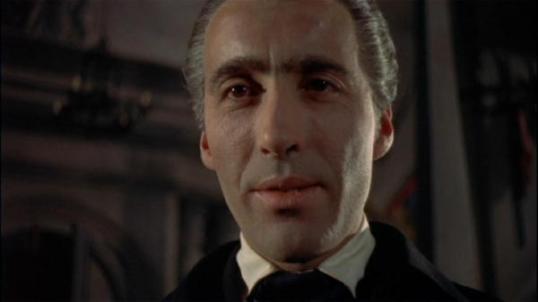
Up until he played Saruman in The Lord of the Rings and Count Dooku in the Stars Wars prequels, Lee was best-known for his performances as Dracula in several Hammer films. By his own account, though, Lee never really cared for Hammer’s interpretation of Dracula. He felt that Hammer did the character a disservice by portraying Dracula as just being a snarling villain. In 1970, Lee finally got his chance to star in a faithful adaptation of Bram Stoker’s original novel when he starred in Jess Franco’s Count Dracula.
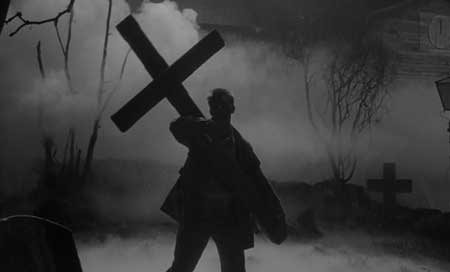
In the scene, an aged Dracula greets Jonathan Harker.
Filmed, reportedly over the course of a few days, in 1974 but not released until 1977, The MeatcleaverMassacre is known for two things.
First off, it’s known for opening and ending with on-screen narration for Christopher Lee. The distinguished-looking Lee begins the film sitting in what appears to be his own personal office. He talks to us about the history of the supernatural and the paranormal and he suggests that the story that we’re about to see, may very well change someone like me from being a skeptic into a believer.
Secondly, MeatCleaverMassacre is known for being one of the last films to be directed by the infamous Edward D. Wood, Jr. Now, it should be understood that Wood didn’t have anything to do with writing or producing the film. And when filming started, the director was a guy named Ken Burns who I assume is not the famed documentarian. Unfortunately, Burns was judged not to be up to the role of directing and he was fired. Edward D. Wood, Jr., who by this point was living in alcoholic squalor in Los Angeles and making his money through writing pornographic books, was brought in as his replacement. When the film was released, the director was credited as being “Evan Lee.” It wasn’t until 2022 that the film’s cinematographer (who was not paid for his work on the film) posted on Facebook that Ed Wood was the director. The cinematographer’s claim was backed up by the film’s editor.
Now, my immediate reaction to learning this was to think: “Oh my God, Ed Wood directed Christopher Lee!”
Well, sorry …. no. All the evidence points to Wood directing Meat Cleaver Massacre. It’s an Ed Wood film, even if it doesn’t feature Wood’s trademark obsession with angora. But the two scenes with Christopher Lee were apparently filmed for a different project, one that was abandoned. In 1977, the distributors of Meatcleaver Massacre purchased the footage of Christopher Lee and inserted it into their film, which was promptly sold as a Christopher Lee film. But the truth of the matter is that Lee’s footage was obviously meant for a far “classier” film than Meatcleaver Massacre and, judging from how dismissive Lee tended to be of the work that he did strictly for the money, it’s totally possible that he didn’t even know that he had become the star of Meatcleaver Massacre.
As for Ed Wood, he died a year after this film was released. At the time of his death, he had been evicted from his apartment and his landlord apparently threw away all of his scripts and movie memorabilia. Sorry, everyone. The first half of Ed Wood’s life story may be popular and funny but it definitely did not lead to a happy ending.
But what about Meat Cleaver Massacre, you may be asking. Well …. actually, it’s not terrible. It’s definitely a low-budget affair and none of the actors are particularly impressive but there are a few scenes that work when taken on their own terms.
James Habif stars as Professor Cantrell, who is first seen teaching a class on how to summon an Irish demon and then returning home to his family. Unfortunately, that night, one of this students, Mason (Larry Justin), orders his gang to break into Cantrell’s house. Mason says that he just wants to play a prank on the professor but instead, he and his idiot friends murder Cantrell’s family and leave Cantrell in a paralyzed state. That said, Cantrell may be paralyzed but he can still summon the demon Morak to hunt down and kill all of Mason’s friends, one-by-one. The deaths are grisly, with Mason’s home invasion bringing to mind the crimes of the Manson’s family and the demon’s acts of vengeance ranging from a disembowelment in the desert to an accident in a garage to an exploding movie projector.
As with most of Ed Wood’s film, the pacing is a bit off and the film is edited in such a way that it’s sometimes difficult to keep track of how much time has passed between scenes. The acting isn’t great, though it’s really not any worse than the acting you would expect to find in a low-budget 70s horror film. The scene in which one of Mason’s gang meets his fate in the desert is actually rather well-done and intentionally surreal. To be honest, there’s not much about the film that would make you think it was an Ed Wood production. As I said before, there’s no references to angora. There’s no Kelton the Cop. Criswell doesn’t make an appearance. By most accounts, Ed spent the final decade of his life broke and doing whatever he had to do to scrounge up enough cash to pay his rent and keep drinking. Doing whatever he had to do included directing films like Meatcleaver Massacre. I wonder how many other films were secretly directed with Ed Wood?
Anyway, if you’re a Christopher Lee or Ed Wood completist, Meatcleaver Massacre is currently available on Tubi.
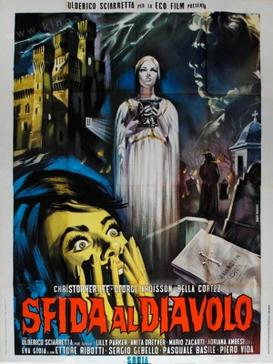
A criminal named Carlo lands in Italy and soon finds himself being pursued a group of gangsters. An extended shoot-out leads to Carlo being serious wounded. Carlo stumbles into a church, where he is met by a monk who used to be an friend of his. Carlo explains that he has been blackmailing a Beirut crime lord and now the crime lord’s men are after him. Unfortunately, Carlo gave all the evidence to an exotic dancer and now he needs the evidence back but, obviously, he can’t show his face in the streets. The monk goes to a nightclub and, after watching several different cabaret acts that have nothing to do with the rest of the film, he finally gets a chance to talk to the dancer. The dancer is also an old friend of his but hasn’t seen him since he became a monk and she demands to know what led to this development in his life. The monk tells her the story of his past, in return for her giving him the evidence.
In the distant past, the monk was a part of a motorcycle gang led by wannabe gangster Gian (Mario Polletin) and a failed poet, Gugo (Giorgio Ardisson). One day, Gian, Gugo, the future monk, and their respective girlfriends decided to break into an apparently deserted castle, where they decided to have a wild party. Of course, to them, a wild party meant playing the bongos and drinking wine. However, it turned out that the castle wasn’t totally deserted. There was an old man (Christopher Lee) living in the castle and the old man explained that the love of his life had died years before and that her body was somewhere in the castle. If Gugo and the gang found her body and brought her to the old man so that he could give her a decent burial before his own death, the old man would give them the castle. The greedy and drunken gang agreed but they soon discovered that the castle was full of secrets and the old man was not quite who he claimed….
Challenge The Devil is a thoroughly disjointed film, one with a plot that is almost impossible to follow. Some of that is because of the film’s troubled production history. Originally, the film was titled Katarsis and it was simply about the gang coming across the castle and meeting Christopher Lee. However, after the film was shot, the production company went out of business and the film’s new owner decided to re-edit the film and tack on the scenes involving Carlo, the dancer, and the monk. None of the new scenes fit with the style of the old scenes and, indeed, all of the nonsense with Carlo and the dancer means that the film’s main story doesn’t even get started until after about 20 minutes of filler. Of course, it should be noted that even the original version of the film doesn’t look like it was that good. This was director Giuseppe Vegezzi’s only feature film and he shows very little natural ability when it comes to framing shots or creating atmosphere.
But what about Christopher Lee, you may be asking. He’s fine. I mean, Christopher Lee is imposing and his physical presence is so strong that he even makes an impression in a bad film. But Lee only gets a few minutes of screen time. For his part, Lee said that this was one of the film that he did for the money and he never actually saw the finished product. I don’t blame him. This one is for Lee completists only.
Once, during an interview, the distinguished British horror actor, Christopher Lee, was asked to name the worst film in which he had appeared.
Being a very busy actor who appeared in well-over 200 films, Lee paused for a minute to give it some thought and then eventually said that, in 1977, he had appeared in a Canadian science fiction film in which he played a mute alien who was using a suicide ray to conquer Earth. Though he wasn’t quite sure what the title had been, that was his pick for the worst movie in which he had ever appeared.
Now, considering some of the films in which Lee appeared, that’s a bold statement. Was Lee correct? Was that film — which was entitled Starship Invasions — the worst film in which he ever appeared?
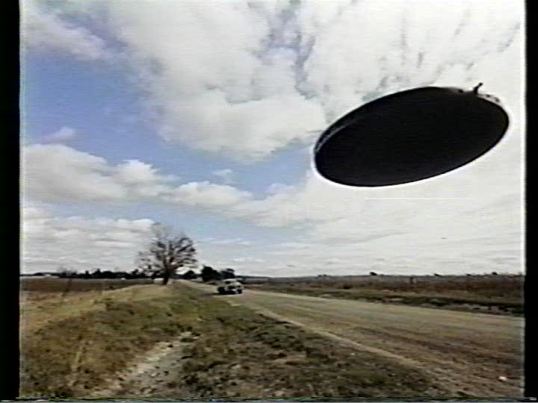
Well …. maybe. It’s certainly not one of his best. Lee plays Captain Ramses, who is the leader of the Legion of the Winged Serpents. The legion’s home planet is about to be destroyed by a supernova so he has taken it upon himself to find a new planet to colonize. Earth looks pretty good to him!
Christopher Lee remembered Ramses as being mute. Actually, he communicates through telepathy. We hear his words but his lips never move. The same is true of every alien that appears in the film. And yes, this could be an example of how different and more advanced the aliens are when compared to the humans but a more likely explanation is that it was cheaper to film the outer space scenes without sound and then just dub in the character’s “thoughts” later.
For reasons that are never quite clear, the Legion of the Winged Serpent abducts several Earthlings before then unleashing their suicide ray. Prof. Allan Duncan (Robert Vaughn) is the UFO expert who investigates the abductions before eventually getting abducted himself by a race of good, gray aliens. The gray aliens are determined to save the Earth from the Legion. It’s never really explained why.
Meanwhile, the suicide ray is causing chaos on Earth as people all over are driven to kill themselves and others. And the ray has just been aimed at Duncan’s wife (played by Helen Shaver) so Allan and the good aliens better hurry up and defeat Ramses and the bad aliens!
Is Starship Invasions really that bad? Well, it’s certainly not …. great. Christopher Lee is properly imposing as Ramses but even he occasionally has a “What have I gotten myself into?” look on his face. Most of all, Starship Invasions is very much a product of the 1970s. When Ramses visits a space station, it looks a lot like an incredibly tacky mix of a fitness center and a cocktail lounge. The fashion of both the Earthlings and the aliens is very much of the era. Robert Vaughn wears a turtleneck that just screams “community college history teacher.” The special effects are rather cheap and the plot never makes much sense. The scenes with the suicide ray, however, are surprisingly effective and the film does have a certain campy charm to it, especially if you’re into low-budget 70s sci-fi. Starship Invasions is probably not Christopher Lee’s worst film. It’s just one of his cheapest.
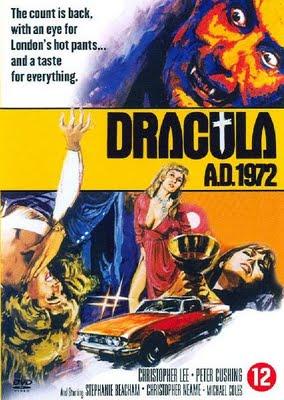
Even in the year 1972, Count Dracula (Christopher Lee) could not escape Prof. Van Helsing (Peter Cushing). Of course, the Van Helsing here was a descendant of the Van Helsing who gave Dracula such a hard time in the 19th century but still, Dracula was not thrilled to see him.
This scene is from Hammer’s Dracula A.D. 1972. It’s not generally considered to be one of the better Dracula films but I enjoy any chance to see Peter Cushing and Christopher Lee (who were the closest of friends off-screen) acting opposite each other.
The City of the Dead, a 1960 British horror film that is also known as Horror Hotel, takes place in the town of Whitewood, Massachusetts. (Though it takes place in America, this is a very British film, from the cast to the sensibility.)
Like most small New England towns (or, at the very least, the type of small New England towns that show up in movies like this), Whitewood has been around forever. And it apparently has quite a history, especially where witches and devil worshipers are concerned! In the 17th century, a witch was burned at the stake. Rumor has it that, before she died, she sold her soul to the devil. As long as she arranges for two virgin sacrifices a year, the spirit of the witch can torment Whitewood for as long as she likes.
Fortunately, a virgin has just arrived in town! Nan Barlow (Venetia Stevenson) is doing a term paper on the history of witchcraft and her very helpful professor, Alan Driscoll (played by the man himself, Christopher Lee), suggested that maybe Nan should visit town and stay at the Raven’s Inn.
As soon as Nan arrives, it becomes obvious to her that there’s something strange about Whitewood. All of the people are so strange and secretive and the streets always seem to be covered in fog. As Nan starts to do her research, she discovers that it will soon be time for the first annual sacrifice. The sacrifice is meant to happen at “The Hour of 13.” What does that mean? Why not go into the basement of the inn and search for some clues….
When Nan never returns from Whitewood, her brother, Dick (Denis Lotis), teams up with her fiance, Bill (Tom Naylor), and they head up to town to investigate. Once Dick arrives in town, he meets Whitewood’s only seemingly normal inhabitant, Pat (Bella St. John). Pat, who had previously befriended Nan and is the daughter of the local (and apparently quite ineffectual) reverend, agrees to help them in their search. Of course, Pat is also apparently the only virgin left in Massachusetts and the time for the second sacrifice is approaching….
Though set in America, The City of the Dead was produced in the UK and features British actors, all of whom do a fairly good job of sounding like natives of New England. (Much like would happen later with the Italian zombie and cannibal films, this very British film was still made with the a focus on appealing to an American audience.) This deliberately paced film is a masterpiece of mood and menace. Director John Llewellyn Moxey emphasizes atmosphere over jump-scares and the black-and-white cinematography gives the entire film a gothic, dream-like feel. Though he’s not in the film as much as you might expect, Christopher Lee still makes the most of his scenes as Prof. Driscoll and the film’s fiery finale definitely makes an impression.
The City of the Dead is one of those films that, because it has fallen into the public domain, is very easy to find. (It seems to get included in every “50-DVD” box set released by Mill Creek.) It also plays frequently on TCM so keep an eye out for it!
100 years ago, on this date, Christopher Lee was born in London. After serving in the secret service during World War II and reportedly inspiring his cousin, Ian Fleming, to create the character of James Bond, Christopher Lee went on to have a legendary acting career. Though he was best known for playing Dracula, Lee appeared in almost every genre of film and he always gave a good performance. Even when the film was bad, Lee was good.
Yesterday, for Peter Cushing’s birthday, I shared a scene of him and Lee in The Satanic Rites of Dracula. Today, for Lee’s birthday, I’m sharing a scene between him and Cushing in 1965’s The Skull. Though The Skull isn’t one of the strongest films that the pair made for Amicus, it’s worth watching for the performances of Cushing and Lee. Often cast as rivals on screen, the two were, in reality, the best of friends and Lee often said that he never really emotionally recovered from Cushing’s death.
In the scene below, Lee and Cushing are obviously having a ball trying to outact one another while playing simple game of pool and discussing slightly esoteric concerns.
Today is Peter Cushing’s birthday. Tomorrow is Christopher Lee’s.
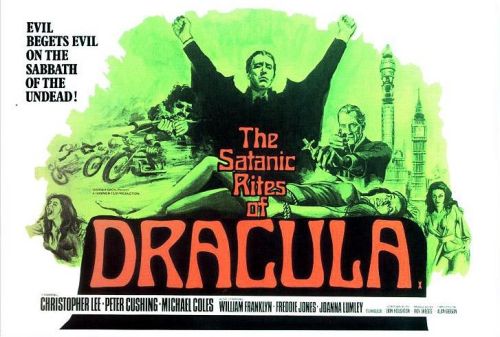
What better way to celebrate than by sharing a scene that I love that features both of them? 1973’s The Satanic Rites of Dracula was one of Hammer’s final Dracula films and, with the action somewhat awkwardly moved to the modern day, it’s also one of the weaker entries. But it does feature Christopher Lee and Peter Cushing, playing Dracula and the latest Van Helsing, and it’s worth watching for that reason.
Though they often played enemies onscreen, Cushing and Lee were best friends offscreen. Lee often said that he never really recovered from Cushing’s death in 1994. Cushing may have spent his career playing villains and obsessive monster hunters but he was said to actually be a kind and rather shy man, an old-fashioned gentlemen who unexpectedly found his fame in horror. Whereas Lee was a serious student of the esoteric, Cushing preferred to spend his time gardening.
In the scene below, Cushing’s Van Helsing confronts Lee’s Dracula and it’s just fun to watch these two old friends go at each other. One gets the feeling that Cushing and Lee had a few laughs after the cameras stopped rolling.





 Through the Shattered Lens