Trash Film Guru Vs. The Summer Blockbusters : “The Amazing Spider-Man 2”


the_amazing_spider_man_2__2014____alternate_poster_by_camw1n-d7c1h7t

Seriously, folks, this whole contrarian role I seem to have either stumbled or , if you want to be grandiose about things,  been thrust into? Its actually getting pretty old.  Sure, I can’t do much about how my brain works, but once in awhile, maybe just for a day or so to see what it would be like, I’d love to at least like the same stuff everybody else does, and dislike all the same stuff that the rest of you do, too, just to relieve the tedium of seeing things in a fundamentally different way than everyone else. Mind you, I’n only talking about changing things up as far as my taste in films and other ostensibly “entertaining” media go here, these other perfectly mainstream ideas like “corporations are our friends and we shouldn’t tax them too high,” and “problems like racism, sexism, and other forms of discrimination are all in this past” — you can keep those, I’m happy to still keep tilting at windmills and telling Mr. and Ms. Middle America that they’re hopelessly deluded if they really believe the Hallmark Card pseudo-reality being sold to them while their pockets are being picked clean by the same rich assholes who then have the nerve to tell them that the real “moochers” are poor folks, or people of color, or single mothers, or any other group still that’s still easy to scapegoat and demonize.

At this point you’re probably wondering what any of this has to do with reviewing the just-released (“just,” in this case, meaning last week) The Amazing Spider-Man 2, and I can’t say I blame you, so here’s what I’m getting at : received “wisdom” has it that this is just some bog-standard, average-at-best super-hero flick. And the same received “wisdom” has it that the reason this is no great shakes (and you can bet the exact same argument will be trotted out in a couple of weeks in regards to the new X-Men movie) is because it’s not a Marvel Studios product but is, in fact, a Sony/Columbia release under license from Marvel. And I’m sorry, but I smell a serious rat with that fallacious line of “reasoning.”

Let me tell you why : Marvel, and their bosses at Disney,  desperately want the Spider-Man property back “in house” (same goes for X-Men) and have a vested interest in promoting the myth that only they can do it “right.” To that end, I’ll bet my bottom dollar that they’re the ultimate source of this goofy idea that somehow Sony’s Spider-Man lacks the “magic” that they’d bring to the property (and that’s really what Spidey is at this point — a “property” — as opposed to an actual character) and I’d even go so far as to speculate that they’ve contacted their bought-and-paid for media mouthpieces and had off-the-record conversations with them designed to subtly kick up an orchestrated “whisper campaign” against this film.

Shit, as science has proven, always runs downhill, and soon the folks who make their living telling other people what to think have affected the opinions of the legions of unpaid armchair critics (like myself) who in turn affect the opinions of fans and more casual movie-goers, and before you know it, the meme that The Amazing Spider-Man 2 just ain’t all that great has taken firm hold in the public consciousness. Sure, it all looks spontaneous enough, and most of the people playing along with the scheme have no idea that they’re doing, essentially, pro bono work for one monolithic studio conglomerate in their covert “war” against another monolithic studio conglomerate, but there you have it.

Spider-Man-Jamie-Foxx

What’s especially despicable about this, though, is how rancid and idiotic “homer”-ism in the “fan” community is so easily manipulated to shady ends, yet seldom if ever turned in a genuinely positive direction. The same “fans” who are actively and openly rooting for Marvel to “get back their baby,” for instance, don’t seem to care too much about the situation of Spidey’s actual creator, Steve Ditko, who is 86 years old and has never seen a dime from any of the flicks his legendary creation appears in — hell, when Sam Raimi’s first Spider-Man movie came out, Ditko was living under, to put it politely, reduced circumstances in a rented apartment above a New York City thrift store. If even a tiny fraction of the amount of energy fans put into campaigning for Marvel Studios were put into campaigning for the dozens, if not hundreds, of creators that Marvel has screwed over, who knows? Maybe the cause of creators’ rights would finally be getting somewhere. Let me be as blunt as possible here : if you care more about Marvel getting back the cinematic rights to Spider-Man, the X-Men, and the Fantastic Four than you do about folks like Steve Ditko, Gary Friedrich, Bill Mantlo, or the heirs of Jack Kirby, then you’re either a complete asshole, being played for a sucker, or both. These actual people deserve your support — not the corporate suits who continue to profit off the fruits of others’ imaginations.

To that end, I don’t have any real personal stake in whether or not The Amazing Spider-Man 2 is “not as good as it could/would be with Marvel Studios in charge,” because I could care less about the bottom-line corporate balance sheets of either DisMar or Sony/Columbia. They’re all faceless, greedy bastards in my book. But after watching the film, the rat I smelled grew even more pungent, so I decided to put my little “homer” theory to the test via the modern “miracle” of social networking.

Don’t worry, I didn’t waste too much time on this off-the-cuff experiment, only about 30 minutes or so, but the results were telling. I went onto twitter, looked for the first dozen comments of the “this would be so much better if Marvel did it” variety (they weren’t had to find), and asked the folks making such statements why they thought that. Of the 12 folks I asked, seven never responded, three said variations of the exact same thing (“because it’s theirs and they’d know how to do it right”) and two said they flat-out didn’t know why, “it just would be.”

Not done making a nuisance of myself, I then asked all 12 people again “What’s so ‘wrong’ with this movie in the first place in comparison with Marvel Studios product?” and received only two answers, one of which was “it just is,” and the other being “you can tell just by watching that they don’t get it.”

Excuse me, but — what’s not to get? It’s not like I’m going to try to convince you here that The Amazing Spider-Man 2 is necessarily all that great, but for what it is, frankly, it’s just fine, and in fact it’s a damn sight better than the last two Marvel Studios releases, the thoroughly uninspired Captain America : The Winter Soldier and the downright risible Thor : The Dark World, both of which were essentially big-budget TV movies-of-the-week (and overseen by television directors, no less). I’d even go so far as to say it’s quite a bit more enjoyable than Marvel’s most-ballyhooed cinematic endeavors, the incredibly over-rated The Avengers and the obviously-constructed-by-the-numbers Iron Man films.

It’s far from a terrific super-hero movie, mind you, like Christopher Nolan’s  Batman Begins or Richard Donner’s original Superman, but it definitely fits comfortably into the “above average, at any rate” group populated by flicks like The Dark Knight (which is nowhere near as good as  many seem to think, but is still fairly solid) and Raimi’s Spider-Man 2. So I guess my main argument isn’t even necessarily that this is all that much  better than at least the top-tier Marvel Studios flicks, like the first Thor and Captain America : The First Avenger, but that it’s in no way appreciably worse. Given that, then, and taking into consideration how positively homogenized and formulaic Marvel’s “in-house” product has become in the absence of genuinely talented directors like Kenneth Branagh and Joe Johnston, there’s absolutely no reason to believe they’d “do a better job of things” if the web-slinger’s rights suddenly fell back into their lap.

green-goblin-spider-man-the-amazing-spider-man-2

Frankly, some of the criticism being leveled at this flick is just plain absurd on its face, and amazingly hypocritical. I’ve seen folks who gushed over The Avengers claim, with a straight face, that the problem with The Amazing Spider-Man 2 is that it “relies too heavily on CGI battle scenes.” And Whedon’s movie didn’t? I’ve seen many self-styled “opinion makers”  who gushed over the the “human”  characterization in Nolan’s Bat-films say that this movie “has too much Peter Parker, not enough Spider-Man.” I’ve seen people who applauded the revisionist origin story given Superman in Zack Snyder’s Man Of Steel grouse about how director Marc Webb and his committee of screenwriters are “playing too fast and loose” with Spidey’s backstory here. And,  while I’ll grant you that Jamie Foxx’s Max Dillon/Electro character is flat-out absurd in both its human and super-human iterations, and that getting shocked by a big cable and falling into a vat of electric eels is a pretty lame way for a villain to get his powers, it’s worth noting that many of the people poking fun at this have no problem with the idea of a chemically-enhanced “super soldier” being frozen in a block of ice and waking up, without having aged a day, in the Captain America movies, or of the Norse Gods being a real race of inter-dimensional super-beings in the Thor films, and are even willing to swallow the single-most laughable notion in all comic-book flicks, that of a spoiled billionaire rich kid who inherits his daddy’s company and still actually works for a living, as Tony Stark does in the Iron Man series.

There are plenty of folks out there telling you what Webb and company get wrong in The Amazing Spider-Man 2 — from the aforementioned Electro stuff to Andrew Garfield’s take on Peter Parker being “unlikable” (news flash — he’s been a self-pitying, self-aborbed, flat-out selfish little prick in the comics from day one) to Sally Field’s Aunt May being “too young” (whatever ,  she does a really nice job)  to Paul Giamatti’s wasted and pointless cameo as the villainous Rhino at the end —let me take just a few minutes to tell you what this movie gets right.

exclusive-the-amazing-spider-man-2-pictures-153555-a-1389698871-470-75

Dane DeHann is positively creepy as Harry Osborn/The Green Goblin and his origin/descent into villainy is portrayed in a way that actually makes sense. Likewise, even though his screen time is limited, Chris Cooper knocks it out of the park as his vicious, megalomaniacal father, Norman. There’s real chemistry between Garfield’s Parker and Emma Stone’s Gwen Stacy, and the film does a nice job of updating/translating the legendary penultimate Spidey/Gwen story for the silver screen. The CGI effects work is solid and a represents a big step up from the lackluster graphics of Webb’s first Spider-film. The characters are allowed to age at least semi-normally, as evidenced by the fact that Peter, Gwen, and their classmates are  shown graduating high school at the start of the film (and a good thing too, since both actors are, what? Pushing 30?). Webb directs the action sequences that he’s being maligned for with far more aplomb than his more-praised counterparts like Jon Favreau or Joss Whedon, who just show one building after another being smashed to rubble in between those fucking interminable shots of Robert Downey Jr.’s face inside of his Iron Man helmet. And at least this movie gives us warts-and-all human beings at its core with plausible psychological motivations for doing what they do rather than mythological gods, science-whiz playboys, sexy Russian super-spies with no accents, or one-dimensional do-gooders fresh out of suspended animation.

It’s not enough to make The Amazing Spider-Man 2 a truly great super-hero movie, and a forced and tacked-on ending epilogue-ish ending doesn’t help (even if there’s plenty of reason for fans to “ooh”and “aah” when we get a sneak peek at the character designs for the members of the sure-to-pop-up-in-the-next-flick Sinister Six, and hey, isn’t that the Black Cat we get to meet — briefly and in her civilian identity — earlier on, too? Where’s the fan-gasming for that?), but it makes it a heck of a lot more involving than much-more-highly-praised (even if it’s dull and repetitious) fare that just so happens to carry the Marvel Studios logo above its title. And you know what? That’s all it would take for fans to love this one, and is the single, solitary reason why many of them don’t. You might call that loyalty, but I call it bullshit.
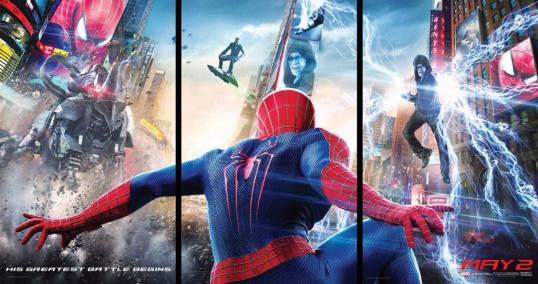
 

Super Bowl Trailer: The Amazing Spider-Man 2 “Enemies Unite”


1024px-Amazing-spider-man-2-poster

The Amazing Spider-Man 2 continues the reboot Sony began with the Spider-Man franchise minus Sam Raimi and Tobey Maguire. While The Amazing Spider-Man did quite well in the box-office when it came out in 2012 the general consensus with fans and critics alike was that it was just another origins tale that rehashed events from the Peter Parker story that was already well-known to comic book and non-comic book fans alike.

This sequel will now bring in villains and some plot points that fans have been waiting for since the franchise first began in the early 2000’s. We have Jamie Foxx and Paul Giamatti as the villains Electro and Rhino finally appearing on film with hints that other iconic Spider-Man villains such as the Vulture and the Hobgoblin probably having a cameo. This sudden flood of villains looks to be Sony’s attempt to set-up a Sinister Six film that would be the studio’s way to counter the success of Marvel’s and Disney’s success with The Avengers.

Time will tell if this gamble will end up paying off for Sony and many comic books wish it won’t since there’s a chance it would return Spider-Man to Marvel Studios thus making him available to appear in future films as an Avenger.

Sony went to unprecedented lengths to make sure people knew about the new trailer arriving on Super Bowl Sunday. We had a teaser teasing the trailer for the Super Bowl. Then we had the brief teaser shown during the Super Bowl. Below is the full 3-minute plus trailer that was shown on-line soon after.

The Amazing Spider-Man 2 is set for a May 2, 2014 release date.

Lisa Marie Does The Company Men (dir. by John Wells)


The Company Men is the first film to be directed by veteran television producer and writer John Wells.  Previously, Wells worked on ER, The West Wing, Southland, Third Watch, and a whole host of other shows that I’d rather die than ever have to actually sit through.  With The Company Men, Wells attempts to tell the story of the current economic recession and what its like to go from being a high-paid executive to just another unemployed statistic.  The end result is a deeply uneven film that comes so very close to succeeding but ultimately fails.

The film opens in 2008 and indeed, most of the film takes place in ’08.  It always amuses me how any film that comes out now that deals with either the economy or the wars in the Middle East (the Hurt Locker being an obvious example), the filmmakers always go out of their way to let us know that their movie is taking place during the Bush administration and not the Obama Administration.  Some people would call that “ass kissing” but I just find it to be amusing. 

Anyway, getting back on track here, the films follows three corporate executives who all work for a fictional company called GTX.  There’s a rich, white guy played by Ben Affleck.  And then there’s a richer, white guy played by Chris Cooper.  And then finally, I guess to add some variety to the mix, there’s a white guy who is really, really rich and he’s played by Tommy Lee Jones.  Anyway, Affleck, Cooper, and Jones are all cheerfully doing their thing until one day, the recession hits and boom!  Suddenly, Affleck is told that he has become “redundant.”  He’s given a severance package and sent off on his merry way.  Meanwhile, Cooper worries that he’s about to face the same fate while Jones — who is one of the company’s vice presidents — tries to keep GTX’s satanic CEO from putting anyone else out of work. 

It’s Affleck and his story that commands most of the film’s running time and, to his credit, Affleck actually gives a surprisingly good performance here as he starts out as smug and self-centered before eventually becoming desperate and insecure until finally, by the end of the film, he’s reached a state of acceptance.  A lot of this has to do with the fact that he finally humbles himself into accepting a job with his blue-collar brother-in-law, a homebuilder played by Kevin Costner.

A word about Kevin Costner in this film: I could have done without him.  First off, I understand his character is supposed to be a blue-collar, plain-spoken, salt-of-the-Earth type but honestly, he just comes across like a overlymacho asshole who probably voted for Lyndon LaRouche at some point in the past.  I guess he’s supposed to be John Wells’ version of the noble savage or something.

But with that one glaring exception, The Company Men is a remarkably well-acted film.  Even though Jones and Cooper are saddled playing predictable characters, they both bring a real unexpected poignancy to their portrayals.  Cooper, especially, is strong and always sympathetic even though you know everything that’s going to happen to him from the minute he first shows up on-screen.  Rosemarie DeWitt has the rather thankless role of being Affleck’s wife but she brings a lot of strength to a thinly written character and she and Affleck have a real chemistry.  When they’re on-screen together, you believe in their marriage which is more than you can say for most screen couples.

The cast of The Company Men is such a strong ensemble that you really find yourself hoping (and sometimes even believing) that the overall film will succeed as well.  But, alas, the film fails and it manages to fail for all the obvious reasons.  John Wells is best known for his work in television and The Company Men never really shakes that made-for-TV feeling.  For every scene that offers up an unexpected insight or a subtle piece of characterization, there’s a hundred more that feel glib, smug, and ultimately forced.  For every honest note, there’s a false one waiting right around the corner to pounce on it and beat it into submission.  This is the type of movie where Tommy Lee Jones walks around a deserted shipyard and delivers a monologue about the way things use to be to a character who has absolutely no logical reason for being there beyond the fact that Wells needed to find an excuse for Jones to deliver the whole long speech to begin with.  Don’t get me wrong — Jones delivers the words beautifully but so what?  The scene still feels safe, predictable, and ultimately false.   

And what’s the deal with Maria Bello in this film?  She plays Sally Wilcox who is apparently in charge of “downsizing” at GTX.  She’s also having an adulterous affair with Tommy Lee Jones despite the fact that all Jones ever does is criticize her for even existing.  Never mind the fact, of course, that Jones is a part of the entire corporate culture that’s responsible for the Sally Wilcoxes of the world to begin with.  It’s hard not to feel that her character is there to largely let Jones off the hook.  It’s not Jones’s fault that everyone who works under him ends up unemployed and, in one really obvious plot development, dead.  No, it’s that evil Sally Wilcox with her blonde hair and black lingerie.  And what you can’t blame on Sally, put the blame on Jones’s wife and toss Cooper’s wife in there as well since they’re both portrayed as being heartless wenches (as opposed to DeWitt who is a good wife because she supports Affleck no matter what).  The Company Men is full of sympathy for depressed, self-pitying white guys but it has next to none for the women who have to live with them. 

Wells is obviously trying to say something about the Recession but what?  Obviously, he lays a lot of the blame at the doorstep of greedy CEOs like the one played, in this film, by Craig T. Nelson.  Unfortunately, you get the feeling that Wells seems to think that he’s the only person in the world who has managed to figure out that excessive corporate greed can be a bad thing.  He may think that he’s educating but really all he’s doing is preaching and the only ones listening are the choir.

Quickie Review: The Town (dir. by Ben Affleck)


If someone just five years ago told me that Ben Affleck would turn out to be a director whose work has been some of the better crime drama/thrillers of the past decade then I would declare shenanigans on that individual. Ben Affleck might have won an Oscar for helping write the screenplay for Good Will Hunting, but his career since could be labeled as being one of a joke (Gigli) interspersed with huge paycheck projects (Armageddon) that showed his range as an actor.

This is not to say that Affleck has no talent in front of the camera. I just believe that early in his career after winning his Oscar he got fooled into thinking that everything else since would be Easy Street paved in gold (financially and critically). To say that it hasn’t turned out to be that way (though he did make a ton of money) would be an understatement. But one thing happened while Affleck’s acting career was heading nowhere but down. He got behind the camera as a director and his very first time directing a feature-length film he would make one of 2007’s best films. I speak of his film adaptation of the Dennis Lehane crime drama, Gone Baby Gone. He didn’t just direct the life out of that film, but he also the screenplay with the help of Aaron Stockard.

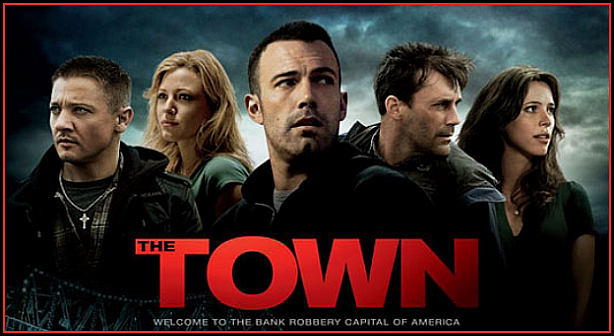
The two of the them would collaborate once again on Affleck’s latest Boston-based crime drama, The Town. He wrote the screenplay and directed the film and pulled in some wonderful performances from an ensemble cast which included Jeremy Renner, Jon Hamm, Rebecca Hall, Blake Lively, Titus Welliver and Pete Postlethwaite. Fellow site writer Lisa Marie already reviewed the film in detail and her review pretty much put down into words exactly what I thought of the film. I will say that I would swerve slightly away from what she considered some of the flaws in the film.

The Town was adapted from Chuck Hogan’s novel, Prince of Thieves. I would consider the screenplay and dialogue as a major strength of the film. While at times it did seemed to follow the step-by-step and by-the-numbers heist thriller story the screenplay itself didn’t ring false. I liken this film to another heist film which shared some themes and similarities. Michael Mann’s Heat also dealt with the cops-and-robbers foundation. Where Mann’s film had a much larger and epic scope to its storytelling it still boiled down to two groups of determined men playing a dangerous game of cat-and-mouse. The women in both film were written just enough that they had distinct personalities, but in the end they were motivations for the men in the film.

Affleck shows that he doesn’t just know how to direct, but continues is reputation as being one very good screenwriter. One just has to be reminded that he is now 3-for-3 when it comes to screenplays he has written which have turned out to be great ones. While he doesn’t have the same flair for words as Tarantino or Mamet when it comes to the screenplay. What he does well was to create an efficient script which flowed from scene to scene. Tarantino’s screenplays are great, but at times he does allow himself to overindulge his inner-film geek and create dialogue that might be Sorkin-like in execution. What I mean is that as great as the dialogue sound there’s no way people really spoke like this to each other. Affleck’s screenplay for The Town felt very natural and even with Jon Hamm’s less than great performance the film had a natural and genuine sound to it’s dialogue.

That’s one flaw pointed out by Lisa Marie that I would disagree with her on. The other two I can see her point, but it bothered me none. Though if I ever took on a life of crime I would hope I find someone just like Rebecca Hall’s Claire. Now there’s a woman who stands by her man no matter what.

I think in the long run this film might just be seen as one of the best of 2010 and some critics have already dubbed it so. While it’s prospects come awards season time is still up in the air I wouldn’t be surprised if it ends up nabbing one of the ten Best Picture nominations when the Oscar nominations get announced. It would be well-deserved and would just prove that Affleck’s career in the film industry might just be hitting its stride. Who would’ve thought it would be as a writer-director and not as an actor.

Film Review: The Town (dir. by Ben Affleck)


Before I get to my review, you should understand that I nearly didn’t see The Town last night.  Earlier, on Friday morning, I had to leave work early because I was so sick and nauseous that I was on the verge of passing out.  Once I got home, I had to 1) convince my aunt that I wasn’t pregnant (“Are you sure?” she said after I reassured her) and 2) had to convince myself that my appendix wasn’t about to burst (and it’s not so don’t worry).  After all that, there was a part of me that said, “The Town can wait.  I’ll go on Saturday or maybe even later in the week.”

But I ignored that part of me and I went and saw the movie anyway.  Why?  Well, I wanted to review it for this site.  (That’s dedication for you!)  Plus, I knew my friend Jeff wanted to see it with me and I wanted to see it with him and since when has a little thing like a ruptured appendix ever been an excuse not to have a good time?  Last but not least, The Town is Ben Affleck’s second movie as a director.  His first was 2007’s Gone, Baby, Gone.  Personally, I think Gone, Baby, Gone is one of the best crime films ever made.  It’s certainly one of my favorite.  I was curious to see if The Town would be a worthy follow-up or would it just prove Gone, Baby, Gone to have been a fluke.

The Town takes place in the Charlestown section of Boston.  At the opening of the film, we’re told that Charlestown apparently produces more professional armed robbers than any other place in the entire world.  It’s a practice that is handed down from father-to-son.  (Or, in the case of this movie, from Chris Cooper to Ben Affleck.)

Affleck plays Doug, a former hockey player who is now the head of a gang of Charlestown bank robbers.  His second-in-command is Jem (played by Jeremy Renner).  Over the course of the film, we learn Doug’s father (Chris Cooper) is a career criminal who is currently serving a life sentence in prison.  When his father went to prison, Doug was taken in by Jem’s family.  Doug even ended up dating Jem’s sister (Blake Lively) and might be the father of Lively’s daughter.  For this reason, Doug and Jem are fiercely loyal to each other despite the fact that Doug is essentially a nice guy and Jem is not.

(As a sidenote, why is it in the crime films that people are always shocked when the psychotic supporting character ends up doing psychotic?  I mean, have these people never gone to the movies before?  Have they never checked out Goodfellas from Netflix?  Did they miss the whole Joe Pesci “How am I funny?” thing?)

At the start of the film, Doug, Jem, and the gang rob a bank.  Doug is a model of professionalism.  Jem goes a little bit crazy and beats one bank employee nearly to death.  This gives the bank manager, Clare (Rebecca Hall), just enough time to set off a silent alarm.  Realizing that the police are on the way, Jem responds by taking Clare hostage as the gang flees.  Clare is later released on a desolate beach.

However, there’s a problem.  Before releasing her, Jem stole Clare’s ID.  Looking at it after the robbery, he discovers that Clare lives in Charlestown and, as a result, there’s now a risk that she might simply see one of the gang on the street and identify him.  Jem wants to kill her but Doug says that he’ll take care of her himself.

By “taking care of,” Doug means that he’ll follow her around town, eventually strike up a conversation with her, and then end up pursuing a romance with her (while declining, of course, to mention that he already knows her).  Jem, however, was under the impression that “taking care of” meant to kill.  So, needless to say, he’s a little bit miffed when he stumbles across Doug and Clare having a lunch date.

Soon, Doug finds himself trapped in the life he’s created for himself.  In love with Clare but torn by his loyalty to the increasingly unstable Jem, Doug agrees to one more big job.  All the while, he is pursued by two relentless FBI agents (Jon Hamm and Titus Welliver) and he has to deal with an Irish mob boss (Pete Postlewaite) who has an agenda of his own.

The Town works largely because Ben Affleck has, unexpectedly, turned out to be an intelligent, no-nonsense director.  The movie features three robbery scenes and, in each one of them, Affleck creates genuine tension and excitement without ever once resorting to outlandish stunts or random slow motion.  Unlike a lot of (bad) actors turned director, Affleck never seems to feel the need to toss in any showy (but ultimately empty) tricks to try to convince us that he’s a director.  This is a confident movie that shows that Gone, Baby, Gone wasn’t a fluke.  (That said, Gone, Baby, Gone remains the superior film for reasons that I’m getting to.)

Also, as with Gone, Baby, Gone, The Town benefits from Affleck’s obvious love for the city and people of Boston.  Shot on location and featuring a number of local actors, The Town has a wonderful sense of place to it.  By the end of it, you feel as if you know Charlestown even if, like me, you’re just a country girl from Texas.

Ben Affleck the director also manages to do something truly surprising — he gets a good performance out of Ben Affleck the actor.  In the past, I’ve always enjoyed looking at Ben Affleck on-screen but I never really wanted to hear him talk.  Because as soon as he would open his mouth, whatever appeal that Affleck possessed would immediately dissolve.  In the past, as an actor, Affleck often epitomized that whole concept of “there’s no there there.”  However, in this film, he gives a low-key, subtle performance that really helps to hold the entire film together.  I still wouldn’t call Affleck a good actor.  Instead, he’s one of those rare directors who (like fellow bad actor Quentin Tarantino) knows how to get good performances even from the most unlikely of performers.

Affleck is well-supported by Hall, Lively, and Renner.  Hall has a difficult job because she’s not so much playing an actual human being as much as she’s playing an idealized concept.  Her character really doesn’t have any purpose beyond offering Doug a chance at redemption and (this is obvious more in retrospect than during the actual film) really doesn’t have much of an identity beyond how her life touches Doug’s.  Hall, however, is so vulnerable in the role that, while you’re watching the film, that none of this really becomes obvious until a few hours after the movie ends.  Lively (better known for her role on Gossip Girl) is only in a few scenes and, in many ways, her character is even less developed than Hall’s.  If Hall has to represent the Madonna part of the Whore/Madonna complex, guess what Lively represents.  Still, Lively brings some much needed humor to the role and to the film.  She’s having fun playing her drunken, drug-addled character and she steals almost every scene that she’s in.

However, the film is ultimately dominated by Jeremy Renner.  With his angelic voice and deceptively soft voice, Renner is the psychopath that you can’t help but love.  Movie psychos are a dime-a-dozen so when an actor comes along and actually finds something new to do with the role, it’s impossible not to be impressed.

So much works in The Town that I almost feel guilty talking about what doesn’t.  For all its strengths, it also has three rather glaring flaws.  As with all things, the final verdict on this film depends on just how willing the viewer is to overlook these flaws.

First off, Ben Affleck proves himself to be a better director than writer.  The Town’s story is well told but the majority of it will still be awfully familiar to anyone who has ever seen a heist film.  Unlike Quentin Tarantino, Martin Scorsese, or Michael Mann, Affleck doesn’t embrace the conventions in order to deconstruct them.  Instead, he uses the conventional storyline as an excuse to explore the Charlestown culture.  As a result, this flaw arguably works to the film’s advantage.  Still, those viewers who are expecting to be surprised by the film’s plot should consider themselves warned.

As well acted as the movie is, there is one big exception in the cast and that is Mad Men’s Jon Hamm.  Hamm plays the FBI agent who is determined to capture Affleck.  He’s the Javert to Affleck’s Valjean.  Unfortunately, as played by Jon Hamm, he’s also a cinematic black hole.  Hamm may be an excellent television actor but, playing a key supporting role and surrounded by actual film actors, it’s obvious that Hamm has no idea how to act for the big screen.  As a result, he never comes across as a worthy or even dangerous adversary and his pursuit of Affleck never becomes compelling nor do we ever worry that Affleck might not be able to outsmart him.  There’s a scene, towards the end of the film, where Hamm yells something like, “Drop your weapon, asshole!”  I have to admit that I stunned just about everyone in the theater when I burst into laughter at the sound of Hamm shouting “asshole” and sounding, more or less, like an overgrown kid on a playground.

(Hamm’s sidekick, by the way, is played by another tv actor, Titus Welliver.  Welliver is probably best known for playing the Man In Black on the final season of Lost.  Though he gets next to nothing to do, Welliver dominates every scene that he’s in.  Unlike Hamm, he knows how to act on a big screen.)

The most glaring flaw with The Town, however, is that the entire plot pretty much depends on the viewer accepting that Hall’s character, just days after being traumatized by being held hostage and seeing one of her co-workers nearly beaten to death because he attempted to protect her, would so easily trust and open up her life to a stranger (even if that stranger is Ben Affleck).  Never mind the fact that we are then expected to believe that she would stay loyal to Affleck even after learning the truth.  Realistically, this would seem to indicate that the character’s something of a sadomasochist but the film really doesn’t explore that (or really anything else that might make Hall’s character anything more than just an idealized Madonna figure).

I mean, I’m always open to experimentation in a relationship.  Different people enjoy different things and I’ve never been one to judge anyone else’s particular fetish.  However, just speaking for myself, the day that you stick a gun in my face, put a blindfold over my eyes, and then abandon me out on the beach is the same day that I decide that there’s probably not going to be a long-term relationship there.

So, once again, it’s all a question of whether or not you can accept these flaws.  I have to admit that, as I watched the film, I occasionally had a hard time doing so.  If you can agree to overlook the flaws, however, then The Town is an entertaining, well-acted crime thriller with an authentic sense of place.  And if you can’t overlook those flaws, than The Town is a good but imperfect movie that still indicates that Ben Affleck has got quite a future as a director.