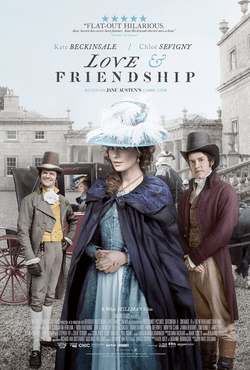
Playing Catch-Up: Love & Friendship (dir by Whit Stillman)


love__friendship_poster

Earlier this week, I named Pride and Prejudice and Zombies as the worst Jane Austen adaptation of 2016.  Of course, I understand that Pride and Prejudice and Zombies isn’t really a Jane Austen adaptation.  Instead, it’s an adaptation of a jokey novel that took Austen’s characters and combined them with zombies.  But you know what?  Nobody would have given a damn if the name of that book and that movie didn’t include three words:  Pride.  And.  Prejudice.  That’s the power of Jane Austen.

But anyway, my point is that Pride and Prejudice and Zombies was pretty much a low point as far as Jane Austen films are concerned.  Fortunately, 2016 also saw the release of a very enjoyable and entertaining Jane Austen film named Love & Friendship and, even better, Love & Friendship was based on something that Austen actually wrote.

Of course, though Austen may have written the novella Lady Susan, it wasn’t published until long after her death and there’s speculation that it was an unfinished (or abandoned) first draft.  In fact, it’s debatable whether or not Lady Susan was something that Austen would have ever wanted to see published.  While it shares themes in common with Austen’s best known work, it also features a lead character who is far different from the stereotypical Austen heroine.  Lady Susan Vernon is vain, selfish, manipulative, and unapologetic about her numerous affairs.  She’s also one of the wittiest of Austen’s characters, a woman who is capable of identifying and seeing through the hypocrisies of 18th century society.

In Love & Friendship, Susan is played by Kate Beckinsale, who does a great job in the role.  One of the best things about Love & Friendship is that it serves to remind us that Kate Beckinsale is a very good actress, even when she isn’t dealing with vampires and Lycans and all that other Underworld stuff.  Lady Susan is a recent widow and has been staying, with her daughter, Frederica (Morfydd Clark), at the estate of Lord and Lady Manwaring (Jenn Murray and Lochlann O’Mearáin) .  That’s a good thing because, as a result of the death of her husband, Lady Susan is now virtually penniless and homeless.  But, once it becomes obvious that Susan is having an affair with Lord Manwaring, she and Frederica are kicked out of the estate.

They eventually find themselves living with Susan’s brother-in-law, Charles (Justin Edwards) and Charles’s wife, Catherine (Emma Greenwell).  Susan, realizing that she needs to find not only a rich husband for Frederica but also one for herself, immediately starts to scheme to win the hand of Catherine’s brother, Reginald DeCourcy (Xavier Samuel).  Meanwhile, Susan also tries to arrange for Frederica to marry the hilariously slow-witted Sir James Martin (Tom Bennett).  Needless to say, things do not go quite as plan and it’s all rather chaotic and hilarious in its wonderfully refined way.

Director Whit Stillman, who has spent his career making refined and witty movies about morality and manners, is the ideal director for Austen’s material and he’s helped by an extremely witty (and, with the exception of Chloe Sevigny, very British) cast.  In the role of Susan, Kate Beckinsale is a force of nature and Tom Bennett is hilariously dense as Sir James, the type of well-meaning dunce who is literally stumped when someone asks him, “How do you do?”  Never before has dullness been so hilariously performed and Bennett’s performance really is a minor miracle.

Love & Friendship was a wonderful excursion into Austenland.  It didn’t even require zombies to be enjoyable.
http://www.youtube.com/watch?v=KhvyupqNhL8


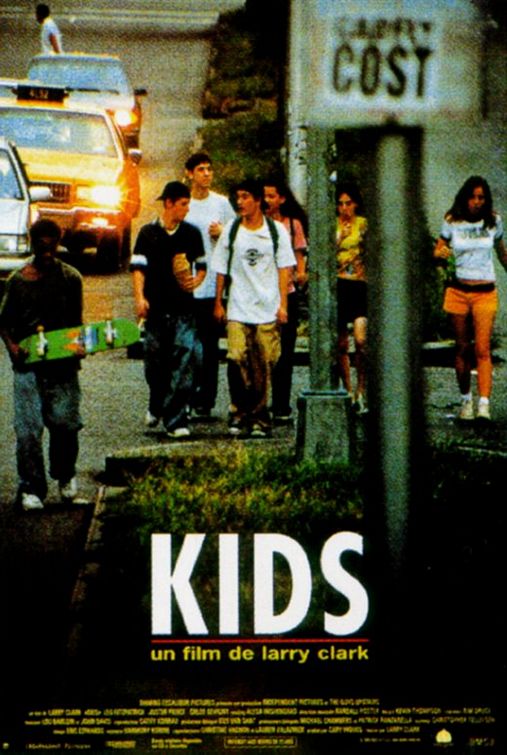
Back to School Part II #32: Kids (dir by Larry Clark)


kids_film

The first time that I ever saw Kids, the 1995 directorial debut of Larry Clark, my initial response was to wonder what the Hell everyone was talking about.

Seriously, I couldn’t understand a word that anyone was saying.  The two main characters — 15 year-old Telly (Leo Fitzpatrick) and his friend Casper (Justin Pierce) — talked almost constantly.  In fact, Telly even narrated the film.  But both of them had such thick Northern accents and both of them were so inarticulate that I spent 75% of the movie trying to understand what they were going on about.  (Add to that, Casper is pretty much either drunk or stoned through the entire film.)  Don’t get me wrong.  I understood enough to know what was going on in the movie.  I knew that Telly was obsessed with having sex with virgins and that he didn’t know that he was HIV positive.  I knew that Casper considered himself to be the “dopest ghost in town,” and that he ended the film by coming out of his daze long enough to look straight at the camera and ask, “What the fuck happened?”  But a lot of the dialogue in-between got lost as a result of Telly growling and Casper slurring.

So, when I rewatched Kids for this review, I turned on the close captioning so that I could read what it was that Telly and Casper were actually saying to each other while they were walking around New York City.  After a few minutes, I started to really wish that I had just remained ignorant.  Seriously, you may hate Telly but you’ll hate even more once you understand everything that he actually says during the opening scenes of the film.  Telly is literally one of the most disgusting pervs to ever be at the center of a motion picture.  “Virgins,” he announces at the start of the film, “I love them!”  He also infects them and what’s truly disturbing is that you get the feeling that, even if he knew he was HIV positive, Telly wouldn’t change his behavior at all.

Reportedly, Leo Fitzpatrick got death threats after starring in Kids.  Because he was making his film debut in Kids and because the film’s cast was reportedly made up of actual street kids, many viewers assumed that Fitzpatrick was playing himself.  Fitzpatrick is one of the few members of the cast to have actually maintained an acting career after Kids and, by most accounts, he’s not Telly.  That said, Telly is such a demonic character and Fitzpatrick does such a good job playing him that, admittedly, it is strange to see him subsequently play characters who are far different from Telly.  (His performance as faux hitman in Clark’s Bully is one of the highlights of that film.)

Justin Pierce also continued to act after Kids, though his efforts to maintain a career were reportedly hampered by his own personal demons.  Sadly, Pierce committed suicide in 2000, hanging himself in Las Vegas.  As raw as it may be, Pierce probably gives the best performance in Kids.  I’m sure that some would be tempted to say that Pierce was just playing himself but there’s also a sly humor to his performance that isn’t necessarily present in the script.  Casper is a despicable character who not only possibly beats a man to death but who also rapes one of his so-called friends when she’s passed out on a coach.  At times, Casper seems to almost be brain-dead.  (We’re told that he’s been sniffing glue since the 4th grade.)  But then there’s a few scenes where we get hints of who Casper could have been if he hadn’t fried his brain.

(For instance, it’s interesting to note that, alone among the male characters, Casper is the only one who occasionally behaves in a generous manner.  He may steal a piece of fruit but he then gives it to a young girl waiting outside of a dilapidated building.  In the famous scene in which a legless man asks for money while singing, “I have no legs/I have no legs,” Casper gives him money while Telly rolls his eyes.  Casper may be awful but, unlike Telly, he’s not a total sociopath.)

(It’s also interesting to note that, while we meet Telly’s mom and hear from her that Telly has a strained relationship with his dad, we never meet or hear about Casper’s family.  While Kids may be critical of Telly and Casper and their friends, it’s true scorn is reserved for the frequently unseen adults who all either seem to either be in denial or just incredibly callous as far as their children are concerned.)

And then there’s Chloe Sevigny and Rosario Dawson, both making their film debut in Kids.  They play friends who, at the start of the movie, both go to a clinic to get the results of their HIV tests.  The promiscuous Ruby (Dawson) is negative.  Jennie (Sevigny), however, is positive.  Since she’s only had sex with one person, she knows that she caught it from Telly.  What little plot that Kids has deals with Jennie’s efforts to track down Telly before he has sex with another virgin.  From the minute that Jennie starts searching for Telly, you know that it’s a pointless mission.  Even if Jennie did manage to track down Telly, it’s doubtful he would listen to her.

Kids was the directorial debut of Larry Clark.  It was also the screenwriting debut of Harmony Korine and reportedly, it was considered to be very shocking and controversial when it was first released.  I have to admit that, even speaking as someone who grew up far away from the streets of New York on which Kids was cast and filmed, I’ve never been that shocked by Kids.  Don’t get me wrong — it’s a raw and powerful film and the scene where Sevigny sits in a cab and repeats to herself that she’s not going to die brought tears to my eyes.  But, no — the idea of kids and teenagers having sex, doing drugs, and getting violent is no longer shocking (if it ever was).

It’s just another day.

44 Days of Paranoia #41: Shattered Glass (dir by Billy Ray)


For our latest entry in the 44 Days of Paranoia, we take a look at one of the best films of the first decade of the 21st Century, 2003’s Shattered Glass.

Shattered Glass tells the true story of Stephen Glass (played, in a surprisingly brilliant way, by Hayden Christensen), a smart and charming journalist who, through a combination of showmanship and carefully calculated moments of vulnerability, has established himself as one of the top reporters at one of the top political magazines in America, The New Republic.  As the film begins, we find Glass at his old high school, giving advice to a classroom of adoring student journalists.  As the self-assured Glass talks about his career, we see scenes of him investigating, pitching, and writing his stores at the New Republic.  It’s here that we see the other side of Glass — not only is he a good writer but he’s a good salesman.  While the rest of his coworkers struggle to pitch dry-sounding stories about Congress, Glass puts on a show as he vividly describes articles about everything from offering his services as a boxing expert to witnessing drug-fueled hijinks at a Young Republican meeting.

However, as the film progresses, we see yet another side to Stephen Glass.  Not only is he a talented writer and an enthusiastic showman but he’s also a pathological liar.  When the head of the Young Republicans challenges Stephen’s article, New Republican editor Mike Kelly (Hank Azaria) investigates and, despite being initially suspicious, is eventually won over by Stephen’s apparent earnestness.

Later, after Kelly has left the magazine and been replaced by new editor Chuck Lane (Peter Sarsgaard), Stephen turns in an article entitled “Hacker Heaven.”  In the article, Stephen writes about witnessing a 12 year-old computer hacker being given a million dollar contract from a company known as Jukt Micronics.  The only problem is that a reporter at Forbes (Steve Zahn) checks the facts in Stephen’s articles and can find no evidence of a company called Jukt Micronics ever existing.

As Lane starts to look into Stephen’s reporting, it starts to become obvious to him that Stephen not only made up the events of “Hacker Heaven” but that he may have falsified several other stories as well.  Already struggling to fill the shoes of the popular Kelly, Lane now finds himself having to investigate one of his most popular reporters.

Shattered Glass is one of those fascinating and unusually intelligent films that I always make a point of watching whenever it shows up on cable.  Not only does it tell a genuinely interesting story but it also features excellent performances from Sarsgaard, Azaria, Chloe Sevigny, and especially Melanie Lynesky.

Even more importantly, it features a revelatory lead performance from Hayden Christensen.  Fairly or not, Christensen is always going to be associated with Star Wars.  In Attack of the Clones and Revenge of the Sith, Christensen didn’t seem like he was a very good actor but then again, did anyone comes out of those films looking better than before they went in?  As bad as Christensen may have been in those two films, he’s absolutely brilliant in Shattered Glass.  He plays Stephen Glass with a puppy dog eagerness to please that is deceptively charming and likable.  It’s only as the film progresses that the audience realizes that there’s nothing behind that affable facade.  Instead, it becomes apparent that he’s a sociopath who lies to hide the fact that his existence is ultimately an empty one.  It’s an amazing performance and one that will make you think twice before blindly accepting the analysis of any of the journalistic “experts” who are regularly trotted out on any of the news shows.

Shattered Glass is also a film that should be seen just so viewers can appreciate the brilliant way that Peter Sarsgaard delivers the line, “This doesn’t seem like a real business card to me.”

Shattered Glass needs to be seen.

Other Entries In The 44 Days of Paranoia 

  1. Clonus
  2. Executive Action
  3. Winter Kills
  4. Interview With The Assassin
  5. The Trial of Lee Harvey Oswald
  6. JFK
  7. Beyond The Doors
  8. Three Days of the Condor
  9. They Saved Hitler’s Brain
  10. The Intruder
  11. Police, Adjective
  12. Burn After Reading
  13. Quiz Show
  14. Flying Blind
  15. God Told Me To
  16. Wag the Dog
  17. Cheaters
  18. Scream and Scream Again
  19. Capricorn One
  20. Seven Days In May
  21. Broken City
  22. Suddenly
  23. Pickup on South Street
  24. The Informer
  25. Chinatown
  26. Compliance
  27. The Lives of Others
  28. The Departed
  29. A Face In The Crowd
  30. Nixon
  31. The Hunger Games: Catching Fire
  32. The Purge
  33. The Stepford Wives
  34. Saboteur
  35. A Dark Truth
  36. The Fugitive
  37. The Day of Jackal
  38. Z
  39. The Fury
  40. The Manchurian Candidate (1962)


Film Review: Lovelace (dir by Rob Epstein and Jeffrey Friedman)


About halfway through the new biopic Lovelace, there’s a scene where former porno actress Linda Lovelace (played by Amanda Seyfried) is hooked up to a lie detector.  The polygraph examiner explains that he’s going to ask Linda a few test questions to get a reading.

“Is your name Linda Lovelace?” he asks.

Visibly nervous, Linda replies, “Can you ask something simpler?”

It’s a great scene because it establishes the central mystery of both the film and the title character.

Just who exactly was Linda Lovelace?

A girl whose main talent was apparently giving head, Lovelace became a star in the 70s when she starred in Deep Throat, the first (and perhaps only) hardcore film to become a legitimate mainstream hit.  For a brief while, Lovelace was the face of the American sex industry.  However, her attempts to have a mainstream film career failed and Lovelace retreated into obscurity.

Several years later, she wrote a book called Ordeal.  In Ordeal, Lovelace claimed that she was forced, by her abusive husband, to perform in Deep Throat.  Whereas Lovelace, during her brief stardom, originally claimed to simply be a sexual adventurer who performed on camera because it was liberating, the post-stardom Lovelace presented herself as being a brainwashed victim.  Or, as Lovelace herself put it, “When you watch Deep Throat, you’re watching me getting raped.”  While several people disputed the authenticity of Ordeal, Lovelace herself passed a polygraph examination.  Lovelace then became an anti-pornography activist before, once again, descending into obscurity and eventually dying in an automotive accident in 2002.

Lovelace deals with the issue of figuring out just who Linda Lovelace was by basically telling her story twice.

During the first 45 minutes of the film, we see how young Linda Boreman first meets Chuck Traynor (Peter Sarsgaard).  Everything about Chuck — from his mustache to his perm to his flashy clothes — practically screams sleaze but, since he’s played by Peter Sarsgaard, he also has an undeniable charm.  (With this film and An Education, Sarsgaard has proven himself to be the definitive older man who your parents warned you about.)  Chuck and Linda eventually marry and, when they need money, Linda turns to “acting” in order to pay the bills.

Under the watchful eye of producers Bobby Cannavale and Chris Noth, director Hank Azaria, and co-star Adam Brody, Linda stars in Deep Throat and becomes the face of the sexual revolution.  While there are occasional hints that things might not be perfect (bruises are often visible on Linda’s arms and legs), Linda seems to truly love the spotlight.  Even Hugh Hefner (played by James Franco, who is way too hot to only have a cameo) says she’s going to be a huge star.

And then, rather abruptly, we jump forward six years.  Linda is now writing Ordeal and we once again see how she first married Chuck Traynor, starred in Deep Throat, and came to be a star..  However, we now see the story through her eyes.  We see that Chuck wasn’t just controlling but that he was also an abusive psychopath who would hold a gun to her head in order to get a performance out of her.  We see that, during the shooting of Deep Throat, she was regularly beaten by her husband.  We see Linda attempting to reconnect with her strict and tradition parents (played by Sharon Stone and Robert Patrick).  We see the ugliness that was hidden underneath the glamour.

Considering the subject matter and the talent involved, Lovelace should have been one of the most interesting films of 2013 but, unfortunately, the two separate halves of the film just don’t come together.  While the first half of the film does a good job of capturing the absurdity of sudden fame, the second half of the film falls apart.

Oddly enough, Chuck Traynor and Linda Lovelace only come across as real human beings during the superficial first half of the film.  During the second half of the film, both Chuck and Linda come across as one-dimensional ciphers.  Linda becomes such a total victim and Chuck becomes such a melodramatic villain that neither one of them is all that compelling as a character.  Instead of being disturbing and revealing, the second half of the film just feels like another generic film about the price of fame.

Most of what I know about Linda Lovelace and Chuck Traynor comes from two sources — the 2005 documentary Inside Deep Throat and Legs McNiel’s and Jennifer Osborne’s book The Other Hollywood.  In both the book and the documentary, Lovelace comes across as being a rather pathetic figure who was exploited by both the adult film industry and the anti-pornography activists who used her as a symbol.  Both the industry and the activists abandoned Linda once her novelty was gone.  Ironically, even though both the documentary and the book are rather critical of her, it is there that she comes across as a far more interesting, sympathetic, and ultimately tragic figure than she does in this biopic.

With all that in mind, Lovelace is not necessarily a failure as a film.  The 70s are convincingly recreated and there’s a few scenes that hint at the type of film that this could have been if the filmmakers had been willing to take a few more risks.

The film is also full of excellent performances.  Seyfried is sympathetic and believable as Linda and, up until the second half of the film requires him to abandon all shades of ambiguity, Sarsgaard perfectly captures the sleazy charm that someone like Chuck Traynor would need to survive.  As Linda’s strict mother, Sharon Stone  is surprisingly strong.  Just watch the scene where Linda’s mom explains to her that she has to go back to abusive husband because that’s what marriage is all about and you’ll see an example of great acting.  Even better is Robert Patrick, who brings a poignant sadness to the role of Linda’s father.  The scene where he tells Linda that he saw her on film is heartbreaking.

Lovelace is a film of hits and misses.  Sadly, it misses the big picture but a few individual parts and performances are strong enough to justify sacrificing spending 93 minutes to watch it.