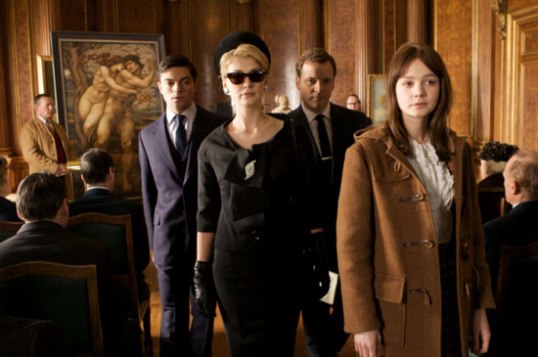
Catching Up With The Films of 2017: A Woman, A Part (dir by Elisabeth Subrin)


There’s a great montage during the first half of A Woman, A Part.

An actress named Anna (Maggie Siff) wanders around her home, reading scripts for tv shows and movies.  In between shots of her snorting cocaine, we listen as she reads dialogue aloud.  One of the scripts features her as a dying mother who, with her last words, asks her children to look after their father.  Another script is obviously from a Lifetime film and again, the role that Maggie reads is for a mother.  In another script, she’s a love interest.  And, in another, she’s just a bitchy authority figure.  As becomes obvious from the dialogue, none of the scripts offer her the chance to play a leading or even a fully developed character.  In each script, she’s either a plot device or a part of the scenery.  She reads a script, she does a line.  As she finishes each script, she tosses it into her pool until soon, the water is full of shallow characters and clichéd dialogue.  Soon, Anna is floating in the pool, surrounded by the debris of her career.

Anna moved to Los Angeles from New York.  In New York, she was all about theater and seeking truth through acting.  In Los Angeles, she has a role on a sitcom and a certain amount of fame.  People stare at her in restaurants.  Some ask for autographs.  Anna is exhausted, frustrated, and very aware that Hollywood has little to offer an actress in her 40s.

Anna escapes Los Angeles, heading back to New York.  She hopes to reunite with her former friends but, when she arrives, she discovers that some have moved on and some have not.  Her former acting partner, Kate (Cara Seymour), no longer considers herself to be an actress and resents Anna for having left their show to go to Los Angeles.  Playwright Isaac (John Ortiz) has written a play, one that centers around a flawed character who Anna immediately recognizes as being based on herself.

A Woman, A Part is the first full-length feature film to be directed by the video artist, Elisabeth Subrin.  It’s a flawed but promising debut.  For every moment that runs the risk of falling into cliché, there’s a sequence like that pool scene or the scenes where Kate and Anna deal with their fractured friendship.  It’s in those scenes between Maggie Siff and Cara Seymour that the film really comes alive.  When a fan approaches Anna while she’s talking to Kate and Anna responds by saying that everyone should be asking for Kate’s autograph, Kate rightly calls Anna out for her condescending attempt at kindness.  At the same time, the film is also honest enough in its characterizations to admit that much of Kate’s reaction is due to her own resentment that Anna found the success that Kate didn’t.  This is a film that realizes that friendships are often the most complex of relationships.  Maggie Siff and Cara Seymour both give honest and poignant performances.

As I said, A Woman, A Part is not without its flaws.  To be honest, the character of Isaac never interested me as much as Anna and Kate.  There are a few scenes which are just a little bit too on the nose.  It’s not a perfect film but it is a promising one and I look forward to seeing what Elisabeth Subrin does next.


Shattered Politics #71: Gangs of New York (dir by Martin Scorsese)


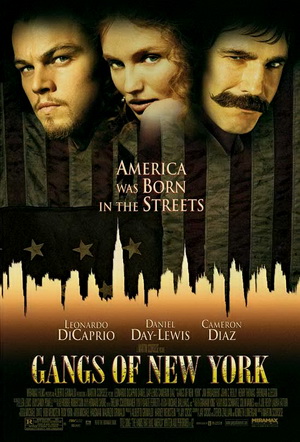
Gangs_of_New_York_Poster

Despite the fact that it was nominated for best picture and marked the start of his fantastically successful collaboration with actor Leonardo DiCaprio, Martin Scorsese’s 2002 film Gangs of New York does not have the best reputation.  It always seems to be regarded as one of Scorsese’s lesser films and, often times, both The Aviator and The Departed are described as representing a comeback of sorts from Gangs.

To a certain extent, I have to agree.  Gangs of New York is a lesser Scorsese movie but then again, a lesser Scorsese film is still a hundred times better than the greatest films from Brett Ratner or Michael Bay.

The flaws of Gangs of New York are many.  The film, which tells the epic story of how an Irish gang led by Leonard DiCaprio battled a nativist gang led by Daniel Day-Lewis in Civil War-era New York City, runs for nearly 3 hours and yet it somehow still feels rushed and incomplete.  Cameron Diaz is far too contemporary of an actress to be truly believable as a 19th century pickpocket.  For that matter, Leonardo DiCaprio gives one of the worst performances of his career, coming across as being one-note and shrill.  If you only knew DiCaprio from his work in Gangs of New York, you would have a hard time believing that he was capable of doing the type of work that he did in Inception or The Wolf of Wall Street.

And yet, Gangs of New York is one of those flawed films that I can’t help but enjoy.

First off, on a purely personal level, how can I not love a film about how terribly the Irish were treated in the 19th Century?  Seriously, the Irish were regarded as if they were somehow subhuman.  They were attacked for being Catholic.  They were viewed as being criminals.  An entire freaking political party — the American party — was formed specifically to keep the Irish out.  But you know what?  We Irish kept coming, we kept fighting for our rights, and now everyone wishes they could be one of us!

Secondly, and this should not a shock when you consider that the film was directed by Martin Scorsese, the film looks absolutely gorgeous!  Despite the fact that it’s takes place in a 19th century slum and most of the characters are poor, Gangs of New York is a visual feast.  I loved the ornate sets and all the colorful clothes.  I loved the attention to detail that was put into everything.

(My favorite visual from the film: Daniel Day-Lewis and his entourage walking down a street while fireworks explode directly over Day-Lewis’s shoulder.)

Third, there’s Daniel Day-Lewis’s performance as Bill “The Butcher” Cutting.  One reason why DiCaprio’s performance is so noticeably bad is because he’s acting opposite Day-Lewis.  Sporting a handle-bar mustache and speaking in an almost satirically exaggerated New York accent, Day-Lewis turns Bill into one cinema’s greatest villains.

Add to that, the great Italian actor Giovanni Lombardo Radice show up for a few minutes, playing Simon Legree in a theatrical production of Uncle Tom’s Cabin!  Scorsese should make more films with Radice.

But, perhaps the main reason why I enjoy Gangs of New York is because, as I’ve mentioned so many times in the past, I really am a big history nerd.  And Gangs of New York deals with a period in American history that really doesn’t get as much attention as it deserves.  While we all know that the Civil War started when the South seceded from the union, what is often forgotten is that the North was not united in their support of Abraham Lincoln and the Union.  In fact, the Mayor of New York, Fernando Wood, was such a strong supporter of the Confederacy that he, at one point, suggested that New York City should secede from the union as well.  And when Lincoln instituted the draft, NYC — and several other cities in the north — exploded into riots.

Of course, Gangs of New York is not a 100% historically accurate.  For one thing, it compresses the time frame of the draft riots and — as films often do — it downplays the culture of Northern racism and instead portrays racists like Bill Cutting as being the exception to the rule.  But, even with that in mind, Gangs of New York still serves as a good starting point for those who want to learn more about American history than what they’ve been told in school.

My favorite parts of Gangs of New York dealt not with how the gangs fought each other but instead how the gangs were used as political foot soldiers.  One of the major supporting characters in Gangs of New York is William “Boss” Tweed (Jim Broadbent), a real-life politician who was at the center of one of America’s first major political scandals.  When we first meet Tweed, he is using Bill Cutting’s gang to fix elections.  However, as the film progresses, Tweed comes to realize that the political future of New York rests with the Irish.  So, Tweed starts using the Irish gang to fix elections.  For those of us who are into political history, the Boss Tweed scenes are a lot of fun.

Gangs of New York has its flaws.  It’s the type of project that, if it were made today, it would probably be a series on HBO and it would win all sorts of awards.  (Actually, it did kinda.  It was called Boardwalk Empire.)  It’s not perfect, but I like it.

Back to School #71: An Education (dir by Lone Scherifg)


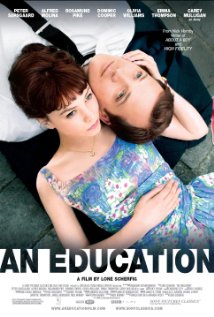
MV5BMTg4NjgzOTc0MF5BMl5BanBnXkFtZTcwOTc2OTE3Mg@@__V1_SX214_AL_

When I first started this series of Back To School reviews, my plans was to somehow write and post 80 reviews over the course of just one week.  What was I thinking?  That one week has now become one month.  However, even if it has taken me longer than I originally planned, I’ve enjoyed writing these reviews and I hope that you’ve enjoyed reading them.

We’ve been looking at these films in chronological order.  We started with 1946’s I Accuse My Parents and now, 70 reviews later, we have reached the wonderful year of 2009.  It seems somewhat appropriate, to me, that as we finally start to reach the end of this series (after this review, only 9 more to go!), we should take a look at one of my favorite films of all time, a film that was nominated for best picture and which introduced the world to one of the best actresses working today.

That film, of course, is An Education.

Set in 1961, An Education tells the story of Jenny (Carey Mulligan), an intelligent and headstrong 16 year-old girl.  Jenny lives in London with her father (Alfred Molina) and mother (Cara Seymour), both of whom have decided that Jenny will eventually attend Oxford University.  She attends public school, where she’s a star pupil and a favorite of her teacher, Miss Stubbs (Olivia Williams) and the stern headmistress (Emma Thompson).  Jenny is someone who, even at the age of 16, seems to have her entire life mapped out for her.

And then she meets David Goldman (Peter Sarsgaard).  David is a handsome and charming older man who, spying Jenny walking in the rain, offers to give her a ride home.  Soon, Jenny and David are secretly pursuing a romantic relationship.  At first glance, David seems to be the perfect dream boyfriend.  He’s sophisticated.  He’s witty.  He knows about art and music and seems to be the exact opposite of Jenny’s boring, conservative father.  And David also has two beautiful friends, Danny (a devastatingly charming Dominic Cooper) and Danny’s glamorous girlfriend, Helen (Rosamund Pike).

Jenny is drawn into David’s exciting circle of friends and, at first, it’s all so intoxicating that the little things don’t matter.  Jenny doesn’t ask, for instance, how David and Danny make their money.  When she finds out that David specifically moves black families into white neighborhoods in order to get people to move so that he can then buy and rent out their former homes, Jenny knows that it’s shady but she pretends not to be worried.  And when David and Danny steal a valuable antique map out of a country home, it’s far too exciting for Jenny to worry about the legality of it all…

26484527_

An Education is such a great film, I don’t even know where to begin in singing its praises.  The cast is absolutely brilliant, with Carey Mulligan proving herself to be a star and Peter Sarsgaard being so charismatic that, much like Jenny, you can’t help but get swept up in his world.  This was the first film that I ever noticed Dominic Cooper in and I walked out of the theater with a crush that I continue to have to this day.  The script, by novelist Nick Hornby, is full of witty lines and, even more importantly, it manages to find something very universal within Jenny’s very personal story.  We’ve all had a David Goldman in our life at some point.

However, what I think I really love about An Education is the way that it portrays the excitement of being just a little bit naughty.  One need only compare the vivid scenes in which David and Jenny dance at a club with the drab scenes of Jenny sitting in class to understand why Jenny (and so many other girls) would fall for a guy like David.

Perhaps my favorite image in the entire film is one in which, after having a fight out in the middle of the street, David and Jenny turn around to see Danny and Helen standing out on a beautiful balcony and waving down to them.  The two couples are just so beautiful and so glamorous that it really does become one of those moments where you really do wish you could just step into the movie and spend a few hours just hanging out with them.

An Education is one of the best!

6383165_orig

The Beautiful People (from L-R): Dominic Cooper, Rosamund Pike, Peter Sarsgaard, and Carey Mulligan.