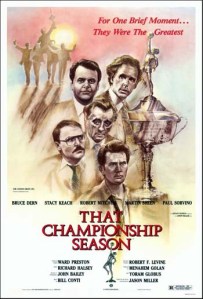
 Four former high school basketball players and their coach gather for a reunion in Pennsylvania. Twenty-five years ago, they were state champions. Now, they are all still struggling with the legacy of that championship season. George (Bruce Dern) is the mayor of Scranton and is in a fierce race for reelection. Phil (Paul Sorvino) is a wealthy and corrupt businessman who is having an affair with George’s wife. James (Stacy Keach) is a high school principal who is still struggling to come to terms with his abusive father. James’s younger brother, Tom (Martin Sheen), is an alcoholic who can not hold down a steady job. The Coach (Robert Mitchum) remains the Coach. All four of the men still want his approval, even though they know that he is actually an old bigot who pushed them to cut too many corners on their way to the championship.
Though Cannon film may have been best known for producing action films with actors like Charles Bronson, Chuck Norris, and Michael Dudikoff, they occasionally tried to improve their image with a prestige picture like That Championship Season. Not only is this film based on Jason Miller’s Pulitzer Prize-winning play but Cannon also hired Miller himself to direct. (Before Miller was brought in, That Championship Season was nearly directed by William Friedkin, who directed Miller in The Exorcist.) While no one knew the text better than Miller, this was also his directorial debut and sometimes, his inexperience shows. The first half of the movie does a good job of opening up the play but the second half takes place almost entirely in the Coach’s house and is very stagey, never escaping its theatrical origins.
One thing That Championship Season has going for it is an excellent cast. Dern, Sorvino, Keach, and even Sheen rarely got roles with as much depth as the ones that they got here and four of them make the best of the opportunity. As for Robert Mitchum, he was known for being a mercurial actor but here, he gives one of the better performances of the latter half of his career. Because of the efforts of the ensemble, That Championship Season is one of the better Cannon prestige pictures, though Chuck Norris is still missed.
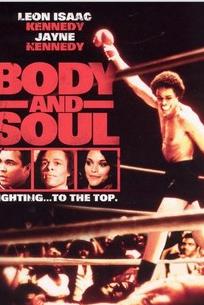 When his little sister falls ill with sickle-cell anemia, Leon Johnson (Leon Isaac Kennedy) has to make a decision. He can either finish his education, graduate from medical school, and treat her as a doctor or he can drop out of school, reinvent himself as “Leon the Lover,” and make a fortune as a professional boxer! At first, Leon’s career goes perfectly. He is winning fights. He is making money. He has a foxy new girlfriend (played Leon Isaac Kennedy’s then-wife, Jayne Kennedy.) But then the fame starts to go to Leon’s head. He forgets where he came from. He’s no longer fighting just to help his sister. Now, he’s fighting for his own personal glory. When Leon finally gets a title shot, a crooked boxing promoter known as Big Man (former JFK in-law Peter Lawford, looking coked up) orders Leon to take a dive. Will Leon intentionally lose the biggest fight of his life or will he stay in the ring and battle Ricardo (Al Denava), a boxer so evil that he literally throws children to the ground? More importantly, will he make his trainer (Muhammad Ali, playing himself!) proud?
 Europe, during World War I. The beautiful dancer, Mata Hari (Sylvia Kristel), is in love with two different soldiers, one German and one French. (The soldiers, played by Olivier Tobias and Christopher Cazenove, are also friends though they are now on opposite sides of the Great War.) Forced into the world of decadent, high class espionage by Frau Doktor (Gaye Brown), Mata Hari sleeps with everyone, shares information with both the Germans and the French, and tries to prevent more people from dying. Just as in history, Mata Hari ultimately has to face a firing squad but not before taking part in threesomes, voyeurism, and a topless sword fight.
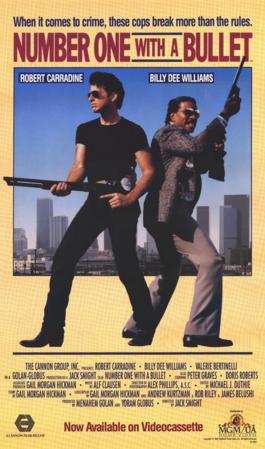 Number One With A Bullet is the story of two cops. Nick Barzack (Robert Carradine) is so crazy that the all criminals have nicknamed “Beserk.” (Who says criminals aren’t clever?) Nick’s partner, Frank Hazeltine (Billy Dee Williams) is so smooth that jazz starts to play whenever he steps into a room. Nick keeps a motorcycle in his living room, wants to get back together with his wife (Valerie Bertinelli), and has an overprotective mother (Doris Roberts). Hazeltine is Billy Dee Williams so all he has to worry about is being the coolest man on Earth. Their captain (Peter Graves!) may want them to do things by the book but Nick and Hazeltine are willing to throw the book out if it means taking down DaCosta, a so-called respectable citizen who they think is actually the city’s biggest drug lord.
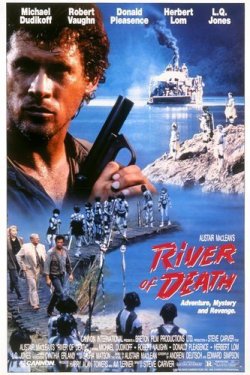 In the Amazon, natives are dying of a mysterious disease. Could it have anything to do with a German war criminal named Wolfgang (played by Robert Vaughn) who is living in a cave that is decorated with a Nazi flag? A scientist (Victor Melleney) and his daughter, Anna (Sarah Maur Thorp), are determined to find out. They hire a tough explorer, John Hamilton (Michael Dudikoff), to lead them up the river but John does not do a very good job because the scientist ends up dead and Anna ends up kidnapped.
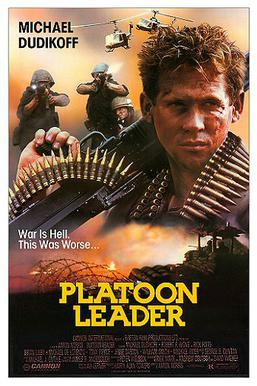 Having just graduated from West Point, Lt. Jeff Knight (Michael Dudikoff, the American Ninja himself) is sent to Vietnam and takes over a battle-weary platoon. Lt. Knight has got his work cut out for him. The VC is all around, drug use is rampant, and the cynical members of the platoon have no respect for him. When Lt. Knight is injured during one of his first patrols, everyone is so convinced that he’ll go back to the U.S. that they loot his quarters. However, Knight does return, determined to earn the respect of his men and become a true platoon leader!
 Dr. Judd Stevens (Roger Moore) is a mild-mannered Chicago psychologist who has never been in any trouble, so why has one of his patients and his receptionist been murdered? Lt. McGreavy (Rod Steiger), who has a personal grudge against Stevens, thinks that the doctor himself might be responsible. Dr. Stevens thinks that the first murder was a case of mistaken identity and that he is being targeted for assassination. Detective Angeli (Elliott Gould) says that he is willing to consider Stevens’s theory but can Stevens trust him? Or should Dr. Stevens put his trust in a veteran P.I. (Art Carney) or maybe even his newest patient (Anne Archer)?
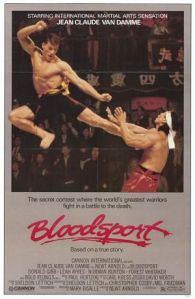 Bloodsport is one of Jean-Claude Van Damme’s earliest films and it is Damme good!
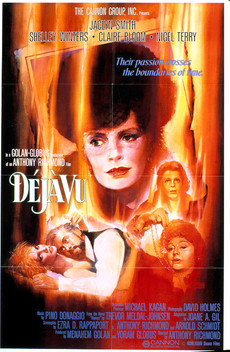 Damn, son. I’ve seen some bad movies before but Deja Vu is something else altogether.
 Charles Bronson, man.
 Through the Shattered Lens