The Eric Roberts Collection: Bed & Breakfast (dir by Marcio Garcia)


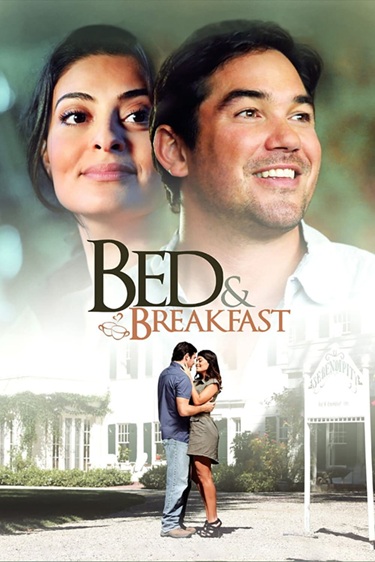
2010’s Bed & Breakfast is one of those Hallmark-y films that takes place at a B&B in a quaint little town.

Having recently been left by his actress wife, Jake (Dean Cain) is trying to open up a bed and breakfast, using a house that was left to him by a former employer.  Helping Jake out is his brother, Peter (Jake Engvall), a member of law enforcement who not only enjoys drinking beer but also enjoys talking about beer as well.  Juliana Paes plays Ana, the niece of the original owner of the house.  Ana is from Brazil and she wants to sell the house because her brother is in debt to some local mobsters.  But then Ana meets the handsome and single Jake and …. well, you already know what’s going to happen.  This is one of those films where the familiarity is the point.  You watch it because you know that Jake and Ana are going to fall in love and you know exactly how long it’s going to take for that to happen.  Dean Cain is rugged.  Juliana Paes is pretty.  The town is lovely.  It’s a sweet little film that you’ll forget about a few minutes after it ends.

Of course, these films always require a cameo or two.  John Savage and Julia Duffy show up as a couple who stay at the B&B and who share a dance at the end of the film.  Ted Lange is the judge who settles the issue of who actually owns the house.  Eric Roberts shows up as a reviewer who stays at the B&B and decides that it’s a wonderful place that more than deserves a good review.  Yay!  I will say that it’s always interesting to see Roberts playing someone who is just a nice, polite guy.  He doesn’t get to do it all that often.  Eric Roberts doesn’t have much screentime in this film but he gets to be pleasant the entire time.  It’s a nice change of pace.

Previous Eric Roberts Films That We Have Reviewed:

  1. Star 80 (1983)
  2. Runaway Train (1985)
  3. Blood Red (1989)
  4. The Ambulance (1990)
  5. The Lost Capone (1990)
  6. Love, Cheat, & Steal (1993)
  7. Voyage (1993)
  8. Love Is A Gun (1994)
  9. Sensation (1994)
  10. Dark Angel (1996)
  11. Doctor Who (1996)
  12. Most Wanted (1997)
  13. Mercy Streets (2000)
  14. Wolves of Wall Street (2002)
  15. Mr. Brightside (2004)
  16. Six: The Mark Unleased (2004)
  17. Hey You (2006)
  18. Amazing Racer (2009)
  19. In The Blink of an Eye (2009)
  20. Enemies Among Us (2010)
  21. The Expendables (2010) 
  22. Sharktopus (2010)
  23. Beyond The Trophy (2012)
  24. The Dead Want Women (2012)
  25. Deadline (2012)
  26. The Mark (2012)
  27. Miss Atomic Bomb (2012)
  28. Bonnie And Clyde: Justified (2013)
  29. Lovelace (2013)
  30. The Mark: Redemption (2013)
  31. Self-Storage (2013)
  32. A Talking Cat!?! (2013)
  33. This Is Our Time (2013)
  34. Inherent Vice (2014)
  35. Road to the Open (2014)
  36. Rumors of War (2014)
  37. Amityville Death House (2015)
  38. A Fatal Obsession (2015)
  39. Stalked By My Doctor (2015)
  40. Enemy Within (2016)
  41. Joker’s Poltergeist (2016)
  42. Prayer Never Fails (2016)
  43. Stalked By My Doctor: The Return (2016)
  44. The Wrong Roommate (2016)
  45. Dark Image (2017)
  46. Black Wake (2018)
  47. Frank and Ava (2018)
  48. Stalked By My Doctor: Patient’s Revenge (2018)
  49. Clinton Island (2019)
  50. Monster Island (2019)
  51. The Reliant (2019)
  52. The Savant (2019)
  53. Seven Deadly Sins (2019)
  54. Stalked By My Doctor: A Sleepwalker’s Nightmare (2019)
  55. The Wrong Mommy (2019)
  56. Exodus of a Prodigal Son (2020)
  57. Free Lunch Express (2020)
  58. Her Deadly Groom (2020)
  59. Top Gunner (2020)
  60. Deadly Nightshade (2021)
  61. The Elevator (2021)
  62. Just What The Doctor Ordered (2021)
  63. Killer Advice (2021)
  64. The Poltergeist Diaries (2021)
  65. The Rebels of PT-218 (2021)
  66. A Town Called Parable (2021)
  67. Bleach (2022)
  68. My Dinner With Eric (2022)
  69. Aftermath (2024)
  70. Devil’s Knight (2024)
  71. The Wrong Life Coach (2024)
  72. When It Rains In L.A. (2025)

The Challenge (1982, directed by John Frankenheimer)


Rick Murphy (Scott Glenn) is a punch-drunk boxer who is hired to return an ancient sword to Japan so that it can be returned to its rightful owner, the honorable Toru (Toshiro Mifune).  Once in Japan, Rick becomes involved in a battle between Toru and his corrupt brother, Hideo (Atsuo Nakamura).  Hideo demands that Rick work as an undercover spy in Toru’s martial arts school or be beheaded.  Rick decides to keep his head and be a spy but he soon finds himself truly wanting to learn the ways of the Bushido.

A martial arts film is the last place most people would expect to find Scott Glenn and considering how miscast Glenn is, that’s understandable.  Scott Glenn feels very out-of-place as both a boxer and a modern-day samurai.  Scott Glenn is a very good actor but the role of Rick Murphy called for someone who could mix comedy with drama and be convincingly desperate.  That’s not Scott Glenn.  Who would have been better in the role?  Tom Berenger was already acting in 1982.  Or maybe even someone like Jan-Michael Vincent.  Vincent was a B-actor but, deep down, The Challenge is a B-movie.

The good thing is that the action often does make up for Glenn’s miscasting.  John Frankenheimer struggled with making the human drama compelling but he knew how to film a good fight.  John Sayles’s script is pulpy without ever being disrespectful to Japanese culture and, as always, Mifune looks like he could battle and defeat the entire world if he wanted to.

One final note: Steven Seagal worked behind-the-scenes on the film but we won’t hold that against it.

Retro Television Review: Broken Angel (dir by Richard T. Heffron)


Welcome to Retro Television Reviews, a feature where we review some of our favorite and least favorite shows of the past!  On Sundays, I will be reviewing the made-for-television movies that used to be a primetime mainstay.  Today’s film is 1988’s Broken Angel!  It  can be viewed on YouTube.

Chuck Coburn (William Shatner) has a nice house in the suburbs, a nice job, a nice car, and a nice Bruins jacket.  He’s hoping that he can once against have a nice marriage with his wife (Susan Blakely), despite the fact that she cheated on him and she still thinks that he spends too much time at work.

Chuck is proud of his teenage daughter, Jaime (Erika Eleniak).  Jaime seems like the perfect suburban and angelic teenager.  But then Jaime goes to prom and her best friend, Jenny (Amy Lynne), is gunned down in front of her.  Jaime runs from the scene and vanishes.  As Chuck searches for his daughter, he is stunned discover that Jaime, Jenny, and their boyfriends were all a part of a gang!  His perfect daughter was smoking weed, doing cocaine, selling crack, and taking part in rumbles with a rival Asian gang.  Even worse, Jaime’s gang was called …. LFN!

LFN?  That stands for Live For Now.  The Live For Now Gang.  Whenever we see the members of the gang preparing to get into a fight with another gang, they all chant, “LFN!  LFN!”  LFN is a gang of white suburban teenagers and they look just as dorky as they sound.  I mean, I think it would be bad enough to discover that your child is in a gang but discovering they were in a dorky gang would probably make it even worse.

The majority of Broken Angel is made up of scenes of Chuck searching the mean streets of Los Angeles.  He partners with a social worker (Roxann Dawson) who is herself a former gang member.  Chuck discovers that his daughter’s street name was — *snicker* — Shadow.  He also befriend a member of the LFN’s rival Asian gang and tries to encourage her to go straight.  This leads to scene in which he is attacked by Al Leong.  Somehow, middle-aged William Shatner manages to beat up Al Leong.  That, in itself, is worth the cost of admission.

Broken Angel deals with a serious issue but it does so in such an overwrought and melodramatic fashion that most viewers will be moved not to tears but to laughter.  In Broken Angel, William Shatner gave the type of overly dramatic and self-serious performance that he routinely pokes fun at today.  If you’re one of those people who enjoys listening as Shatner emphasize random syllables and takes meaningly pauses, this movie will give you a lot to enjoy.  In every scene, Shatner seems to be saying, “Notice me, Emmy voters!  Notice me!”  Of course, it wouldn’t be until Shatner learned how to laugh at himself that the Emmy voters would finally notice him.

The film ends on an abrupt note but with the promise of better days ahead.  Just remember — keep an eye out for the LFN!

Film Review: Robocop (dir by Paul Verhoeven)


Last week, I watched the original Robocop (along with Robocop 2 and Robocop 3) and I have to say that the first film holds up far better than I was expecting. Made and released way back in 1987, Robocop may be one of the most prophetic films ever made.

Consider the plot:

America is torn apart by crime and a growing gap between the rich and the poor. That was probably true in 1987 and it’s certainly true in 2021.

Throughout the film, we see news reports about what’s happening in the world. The news is always grim but the reporters are always cheerful and the main message is that, no matter what’s happening, the government is not to blame and anyone who questions the wisdom of the establishment is a fool. If that’s not a perfect description of cable news and our current state-run media, I don’t know what is.

The populace is often too busy watching stupid game shows to really pay attention to what’s happening all around them. I’m writing these words on a Wednesday, which means that Game of Talents will be on Fox tonight, immediately after The Masked Singer.

Detroit, a once proud center of industry, has now turned into a dystopian Hellhole where no one feels that they’re safe. Now, I don’t live in Detroit so I don’t know how true that is but I do know that most of the recent news that I’ve heard about the city has not exactly been positive. Also, this seems like a good time to point out that, even though the film is set in Detroit, it was shot in Dallas. Though the Dallas skyline has undoubtedly changed a bit since 1987, I still recognized several buildings while watching Robocop. Seeing Reunion Tower in the background of a movie that’s supposed to be set in Detroit was interesting, though perhaps not as interesting as seeing our City Hall transformed into the headquarters of Detroit’s beleaguered police force.

OCP, a multi-national conglomerate that’s run by the amoral but occasionally charming Old Man (played by the brilliant Dan O’Herlihy), has a contract with city of Detroit to run their police department. This certainly doesn’t seem far-fetched in 2021. Considering that we now have prisons that are run by private companies and that the government has shown a willingness to work with private mercenaries overseas, it’s not a stretch to imagine a city — especially one on the verge of bankruptcy — handing over the police department to a private company.

Two OCP executives — Dick Jones (Ronny Cox) and Bob Morton (Miguel Ferrer) — are competing to see who can be the first to create and develop a peace-keeping robot, a machine that will replace the need to employ (and pay) human police officers. Dick Jones goes with an actual robot, which malfunctions during a boardroom demonstration and guns down another executive. (The scene where the poor exec is targeted is both terrifying and darkly humorous at the same time. Particularly disturbing is how everyone in the boardroom keeps shoving him back towards the robot in order to ensure that they won’t accidentally be in the line of fire.) Bob Morton, however, takes a mortally wounded cop named Murphy (Peter Weller) and turns him into Robocop!

Robocop turns out to be a huge success and is very popular with the media. (Anyone who doubts this would really happen has obviously never watched news coverage of a drone attack.) As you can guess, Dick is not particularly happy about getting shown up by Morton and his robocop. Dick also happens to be secretly in league with Clarence Boddicker (Kurtwood Smith), the crimelord who blew Murphy apart in the first place.

(A gangster and a businessman working together!? I doubt that was shocking even in 1987.)

Robocop claims that he’s just a machine, without a past or emotions, but he’s still haunted by random flashes of his life as Murphy. Working with Lewis (Nancy Allen), Murphy’s former partner, Robocop tracks down Boddicker and his gang. A lot of people die in outrageously violent ways. (The scene where Boddicker and his gang use a shotgun to torture Murphy is still shocking, even after all these years.) The violence is so over-the-top that it soon becomes obvious that director Paul Verhoeven is deliberately trying to get those of us watching to ask ourselves why we find films like this to be so entertaining. On the one hand, Robocop is an exciting action film with a sense of humor. On the other hand, it’s the type of subversive satire of pop and trash culture to which Verhoeven would return with Basic Instinct, Starship Troopers, and Showgirls. This is the type of film that asks the audience, “What are you doing here?”

34 years after it was first made, Robocop remains a triumph. Peter Weller’s performance holds up well, as he does a great job of capturing Robocop’s anguish while, at the same time, never forgetting that the character is ultimately a machine, one that’s trapped in a sort of permanent limbo. I also really liked the performance of Miguel Ferrer, who takes a character who should be unlikable and instead makes him into a surprisingly sympathetic figure.

Of course, a film like this lives and dies on the strength of its villains and both Ronny Cox and Kurtwood Smith are ideally cast as Dick Jones and Clarence Boddicker. Kurtwood Smith especially took me by surprise by how believably evil and frightening he was. As a I watched the film, I realized that it was his glasses that made him so intimidating. Wearing his glasses, he looked like some sort of rogue poet, a sociopathic intellectual who had chosen to use his talents to specifically make the world into a terrible place. Boddicker’s crew was full of familiar actors like Paul McCrane, Ray Wise, and, as the always laughing Joe Cox, Jesse Goins. Interestingly enough, all of the bad guys seemed to genuinely be friends. Even though they were all willing to betray each other (“Can you fly Bobby?”), they also seemed to really enjoy each other’s company. That somehow made them even more disturbing than a group of bad guys who were only in it for the money. The villains in Robocop really do seem to savor the chance to show off just how evil they can be.

(Incidentally, for all of the Twin Peaks fans out there, this film features three members of the show’s ensemble: Miguel Ferrer, Ray Wise, and Dan O’Herlihy.)

Robocop holds up well as entertainment, prophecy, and satire. Though not much was expected from it when it was first released, it became a surprise hit at the box office. Needless to say, this led to a sequel. I’ll deal with that film in about an hour.

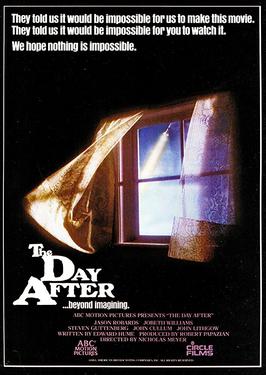
Film Review: The Day After (dir by Nicholas Meyer)


“This is Lawrence. This is Lawrence, Kansas. Is anybody there? Anybody at all?”

The words of Joe Huxley (John Lithgow) hang over the ending of The Day After, a 1983 film that imagines what the aftermath of a nuclear war would be like not on the East or the West Coasts but instead in the rural heartland of America.  Huxley is a professor at the University of Kansas and, as he explains early on in the film, Kansas would be an automatic target in any nuclear war because it houses a number of missile silos.  When he explains that, it’s in an almost joking tone, largely because the missiles haven’t been launched yet.  Instead, the only thing we’ve heard are a few barely noticed news stories about growing tensions between America and Russia.  About halfway through The Day After, the bombs go off and there are suddenly no more jokes to be made.

When the bombs drop over Kansas, we watch as cities and field and people burst into flames.  In a matter of minutes, several thousands are killed.  I’m almost ashamed to admit that I was probably more upset by the image of a horse being vaporized than I was by the death of poor Bruce Gallatin (Jeff East), the college student who was planning on marrying Denise Dahlberg (Lori Lethin).  I guess it’s because horses — really, all animals — have nothing to do with the conflicts between nations.  Humans are the ones who take the time to build bigger and better weapons and The Day After is one of the few films about war that’s willing to acknowledge that, when humans fight, it’s not just humans that die.

The bombing sequence is lengthy and I have to admit that I was a bit distracted by the fact that I recognized some of the footage from other movies.  A scene of panicked people running through a building was taken from Two-Minute Warning.  A scene of a building exploding and a construction worker being consumed by flames was lifted from Meteor.  As well, there’s some stock footage which should be familiar to anyone who has ever seen a documentary about the early days of the Cold War.  Still, despite that, it’s an effective sequence simply because it’s so relentless.  Some of the film’s most likable characters are vaporized before our eyes.  Steve Guttenberg, of all people, is seen ducking into a store.

Guttenberg plays Stephen Klein, a pre-med student who manages to survive the initial attack and takes shelter with the Dahlberg family at their ranch.  At first, it’s a bit distracting to see Steve Guttenberg in a very serious and very grim film about the nuclear apocalypse but he does a good job.  The sight of him losing both his teeth and his hair carries a punch precisely because he is reliably goofy Steve Guttenberg.

If the film has a star, it’s probably Jason Robards, the doctor who witnesses the initial blast from the safety of his car and then treats the dying in Lawrence, Kansas.  He does so, despite the fact that he doesn’t know if his wife, son, and daughter are even still alive.  He continues to do so until he also falls ill with radiation poisoning.  Knowing that he’s dying, he heads home just to discover that there is no home to return to.

Home is reccuring theme throughout The Day After.  Everyone wants to return to their home but everyone’s home has been wiped out.  “This is my home,” Jim Dahlberg (John Cullum) tries to explain before he’s attacked by a group of feral nomads.  Home no longer exists and trying to pretend like life can go back to the way it once was is an often fatal mistake.

Real happy film, right?  Yeah, this isn’t exactly a film that you watch for fun.  I have to admit that I made a joke about how I wouldn’t want to die while wearing the unfortunate blue jumpsuit that Jason Robards’s daughter chooses to wear on the day of the nuclear attack and I felt guilty immediately.  (Well, not that guilty.  Seriously, it was a terrible fashion choice.)  The Day After is a film that gives audiences zero hope by design.  It was made at a time when it was generally assumed that nuclear was inevitable and it was designed to scare the Hell out of everyone watching.  And while I can’t attest to how audience may have reacted in 1983, I can say that, in 2020, it’s still a powerful and disturbing film.

“Is anybody there? Anybody at all?” Joe Huxley asks and by the end of the film, the answer doesn’t matter.  The damage has already been done.