Ah, the folly of youth. When we’re young, we’re so determined to prove we can “make it on our own” that we’ll turn our backs on opportunities that might serve us better in the long run just because they would mean answering to “The Man” in the short term. A hot-shot young chef (a nauseating demographic which our nation is currently, and quite literally, under absolute fucking assault from) will bypass the chance to apprentice under a master of his craft in a popular and established kitchen in order to go start up his own restaurant that will be lucky to last out the year. A promising young journalist will eschew the opportunity to work as a “beat” reporter on a local paper in order to start up a “cutting edge” news website with “attitude” that folds when they can’t get any advertisers. A way-too-full-of-himself young lawyer will say “no thanks” to a “lesser” offer from a major, established firm in order to start his own personal injury practice before realizing that there are already 10,000 other guys in town doing the exact same thing. There’s no doubt about it, my friends — we don’t know jack shit when we’re young, but we know we know better than anybody else.
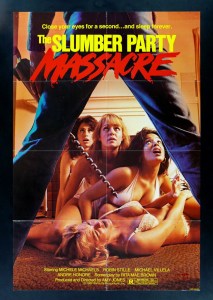
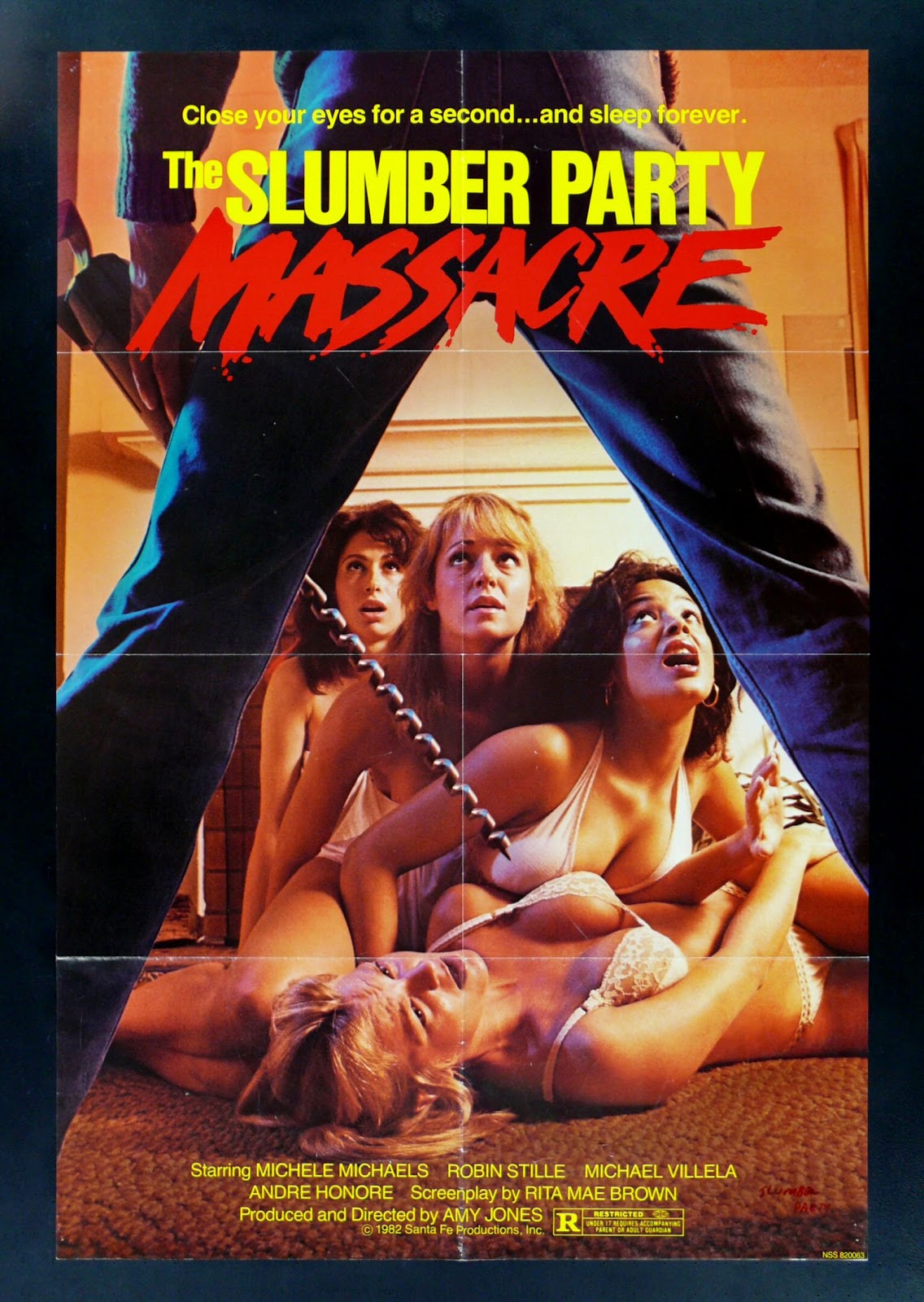
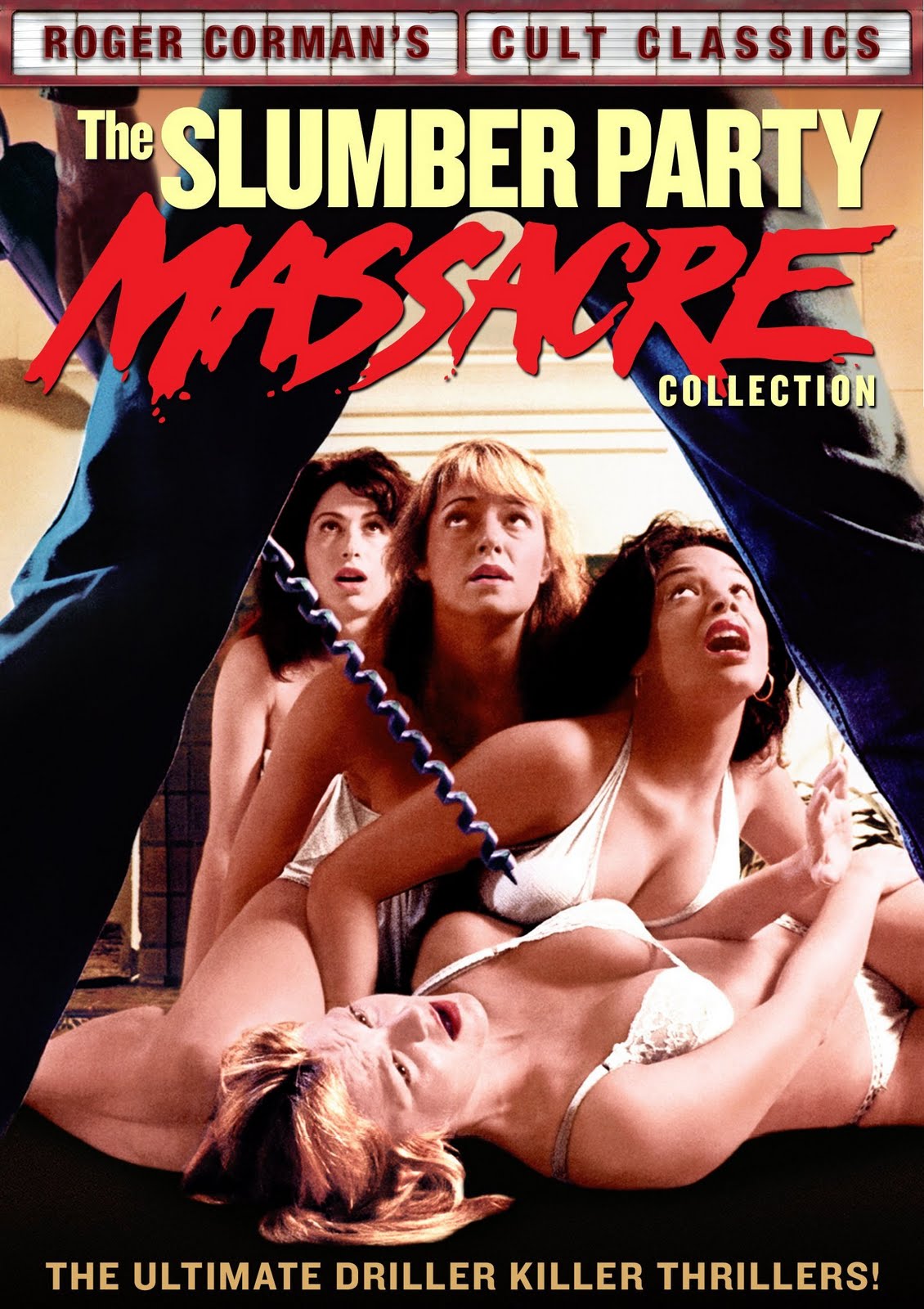
All of which is to say, I guess, a couple of things : one, that I’m older and wiser now and will gladly give up the “freedom” and “total control” I have over my own website in less than a goddamn heartbeat in order to go work for somebody who actually pays me to write this shit; and two, that back in 1982 a semi-recent USC film school grad named Amy Holden Jones, who was considered something of an up-and-comer behind the camera in Hollywood at the time, turned down the chance to be Steven Spielberg’s cinematographer on a little something called E.T. in order to direct a much littler something for Roger Corman called The Slumber Party Massacre.
I’m sure she’s not kicking herself too badly over that decision today.

Corman, of course, as he always seemed to, had an angle figured with this one, as well — in order to deflect, or at least try to deflect, some of the rampant feminist criticism that was just starting to be directed at the “slasher” genre back then, he’d take the largely (okay, entirely) symbolic step of hiring women to both direct (Jones) and script (Rita Mae Brown) his latest girls-take-off-their-shirts-and-get-butchered-for-being -“slutty” opus, therefore “proving” that he, himself, had no problem with the fairer sex —only his movies did.
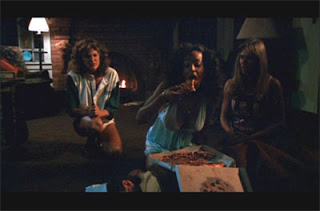
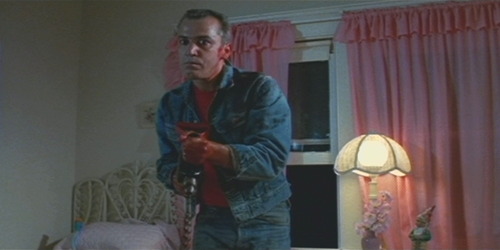
To their credit, both Jones and Brown obviously knew full well what they were getting into here (hell, how could you not?) and decided to play the whole thing up for all it was worth by indulging in blatant self-parody at more or less every turn. Their escaped-from-the-loony-bin killer, one Russ Thorne (Michael Villella) is given essentially no motivation whatsoever and goes after his victims with the most overtly phallic power drill ever conceived of; he’s thrust into the middle of a high school all-girls’ basketball team slumber party (hence, ya know, the title) by the most contrived set of circumstances possible; and every one of the nubile young targets of his kill-spree is a paper-thin, less-than-two-dimensional cipher rather than being anything like an actual, proper character.

As far as any kind of plot synopsis goes, that’s probably all you really need here, if not more — after all, you know the drill (sorry!), right? The party’s hostess, Trish (Michelle Michaels), despite being listed first in the credits, isn’t gonna be the last girl standing (or limping, or writhing, or crawling), that honor goes to picked-on-for-being-aloof-quiet-and-too-much-better-at-basketball-than-the-others (she’s even a new girl at school, to boot! How many different ways can you say “virgin” without just blurting it out?) Valerie (Robin Stille). All the proceedings here follow the typical cut-and-dried formula more or less to a “T,” with a heavy dose of self-awareness being basically the only wrinkle added into the mix, apart from “keep your eyes open for an early turn by future ‘scream queen’ semi-star Brinke Stevens.”
None of which is to say that I didn’t enjoy The Slumber Party Massacre — the fact of the matter is, this one of those flicks that I always kinda turn to when I want to turn my brain off. It’s solid, if unspectacular, tongue-in-cheek fun, leaves a pleasant-enough grin on your face, and keeps you reasonably involved for its brief-but-just-right-all-things-considered 77-minute run time. If ol’ Russ was as smart and efficient at his job as Holden was at hers, he might still be running around sticking his power drill in high school girls today. And yeah, I realize that last sentence sounded every bit as unsubtle as this movie is, that was kinda the — errrmmm — point (damn! Just can’t help myself).

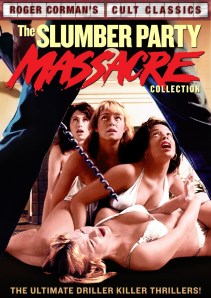
Being that this movie and its two sequels (part two being even more OTT farcical than this one, part three being something of a “back-to-basics” straight-to-video affair) have a semi-sizable cult following, Shout! Factory made the wise decision to release ’em all together in one collection on (two-disc) DVD and (single-disc) Blu-Ray. Since I’ll be going to the “effort” of reviewing ’em all here in the next few days, I’ll just take it one at a time with the technical specs and extras. The Slumber Party Massacre is presented in a 1.78:1 widescreen remastered transfer that looks pretty damn stunning, and the remastered mono sound is perfectly serviceable, as well. There’s a really good little “making-of” featurette included , a photo still and poster artwork gallery, and director Jones is on hand for a full-length commentary track. The original theatrical trailer, a smattering of trailers for other titles in the “Roger Corman’s Cult Classics” series, and a solid set of liner notes by Jason Paul Collum round out the package.
If you don’t have the time, money, or inclination to break new ground — and let’s face it, Roger Corman never had any of the above — you could do a lot worse than to tread the same ol’ familiar territory with a little bit of style, self-deprecating wit, and a quick little wink to the audience. The Slumber Party Massacre certainly delivers on each of those counts, and while I’ll never be fully on board with those who view this thing as some sort of “classic,” it’s definitely a good — if thoroughly predictable — time.
I’m older and wiser now, remember? I’m perfectly happy to take what I can get.
 Would you watch a reality show produced by Joe Estevez?



 Through the Shattered Lens