Welcome to Retro Television Reviews, a feature where we review some of our favorite and least favorite shows of the past! On Saturdays, I will be reviewing The American Short Story, which ran semi-regularly on PBS in 1974 to 1981. The entire show can be purchased on Prime and found on YouTube and Tubi.
This week, The American Short Story comes to a close.
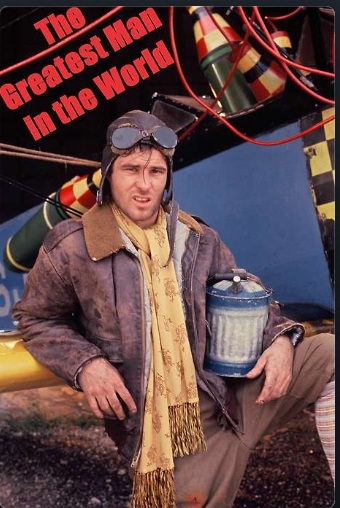
Episode #17: The Greatest Man In The World
(Dir by Ralph Rosenbaum, originally aired in 1981)
In this adaptation of a James Thurber short story, a country boy named Jack Smurch (Brad Davis) briefly becomes a celebrity when he breaks Charles Lindbergh’s record for flying nostop around the world. Two reporters (Reed Birney and John McMartin) are assigned to write a glowing profile of him. The U.S. Secretary of State (William Prince) wants to make him a symbol of America. The only problem is that Smurch himself is a violent and dull-minded habitual criminal who can barely fly his plane and who almost crashes when he comes in for a landing at the end of his flight. Before he took off in his plane, the only person who cared about Smurch was his girlfriend (Carol Kane). Even Smurch’s own mother says that she hopes that he crashes and drowns. But once he manages to land, Smurch becomes a hero. As the saying goes, print the legend.
Smurch, unfortunately, isn’t smart enough to play along with the hero routine. At a meeting with the Secretary of State and the President (who is implied to be FDR), Smurch proves to be so obnoxious that he’s tossed out of a window. He plunges to his death but he dies an American hero.
The final episode of The American Short Story was also the best, a wonderfully dark satire on the media and our cultural need for heroes. Brad Davis’s naturally obnoxious screen presence — the same presence that made audiences enjoy seeing him get tortured in Midnight Express — is put to good use here. Jack Smurch is such a jerk that you really can’t blame anyone for tossing him out that window. If nothing else, it got him to stop talking.
The American Short Story was, overall, an uneven series. Too often, the episodes failed to really capture the tone and style that made the original stories so memorable. That said, there were a few good episodes, like this one. If nothing else, perhaps this series inspired people to read the original stories for themselves. That would have been the best possible outcome.
Next week …. something new will premiere in the time slot! What will it be? I’ll give you a clue — it’s set on the beach but it’s not Pacific Blue. Let’s just say that some people stand in the darkness….
In the 1980s, director Robert Altman found himself even more outside of the Hollywood system than usual. A series of films that confused critics and repelled audiences had led to Altman becoming something of a pariah. As no studio was willing to give Altman a chance to make the type of quirky feature films that he made his name with in the 70s, Altman instead directed a series of low-budget theatrical adaptations. These films may not have gotten the attention of his earlier films but they allowed Altman to show off his talents, especially when it came to working with actors.
1988’s The Caine Mutiny Court-Martial was one of those films. Made for television and based on the play by Herman Wouk, The Caine Mutiny Court-Martial was a courtroom drama that Altman brought to life with his usual flair. Anyone who has read either the play or Herman Wouk’s original novel (or who has seen the 1953 film version, The Caine Mutiny) will know the story. In the final days of World War II, Lt. Steven Maryk (Jeff Daniels) has been court-martialed for mutiny. During a particularly violent storm, Maryk took command of the USS Caine away from Lt. Commander Queeg (Brad Davis). Maryk and his fellow officers, including aspiring novelist Lt. Thomas Keefer (Kevin J. O’Connor), claim that, after several incidents that indicated he was mentally unstable, Queeg froze up on the bridge and had to be relieved of command. Queeg claims that everything he did was to enforce discipline on the ship and that he never froze. Prosecuting Maryk is Lt. Commander John Challee (Peter Gallagher). Defending him is Lt. Barney Greenwald (Eric Bogosian), who is determined to win the case even though he doesn’t necessarily agree with Maryk’s actions.
The Caine Mutiny Court-Martial is very much a filmed play. Almost all of the action takes place in one location, a gymnasium that has been converted into a court of military law. We don’t actually see what happened on the Caine when Maryk took control. Instead, we just hear the testimony of those involved. Queeg defends himself, ably at first but soon he starts to show signs of the pressure of being in command. Maryk explains his actions and we want to believe him because he’s played by fresh-faced Jeff Daniels but, at the same time, there’s something a little bit too smug about his declaration that Queeg was not fit for command. The other officers on the Caine testify. Under Greenwald’s skillful cross-examination, Queeg is continually portrayed as being a flawed officer. But only Greenwald understand that Queeg was isolated not only by the loneliness of being in charge but also by members so his own crew, like Keefer, who hated the Navy and didn’t want to take their part in the war effort seriously. As a Jew who is very much aware of what’s at stake in the war, Greenwald has mixed feelings about the way that Queeg was treated. It ends with a party, where a drunk Greenwald calls out the true architect of The Caine Mutiny. As opposed to the way the scene was portrayed in the 1953 film or in Willam Friedkin’s recent adaptation), Altman focuses not so much on Greenwald but on the party occurring around him. If the other versions of this story ended on a note of triumph for Greenwald, this one ends on a note of sadness with Greenwald’s words being almost unheard by the officers of the Caine.
Altman gets excellent performances from the entire cast and, even more importantly, he avoids the downfall of so many other theatrical adaptations. The Caine Mutiny Court-Martial may be a talky film and it may largely take place in only one location but it’s never boring. Altman’s camera is continually prowling around the makeshift courtroom, reflecting the tension of the case in every movement. The end result is one of Altman’s best theatrical adaptations.
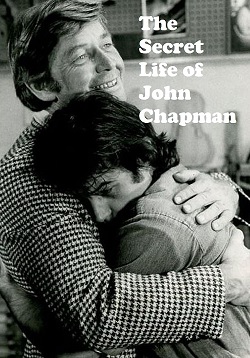
Welcome to Retro Television Reviews, a feature where we review some of our favorite and least favorite shows of the past! On Sundays, I will be reviewing the made-for-television movies that used to be a primetime mainstay. Today’s film is 1976’s The Secret Life of John Chapman! It can be viewed on Tubi.
John Chapman (Ralph Waite) is a mild-mannered college president and a recent widower. Everyone tends to assume that John grew up wealthy but John is actually the son of a bricklayer. As he puts it, his father literally helped to build the college of which John is now president. John has felt lost and directionless ever since the passing of his wife. When his rebellious son (Brad Davis) announces that he’s going to drop out of college and pursue a career as a laborer, John is at first outraged but soon, he’s wondering if perhaps his son has a point. Has John spent so much time cocooned in his college that he’s lost touch with the rest of the world?
John takes a sabbatical and pursues a career as a blue collar worker. He discovers that it’s not as easy as he assumed. Because John doesn’t want to reveal that he’s an academic, John doesn’t really have any references to offer up to potential employers. Because he’s nearly 50, John is continually told that he’s too old for most of the jobs that he applies for. When he goes into a bar and attempts to order a dry martini, he quickly realizes that he has no idea what it’s like to be blue collar.
John eventually does get a job, helping to lay water pipes. His boss is the gruff Gus Reed (Pat Hingle), who John eventually discovers is not quite as fearsome a figure as he originally appears. Once the pipe job is done, John gets a job in a diner and even pursues a tentative romance with a waitress (Susan Anspach) who, as she points out, comes from a totally different world than him. And yet, despite John’s efforts, his son remains unimpressed. According to his son, John is just slumming. He has the freedom to quit and return to the college whenever he wants.
Yikes! John’s son is a bit judgmental and it doesn’t help that he’s played by Brad Davis, who was never a particularly likable actor. (Davis later starred in Midnight Express, in which director Alan Parker used his lack of likability to good effect.) Yet, watching the film, you can’t help but feel that John’s son has a point. At times, it seems like John wants a lot of credit for spending a week working in the type of job that most people take because they don’t have any other option. Indeed, you could argue that John’s project is basically keeping someone who really needs the money from finding a job. It’s not like John gives up any of his money when he goes to work. It doesn’t help that John Chapman narrates his story and his voice-over often feels like a parody of liberal noblesse oblige.
Fortunately, Ralph Waite was a likable actor and he plays John Chapman as being well-intentioned if occasionally a bit condescending. The made-for-TV movie plays like a pilot and it’s easy to imagine a series in which John Chapman would have worked a different job every week. It’s a slight but pleasant-enough made-for-TV movie. Seen today, it works best as a time capsule, a portrait of a society still trying to find its identity in the wake of the turbulence of the 60s.
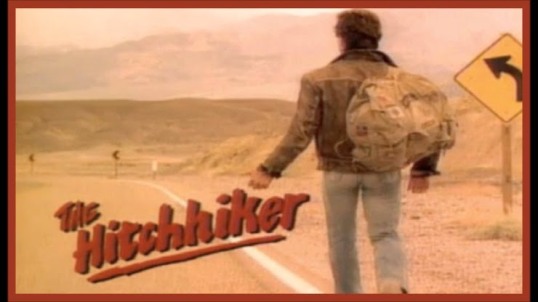
Tonight’s episode of The Hitchhiker is an early example of found footage horror.
Jerry Rulack (played by the star of Midnight Express, Brad Davis, in one of his final performances) is a smarmy TV host who, along with his camera crew, goes from nightclub to nightclub and asks the clubgoers, “Why are you here?” Eventually, Jerry runs into a rich girl named Donette (Helen Hunt), who turns the question around and leaves Jerry to wonder why he’s there. Donette and her friends are rich, decadent, and ultimately dangerous. Eventually, Jerry discovers that there is a price to pay for asking too many stupid questions. Brad Davis does an adequate Geraldo Rivera impersonation while Helen Hunt seems to be having fun playing someone who literally cares about nothing. As the Hitchhiker, Page Fletcher is wonderfully judgmental while introducing Jerry and later while considering his fate.
This episode originally aired on March 10th, 1987.
Since it’s currently Spring Break, I figured that I would spend the next two weeks reviewing films about people on vacation. Some of the films will be about good vacations. Some of the films will be about bad vacations. But, in the end, they’ll all be about celebrating those moments that make us yearn for the chance to get away from it all.
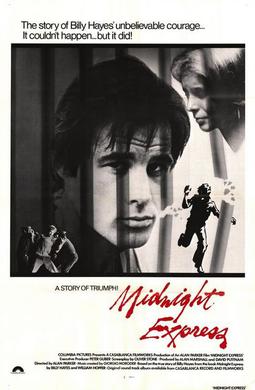
Take Midnight Express, for instance. This 1978 film (which was nominated for six Oscars and won two) tells the story of what happens when a carefree college student named Billy Hayes decides to spend his holiday in Turkey.
When the film begins, Billy Hayes (played by Brad Davis), is at an airport in Turkey. He’s preparing to return home to the United States. His girlfriend, Susan (Irene Miracle), informs him that Janis Joplin has just died. When Billy responds by making a joke, Susan accuses him of not taking anything seriously. What Susan doesn’t realize is that Billy actually has a lot on his mind. For one thing, he’s got several bricks of hashish taped around his waist. He purchased it from a cab driver and he’s planning on selling it to his friends back in the United States. Unfortunately, Billy’s not quite as clever as he thinks he is. Because of recent terrorist bombings, the Turkish police are searching everyone before they board their plane. Billy finds himself standing out in the middle of the runway with his hands up in the air, surrounded by gun-wielding Turkish policemen.
Billy finds himself stranded in a country that he doesn’t understand, being interrogated by men whose language he cannot speak. An enigmatic American (Bo Hopkins) shows up and assures Billy that he’ll be safe, as long as he identifies the taxi driver who sold him to the drugs. Billy does so but then makes the mistake of trying to flee from the police. In the end, it’s the American who captures him and, holding a gun to Billy’s head, tells him not to make another move.
Soon, Billy is an inmate at Sağmalcılar Prison. He’s beaten when he first arrives and it’s only days later that he’s able to walk and think clearly. He befriends some of the other prisoners, including a heroin addict named Max (John Hurt) and an idiot named Jimmy (Randy Quaid). Billy watches as the prisoners are tortured by the fearsome head guard (Paul L. Smith) and listens to the screams of inmates being raped behind closed doors. After being told that his original four-year sentence has been lengthened to a 30-year sentence, Billy starts to degenerate. When Susan visits, Billy end up pathetically masturbating in front of her. When another prisoner taunts Billy, Billy bites out the man’s tongue, an act that we see in both close up and slow motion. If Billy has any hope of regaining his humanity, he has to escape. He has to catch what Jimmy calls the “midnight express…..”
Midnight Express is a brutal and rather crude film. Though it may have been directed by a mainstream director (Alan Parker) and written by a future Oscar-winner (Oliver Stone), Midnight Express is a pure grindhouse film at heart. There’s not a subtle moment to be found in the film. The camera lingers over every act of sadism while Giorgio Moroder’s synth-based score pulsates in the background. When Billy grows more and more feral and brutal in his behavior, it’s hard not to be reminded of Lon Chaney, Jr. turning into The Wolf Man. The film may be incredibly heavy-handed but it’s nightmarishly effective, playing out with the intensity of a fever dream.
As for the cast, Brad Davis wasn’t particularly likable or sympathetic as Billy. On the one hand, he’s a victim of an unjust system, betrayed by his own country and tortured by another. On the other hand, Billy was an idiot who apparently thought no one would notice all that hash wrapped around his chest. That said, Davis’s unlikable screen presence actually worked to the film’s advantage. If you actually liked Billy, the film would be unbearable to watch. Before Davis was cast, Dennis Quaid and Mark Hamill were both considered for the role. If either of those actors has been cast, Midnight Express would be too intense and disturbing to watch. For instance, it would be depressing to watch Dennis Quaid rip a man’s tongue out of his mouth. You would be like, “No, Mr. Quaid, you’ll never recover your humanity!” But when Brad Davis does it, you’re just like, “Eh. It was bound to happen sometime.”
For more effective are John Hurt and Bo Hopkins. Hurt and Hopkins both have small roles but they both make a big impression, if just because they’re the only two characters in the film who aren’t either yelling or crying all of the time. While everyone else is constantly cursing their imprisonment, Hurt is quietly sardonic. As for Hopkins, we’re supposed to dislike him because he’s with the CIA and he sold out Billy. But honestly, no one made Billy tape all that hash to his chest. Finally, you’ve got Randy Quaid and Paul L. Smith, who both glower their way through the film. Smith is wonderfully evil while Randy Quaid is …. well, he’s Randy Quaid, the loudest American in Turkey.
Midnight Express was such a success at the box office that it caused an international incident. There’s not a single positive Turkish character to be found in the entire film and it’s impossible not to feel that the film is not only condemning Turkey’s drug policies but that it’s also condemning the entire country as well. The Turkish prisoners are portrayed as being just as bad as the guards and even Billy’s defense attorney comes across as being greedy and untrustworthy. Watching the film today can be an awkward experience. It’s undeniably effective but it’s impossible not to cringe at the way anyone who isn’t from the west is portrayed. In recent years, everyone from director Alan Parker to screenwriter Oliver Stone to the real-life Billy Hayes has apologized for the way that the Turkish people were portrayed in the film.
Despite the controversy, Midnight Express was a huge box office success and it was nominated for best picture. It lost to another controversial film about people imprisoned in Asia, The Deer Hunter.
It took me two viewings to really appreciate the film Chariot of Fire.
First released in 1981, Chariots of Fire won the Oscar for best picture. It’s also one of the few British productions to take the top award. (British films are regularly nominated but the winner is usually an American production.) A few nights ago, it was broadcast on TCM and I watched it for the first time. And I have to admit that I struggled to follow the film.
It’s not that the film’s story was exceptionally complicated. At heart, it’s an inspirational sports film and it features all of the clichés that one usually associates with inspirational sports films — i.e., come-from-behind victories, eccentric trainers, athletes who are determined to compete under their own terms, training montages, and a memorable score. (The score for Chariots of Fire was so effective that it’s still used as the background music for countless Olympic specials.)
No, I struggled to follow the film because it really was just so extremely British, featuring everything from Cambridge to Gilbert and Sullivan to a rigidly enforced class system to casual anti-Semitism, This may have been a sports film but it was a very reserved sports film. If Chariots of Fire had been an American film, we would have gotten countless shots of people screaming, “YESSSSS! GO! GO! GO! GO!” Instead, the characters in Chariots of Fire are far more likely to say, “Good show, old boy.” Whereas an American sports film would have scored a montage of competition to the sound of “Eye of the Tiger,” Chariots of Fire features a men’s chorus singing, “For he is an Englishman….”
It takes a bit of getting used to and perhaps I knew that because, even as I was watching Chariots of Fire, I still set the DVR to record it. The first time I watched the film, I was overwhelmed by the culture shock and the resolute Britishness of it all. My reaction was to think that, much like The Big Chill, Chariots of Fire was a “you just had to be there” type of film, the type of film that was once impressive but now just inspires you to go “meh.”
And I was prepared to write a review stating just that. But, somehow, in the back of my mind, I knew that I should give Chariots of Fire another chance before I dismissed it. Maybe it was the fact that I couldn’t get the damn music out of my head. Who knows? But I couldn’t think about the film’s opening — with all those men running on the beach and getting mud all over their white uniforms — without smiling.
So, seeing as how I am currently snowed in for the weekend, I spent this morning watching Chariots of Fire for a second time and I’m glad that I did. Because you know what? Chariots of Fire is actually a pretty good film. It tells the story of Eric Lidell (Ian Charleson) and Harold Abrahams (Ben Cross), two British runners who competed at the 1924 Olympics. Harold is a student at Cambridge. He’s an angry young man who is running to prove all of the anti-Semites wrong. (Of course, Harold is angry in a very sort of upper class British way). Eric is the son of missionaries who views running as a mission from God and who refuses to run on a Sunday. The film looks gorgeous, Charleson and Cross both give good performances, and that music demands an emotional response. While Chariots of Fire may not be a great film, it’s definitely a likable film and there’s something to be said for that.

 Through the Shattered Lens