Happy 74th Birthday, Kurt Russell! In GUNS OF DIABLO (1964), a young Kurt graces the screen with cinema icon Charles Bronson.


As a person who sees his love of movies through a lens of “Bronson connections,” I have a special fondness for Kurt Russell. In 1963 and 1964, Charles Bronson worked on a television series with Kurt Russell called THE TRAVELS OF JAIMIE MCPHEETERS. The series itself is the story of twelve year old Jaimie McPheeters (Kurt Russell) who, along with his ne’er-do-well doctor dad (Dan O’Herlihy) and a ragtag group of pioneers, travel westward from Paducah, Kentucky to the California gold fields in 1849. Charles Bronson first appeared on episode 10 of the series, and would stay with the series until it ended after 26 episodes. Russell was the star, with Charles Bronson riding along in the important role of Linc Murdock, the guide who gets them through all sorts of dangerous situations. 1964’s GUNS OF DIABLO is an interesting concoction, using the final episode of the series, “The Day of Reckoning” and adding some new scenes shot specifically for a movie release.

GUNS OF DIABLO opens with Linc Murdock (Charles Bronson) leading the wagon train across a raging river. The group constructs a wooden barge, and most of the group makes it across safely. Unfortunately for one of the groups, a tree floating down the river smashes into the barge, causing it to sink along with the wagon and the man on top of it. Murdock jumps into the river and is able to save the man who unfortunately suffers a broken leg. Needing to rest for a few days, Murdock decides to go into the local town, Devil’s Gap, to get supplies. Jaimie (Kurt Russell), a boy with the wagon train, asks his dad if he can go with him. Dad says yes under one condition, Jaimie gets a real bath while he’s in town. So Linc and Jaimie head off together. When they get to town, Linc immediately goes to the saloon to get a beer, where he sees the beautiful Maria (Susan Oliver), a woman with whom he has a dangerous past. Via flashback, we learn the story of Linc and Maria falling in love while he was working as a hand on the Macklin ranch five years earlier. But it was a doomed love affair as Maria had been promised to the eldest son of the family, Rance Macklin (Jan Merlin). When Linc and Maria plan to elope and get married, Rance and his brothers get the drop on them. A big gunfight ensues, with Rance taking a shot in the arm, and Maria being shot in the crossfire. Believing her to be dead, Linc barely escapes with his own life.

Back in the present time we meet a Maria who is stuck in a loveless marriage to a one-armed Rance. Rance and his brothers have lost the ranch and are always trying to stay one step ahead of the law. That’s why Maria’s been reduced to working as a waitress at the saloon. She also believes that Linc ran out on her five years ago, so she’s mad at him. But soon those old feelings start stirring up deep within her when Linc talks sweet to her. When the duplicitous bartender Ives (John Fiedler) sees Linc go into Maria’s room, he sends word to Rance. Soon the Macklin Brothers are on their way back to town to settle their old score with Linc. What they didn’t count on was the 12 year old Jaimie McPheeters, with all of his youthful exuberance and ingenuity, being there to swing the odds in Linc’s favor! I made up that last line, but Jaimie does help Linc a couple of times. 

I mentioned earlier that GUNS OF DIABLO was assembled together using the final episode of THE TRAVELS OF JAIMIE MCPHEETERS, along with some new footage added specifically for the movie. I’ve never seen the final episode of the series that this movie was based on, but I have seen some of the earlier episodes and I did notice one key difference. The TV series revolves mostly around the trials and tribulations of Jaimie and his dad, Dr. Sardis McPheeters. Dan O’Herlihy played Dr. McPheeters in the series, but actor Russ Conway plays him in this movie. He’s not a big part of the movie, just appearing at the beginning and the end, but it was odd seeing a different actor portraying Jaimie’s dad. It sure would be great if the series were to become more widely available at some point in time. I’d love to compare the TV version to this movie version.

Charles Bronson was not a big movie star when GUNS OF DIABLO was released, but he was a well respected character actor. He had already headlined his own TV series, MAN WITH A CAMERA (1958-1960), and he had prominent roles in the massive box office hits THE MAGNIFICENT SEVEN (1960) and THE GREAT ESCAPE (1963). This movie heavily focuses on his character, and Jaimie McPheeters takes a back seat. Bronson, already 43 years old, was more than up to the challenge. He comes across as a decent, hardworking man, who’s capable of taking care of himself. In other words, he shows the strength and charisma that would make him the most popular actor in the world just a few years later. Susan Oliver is quite beautiful as Maria. Although primarily known as a blonde, blue eyed beauty, her hair is dark here. She’s so beautiful that I can understand why a man with such limited options would be willing to fight to the death for her. And what can you really say about Kurt Russell?! He’s such a good child actor. While Jaimie McPheeters may not be the focus of the movie, he’s still so good in the role, showing kindness, loyalty and bravery in equal measure. In a world where so many child actors can’t adjust to life as an adult, Russell has made it look easy for the last six decades. In my opinion, he’s one of the all time greats. 

Overall, GUNS OF DIABLO will never be confused with HIGH NOON (1952) or RIO BRAVO (1959), but for a movie assembled from a 60’s TV western and a few newly shot scenes, it’s actually quite enjoyable. And the storyline may not be the most original, but the time tested tale of true love and honor winning out over greed and evil will always make for compelling viewing. I got my first VHS of this film in the 80’s and I still own it to this day. I even watched it multiple times while I was writing up this review. As far as I’m concerned, GUNS OF DIABLO is well worth watching for fans of westerns or fans of the stars. 

Rather than sharing a trailer for the film I thought I’d share this heartwarming story of the time Kurt Russell bought Charles Bronson a birthday gift while they were working together on this series. It’s a classic. Enjoy, my friends!
Retro Television Review: Indict & Convict (dir by Boris Sagal)


Welcome to Retro Television Reviews, a feature where we review some of our favorite and least favorite shows of the past!  On Sundays, I will be reviewing the made-for-television movies that used to be a primetime mainstay.  Today’s film is 1974’s Indict & Convict!  It  can be viewed on YouTube.

There’s been a murder!

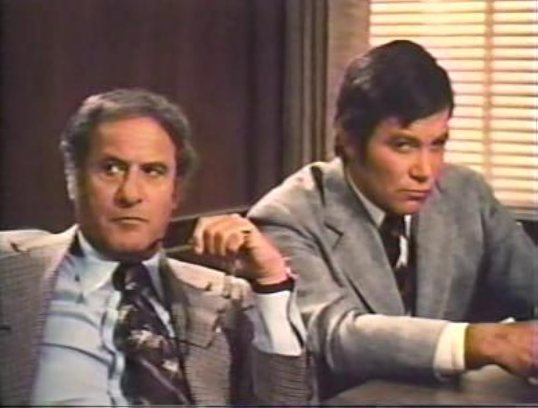
The wife of Assistant District Attorney Sam Belden (William Shatner) has been found, shot to death.  Making things especially awkward is that the body of her lover is found next to her.  Though Belden is the obvious suspect, he has an alibi for the time of the murders.  He claims that he was in Las Vegas, attending a convention.  Two gas station attendants remember seeing him filling up his car with gas at around the same time that his wife and her lover was being shot.

Attorney General Timothy Fitzgerald (Ed Flanders) is not so sure that Belden is innocent.  He instructs two of his top prosecutors to check out Belden’s story and to see if there’s enough evidence to not only indict but also to convict.  Bob Matthews (George Grizzard) is a veteran prosecutor and he’s the one who narrates the story for us.  Assisting him is Mike Belano, who is played by the always likable Reni Santoni.  Just three years before this movie aired, Santoni played Harry Callahan’s partner in Dirty Harry.  There was just something about Santoni’s friendly but determined demeanor that made him perfect the role of the supportive partner or assistant.

The film is very much a legal procedural, with the emphasis on not only the investigation but also on the strategies and the techniques that are used in the courtroom by Matthews and defense attorney DeWitt Foster (Eli Wallach).  In many ways, it feels like a forerunner to Law & Order.  Usually, I love court procedurals but Indict & Convict was a bit too slow and high-minded for its own good.  Maybe it’s because I’ve been spoiled by all of the legal shows that I’ve seen but I have to admit that I spent a good deal of Indict & Convict wanting the prosecutors to get on with it.  Flanders, Grizzard, Santoni, and Wallach were all ideally cast but the film itself sometimes got bogged down with all the debate about the best way to win a conviction.  It’s a shame because the story itself is an intriguing one and I actually enjoyed the movie’s use of spinning newspaper headlines to let us know what had happened in between scenes.  Also, as a classic film fan, I enjoyed seeing Myrna Loy as the judge.  She didn’t get to do much other than say, “Sustained” and “Overruled,” but still …. Myrna Loy!

Most people who watch this film will probably do so out of the hope of seeing some trademark Shatner overacting.  William Shatner doesn’t actually get to say much in this film.  He spends most of the running time sitting silently at the defense table.  Towards the end, he does finally get a chance to deliver a brief speech and it’s everything you could hope for.  Shatner takes dramatic pauses.  Shatner emphasizes random words.  Every line is delivered with the subtext of, “Pay attention, Emmy voters!”  Eventually, Shatner would learn the value of laughing at oneself but apparently, that lesson had not yet been learned when he did Indict & Convict.

Retro Television Reviews: The Failing of Raymond (dir by Boris Sagal)


Welcome to Retro Television Reviews, a feature where we review some of our favorite and least favorite shows of the past!  On Sundays, I will be reviewing the made-for-television movies that used to be a primetime mainstay.  Today’s film is 1971’s The Failing of Raymond!  It  can be viewed on YouTube!

Poor Raymond!

Played by a young Dean Stockwell, Raymond is patient at a mental hospital who blames everything that has gone wrong on his life on one failed test.  During his senior year of high school, he got a 61 on an English test and, as a result, he not only only failed the class but he also wasn’t allowed to graduate.  The test was administered by a substitute teacher named Mary Bloomquist (Jane Wyman), one who did not know that Raymond had a reputation for being a bit eccentric.  When Raymond tried to ask her whether or not the final two questions were for extra credit, Mary refused to call on him because she was more preoccupied with her failed affair with another teacher (Dana Andrews).  Raymond didn’t answer the final two questions, even though he believed that he had the correct answers.  Now, locked away in a hospital, Raymond comes across an article announcing that beloved teacher Mary Bloomquist will soon be retiring and moving to England.

Seeking revenge, Raymond escapes from the hospital.  While police Sgt. Manzek (Murray Hamilton) search for Raymond, Raymond returns to his old school.  When he finds Mary in her classroom, Mary mistakes Raymond for a mover responding to a classified ad asking for help in getting all of her things packed up.  Raymond may be a homicidal but he also craves direction and praise so he helps Mary with her packing.  As he packs, Mary talks about her decision to retire and it turns out that she’s not quite the monster that Raymond imagined her to be.  Mary is retiring because she feels that she has never made a difference as a teacher.

That said, Raymond is still determined to get his revenge.  He wants Mary to give him the test a second time and to give him a passing grade.  And if she doesn’t, he’s prepared to kill her.  Unfortunately, despite claiming to have spent years studying the material, Raymond still thinks that Robert Browning wrote the Rhyme of the Ancient Mariner.

As the old saying goes, you never know how much your actions might effect someone else’s life.  Mary is a dedicated and well-meaning teacher who cares about her students but her decision to fail Raymond, made on a day when she was distracted by her own personal problems, is something that Raymond has never forgotten or forgiven.  Mary can barely remember it happening but Raymond has based his entire life around that moment and, as the film progresses, it becomes clear that he’s incapable of understanding that the entire world doesn’t revolve around what happened to him during his senior year.  On the one hand, Mary definitely should have answered Raymond’s question about whether or not the final two questions were multiple choice.  On the other hand, Raymond has clearly been using the incident as an excuse to justify every mistake that he’s made sense.  Ironically, Raymond’s quest for revenge gives Mary the chance to finally be the teacher that she truly wants to be.

It’s an intriguing premise.  Unfortunately, like so many made-for-TV movies from the early 70s, The Failing of Raymond is occasionally a bit too stagey for its own good.  Despite only being 73 minutes long, it never really develops any sort of narrative momentum.  That said, Dean Stockwell gives a performance that makes clear why Alfred Hitchcock was planning on casting him as Norman Bates if Anthony Perkins somehow fell through.  As played by Stockwell, Raymond is unfailingly polite and so obviously wounded that it’s impossible not to feel sympathy for him, even when he’s threatening to kill his former teacher.  Jane Wyman, as well, gives a sympathetic performance as Mary, who, despite that one bad day with Raymond, really is the type of teacher we all wish we could have had.

This film was directed by Boris Sagal, who did several made-for-TV movies and also directed Charlton Heston in The Omega Man.  His daughter, Katey Sagal, makes her film debut in a small role as one of Raymond’s fellow patients.

Film Review: Night Gallery (dir by Boris Sagal, Barry Shear, and Steven Spielberg)


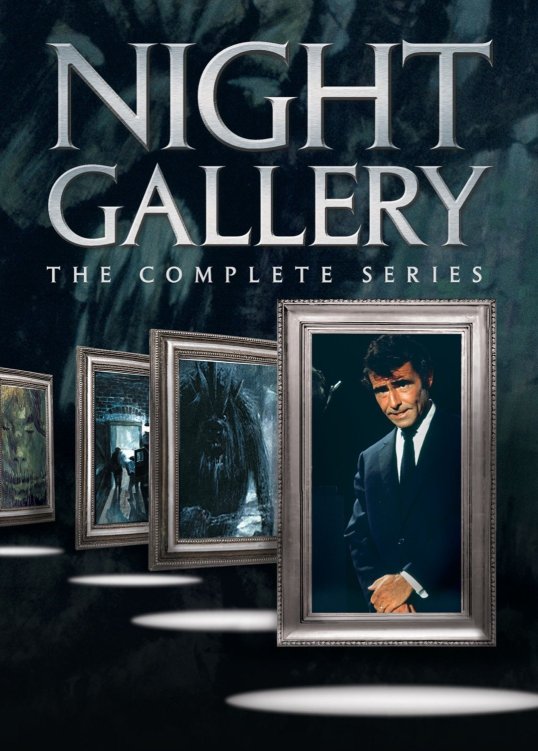
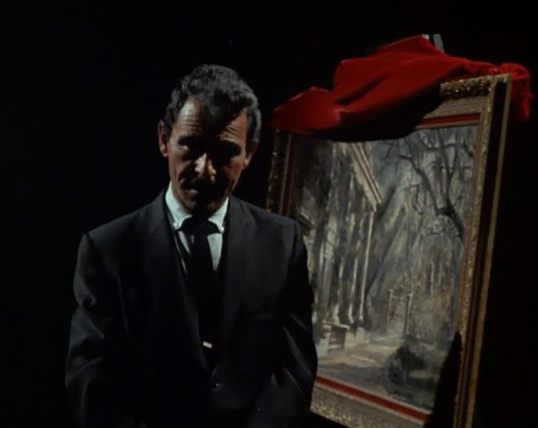
Night Gallery was a horror anthology series that aired on NBC in the early 70s.  Each episode featured Rod Serling, of Twilight Zone fame, serving as the curator of a museum where all of the paintings have a somewhat macabre theme.  (One could even say that the museum was a …. wait for it …. night gallery!)  Serling would give each painting a properly pithy introduction and then the audience would see the story behind the artwork.  It was a bit like the Twilight Zone, except the Night Gallery episodes were in color, they were all horror-themed, and, for the most part, they steered away from social commentary.  The series ran from 1970 and 1973 and it still airs in syndication and on some of the retro stations.  (I believe it currently airs on Comet TV.)  Even if it wasn’t as consistently good as Twilight Zone, it’s still a pretty fun little series.

Two Christmases ago, I was gifted  Night Gallery: The Complete Series on DVD.  Though I’ve watched several episodes from the DVD, I recently realized that I have never actually sat down and watched every episode in order.  With the world currently shut down due to the pandemic (a development that, if we’re going to be honest, sounds like something Rod Serling would have used on the Twilight Zone), I figured what better time to watch the entire series then now?

I started out by watching the Night Gallery pilot film.  This originally aired on November 8th, 1969, a full year before Night Gallery became a weekly series.  It features three different stories (all written by Rod Serling) of the macabre.  As with every episode of the subsequent series, each story is introduced by Serling standing in front of a painting.  In the pilot, though, the museum is rather bare and the painting’s are a bit minimalist.  I have to admit that, as a lover of the baroque, I was a bit disappointed in that aspect of the pilot.

But what about the stories themselves?  Read on!

The Cemetery (dir by Boris Sagal)

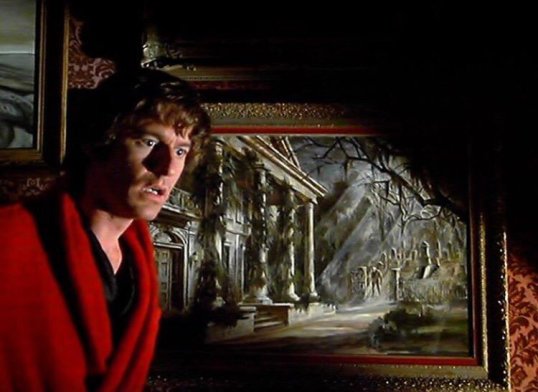
The first story was The Cemetery, a cheerfully gruesome little tale that featured Roddy McDowall and Ossie Davis.  McDowall plays Jeremy, a spoiled young man who murders his uncle so that he might inherit the dead man’s estate.  At first, it looks like McDowall’s plot is a complete success but then McDowall notices a painting of the family graveyard hanging above a staircase.  (To be honest, it seems odd to hang a painting of a graveyard in the foyer but I guess that’s something old rich people do.)  The painting keeps changing.  One minute, the painting looks normal.  The next minute, it features a newly dug grave.  And then something emerging grave.  And then something heading towards the house….

Is Jeremy losing his mind or is the painting warning him that his uncle has risen from the dead and is seeking revenge!?  You’ll probably be able to guess the answer long before poor Jeremy but no matter.  This is a fun little horror story and it benefits from two enjoyably arch performances, from McDowall and, in the role of a butler who may have an agenda of his own, Ossie Davis.

Eyes (dir by Steven Spielberg)

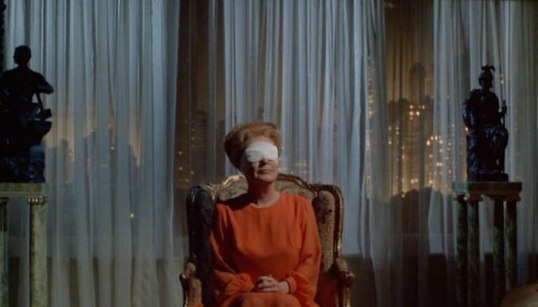
Of the three stories presented in the pilot, Eyes probably gets the most attention from critics because it not only stars Joan Crawford in one of her final performances but it was the professional directorial debut (if you don’t count Amblin’) of 22 year-old Steven Spielberg.  Spielberg apparently had some issues dealing with the veteran crew members, many of whom didn’t like the idea of taking orders from a 22 year-old.  (It probably didn’t help that pictures from that era suggest that Spielberg looked several years younger than his age.  Let’s just say that it’s easy to understand why he eventually grew that beard.)  I’d like to think that Joan Crawford yelled at everyone and defended Spielberg and maybe even Rod Serling came down with Luca Brasi and said, “You’re going to the give this kid the respect he deserves or your brains are going to be all over that union contract.”  I don’t know if that’s true but it’s a nice thought.

That said, Eyes is pretty good.  Even if the crew doubted him, Spielberg proved himself as a director with this story.  It’s about a hateful and selfish woman (Joan Crawford) who happens to be both rich and blind.  She has manipulated a doctor into performing an experimental operation that will allow her to see.  The only catch is that the operation will only be good for 22 hours and a donor (Tom Bosley, as a bookie who is in trouble with the mob) will be required to give up his eyes so that Crawford can have those 22 hours.

On the one hand, this is very-much a Rod Serling-type tale.  It’s easy to imagine Eyes, with its belief in karma and its final macabre twist, as a Twilight Zone episode.  At the same time, Spielberg very much brings his own signature style to the film, livening up dialogue-heavy scenes with interesting camera angles and getting good performances from Crawford, Barry Sullivan, and Tom Bosley.  Eyes is a clever story but, for modern viewers, the most interesting thing about it will be discovering that, even at the age of 22, Spielberg already had a clear directorial style.

The Escape Route (dir by Barry Shear)

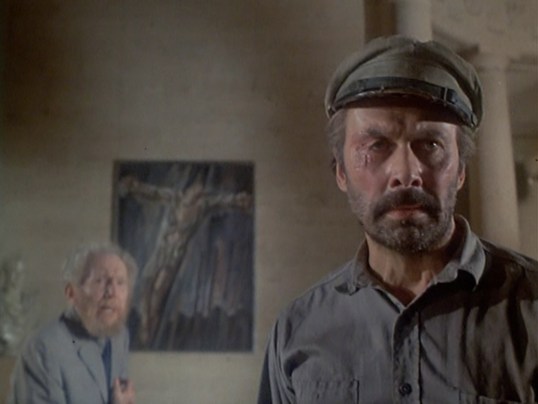
The Escape Route is about an Nazi war criminal named Joseph Strobe (played by Richard Kiley) who is hiding out in South America and spending all of his time nervously looking over his shoulder.  One day, he enters a museum where he finds himself drawn to two paintings.  One painting features a man who has been crucified in a concentration camp, which we learn was Strobe’s trademark back when he, himself, was a camp commandant.  The other painting features a fisherman in a peaceful setting.  Even though Strobe imagines himself as the peaceful fisherman, his attention keeps getting redirected to the painting of the concentration camp.  Soon, Strobe realizes that a survivor of the camp (played by Sam Jaffe) is also in the museum and that he is studying the painting as well.

Compared to Eyes and especially The Cemetery, The Escape Route may seem like a rather low-key story but it has a power that sneaks up on you.  Hiding out (as many real-life Nazi war criminals did) in South America, Strobe is full of excuses for his past and he may indeed be sincere in his wish that he had just become a fisherman as opposed to a brutal Nazi.  But, in the end, Strobe can neither escape his past nor his final punishment.  Justice cannot be escaped, no matter how hard Strobe tries to outrun it.  In the end, there is no escape for the wicked.  Richard Kiley and Sam Jaffe both give excellent performances.  The Escape Route will stick with you.

As a series, Night Gallery was a bit uneven but the pilot stands as a classic of its type, featuring three short films that all deserve to be remembered.

As for me, I’m going to try to watch an episode or two a day.  I may review a few more Night Gallery episodes here on the Shattered Lens.  As I said, the series itself was a bit uneven and not every episode is as good as the pilot.  Still, there’s definitely some gems to be found in the Night Gallery and I’ll share them as I come across them.

Horror on the Lens: The Failing of Raymond (dir by Boris Sagal)


Raymond (Dean Stockwell) has just escaped from a mental hospital and he has only one thing on his mind.  Raymond wants revenge.  Having looked over the past events of his life, Raymond has figured out that things started to go downhill for him when he failed a test in high school.  He blames his failure on his old teacher, Mary Bloomquist (Jane Wyman).

At the same time that Raymond is escaping, Mary is planning her retirement.  She’s decided that she no longer wants to teach.  The job just doesn’t seem worth it anymore.  But Raymond has other ideas.  Raymond wants her to give him the same test that he failed ten years before.  And this time, Raymond wants her to pass him or else.

The Failing of Raymond is a made-for-TV movie from 1971 and it features a good performance from Jane Wyman and a great one from Dean Stockwell.  The film ultimately hinges on one question.  Did Raymond really fail that test or did Mary fail Raymond?

Enjoy!

http://www.youtube.com/watch?v=egFBvsOaLnY

Horror On TV: The Twilight Zone 3.2 “The Arrival”


When Flight 107 out of Buffalo, New York makes a perfect (if unannounced) landing, airport officials are shocked to discover that the airplane has no passengers, no luggage, and no pilots!  It’s up to Grant Sheckley (Harold J. Stone) to solve the mystery but Sheckley has a secret of his own.

This episode of The Twilight Zone was written by Rod Serling and directed by Boris Sagal.  It was originally broadcast on September 22nd, 1961.