Retro Television Reviews: Dragnet 1966 (dir by Jack Webb)


Welcome to Retro Television Reviews, a feature where we review some of our favorite and least favorite shows of the past!  On Sundays, I will be reviewing the made-for-television movies that used to be a primetime mainstay.  Today’s film is 1969’s Dragnet 1966!  It can be viewed on YouTube!

“This is the city….”

So begins Dragnet, a television movie version of the classic cop show that was the Law & Order of it’s day.  Dragnet began as a radio program in 1949 before making it’s way over to television in 1951.  Each episode starred (and the majority were directed by) Jack Webb, who played a no-nonsense cop named Joe Friday.  Friday narrated every episode, dropping trivia about the history of Los Angeles while also showing viewers how the cops went about catching criminals.  Despite what is commonly believed, Joe Friday never said, “Just the facts, ma’m,” but he did investigate each case with the cool determination of a professional who kept his emotions under control.  The majority of Dragnet’s episodes were based on actual cases that were worked by the LAPD, hence the opening declaration of, “The story you are about to see is true.”

On television, Dragnet originally ran from 1951 to 1959, during which time Dragnet also became the first television series to be adapted into a feature film.  Jack Webb decided to relaunch Dragnet in 1966 and he produced a made-for-television movie that followed Friday and his latest partner, the far more talkative Bill Gannon (Harry Morgan), as they worked multiple cases over the course of one long weekend.  The pilot movie did lead to a new show, one that lasted from 1967 to 1970 and which is today fondly remembered for scenes of Friday and Gannon debating the merits of the legal system with hippies.  However, for whatever reason, the 1966 pilot movie was not actually aired until 1969.

The made-for-TV movie features Friday and Gannon searching not for LSD dealers and draft dodgers but instead for a crazed photographer (Vic Perrin) who hires women to pose for him and then ties them up and takes their picture right before her murders them.  The photographer is based on real-life serial killer Harvey Glatman and Perrin is perfectly creepy in the role.  Though Friday never loses his composure, his disgust at the photographer and his crimes is palpable and it adds an extra charge to the scene where, in the middle of a drenching rain storm, Friday tries to sneak up on the trailer where he believes the photographer is holding his latest victim.  It’s actually a pretty exciting scene and definitely one that will take by surprise anyone who thinks of the 60s Dragnet as just being a campy exercise in establishment resentment.

Of course, catching a serial killer is not all that Friday and Gannon deal with.  It’s a long weekend so Friday and Gannon end up investigating the murder of a French tourist and Friday helps a younger, black detective deal with a racist criminal.  (The scene where Friday stands up to the racist was obviously meant to answer those who claimed the LAPD was a racist organization.)  At the start of the film, Joe almost gets collared into working security for a visiting Russian diplomat and the Russian’s paranoid security team is contrasted to the level-headed and capable men of the LAPD.  Some of these scenes are better than others.  The French tourist subplot features some truly risible acting and the scene with the racist is well-intentioned but still feels a bit condescending in its portrayal of the black detective needing Friday to help him deal with the suspect.  That said, I did enjoy listening to Bill Gannon talking about his plans for retirement and how working for the LAPD was destroying his teeth.  Harry Morgan’s folksy humor was always the perfect counterpart to Jack Webb’s perpetually rational Friday.

Finally, I appreciated that the movie featured a scene with Friday and Gannon went undercover at a lonely hearts club.  If you’ve watched the 1960s version of Dragnet, you know that, for all the times that Friday and Gannon went undercover, they never really put much effort into it.  I mean, they didn’t ever bother to take off their jackets!
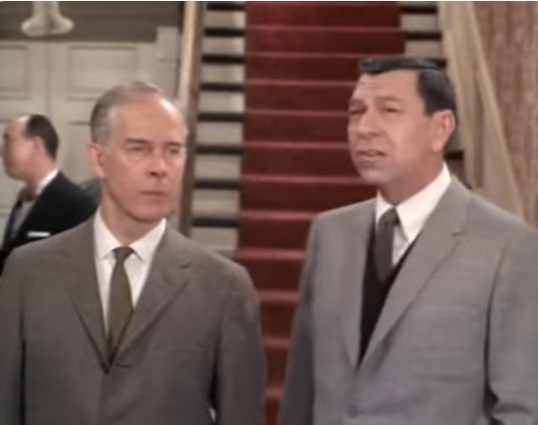
Though I was disappointed by the lack of hippies, Dragnet 1966 was still not only a good police procedural but also a fun time capsule of its era.

Retro Television Reviews: Half Nelson Episode 1.8 “Malibu Colony”


Welcome to Retro Television Reviews, a new feature where we review some of our favorite and least favorite shows of the past! On Fridays, I will be reviewing Half Nelson, which ran on NBC from March to May of 1985. Almost all nine of the show’s episodes can be found on YouTube!

Last week, I took a look at the sixth episode of Half Nelson, which was called Nose Job and which featured Rocky (Joe Pesci) dealing with an obsessed plastic surgeon who was stalking a former girlfriend.  That episode featured not only two villains (it turned out that the plastic surgeon wasn’t the only homicidal stalker in Hollywood) but is also ended with Victoria Jackson’s Annie O’Hara starting a romantic relationship with Gary Grubbs’s Detective Hamill.

Nose Job was followed by an episode called Chariots For Hire.  It apparently aired on April 26th, 1985 and that’s really all I can tell you about the episode.  Chariots For Hire is the only episode of Half Nelson that has not been uploaded to YouTube.  I can’t even find a plot summary for it on the imdb.  Chariots For Hire is apparently the lost episode of Half Nelson.

Fortunately, the eighth episode of Half Nelson is on YouTube.  So, let’s pick up the adventures of Rocky Nelson in Malibu Colony!

Episode 1.8 “Malibu Colony”

(Dir by James Sheldon, originally aired on May 3rd, 1985)

Rocky, Annie, Beau (Dick Butkus), and Kurt (Bubba Smith) have been assigned to guard what Rocky claims is “one of the most valuable art collections in the world.”  Fortunately, this job means that they get to spend a few days hanging out in a fabulous beach house in Malibu!  Standing out on the deck of the beach house, Annie looks out at the ocean and says that she can hardly believe that China is on the other side of it.

“I wonder how the egg rolls stay fresh crossing over from that far,” Kurt says.

Before anyone can ponder that question for too long, a half-naked woman runs screaming down the beach while being pursued by two thugs in suits.  Rocky saves the woman from the thugs and sends her into the beach house so that she can borrow some clothes from Annie.  Once dressed, the woman explains that she’s Nancy Norton (Shari Shattuck) and that she was fleeing from a nearby yacht club.  She claims that the owner of the club has some naked pictures of her and she needs to get them back.  Rocky, deciding that the art can protect itself, helps Nancy sneak back into the club so that she can retrieve her photographs.  However, when she sees the club’s president, Crane (John Beck), she suddenly holds up a gun and shoots at him.  Rocky is able to push Crane out of the way of the bullets and then he chases after Nancy.

Fortunately, both Rocky and Nancy make it out of the club without anyone realizing that they’re together.  Despite the fact that she nearly made him an accessory to murder, Rocky still wants to help Nancy.  Nancy explains that there are no pictures and she wasn’t trying to kill Crane.  (“I just wanted to scare him.”)  Nancy’s father lost a lot of money while playing poker with Crane and now Crane is threatening to kill him if he doesn’t pay.  But Nancy is convinced that the poker game was rigged.  The reason she was in club earlier was to take a look at Crane’s cards.

(For some reason, she thought it would be smart to do that while wearing a bikini, the top of which was somehow lost while she was fleeing Crane’s guards.  That explains that partial nudity, which I am sure was definitely viewed as being important to the plot and not just as an attempt to boost the show’s ratings.)

Having saved Crane’s life, Rocky is able to get Annie, Kurt, and Beau jobs at the club.  Annie models clothes.  Kurt and Beau work as waiters.  Rocky’s boss, Chester (Fred Williamson), shows up at the club with Dean Martin and is shocked to see all of his employees working there.  Dean demands that Chester give them all raises so that they can quit their second jobs.

Eventually, Rocky finds his proof that Crane is a criminal and, with Chester’s help, he takes Crane down.  After being stuck in the office for the past few episodes, Chester actually gets to do something in this episode.  It’s always nice to see Fred Williamson in action and making it even better is that he smokes a big cigar while he’s taking down the bad guys.  Finally, after eight episodes, Half Nelson reminded everyone of why Fred Williamson was so cool to begin with.

This episode definitely earns some points for allowing the entire supporting cast — from Fred Williamson to Victoria Jackson to Dean Martin — to play a role in solving the case of the week.  One of Half Nelson‘s biggest flaws was that the appealingly quirky supporting characters often felt underused and Malibu Colony finally gives them a chance to show what they could have done as an ensemble.  The mix of Pesci’s wise guy nerve, Jackson’s spaciness, Williamson’s effortless coolness, and Butkus and Smith’s comedic relief is actually pretty entertaining.  Unfortunately, as good as the heroes are, Crane is pretty boring villain and the case of the week isn’t particularly interesting.  In particular, Nancy’s actions never really make that much sense.

Oh well.  This was a flawed episode but it still offered up a hint of what Half Nelson could have been.  Next week, I will be reviewing this show’s final episode.  Until then, L.A. — you belong to me!

Retro Television Review: Fantasy Island 2.12 “Charlie’s Cherubs/Stalag 3”


Welcome to Retro Television Reviews, a feature where we review some of our favorite and least favorite shows of the past!  On Tuesdays, I will be reviewing the original Fantasy Island, which ran on ABC from 1977 to 1986.  The entire show is currently streaming on Tubi!

This week, Fantasy Island is invaded by Nazis and Angels!

Episode 2.3 “Charlie’s Cherubs/Stalag 3”

(Dir by Cliff Bole, originally aired on December 9th, 1978)

Today’s episode begins with Mr. Roarke noticing that Tattoo is carrying a calculator with him.

“What is that, Tattoo?” he asks.

“A mini-computer,” Tattoo replies, “My cousin Igor sent it to me.  Computers can take away a lot of guess work.”

Mr. Roarke, obviously thinking that these “computer” things are but a mere fad, replies, “So can bikinis.  Let us meet our guests.”

This week, all of the guests have dangerous fantasies.  For instance, Danny Ryan (Cornel Wilde) is a World War II veteran who has never really been able to make it in the post-War world.  So, he invites three fellow vets to return with him to the French town in which they spent 1944.  During the War, they were POWS at Stalag 3 but they were famous for continually outsmarting Commandant Horst Von Stern (Nehemiah Persoff).  In fact, Von Stern’s career and reputation never really recovered from the time that Danny and his friends escaped.  (I imagine that, after the war, Von Stern’s reputation was also damaged by the fact that he was a freaking Nazi commandant.)  Not only has Mr. Roarke arranged for the old French village — complete with Fifi of the Resistance (played by Yvonne DeCarlo) — to be moved to Fantasy Island but he also brought over the old POW camp.  Unfortunately, Von Stern decides to come over as well and get his revenge by tossing Danny and friends back in the camp.

“You see,” Von Stern announces, “generals have fantasies too.”

What the Hell is going on with this Island?  Does Mr. Roarke just give anyone a fantasy, even a Nazi war criminal?  Actually, it appears that Mr. Roarke doesn’t know that Von Stern has come to the Island nor does he know that there is a treasure of stolen diamonds hidden in the village.  Apparently, Roarke decided to just let this fantasy run on autopilot without actually bothering to check in with what was going on.

Both Mr. Roarke and Tattoo are more concerned with the three secretaries (Melinda Naud, Brenda Benet, and Bond Gideon) who want to be Charlie’s Angels and solve a crime.  The crime involves a theft on Fantasy Island and …. well, it’s really not much of a mystery.  It’s basically a 20-minutes episode of Charlie’s Angels, with a bit less action but a lot more scenes of people saying stuff like, “He knows about electronics so he’s the thief!”  It was really a weak fantasy, which is a shame because, if I ever went to Fantasy Island, I would probably want to be a detective as well!

The show ends with Von Stern being sent to Germany to be put on trial for war crimes and the Angels saying that they’re ready to be secretaries again.  Roarke informs them that most angels fantasize about being secretaries.  Uhmmm, Mr. Roarke …. the proper term is administrative professional.  Everything appears to be wrapped up but, as the show ends, Tattoo announces that someone has stolen his mini-computer and Mr. Roarke laughs at his assistant’s misfortune.  Perhaps Tattoo losing his most prized possession was Roarke’s fantasy.

This was a weird episode.  Mr. Roarke might need to pay closer attention to what’s happening on his island!

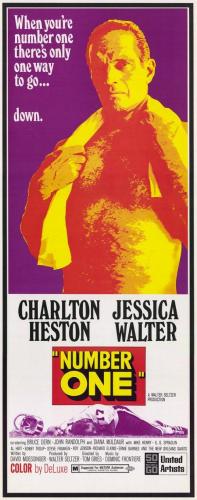
A Movie A Day #32: Number One (1969, directed by Tom Gries)


number-oneQuarterback Cat Catlan (Charlton Heston) used to be one of the greats.  For fifteen years, he has been a professional football player.  He probably should have retired after he led the New Orleans Saints to their first championship but, instead, the stubborn Cat kept playing.  Now, he is 40 years old and struggling to keep up with the younger players.  His coach (John Randolph) says that Cat has another two or three years left in him but the team doctor (G.D. Spradlin who, ten years later, played a coach in North Dallas Forty) says that one more strong hit could not only end Cat’s career but possibly his life as well.  Two of former Cat’s former teammates (Bruce Dern and Bobby Troup) offer to help Cat find a job off the field but Cat tells them the same thing that he tells his long-suffering wife (Jessica Walter).  He just has to win one more championship.
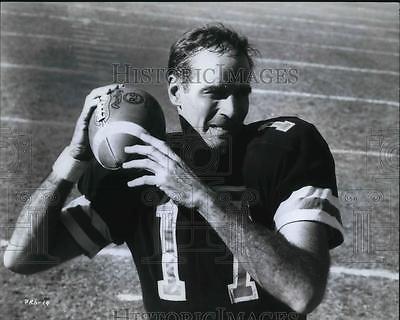
Number One is unique for being one of the first movies to ever take a look at the dark side of professional football.  At 40, Cat is facing an uncertain future.  His years of being a star have left him unprepared to deal with life in the real world.  He has no real friends and a wife who no longer needs him.  This would seem like a perfect role for Heston, who always excelled at playing misanthropes.  Heston is convincing when he’s arguing with his wife or refusing to sign an autograph but, surprisingly, he is thoroughly unconvincing whenever he’s on the field.  For all of his grunting and all the lines delivered through gritted teeth, Heston is simply not believable as a professional athlete, even one who is past his prime.  (When he played the 40 year-old Cat, Heston was 46 and looked like he was 56.)  Whenever Cat throws a football, he’s played by Heston in close-ups and very obviously replaced by real-life Saints quarterback Billy Kilmer for the long shots.  A football film is only as good and convincing as the football action and, on that front, Number One leaves much to be desired.

The 1969 press photo displays Heston's throwing technique.

This 1969 press photo displays Heston’s throwing technique.

Two final notes: For the scene in which Cat is tackled by three Dallas Cowboys (all played by actual players), Heston requested that the players actually tackle him.  Heston ended up with three broken ribs.

Finally, Number One was made the cooperation of the New Orleans Saints and features several players in the cast.  When Number One was filmed, the Saints were still a relatively new expansion team.  Cat is described as having already led the Saints to a championship but it would actually be another 40 years before the Saints would finally make their first trip to the Super Bowl.