Horror Film Review: Giant From The Unknown (dir by Richard E. Cunha)


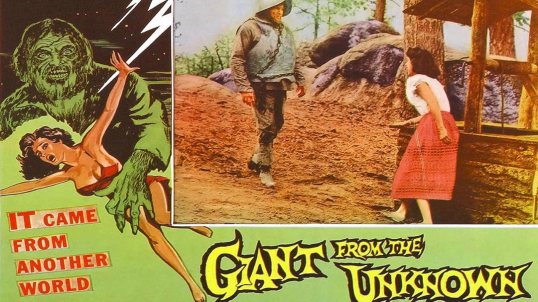
In 1958’s Giant From The Unknown, something strange is happening in a California mountain town.  Animals are being killed.  Property is being destroyed.  People are being murdered.

Sheriff Parker (Bob Steele) suspects that the murderer might be Dr. Frederick Cleveland (Morris Ankrum), mostly because Dr. Cleveland spends a lot of time in the mountains looking at fossils with his daughter, Janet (Sally Fraser).  When a younger scientist named Wayne (Ed Kemmer) shows up to help Dr. Cleveland out with his research, Sheriff Parker is even more suspicious.  Meanwhile, the local citizenry suspects that it might be a member of the local Native American community.

It turns out that everyone’s wrong!

The murderer is a formerly dead conquistador (Buddy Baer), who was brought back to life by a bolt of lightning and who is now wandering around the mountains and killing people.  The conquistador walks around in his full conquistador uniform, which is in pretty good shape when you consider the fact that he’s been dead for over two hundred years, maybe longer.

The odd thing about the conquistador is that he’s regularly described as being a giant, even though he’s clearly not.  I mean, he’s tall.  He appears like he might be 6’5.  That makes him taller than the average person but shorter than the average professional basketball player.  The filmmakers regularly attempt to shoot him from a lower angle in order to make him look taller but there’s nothing that can be done to disguise the fact that he’s just a 6’5 guy wearing what appears to be a fake beard and mustache.  If anything, he looks like the frozen-faced Burger KIng mascot.  Maybe he would stop killing people if the sheriff would just order a cheeseburger and fries.  I mean, seriously, his whole rampage could have been avoided.

The title is also incorrect about the giant being from the unknown.  He’s very obviously from Spain.  All one has to do is look at his uniform.  I think the unknown element of this film is how the conquistador has spent centuries underground without losing any skin.  For someone who has been dead for as long as this conquistador was, his hair is very clean and well-groomed.  Watching this film, it’s hard not to feel that Dr. Cleveland should have spent some time researching conquistador embalming techniques because whoever preserved the “giant” did a very good job!  Everyone should be so lucky to look that good for being dead for that long.

Giant From The Unknown attempts to do the usual thing where the monster falls for the only woman in the entire film.  (Indeed, it was hard not to notice that town’s population seemed to be 99% male.)  Unfortunately, the giant was a pretty silly monster so it was difficult to get wrapped up in his emotional journey.  There are some monsters that you feel sorry for and there are other monsters that you just wish would go away.  The giant is a monster who probably had a lot of good haircare tips and who could have probably helped out the entire town …. if only they had been willing to listen!

Hang ‘Em High (1968, directed by Ted Post)


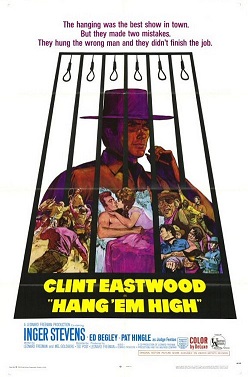
1889.  The Oklahoma Territory.  A former lawman-turned-cattleman named Jed Cooper (Clint Eastwood) is falsely accused of working with a cattle thief.  A group of men, led by Captain Wilson (Ed Begley) lynch him and leave Cooper hanging at the end of a rope.  Marshal Dave Bliss (Ben Johnson) saves Cooper, cutting him down and then taking him to the courthouse of Judge Adam Fenton (Pat Hingle).  Fenton, a notorious hanging judge, is the law in the Oklahoma territory.  Fenton makes Cooper a marshal, on the condition that he not seek violent revenge on those who lynched him but that he instead bring them to trial.  Cooper agrees.

An American attempt to capture the style of the Italian spaghetti westerns that made Eastwood an international star, HangEm High gives Eastwood a chance to play a character who is not quite as cynical and certainly not as indestructible as The Man With No Name.  Cooper starts the film nearly getting lynched and later, he’s shot and is slowly nursed back to health by a widow (Inger Stevens).  Cooper is not a mythical figure like The Man With No Name.  He’s an ordinary man who gets a lesson in frontier justice as he discovers that, until Oklahoma becomes a state, Judge Fenton feels that he has no choice but to hang nearly every man convicted of a crime.  (Judge Fenton was based on the real-life hanging judge, Isaac Parker.)  Over the course of this episodic film, Cooper becomes disgusted with frontier justice.

HangEm High is a little on the long side but it’s still a good revisionist western, featuring a fine leading performance from Clint Eastwood and an excellent supporting turn from Pat Hingle.  The film’s episodic structure allows for Eastwood to interact with a motley crew of memorable character actors, including Bruce Dern, Dennis Hopper, L.Q. Jones, Alan Hale (yes, the Skipper), and Bob Steele.  HangEm High has a rough-hewn authenticity to it, with every scene in Fenton’s courtroom featuring the sound of the gallows in the background, a reminder that justice in the west was often not tempered with mercy.

Historically, Hang ‘Em High is important as both the first film to be produced by Eastwood’s production company, Malpaso, and also the first to feature Eastwood acting opposite his soon-to-be frequent co-star, Pat Hingle.  Ted Post would go on to direct Magnum Force.

Billy The Kid’s Range War (1941, directed by Sam Newfield)


Billy the Kid was a big damn hero.

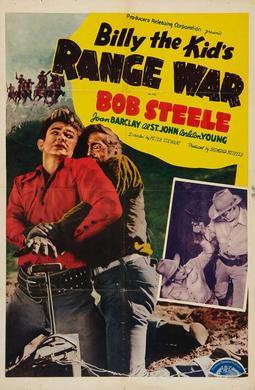
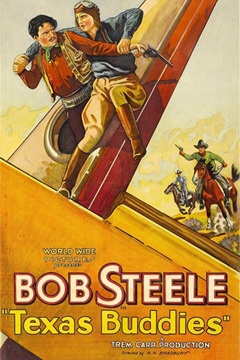
At least that’s the claim of Billy The Kid’s Range War, in which Billy (played by middle-aged Bob Steele) is a do-gooder with a comedic sidekick named Fuzzy (Al St. John) and a hankering to help Ellen Gorman (Joan Barclay) bring a new stagecoach line to town.  Williams (Karl Hackett) does want to the Gorman family to success so he hires Buck (Rex Lease) to dress up like Billy the Kid and ride a horse that looks like Billy the Kid’s and commit crimes, like killing Ellen’s father.  Framed for all those crimes that he didn’t commit and with his best friend (Carleton Young) ordered to arrest him, Billy decides to go under cover so that he can clear his good name.  Someone pretending to be Billy the Kid got him into this mess.  Now, Billy’s going to get out of it by pretending to be someone else.

The action is pretty standard for a B-western.  Mostly, it’s interesting to see a movie where Billy the Kid is actually a nice guy who gets framed.  No wonder a whole generation grew up with no idea about true history of the American frontier.  Sam Newfield directed a handful of Billy the Kid films and the capable Bob Steele starred in most of them but this is the only one that I’ve sat down and watched and it actually left me missing the production values of the Johnny Mack Brown films.  For fans of these type of westerns, there’s the promise of seeing familiar actors like George Cheseboro and Ted Adams doing there thing.  Even the outstanding character actor Milton Kibbee makes an appearance.  For those who do not like westerns, this film is not going to change their minds.

Despite the promise of the title, there is no range war in this movie.  There’s just Billy the Kid, trying to clear his good name.

Cattle Drive (1951, directed by Kurt Neumann)


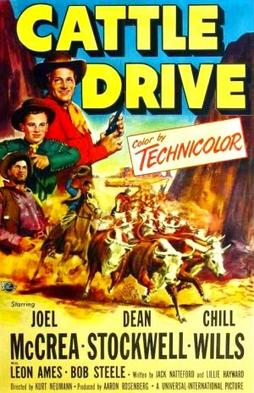
In this coming-of-age Western, Dean Stockwell plays Chester Graham, Jr., the spoiled and unruly son of a railroad owner (Leon Ames).  While riding on his father’s train and making trouble for the conductor, Chester overhears his father talking about sending him to a military school.  When the train makes as top, Chester impulsively runs away.  The train leaves without him and Chester finds himself stranded in the middle of the wilderness.  That’s when he sees cowboy Dan Matthews (Joel McCrea) trying to catch a wild stallion.

Dan is a part of a cattle drive.  Knowing that he can’t leave Chester to die in the wilderness, Dan brings him back to his camp.  The other members of the company aren’t too keen on having to look after a spoiled brat along with the cattle and Chester isn’t too happy to hear that he’ll be expected to work if he expects to get fed.  But with no choice but to work together, Chester, Dan, and the rest of the company make the journey to Santa Fe.  Chester finally drops his attitude enough to work with the company’s cook (Chill Wills) while Dan deals with a rival cowboy named Currie (Henry Brandon). Chester learns about responsibility and Dan finally finds the courage to consider settling down.

Of the many westerns that Joel McCrea made over the course of his career, he considered Cattle Drive to be his favorite and it’s easy to see why.  Cattle Drive features McCrea doing what he did best, playing a tough but good-hearted and down-to-earth cowboy who looked after an outsider.  If you were ever lost in the old west, Joel McCrea is precisely the type of cowboy that you would hope would come to your rescue.  The plot features almost every single cattle drive cliché that you could imagine but McCrea plays his role with a winning combination of grit and compassion and he and Dean Stockwell, who is also very good, make a good team.  Shot in Death Valley and Utah, Cattle Drive feels and look authentic and should be enjoyed by anyone looking for good, heartfelt western.

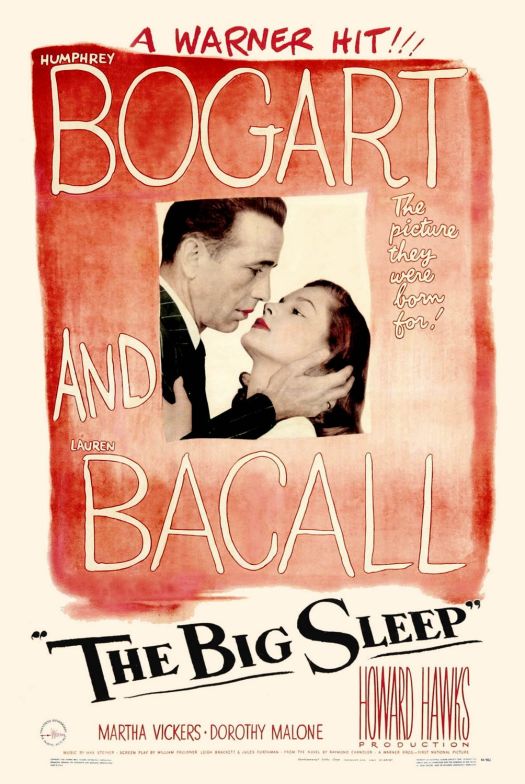
Marlowe at the Movies Returns!: Bogie & Bacall in THE BIG SLEEP (Warner Brothers 1946)


gary loggins's avatarcracked rear viewer

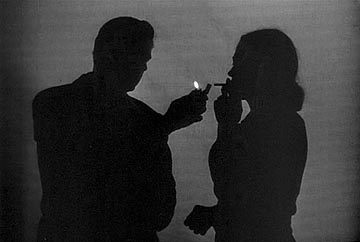
It’s been a long time since we last visited with Raymond Chandler’s fictional “knight-errant”, PI Philip Marlowe. Way too long, so let’s take a look at THE BIG SLEEP, starring Humphrey Bogart as the definitive screen Marlowe. This 1946 Howard Hawks film was a follow-up to 1944’s hit TO HAVE AND HAVE NOT, which introduced audiences (and Bogie) to luscious Lauren Bacall . The pair was dynamite together onscreen, and off as well, marrying a year later. Their May/December romance was one of Hollywood’s greatest love stories, lasting until Bogart’s death from cancer in 1957.

For me to try and explain the plot here would be futile, as it takes more twists and turns than a “Balinese belly dancer”. Marlowe is hired by elderly General Sternwood, whose sexy young daughter Carmen is being blackmailed. The General’s other daughter Vivien, a sexy divorcee, is also in trouble. This takes Our Man Marlowe…

View original post 582 more words

Lisa Reviews An Oscar Nominee: The Longest Day (dir by Ken Annakin, Andrew Marton, Bernhard Wicki, Gerd Oswald, and Darryl F. Zanuck)


As my sister has already pointed out, today is the 73rd anniversary of D-Day.  With that in mind, and as a part of my ongoing mission to see and review every single film ever nominated for best picture, I decided to watch the 1962 film, The Longest Day!

The Longest Day is a pain-staking and meticulous recreation of invasion of Normandy, much of it filmed on location.  It was reportedly something of a dream project for the head of the 20th Century Fox, Darryl F. Zanuck.  Zanuck set out to make both the ultimate tribute to the Allied forces and the greatest war movie ever.  Based on a best seller, The Longest Day has five credited screenwriters and three credited directors.  (Ken Annakin was credited with “British and French exteriors,” Andrew Marton did “American exteriors,” and the German scenes were credited to Bernhard Wicki.  Oddly, Gerd Oswald was not credited for his work on the parachuting scenes, even though those were some of the strongest scenes in the film.)  Even though he was not credited as either a screenwriter or a director, it is generally agreed that the film ultimately reflected the vision of Darryl F. Zanuck.  Zanuck not only rewrote the script but he also directed a few scenes as well.  The film had a budget of 7.75 million dollars, which was a huge amount in 1962.  (Until Steven Spielberg’s Schindler’s List, The Longest Day was the most expensive black-and-white film ever made.)  Not only did the film tell an epic story, but it also had an epic length.  Clocking in at 3 hours, The Longest Day was also one of the longest movies to ever be nominated for best picture.

The Longest Day also had an epic cast.  Zanuck assembled an all-star cast for his recreation of D-Day.  If you’re like me and you love watching old movies on TCM, you’ll see a lot of familiar faces go rushing by during the course of The Longest Day.  American generals were played by actors like Robert Mitchum, Robert Ryan, Henry Fonda, and John Wayne.  Peter Lawford, then the brother-in-law of the President of the United States, had a memorable role as the Scottish Lord Lovat, who marched through D-Day to the sounds of bagpipes.  When the Allied troops storm the beach, everyone from Roddy McDowall to Sal Mineo to Robert Wagner to singer Paul Anka can be seen dodging bullets.  Sean Connery pops up, speaking in his Scottish accent and providing comic relief.  When a group of paratroopers parachute into an occupied village, comedian Red Buttons ends up hanging from the steeple of a church.  When Richard Beymer (who is currently playing Ben Horne on Twin Peaks) gets separated from his squad, he stumbles across Richard Burton.  Among those representing the French are Arletty and Christian Marquand.  (Ironically, after World War II, Arletty was convicted of collaborating with the Germans and spent 18 months under house arrest.  Her crime was having a romantic relationship with a German soldier.  It is said that, in response to the charges, Arletty said, “My heart is French but my ass is international.”)  Meanwhile, among the Germans, one can find three future Bond villains: Gert Frobe, Curt Jurgens, and Walter Gotell.

It’s a big film and, to be honest, it’s too big.  It’s hard to keep track of everyone and, even though the battle scenes are probably about an intense as one could get away with in 1962 (though it’s nowhere near as effective as the famous opening of Saving Private Ryan, I still felt bad when Jeffrey Hunter and Eddie Albert were gunned down), their effectiveness is compromised by the film’s all-star approach.  Often times, the action threatens to come to a halt so that everyone can get their close-up.  Unfortunately, most of those famous faces don’t really get much of a chance to make an impression.  Even as the battle rages, you keep getting distracted by questions like, “Was that guy famous or was he just an extra?”

Among the big stars, most of them play to their personas.  John Wayne, for instance, may have been cast as General Benjamin Vandervoort but there’s never any doubt that he’s playing John Wayne.  When he tells his troops to “send them to Hell,” it’s not Vandervoort giving orders.  It’s John Wayne representing America.  Henry Fonda may be identified as being General Theodore Roosevelt II but, ultimately, you react to him because he’s Henry Fonda, a symbol of middle-American decency.  Neither Wayne nor Fonda gives a bad performance but you never forget that you’re watching Fonda and Wayne.

Throughout this huge film, there are bits and pieces that work so well that you wish the film had just concentrated on them as opposed to trying to tell every single story that occurred during D-Day.  I liked Robert Mitchum as a tough but caring general who, in the midst of battle, gives a speech that inspires his troops to keep fighting.  The scenes of Peter Lawford marching with a bagpiper at his side were nicely surreal.  Finally, there’s Richard Beymer, wandering around the French countryside and going through the entire day without firing his gun once.  Beymer gets the best line of the film when he says, “I wonder if we won.”  It’s such a modest line but it’s probably the most powerful line in the film.  I wish The Longest Day had more scenes like that.

The Longest Day was nominated for best picture of 1962 but it lost to an even longer film, Lawrence of Arabia.

The Daily Grindhouse: Revenge of the Zombies (dir by Steve Sekely)


revengeofzombies36

Last night, the Late Night Movie Crew and I watched the 1943 film, Revenge of the Zombies.

Revenge of the Zombies deals with the mysterious Dr. von Aldermann (John Carradine), who has a house on the Louisiana bayous and who is involved in weird, 1940s-style scientific experiments.  As is evident from his name (but not particularly from Carradine’s disinterested performance), von Aldermann is from Germany and his experiments are designed to create an army of zombies who will destroy American from within for the benefit for the Third Reich.  This is a pretty big deal and von Aldermann isn’t particularly subtle about his schemes but, as the film’s begins, nobody has figured out what’s going on.

I guess you can get away with anything on the bayous.

Von Aldermann’s wife Lila (Veda Ann Borg) has recently died but, thanks to the mad scientist, she’s still walking around Louisiana and leading an army of zombies.  Lila’s brother (Robert Lowery) shows up with a private investigator (Mauritz Hugo) and yet another mad scientist (Barry Macollum)  and they eventually figure out that something weird is happening.  With the help of von Aldermann’s secretary (Gale Storm), they try to thwart von Aldermann’s plans and keep the world safe for democracy.

There are a few good points about Revenge of the Zombies.  For one thing, the film is only 61 minutes long so the suffering is short.  As with any low-budget John Carradine horror film, Revenge of the Zombies is fun to watch with a group of snarky friends.  Historically, this film is significant for being one of the first zombie movies.  It’s always interesting to see how non-threatening zombies were in the days before George Romero and The Walking Dead.

revengeofzombies25

And then there’s the character of Jeff (Mantan Moreland), who is a chauffeur and who provides most of the film’s comic relief. It’s always difficult for contemporary audiences to deal with the racial attitudes displayed in the films and literature of the past.  On the one hand, Jeff is written as a complete and total stereotype and, as you listen to his dialogue, you’re painfully aware of the fact that the goal was to get audiences to laugh at him as opposed to with him.  On the other hand, Moreland is literally the only actor in the film who actually gives a good performance.  Even when delivering the most cringe-worthy of dialogue, Moreland does so with a conviction and commitment that holds your interest.  As you watch Revenge of the Zombies, you really don’t care what happens to most of the bland and interchangeable characters.  But you really do want Jeff to survive.

And, ultimately, you do take some comfort in that.  Moreland was given a role that, as written, was very demeaning but, in the end, Jeff is the only character that you care about.

As for the rest of Revenge of the Zombies, it’s short, it’s pretty bad but it’s not terrible, and you can watch it below!

http://www.youtube.com/watch?v=AOBM9kxpkoU