October True Crime: In Broad Daylight (dir by James Steven Sadwith)


On July 10th, 1981, Kenneth Rex McElroy was gunned down in Skidmore, Oklahoma.  He was shot while sitting in his truck.  Over 40 bullets were fired into the truck but only two actually hit McElroy.  His fourth wife, Trena (who Kenneth first met when she was 12 and he was 35), was sitting beside him at the time but was not hit by any bullets.  McElroy was 47 years old when he was gunned down in broad daylight.  There were reportedly 46 witnesses who saw the shooting occurred.  When interrogated by the police, not a single one said that they saw anything.  Quite a few did mention that Ken McElroy had gotten exactly what he deserved.

Ken McElroy was a high dropout, a barely literate career criminal who rustled cattle, burned down houses, raped his fourth wife when she was just 12, and then killed her family’s dogs in order to intimidate them into not pressing charges against him.  He was known as the town bully, a surly man who had 17 children with 6 different women and who would shoot anyone who disagreed with him.  Whenever he was charged with a crime, he would intimidate the witnesses into not testifying against him.  In 1980. he got angry at a store owner after one of his kids was accused of shoplifting candy.  McElroy shot the man and was put on trial for attempted murder.  For once, he was convicted but he was freed on bail while awaiting appeal.  When it become apparent that McElroy would not be going to prison for a while, the citizens of Skidmore….

Well, I should probably chose my words carefully.  The truth of the matter is that no one has even been charged with or convicted of killing Ken McElroy.  It is known that several citizens did have a meeting a few night before McElroy’s death and that they discussed what they could best do to keep McElroy from hurting anyone else.  It’s also knoqn that, a week before he was shot, McElroy walked into the local bar with his rifle and dared anyone who wanted him dead to come get him.  Does that mean that a group of concerned citizens took it upon themselves to dispense vigilante justice?  That’s what Trena always claimed but again, no one was every charged, indicted, or convicted.  The death of Ken McElroy remains officially unsolved.

Perhaps that’s why the names were changed for the 1991 made-for-television movie In Broad Daylight.  Brian Denney may be playing a character named Len Rowan but, for anyone familiar with the case, it’s obvious that he’s playing Ken McElroy just as Marcia Gay Harden is obviously playing Tena McElroy, even if her character is called Adina.  The film doesn’t change the name of the town and it doesn’t change the circumstances that led to McElroy’s death.  W watch as McElroy intimidates the owners of a grocery store (played by Cloris Leachman and John Anderson) and even attempts to bully the local police (represented here by Chris Cooper).  The film features a gun-toting crowd surrounding Len Rowan’s vehicle but it’s shot in such a way that their faces are blurry.

In Broad Daylight was filmed in Texas and it definitely captures both the beauty and the potential danger that comes with living in a rural community.  Everyone in town knows everyone else.  There’s a strong sense of community but, because the community is so small and isolated, it’s easy for a man like Len Rowan to bully the entire town.  Some of the actors lean a bit too hard into their country accents.  (Lord protect us from Yankees trying to sound Southern.)  But the main members of the supporting cast  — Cloris Leachman, John Anderson, Chris Cooper, Marcia Gay Harden — all give convincing performances.  As for Brian Dennehy, he’s absolutely horrifying as the astoundingly cruel Len Rowan.  Dennehy plays Len as being a man who might not exactly intelligent (the real Ken McElroy dropped out of school early) but who is positively brilliant at intimidating people.  Dennehy plays Rowan as if he has a death wish.  All of his threats and his speeches make it clear that he’s just daring someone to shoot him.  Even when he realizes he’s about to get shot while sitting in his truck, he sit there and accepts the inevitable.  Perhaps even he was getting sick of dealing with himself.

After watching In Broad Daylight, it’s easy to understand why no one came forward as a witness.  By his own actions, Ken McErloy was destined to die violently.  A few people just decided to speed things up a little.  Who knows who?

The TSL Horror Grindhouse: Creature From Black Lake (dir by Joy N. Houck, Jr.)


It’s Bigfoot time!

1976’s Creature From Black Lake tells the story of two students at the University of Chicago.  Pahoo (Dennis Fimple) and Rives (John David Carson) decide that they want to spend their Spring Break on the Arkansas/Louisiana border, researching the legend that a Bigfoot-like creature that lives in the bayous.  (The creature is obviously based on the legendary Fouke Monster, who was also the subject of the 1972 documentary, The Legend of Boggy Creek.)

Pahoo and Rives head down South, looking to interview anyone who has seen the Creature From Black Lake.  Some people are willing to talk to them and they tell stories involving the Creature causing cars to crash, killing dogs, and attacking fisherman.  The Creature does not sound nice at all.  Still, the majority of the people in town don’t really feel like opening up to two Yankee monster hunters.  They’re worried that Pahoo and Rives are only in town because they want to portray everyone as being a bunch of ignorant rednecks who are scared of things that go bump in the night.

And really, they have every right to be concerned.  I grew up all over the South and the Southwest.  My family briefly lived in Fouke, the home of the Fouke Monster.  (No, I never saw or heard the monster, mostly because the monster doesn’t exist.)  When I was a kid, I lived in both Louisiana and Arkansas, among other states.  From my own personal experience, I can tell you that there is no one more condescending than a Northerner who is visiting the South for the very first time.   “Why is it so hot?”  “Why is everyone down here so polite?”  “Why can’t I find a Wawa!?”  Seriously, it gets old really quickly.  Now, to their credit, Pahoo and Rives are actually pretty polite and considerate when talking to the people who think that they have seen the Creature From Black Lake.  But still, one can understand why the town isn’t exactly thrilled to have them asking about monsters.

Anyway, after interviewing both Jack Elam and Dub Taylor about their experiences with the monster and getting yelled at by the local sheriff (played by Bill Thurman), Pahoo and Rives head out to the local swamp, hoping to find the creature themselves.  That, of course, turns out to be a huge mistake on their part.

Creature From Black Lake is a deliberately-paced film, which is a polite way of saying that it’s a bit slow.  Obviously inspired by The Legend of Boggy Creek, a good deal of the film is taken up with scenes of Pahoo and Rives interviewing people about their encounters with the monster.  That said, the film definitely picks up when Pahoo and Rives head into the swamp themselves and their eventual meeting with the monster is well-directed.  I have to admit that I spent this entire film dreading the moment when it would be revealed that the Monster was actually misunderstood and peaceful and I appreciated that the film did not go that route.  The creature turns out to be no one’s friend and is genuinely menacing.

The cast is full of familiar county character actors, all of whom do a good job bringing their characters to life.  Dennis Fimple and John David Carson are likable as the two students.  This film was also an early credit for cinematographer Dean Cudney and, just as he would later do for John Carpenter, Cudney creates a perfectly ominous atmosphere of isolation.  Creature From Black Lake may start out slow but, ultimately, it’s an effective creature feature.


Horror on the Lens: Curse of the Swamp Creature (dir by Larry Buchanan)


Today’s horror on the lens is 1966’s Curse of the Swamp Creature!

Probably the best thing about Curse of the Swamp Creature is that it was filmed in the town of Uncertain, Texas, which is right near the Texas/Louisiana border.  Uncertain, which sits on the shores of Caddo Lake, was incorporated in 1961.  Reportedly, when filling out the paperwork, the town’s founders wrote “Uncertain” in the blank for the name because they genuinely hadn’t come up with a name.  And …. well, you know what happens when you try to make a joke on an official document.

Anyway, this film was directed by Larry Buchanan and that’s really all you need to know about it.  Buchanan specialized in making low-budget remakes of other films, though he always claimed that Curse of the Swamp Creature was a totally original idea on his part.  The film is about a mad scientist who lives in the swamp and is trying to reverse evolution.  Things don’t always work out the way that they should and occasionally, the mad scientist has to feed his alligators.  John Agar’s in the movie, of course.

Enjoy!

The TSL’s Horror Grindhouse: The Yesterday Machine (dir by Russ Marker)


The 1965 film The Yesterday Machine opens with dancing!

Well, okay, actually, it opens with two college students out in the middle of nowhere, listening to an old radio.  Howie Ellison (Jay Ramsey) is working on his car, trying to get the engine to work again.  Margie de Mar (Linda Jenkins) is working on her baton twirling, as one tends to due when stuck out in the middle of nowhere.

As soon as the film started and I got one look at the barren landscape, I knew that it had to have been filmed in my part of the world.  The whole thing just screamed Texas/Oklahoma border.  Then I saw Margie’s boots and then I heard Howie and Margie’s accents and I yelled, “OH MY GOD, THEY FILMED THIS IN TEXAS!”

And, indeed, they did.  The Yesterday Machine is a regional production, through and through.  Nearly everyone in the film has a strong accent and the North Texas landscape is notably flat.  (The film’s harsh black-and-white cinematography actually gives it something of a apocalyptic feel.)  After I watched this film, I did some research and I discovered that this film was shot in Dallas.  Director Russ Marker was a Texas filmmaker and actor.  He apparently directed two films over the course of his short career, this and The Demon From Devil’s Lake.  He also had an uncredited role as a bank guard in Bonnie and Clyde.

(There were actually quite a few low-budget filmmakers working in Texas in the 60s.  The best-known, of course, would probably be Larry Buchanan.  But, at the same time that Russ Marker was shooting this film, Hal Warren was filming Manos: The Hands of Fear.)

Anyway, Howie and Margie are supposed to be heading to a college football game but it turns out that Howie is totally useless when it comes to fixing cars.  So, instead, they leave the car and go looking for help.  After wandering around for a bit, they run into some soldiers who are dressed in Confederate army uniforms.

“Those are some crazy threads, Dad!” Howie says.

Having no respect for Howie’s beatnik ways, the soldiers shoot him and then kidnap Margie.

What’s going on, you may ask.  Well, fear not!  Lt. Partane (Tim Holt) is on the case!  And yes, classic film fans, you read that actor’s name correctly.  Tim Holt, star of both The Magnificent Ambersons and Treasure of the Sierra Madre, lends his gravitas to The Yesterday Machine!  According to the imdb, Holt grew disillusioned with Hollywood in the 50s and gave up the movies, retiring to his ranch in Oklahoma.  He only came out of retirement to play Lt. Partane in this film and Agent Clark in Herschell Gordon Lewis’s moonshiner epic, This Stuff’ll Kill You.  According to imdb, Holt only came out of retirement as a “favor for his friends.”  So, in other words, Tim Holt probably did this movie to be nice.

Helping out Lt. Partane is a reporter named Jim Crandall (James Britton) and Margie’s sister, a singer named Sandy (Ann Pelligrino).  Working together, they investigate why Confederate soldiers are wandering around North Texas and what they discover is that it’s because a fugitive Nazi scientist, Dr. Blake (Charles Young), has built a time machine!  He’s planning on using it to go to the past and help Hitler win World War II!

However, before he does that, he wants to make sure that everyone knows how time travel works.  This leads to a — I kid you not, dear readers — TEN MINUTE LECTURE IN FRONT OF A BLACKBOARD, during which Dr. Blake goes into meticulous detail about how he can travel in time!  It’s interesting because you can tell that the filmmakers actually did go to the trouble of researching all of the theories about how time works and how man might be able to travel into the past and it’s also obvious that they really wanted to show off what they had learned.

But, here’s the thing.  It’s totally unnecessary.  We’ve already seen the Confederate soldiers.  If we’re still watching the film by the time that Dr. Blake shows up then it’s safe to assume that we’ve suspended our disbelief enough to accept that time travel is possible.  There’s no need to convince us.  And, since Young wasn’t exactly the best actor in Texas, having him spend ten minutes madly lecturing the audience wasn’t exactly going to convince anyone that time travel was a plausible reality.  Instead, it just brings the entire film to a halt and kills the small amount of narrative momentum that it had going for it.

Anyway, once Dr. Blake finally shuts up, it’s time to stop his nefarious plans and hopefully make the world safe for college football games.

The Yesterday Machine is a really bad movie but I have to admit that I always kind of enjoy watching these regional oddities.  There’s something touching about everyone’s attempt to turn The Yesterday Machine into a “real” movie and, at its best, the film features the type of enthusiasm that you can only get from a low-budget amateur production.  If nothing else, this movie about time travel is a real time capsule.  Movies like this are about as close to real time machine as we’ll ever get.

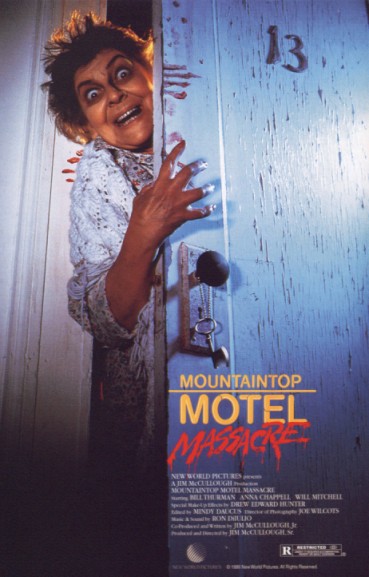
The TSL’s Daily Horror Grindhouse: Mountaintop Motel Massacre (dir by Jim McCullough)


mountaintop-motel-massacre

AGCK!  What a scary woman!  Seriously, the poster for the 1986 slasher film Mountain Top Motel Massacre is pure nightmare fuel!  Unfortunately, the poster above does not feature the film’s tag line, which I happen to love.

You want to know what it was?

“Please do not disturb Evelyn.  She already is!”

BRILLIANT!  Of course, I have to admit that one reason why I love that tagline is because my best friend is named Evelyn and you better believe that, as soon as I came across this film, I called her up and I said, “Please don’t disturb Evelyn.  She already is.”

Evelyn, of course, had no idea what I was talking about because not many people have heard of Mountaintop Motel Massacre.  It’s one of the many low-budget slasher films to be released in the late 80s.  (That said, the film was actually made in 1983 and sat on the shelf for three years before getting a release.)  With a few notable exceptions, these films are pretty much forgotten, except for when they occasionally turn up on TV or when you come across them in the bargain bin.  I found my copy of Mountaintop Motel Massacre at the Movie Trading Company.  It was being sold for $1.99, which is another way of saying, “Nobody in the world cares about this damn movie.”  But I bought it, because I thought the old woman was scary and I love horror movies.

Mountaintop Motel Massacre was filmed in Louisiana and it perfectly captures that whole you’re-going-to-die-as-soon-as-you-turn-off-the-lights atmosphere of the Deep South.  Personally, I was hoping that all the guests at the motel would be obnoxious tourists from up north, the type who would bitch about not being able to get a good philly cheesesteak in Louisiana before being killed and dumped in the bayous.  (Either that or they’d go up to the desk clerk and say, “We refuse to shop at a low class establishment like Walmart.  Where is the closest Wawa?”)

Unfortunately (or perhaps fortunately, depending on how you look at it), there were no Northerners in this film.  Instead, all the guests at the motel were locals.  For instance, there was the alcoholic preacher.  And then there was the newlywed couple, determined to have a wonderful wedding night despite not being able to afford the Holiday Inn.  (Why would you marry a man who couldn’t even afford the Holiday Inn?  Why, God, why!?)  And then there was Al, the traveling salesman.  Al checked into the motel with two hitchhikers, both of whom were under the impression that Al worked for a record company.  Al’s kinda sleazy but he was also the film’s designated hero.

Needless to say, not many guests survived the night.  Some were killed by snakes.  Some were killed by sickles to the face.  All were killed by a crazy old woman named Evelyn.  Evelyn owned the motel but she had previously spent three years in a mental hospital.  Before she killed all of her guests, she apparently murdered her daughter as well.  Except, for the fact, that her daughter was later seen walking through the woods.  Was her daughter a zombie or was this just a set-up for a sequel that would never be made?  Your guess is as good as mine.

Anyway, Mountaintop Motel Massacre doesn’t make a lot of sense.  Like many slasher films, the film’s plot is pretty much dependent on everyone acting like a total moron.  Usually, I defend the slasher genre by pointing out that, realistically speaking, most people do act like morons in the face of danger.  But, compared to some of the people in Mountaintop Motel Massacre, the counselors at Camp Crystal Lake look like freaking geniuses.

However, with all that in mind, Mountaintop Motel Massacre is still an effectively creepy movie.  It’s drenched in atmosphere and, as played by Ann Chappell, Evelyn is more frightening than your average anonymous 80s slasher.  She spends most of the film running through a series of underground tunnels that are underneath the hotel and the sight of that murderous old woman burrowing from room to room will stick with you long after the movie ends.

So, if you happen to come across it this October, feel free to give Mountaintop Motel Massacre a shot.  If you’re a fan of the slasher genre, you might enjoy it.

And … please.

Don’t disturb Evelyn.

SHE ALREADY IS!

Back To School #11: The Last Picture Show (dir by Peter Bogdanovich)


Monday is the first day of school down here in Dallas so it seems only appropriate that this latest entry in our Back to School series should be a look at one of those most quintessential Texas films ever made, the 1971 best picture nominee, The Last Picture Show.

http://www.youtube.com/watch?v=3YQomR5xJ_Y

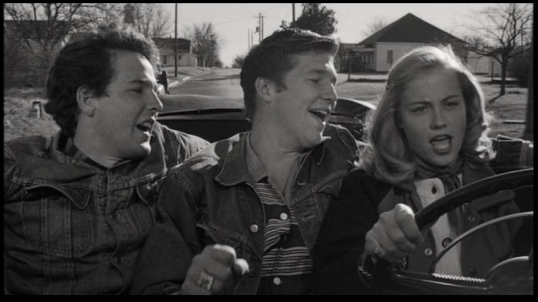
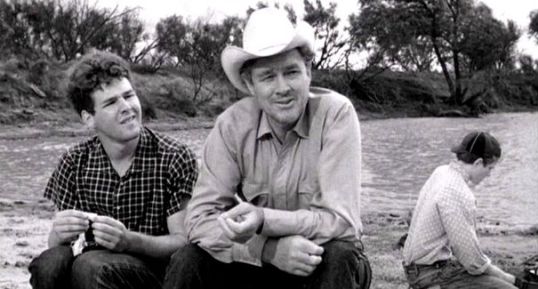
Directed by Peter Bogdanovich and based on a novel by Larry McMurtry, The Last Picture Show takes place in 1951 and tells the story of two high school seniors, best friends Sonny Crawford (Timothy Bottoms) and Duane Jackson (Jeff Bridges, reminding us once again why everbody loves him).  Sonny and Duane live in the rural town of Anarene, Texas.  With little to look forward to in the future, beyond perhaps getting a job working in the oil fields, Sonny and Duane are both intent on enjoying their final year of high school.  Sometimes, that means driving down to Mexico for the weekend.  Sometimes, it means going to the only theater in town and seeing a movie.  Most of the time, however, it means hanging out in a pool hall owned by the strict but fatherly Sam (Oscar winner Ben Johnson).  Often times they are accompanied by the intellectually disabled Billy (Sam Bottoms), who responds to everything with a blank smile and spends most of his spare time wandering around with a broom, futilely trying to sweep the dusty streets.

last-picture-show

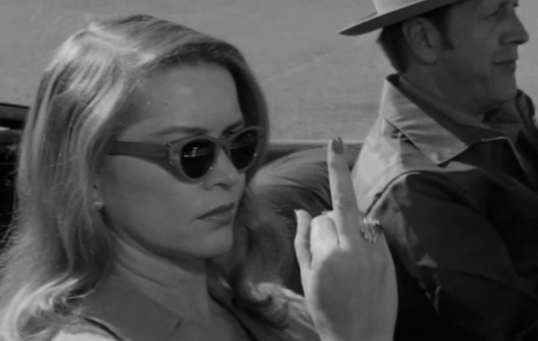
The charismatic and impetuous Sonny is dating the beautiful and self-centered Jacy Farrow (Cybil Shepherd), who is the daughter of the wealthiest woman in town.  Jacy knows that her cynical mother (Ellen Burstyn) is having an affair with an oil worker named Abilene (Clu Gulager) but she’s more concerned with her own future.  Even though she’s dating Sonny, Jacy still accepts an invitation from the awkward Lester Marlow (played by a memorably goofy Randy Quaid) to attend a naked indoor pool party.  At the party, she meets Bobby Sheen (Gary Brockette), who is rich and will be able to provide her with the future that Duane never will.  However, Bobby tells Jacy that he isn’t interested in her because she’s a virgin.  If nothing else, this gives Jacy a reason to stay with Duane, at least until after they have sex.

Meanwhile, the far more sensitive Sonny ends up having an affair with Ruth Popper (Cloris Leachman, who won an Oscar for her performance in this film), the wife of the high school football coach.  It appears that Sonny truly cares about Ruth but then he finds himself being tempted by none other than his best friend’s girlfriend…

Sonny and Ruth

At heart, The Last Picture Show really is basically a small town soap opera, a Texas version of Peyton Place.  The difference between the two films — beyond the fact that The Last Picture Show just happens to be a 1oo times better than Peyton Place — is that The Last Picture Show doesn’t take place in a beautiful, idealized small town.  Instead, the town of Anarene is a believably bleak location, one that will be familiar to anyone who, like me, grew up in the American southwest.  A good deal of the success of The Last Picture Show is due to the fact that it was actually filmed on location in Archer City, Texas.

(Nothing annoys me more than when I see the mountains of California in the background of a movie that’s supposed to be taking place in North Texas.  We don’t have mountains up here.  For the most part, we don’t even have hills.  The land is flat.  You can see forever, if you know where to look.)

Of course, you can’t talk about The Last Picture Show without talking about Robert Surtees’s stunning black-and-white cinematography.  Not only does the black-and-white remind us that this is a film about a fading way of life but it drives home the fact that Sonny and Duane don’t have much to look forward to.  Growing up in Anarene means they are destined for lives without color or excitement.  In the end, can you really blame them for occasionally acting before they think?

Ben Johnson

Ultimately, the success of The Last Picture Show is due to a lot of things.  This was Peter Bogdanovich’s second film as a director and he did such an excellent job here that he’s basically spent the rest of his career trying to live up to this one film.  (That said, Bodganovich also left his wife for Cybill Shepherd — despite the fact that his wife was the one who suggested that he make this film and cast Cybill in the first place!  Don’t worry though — Polly Platt got her revenge by having a far more successful career than her ex-husband and she even produced Say Anything, a film that we will soon be looking at.)  The screenplay, by McMurtry and Bogdanovich, is full of sharp dialogue and memorable characters.  As for the performers, this is probably one of the best acted films ever made.  Jeff Bridges and Timothy Bottoms play off each other well, Cybill Shepherd is the epitome of casual destructiveness, and Ben Johnson is brilliantly cast as the film’s moral center.  My favorite performance comes from Ellen Burstyn, who delivers every line with just the right combination of contempt and ennui.

Ellen Burstyn in The Last Picture Show

Ellen Burstyn in The Last Picture Show

If you’re a Texan, The Last Picture Show is one of those films that you simply have to see.  And if you don’t enjoy it and if you don’t relate to at least a few of the characters (I related to Jacy, though I like to think that I’m a lot nicer in the way I treat people), then you’re not a real Texan.

It’s as simple as that.

the-last-picture-show-poster