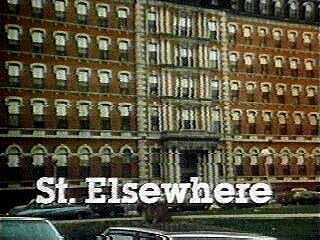
Retro Television Review: St. Elsewhere 3.10 “Girls Just Want To Have Fun”


Welcome to Retro Television Reviews, a feature where we review some of our favorite and least favorite shows of the past! On Fridays, I will be reviewing St. Elsewhere, a medical show which ran on NBC from 1982 to 1988.  The show can be found on Daily Motion.
This episode proves that Dr. Cavanero is the worst.

Episode 3.10 “Girls Just Want To Have Fun”

(Dir by Bruce Paltrow, originally aired on November 28th, 1984)

The struggle is real.

Seriously, I am thankful that someone uploaded St. Elsewhere to Daily Motion.  With the show no longer on Hulu and Prime only having the first season available, Daily Motion is pretty much the only place where I can stream the show.  That said, the sound quality is not great.  The sound quality wasn’t particularly good when the show was on Hulu either but at least then I could turn on the captions.  The Daily Motion uploads don’t have that option.  I had to strain to hear the dialogue and, as a result, this review is not going to be as in-depth as it could be.

What I can tell you is that Dr. Cavanero is now one of the least sympathetic characters that I have ever seen on a television show.  Last week, Dr. Christine Holz (Caroline McWilliams) told Cavanero that she was a lesbian.  This week, Cavanero blabbed that information around the hospital, leading to a lot of homophobic comments from certain members of the stuff.  (Not surprisingly, Victor Ehrlich was there to say something stupid.)  Cavenero admitted to Christine that she found Christine’s lifestyle to be “unnatural.”  Christine smiled sadly and left Cavanero’s apartment and left the show.  Keep in mind, Dr. Holz was portrayed as being a brilliant surgeon and bone marrow expert.  It probably would have been good to keep her around the hospital for a little while but nope.  Sorry.  Dr. Cavanero — who really hasn’t done anything of note since the first season — felt uncomfortable.

(Originally, Christine and Cavanero were supposed to have a romantic relationship but Cynthia Sikes, the actress playing Cavavero, objected to the storyline.  As a result, the story was rewritten and perhaps it’s not a coincidence that Cavanero comes across as being a bit of a homophobe.)

Meanwhile, Dr. Chandler was concerned when he discovered that a neighborhood woman (Beah Richards) was practicing medicine out of her apartment.  This storyline at least gave Denzel Washington more to do than usual, which was good.  St. Elsewhere, at least so far, has often tended to underuse both Chandler as a character and Washington as an actor.

Jack’s friend (John Schuck) insisted on doing an experimental kidney procedure to try to save the life of his daughter (Brandy Gold) and Dr. Auschlander finally gave his approval for it to be done.  I would say that was a good thing except for the fact that Jack’s storylines hardly ever have a happy ending.  There’s a reason why Morrison is the most depressed resident in the hospital.

Nurse Rosenthal continued her affair with Richard Clarendon, even though Richard’s wife (Beverly Sanders) is now working at the hospital.  Wow, that’s going to be awkward.  In fact, I hope it’s really awkward.  I’m tired of Nurse Rosenthal and her holier-than-thou attitude.

Dr. Craig testified at a city council hearing.  The poor sound quality kept me from fully understanding what the hearing was about but at Dr. Craig told everyone off.  It’s always fun to watch William Daniels tell people off.

Here’s hoping the sound will be a bit less muddy next week!
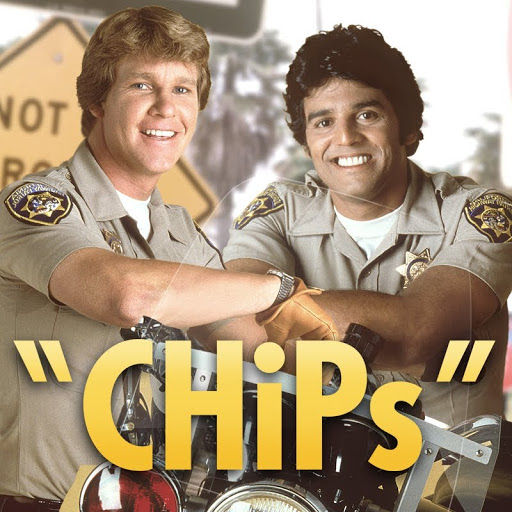
 

Late Night Retro Television Review: CHiPs 4.12 “Home Fires Burning”


Welcome to Late Night Retro Television Reviews, a feature where we review some of our favorite and least favorite shows of the past!  On Mondays, I will be reviewing CHiPs, which ran on NBC from 1977 to 1983.  The entire show is currently streaming on Prime!

It’s arson and basketball on CHiPs!

Episode 4.12 “Home Fires Burning”

(Dir by Charles Bail, originally aired on February 1st, 1981)

Two arsonists (David Hayward and Michael Cavanugh) are setting RVs on fire as a part of an insurance scam.  One man (Jack Kruschen) who hires the arsonists is horrified when their carelessness leads to a security guard getting seriously injured.  If the guard dies, the man is looking at serious jail time!  (Luckily, the guard doesn’t die and apparently, everyone just forgets about sending his boss to jail.)

Luckily, Baker is there to help track the arsonists down.  Ponch, on the other hand, is busy putting together a Highway Patrol basketball team.  It’s hard not to notice how much time the Highway Patrol spends on stuff like basketball, dirt bike competitions, and drag car racing.  Somehow, Ponch has gone from being the department’s screw-up to now being the guy who is automatically given all of the responsibility.  It’s the Ponch Show and everyone knows it.

This episode was directed by veteran stuntman Charles Bail and it does have some spectacular stunts.  (A car jumping through an exploding RV was my favorite.)  And let’s be honest.  I could sit here and spend hours talking about CHiPs became the Ponch Show during the fourth season and how the rest of the cast was underutilized.  And I would be totally correct.  But the stunts and the car crashes are the main appeal of this show and this episode featured several examples of each.

As such, this was a good episode.

Film Review: …. And Justice For All (Dir by Norman Jewison)


First released in 1979, ….And Justice For All will always be remembered for one scene.

Yell it with me, “YOU’RE OUT OF ORDER!  THE WHOLE TRIAL IS OUT OF ORDER!  THEY’RE OUT OF ORDER!”

When attorney Arthur Kirkland (Al Pacino) starts screaming in the middle of the courtroom, it’s a cathartic moment.  We’ve spent nearly two hours watching as Arthur deals with one insane situation after another.  One of Arthur’s partners, Warren (Larry Bryggman), cares more about his car than actually delivering the right documents to a judge.  Another of Arthur’s partners, Jay (Jeffrey Tambor), has a nervous breakdown and, after shaving his head, ends up throwing cafeteria plates at people in the courthouse.  Arthur has three clients, one of whom is indigent, one of whom is innocent, and one of whom is a wealthy and despised judge (John Forsythe) who has been accused of a rape that Arthur suspects he committed.  The system offers no mercy for Arthur’s innocent (or, at the very least, harmless) clients while going out of it’s way to defend the judge.  Meanwhile, another judge (Jack Warden), is driven to take suicidal risks, like flying a helicopter until it runs out of fuel and comes down in a nearby harbor.  The assistant district attorney (Craig T. Nelson) only cares about his political ambitions and finally, after one incident after another, Arthur snaps.  And it’s cathartic because we’re all on the verge of snapping as well.

That final moment, with its signature Al Pacino rant, is such a strong and iconic scene that it’s easy to forget that the film itself is actually rather uneven.  The script, by Barry Levinson and Valerie Curtin, owes a good deal to the work of Paddy Chayefsky.  Just as Chayefsky often wrote about men being driven mad by institutional failure, ….And Justice For All features character after character snapping when faced with the screwed-up realities of the American justice system.  The final “out of order” speech is obviously meant to be this film’s version of Howard Beale’s “I’m as mad as Hell and I’m not going to take it!” speech from Network and, much like George C. Scott in the Chayefsky-written The Hospital, Arthur spends a lot of time talking about what he doesn’t like about his job.  The thing that sets ….And Justice For All apart from the best works of Chayefsky is that Levinson, Curtin, and director Norman Jewison all take Arthur Kirkland at his word while one gets the feeling that Chayefsky would have been a bit more willing to call out Arthur on his self-righteousness.  Arthur has every right to be angry when Warren forgets to give a judge an important document while Warren is substituting for him in court.  At the same time, Arthur is the one who trusted Warren to do it.  In the end, the document was not about one of Warren’s client.  In fact, Warren knew absolutely nothing about the case or Arthur’s client.  The document was about Arthur’s client and Arthur was the one who decided trust someone who had consistently shown himself to not be particularly detailed-orientated.  One gets the feeling that Chayefsky would not have let Arthur off the hook as easily as Levinson, Curtin, and Jewison do.  Arthur’s perpetual indignation can sometimes be a little hard to take.

It’s a very episodic film.  Arthur goes from one crisis to another and sometimes, you do have to wonder if Arthur has ever had any human or legal interactions that haven’t ended with someone either going insane or dying.  There’s no gradual build-up to the film’s insanity, it’s right there from the beginning.  And while this means the narrative often feels heavy-handed, it also makes that final speech all the more cathartic.  It’s an uneven film and, of all of the characters that Pacino played in the 70s, Arthur is probably the least interesting.  But that final rant makes up for a lot and, fortunately, Pacino was just the actor to make it memorable.  For all it’s flaws, the final few minutes of ….And Justice For All make the film unforgettable.