Though the Academy of Motion Picture Arts and Sciences claim that the Oscars honor the best of the year, we all know that there are always worthy films and performances that end up getting overlooked. Sometimes, it’s because the competition too fierce. Sometimes, it’s because the film itself was too controversial. Often, it’s just a case of a film’s quality not being fully recognized until years after its initial released. This series of reviews takes a look at the films and performances that should have been nominated but were, for whatever reason, overlooked. These are the Unnominated.
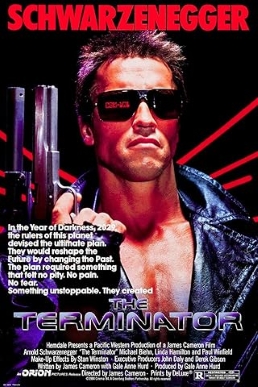
First released in 1984, The Terminator was the one of the top box office hits of the year. It’s the film that established James Cameron as a filmmaker. It’s the film that made a bona-fide star out of Arnold Schwarzenegger. It’s a film that was imitated a thousand times before it even got its first official sequel. It’s a film that’s still celebrated today. 41 years later, people are still saying, “I’ll be back.” Would Arnold Schwarzenegger ever have become governor of California if he hadn’t first played a killing machine? There’s a reason why his political nickname was the Governator.
And yet, The Terminator was not nominated for a single Oscar. For all of the explosions and the gunfire and the screaming, it wasn’t even nominated for Best Sound. Some of the special effects may now seem a bit hokey in this age of rampant CGI but it’s still a surprise that The Terminator was not nominated for Best Visual Effects. The breath-taking action scenes did not result in a nomination for Best Editing. Linda Hamilton was not nominated for her fantastic performance as Sarah Connor, a young woman who finds herself being pursued by a killer cyborg from the future. Arnold Schwarzenegger was not nominated for playing one of the most memorable villains of the past 40 years. Those who claim that Schwarzenegger was just playing himself are being overly glib. Anyone could have said, “I’ll be back.” It took Schwarzenegger’s delivery to make it a great line.
The lack of nominations aren’t really not a surprise, of course. The Academy has only recently started to show an openness to nominating genre films for major awards and, even now, a genre film has to be considered a “cultural event” to even get a nomination. Black Panther, Get Out, and even Mad Max: Fury Road and Dune were all nominated because it was felt that they had transcended their genre origins. The Terminator is a sci-fi action movie and it’s proud to be a sci-fi action movie. (Terminator 2: Judgment Day, it could be argued, transcended its genre origins but it was released in 1991 and Silence of the Lambs was destined to be the genre nominee that year.) It’s also so relentlessly paced and intelligently written and directed that it’s a film that, even after all these years, it can still leave you breathless. Nominated or not, The Terminator is a film that grabs your attention and holds it for a full 107 minutes. There’s not many films that can make that claim.
The Terminator is a film that has held up surprisingly well. (It’s certainly held up better than some of its more recent sequels.) The performances of Linda Hamilton, Michael Biehn, and Arnold Schwarzenegger still work. It’s still terrifying to watch as The Terminator relentlessly kills everyone that he comes into contact with. (One thing that always gets me about the Terminator is that, even though he’s huge and superstrong and could probably physically rip anyone he wanted to apart, he still carries and uses a gun. This makes him seem like even more of a bully.) The Terminator is a machine and what makes him especially intimidating is that he doesn’t care if people see him coming or if they witness his crimes. He has one function and that’s all he worries about. When Michael Biehn first shows up, you can’t help but wonder why this guy, with his slight build and his somewhat nervous mannerisms, would be sent to try to stop the Terminator. Of course, by the end of the movie, you understand.
(And what an ending! The sight of those clouds, Linda Hamilton’s delivery of her final line, and the feeling that the future has already been determined, it all definitely makes an impression that has managed to survive every sequel after Judgment Day. There’s a reason why Skynet — much like “I’ll be back” — has taken on a cultural life of its own.)
There were a lot of very good films that were nominated for Oscars in 1984. The Terminator, much like Once Upon A Time In America, was not one of them but it will still never be forgotten.
Previous Entries In The Unnominated:

 Through the Shattered Lens