October True Crime: Stolen Innocence (dir by Bill L. Norton)


1995’s Stolen Innocence opens with 18 year-old Stacy Sapp (Tracey Gold) trying to sneak back into her house after a long night of drinking and partying.  Unfortunately for her, Stacey isn’t very good at sneaking around and she’s caught by her mother (Bess Armstrong) and her father (Nick Searcy).

“I’m 18!” Stacy argues.

“You’re going to end up pregnant!” her mother yells.

Stacy says that that her mother is just scared that she’s going to end up a loser “like you!”  Well …. yeah, Stacy, that’s kind of the point.  If your mother has experience with the life decisions necessary to become a loser, maybe you should listen to her warnings.

Anyway, Stacy runs away with a friend of her’s.  After her friend decides to go back home, Stacy hitches a ride with a trucker.  When the trucker stops off at a truck stop so he can get his brakes looked at, Stacy meets Richard Brown (Thomas Calabro, wearing a really bad wig).  Richard is long-haired and has got a tough guy beard and a cheesy tattoo of a heart on his scrawny forearm.  Stacy, of course, is totally smitten and she goes off with Richard and his “friend,” Eddie (Matt Letscher).

It doesn’t take long for us to figure out what Richard is bad news.  He carries a gun.  He’s financing his trip through stolen checks.  He might not even own the truck that he’s driving.  He and Eddie have a bizarre relationship in which Richard continually abuses Eddie but Eddie refuses to leave.  Richard is obviously a bad guy and we can all see it.  When Stacy finally calls her parents from the road, they immediately figure out that Stacy is in trouble.  However, it takes Stacy forever to figure it out because Stacy’s kind of an idiot.

I cringed a lot while watching Stolen Innocence, not so much because of the film’s depiction of Richard’s criminal lifestyle but because I used to have a definite weakness for bad boys and I could kind of understand what was going through Stacy’s mind when she first met Richard.  That said, I’m pretty sure that I would have figured things out a lot quicker than Stacy did.  Stacy quickly goes from being a somewhat sympathetic rebellious teenager to being someone who you really start to get annoyed with.  Oh, he’s threatening you with a gun?  Okay, that’s when you leave!  That’s when you start plotting your escape.  You don’t make excuses for him.  He’s financing his trip with stolen checks?  I’m sorry, is that not a red flag?  Add to that, as played by a miscast Thomas Calabro, it’s not like Richard is some boiling cauldron of charisma.  From the first minute we see him, with his long hair and his cowboy hat and his tattoo, the guy seems like a joke.

Eventually, Stacy does figure out the truth but, by that point, Richard and her are holed up in a motel room and Richard is exchanging gunfire with the FBI.  The film ends with a title card, reminding us that this was a true story.  “He’s not a bad person!” Stacy wails to the police.  I guess some people really are that stupid.
Nothing In Common (1986, directed by Garry Marshall)


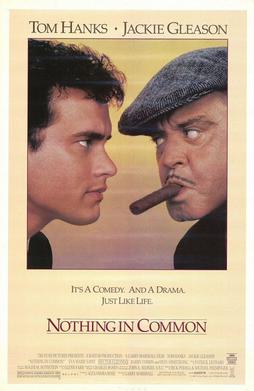
Tom Hanks plays David Basner (Tom Hanks), an advertising executive whose immature lifestyle gives him insight into what sells but has also left him totally unprepared to deal with the fallout when his mother (Eva Marie Saint) leaves his father, Max (Jackie Gleason).  David, who is struggling to come up with the perfect commercial for a demanding client (Hector Elizondo), has to come to terms with both his father’s bad health and his history of infidelity.

This isn’t my favorite Tom Hanks movie.  It comes from that awkward period when Hanks was trying to make the transition from comedy to drama and its attempt to mix the two genres is not always successful.  The scenes of Hanks at the ad agency are often so cartoonish that they don’t seem like they belong in a movie where Jackie Gleason loses a foot to diabetes and realizes that he spent his entire marriage emotionally abusing his wife.  The movie, though, is worth watching for the teaming of Hanks and Gleason, two comedic actors who eventually proved themselves to equally as skilled at playing it serious.  Gleason, especially, gives a strong performance.  This was his final film and Garry Marshall convinced him to take it by asking, “Do you really want to go out on Smokey and the Bandit 3?”  Gleason would die a little over a year after the release of Nothing In Common and this film, even if it wasn’t perfect, gave the world a chance to see what a good actor he really was.

This film is often cited as the the movie that started Hanks on the way to becoming a dramatic actor.  Like Punchline, Nothing In Common played a role in Hanks becoming more than just a comedian but  I think Big was ultimately the better showcase for Hanks’s ability to mix pathos with laughs.  Nothing In Common was directed by Garry Marshall and, as was usually the case with Marshall, he often doesn’t trust the audience to figure things out for themselves.  He goes overboard trying to force an emotional response instead of just trusting the material.  Tom Hanks still does a good enough job in Nothing In Common.  Hanks is as likable as always and you can see the dramatic actor emerging in Hanks’s performance even if Hanks still wasn’t totally comfortable with it.

Nothing In Common is flawed but it was definitely a better swan song for Jackie Gleason than Smokey and the Bandit 3.

A Blast From The Past: Barefoot In The Park (dir by Harvey Medelinsky)


Our regularly scheduled review of Welcome Back Kotter will not be posted this week so that we may bring you this special presentation….

From 1982 and filmed for HBO, it’s a stage production of Barefoot In The Park!  I’ve always loved the Robert Redford/Jane Fonda film version but I also enjoy this recording of one of the play’s periodic Broadway revivals.  Richard Thomas and Bess Armstrong play the newlyweds and they really bring Neil Simon’s dialogue to life.

Without further ado, here is Barefoot In The Park!

Retro Television Reviews: The Love Boat 2.4 “The Man Who Loved Women / A Different Girl / Oh, My Aching Brother”


Welcome to Retro Television Reviews, a feature where we review some of our favorite and least favorite shows of the past!  On Wednesdays, I will be reviewing the original Love Boat, which aired on ABC from 1977 to 1986!  The series can be streamed on Paramount Plus!

Come aboard!

Episode 2.4 “The Man Who Loved Women / A Different Girl / Oh, My Aching Brother”

(Dir by Allen Baron, originally aired on September 30th, 1978)

This week’s cruise is all about deception …. and love!

For instance, Joe (Marty Ingels) and Harold Nash (Sonny Bono) are two brothers who thrive on deception.  Harold specializes in pretending to get injured.  Joe specializes in threatening to sue until the brothers get paid off.  Apparently, it’s a scheme that works well for them, though Joe seems to be a lot more enthusiastic about it than Harold.  In fact, Harold seems to be a nice guy who mostly just wants to enjoy the cruise and flirt with another passenger, Rita (Judy Landers).  Still, Joe insists that Harold pretend to hurt his back so Harold takes a dramatic fall on the shuffleboard course.

Of course, the crew can spot a fake injury from miles away.  For once, Doc Bricker actually does his job and announces that, despite all of his yelling and groaning, there does not appear to be anything wrong with Harold’s back.  Still, if Harold goes through the entire cruise without walking, the Pacific Princess will probably pay a settlement.  Joe’s happy about that.  Harold’s unhappy because he wants to get up and walk over to Rita’s cabin.  In the end, it is Harold’s love for Rita that defeats the scheme.  When he sees Rita actually trip and take a fall, Harold can’t stop himself from jumping out of his wheelchair to help her.  Awwwwwww!

This storyline was dumb but kind of sweet.  Sonny Bono was not a particularly good actor but there was something rather genuine about his chemistry with Judy Landers.

Meanwhile, the Captain Stubing’s godson, Dave Stanton (Grant Goodeve), is taking the cruise with his wife, Laura (Bess Armstrong).  Though they’ve been married for two years, they are only now getting to take their honeymoon.  (Dave was in the army and Laura was caring for her terminally ill mother.)  During the trip, they discover that they’ve both changed over the past two years.  Laura’s more independent now.  Plus, she had an affair while  Dave was gone.  Dave gets pretty upset but Captain Stubing asks Dave if he can really say that he’s never cheated on Laura.  Dave admits that he cheated on her too.  Now that they know that they’re both cheaters, Dave and Laura’s marriage is strong than ever!

This storyline was defeated by the fact that neither Dave nor Laura were particularly sympathetic characters.  At one point, Dave actually says that his cheating was different from Laura’s cheating because he’s a guy and she’s a woman.  AGCK!  Probably the most interesting part of this story is that it gave Stubing a chance to talk about why his own marriage fell apart.  This show has often hinted that there is a lot of darkness and trauma in Stubing’s past and Gavin MacLeod always brings a lot of sincerity to the scenes where the captain admits that he has regrets.

Finally, Charlotte (Cathryn Damon), Bonnie (Jo Ann Pflug), and Anita (Brett Sommers) are three divorcees who take the cruise together.  All three of them end up meeting a man.  Charlotte meets a man named Alvin, who she decides to call him by his middle name, “Cornelius.”  Bonnie meets a man who she calls Vinny.  Anita meets a man who she calls by his last name, “McNair.”  What they don’t know is that all of them have met the same man, Alvin Cornelius McNair (David Doyle).  Alvin goes out with all three of the women but he starts to feel guilty when he realizes that they’re all cabinmates.  However, Charlotte, Bonnie, and Anita tell him that it doesn’t matter to them because Alvin was always honest with them and didn’t try to manipulate any of them.  Awwwww!  I liked this story.  Damon, Pflug, and Sommers were believable as old friends and Doyle was likable as Alvin.

This was actually a pretty enjoyable episode.  It may not have been perfect but it was a pleasant trip.

Horror Film Review: Jaws 3 (dir by Joe Alves)


So, this is a strange one.

As the title states, this 1983 film is the third sequel to the Jaws.  As I pointed out in my reviews of the first film and Jaws 2, the first two films all starred Roy Scheider and took place on Amity Island.  In fact, it can be argued that Amity Island was almost as important to the success of the first two films as the shark.  When Martin Brody conquered his fears and got out on the water, it wasn’t just to destroy a shark.  It was also to protect a community under siege.

Well, there’s no such community like Amity Island in Jaws 3.  And there’s no Roy Scheider either.  Instead, our hero is Martin Brody’s son, Mike.  Mike is all grown up and working as the senior marine biologist at SeaWorld Orlando.  Mike is now played by a very young and very bearded Dennis Quaid.  This leads to an interesting situation where Mike — who grew up in New England and whose father was a former New York City cop — has a very pronounced Texas accent.  That’s not a complaint, of course.  I’m from Texas so I’m always happy to see (and hear) a fellow Texan in a movie.  Plus, Dennis Quaid’s a likable actor.  Still, it somehow seems appropriate that the third installment of the Jaws franchise would feature a New Yorker growing up to be a Texan.  I mean, if we’re going to accept that the same outlandish event can keep happening to the members of the same family then I guess anything’s possible.

The other Brody son, Sean, is also featured in the film.  Sean is now played by John Putch and, when he first shows up to visit Mike, he’s dressed like he just got off work at the rodeo.  You have to kind of wonder if maybe the trauma of nearly getting killed in Jaws 2 led to both of the Brody boys rejecting their New England roots and embracing the ways of the west.  Say what you will about Texas and all the states in between El Paso and Los Angeles, we’re pretty much shark free.

Anyway, this is a Jaws films so you can guess what happens.  A big shark ends up getting loose in SeaWorld and Mike tries to close the park down, just to be overruled by the park’s manger, Calvin Bouchard (Lou Gossett, Jr.).  Meanwhile, a hunter named Philip Fitzroyce (Simon MacCorkindale) announces that he will personally track down and kill the shark.  As you might guess just from the fact that his last name is Fitzroyce, Philip is arrogant and speaks with a posh accent.  Mike takes an immediate dislike to him but I was happy whenever Philip showed up, mostly because Simon MacCorkindale gave a performance that was so over-the-top that it was fun to watch.  Whenever MacCorkindale and Gossett got together in the same scene, the film stopped being about the shark and instead became a contest to see who could overenunciate their dialogue with the most style.

(In the end, MacCorkindale won, but only narrowly.  A few years after Jaws 3, Gossett would co-star in The Principal and would go on to secure his spot in the Overenunciation Hall Of Fame by pronouncing the word “drugs” in such a way that I first thought he was talking about druids.)

One of the reasons why Jaws 3 seems odd when watched today is because it was originally released in 3-D.  (In fact, the film’s original title was Jaws 3-D.)  As a result, there’s a lot of scenes of people either walking towards or pointing directly at the camera.  Whenever anyone holds up a pole or a harpoon or anything similar, you know that they’re going to end up pointing the end of it straight at the viewer.  At the start of the film, when the shark bites a fish in half, the fish’s head ominously floats closer and closer to the camera.  There’s a lot of scenes that were obviously designed to make audiences says, “Oh my God!  I feel like I could reach out and touch it!” but, in the non-3D version, those scenes are just weirdly paced and slightly out-of-focus.  (At one point during the film, the picture was so blurry that I actually checked to make sure I had my contacts in.)

Add to that, there’s more than few scenes where it’s obvious that the shark has been superimposed into the action.  If the first two Jaws films featured big sharks, Jaws 3 often seems to feature a cartoon shark.  In short, what may have been impressive in a theater in 1983 to an audience wearing special glasses is far less impressive when you’re watching the movie at 3 in the morning on AMC.

The other weird thing about this film is that it was actually filmed at SeaWorld Orlando.  I’m going to guess that the film was supposed to serve as a 99-minute advertisement and a lot of time is devoted to people talking about how much they love SeaWorld.  At the same time, this film also features the park’s manager refusing to shut down the park and basically putting everyone’s life in danger.  If anything, the film’s main message seems to be, “If you go to SeaWorld, you’ll die.”  You have to wonder if some executive lost his job after Jaws 3 came out.

Anyway, Jaws 3 is a silly movie that never quite comes to life in the way that both Jaws and, to a lesser extent, Jaws 2 did.  Yes, the shark’s ruthless and we get to hear the familiar music and there’s some cute dolphins but otherwise, the movie itself is just kind of bland.  Rumor has it that Jaws 3 was originally going to be a comedy called Jaws 3 People 0.  That probably would have made for a more memorable movie but, at the same time, I got some good laughs out of the scene where the tourists in an underwater tunnel realized that a shark was watching them so, in the end, everything worked out for the best.

Embracing the Melodrama Part II #88: Dream Lover (dir by Nicholas Kazan)


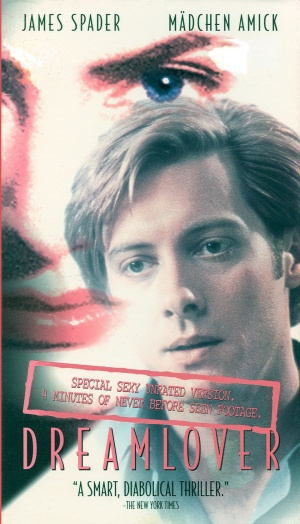
Dream_Lover_FilmPosterThe 1994 film Dream Lover is almost as strange as Zandalee.

Dream Lover opens with Roy Reardon (James Spader, giving a very James Spaderish performance) in the process of getting divorced.  Sitting in court, he announces that he’s fired his attorney and that he’s no longer contesting the divorce.  The judge informs him that, if he did contest the divorce, the final judgment would be in his favor.  Roy says that doesn’t matter.  He doesn’t want to contest the divorce.

In the next scene, Roy’s ex-wife tells him that he’s a great guy and that it’s too bad that they couldn’t make the marriage work.  They agree that they were just too different.  She apologizes for cheating on him.  Roy apologizes for hitting her.  They agree that Roy has trust issues.

Over the next few minutes of the film, we follow Roy over the course of his new single life.  We discover that Roy is a successful architect who is always attracted to brunette artists with troubled backstories.  We also discover that Roy’s best friend is an obnoxious yet strangely likable guy named Norman (Larry Miller, who brings some unexpected depth to an obnoxious character).  Norman begs Roy for money.  Roy refuses to give it to him.  Norman invites Roy to an art gallery and offers to set him up with a woman he knows.  Roy agrees.  And, seriously, the first 20 minutes of the film are so dominated by Norman that you’re kind of surprised when the film moves on and he’s no longer in every scene.

(But then again, that’s the type of film that Dream Lover is.  Characters appear and vanish at random.  Plot points are raised and then abandoned.)

Anyway, Roy’s date is disastrous.  (“You don’t like me,” the woman says as tears stream down her face.)  However, during the date, Roy meets Lena (Madchen Amick).  When first they meet, they fight.  Then they run into each other again at the grocery store and they hit it off.  They go to dinner and, despite having a good time, Lena makes a point of not inviting Roy up to her apartment.  The next night, Roy shows up unannounced and Lena does invite him up.  At first, she’s cold towards him.  Then they’re making love.  And then they’re getting married.  And then the clowns show up…

Oh yes, there are clowns in this movie.  Roy is haunted by visions, where he’s at a carnival and random clowns pop up and say cryptic things to him.  “How’s the family?” one asks.  Another one continually reminds him that he doesn’t know much about Lena.

Years pass by.  Lena and Roy have two children but it continues to nag at Roy that he doesn’t know anything about her.  He worries that she’s cheating on him.  He fears that the children are not his.  Roy’s friends tell him that he’s being paranoid.  Roy argues that paranoia is just a heightened form of consciousness.

Roy starts to investigate Lena’s past and here’s where I really laughed out loud.  Roy finds out that Lena is from North Texas and goes down to her hometown.  As Roy arrives in this tiny country town, the camera reveals a huge mountain in the background.  Really, Dream Lover?  A mountain in North Texas?

Anyway, for me, this film never really recovered from that mountain but, if you can overlook that geographic mistake, Dream Lover is occasionally enjoyable because it is such a weird film.  James Spader is hot, Madchen Amick is beautiful, and the entire film features one of those huge and improbable twists that you simply have to see for yourself.

And you can see it because it’s currently available on Netflix!

http://www.youtube.com/watch?v=AHgCBol-b2I