Horror On The Lens: The Devil Bat (dir by Jean Yarborough)


In the 1940 film, The Devil Bat, the owners of a company in the small town of Heathville are super-excited because they’re going to be given their head chemist, Dr. Paul Carruthers (Bela Lugosi), a bonus check of $5,000.  However, since Carruthers’s inventions have made millions for the company, he is offended by the small check and decides that the best way to handle this would be to sue in court and demand fair compensation …. just kidding!  Instead, Dr. Carruthers sends his army of giant bats to kill the families of his employers.

The Devil Bat was produced by Production Releasing Corporation, a poverty row studio that specialized in shooting quickly and cheaply.  Going from Universal to PRC was technically a step down for Lugosi but The Devil Bat is actually an excellent showcase for Lugosi and he gives one of his better non-Dracula performances as the embittered Dr. Carruthers.  Indeed, one can imagine that Lugosi, who played such a big role in putting Universal on the map, could relate to Carruthers and his bitterness over not being fairly rewarded for the work he did to make others wealthy.

Enjoy The Devil Bat, starring the great Bela Lugosi!

Horror Film Review: Black Friday (dir by Arthur Lubin)


The 1940 film, Black Friday, opens with Dr. Ernest Sovac (Boris Karloff), a once-respected scientist, being led out of his cell on Death Row and being taken to the electric chair.  As he enters the death chamber, he hands one of the gathered reporters his journal.  Dr. Sovac says that he wants the reporter to know the true story of how he came to be on Death Row.  While the police strap Dr. Sovac into the electric chair, the reporter reads the journal.

It’s flashback time!

Months earlier, Dr. Sovac’s best friend, an befuddled English professor named George Kingsley (Stanley Ridges), is nearly fatally injured when he has the misfortune to get caught in the middle of an attempt to assassinate a gangster.  In order to save George’s life, Sovac performs a brain transplant, giving George part of the gangster’s brain.  George does recover but now he’s got the gangster inside of his head, trying to take control.  Much like Dr. Jekyll, George continually switches identities and becomes a viscous hoodlum who is looking for revenge against those who betrayed him, including gang boss Eric Marnay (Bela Lugosi).

Dr. Sovac, however, is more concerned with the fact that, before he died, the gangster apparently hid a good deal of money somewhere.  Sovac wants that money for himself so that he can build his own laboratory and hopefully help other people with otherwise incurable brain conditions.  Sovac tells himself that, once he gets his hands on the money, he can find a way to rid George of his evil alternative personality.  But until George finds the money, Sovac is content to allow George to continue turning into a murderous gangster.  Things, however, come to a head when George starts to threaten Sovac’s daughter (Anne Gwynne).

Black Friday is yet another Universal Horror Film featuring Boris Karloff was a mad scientist.  What makes Dr. Sovac a compelling character is that he starts out with the best of intentions.  He just wants to save the life of his best friend and Sovac’s desperation is increased by the fact that George himself was just an innocent bystander when he was injured.  Later, when Sovac starts searching for the gangster’s money, his intentions are again not necessarily bad.  He sincerely wants to do some good with that money and he uses those good intentions to justify allowing George to do some very bad things.  In the end, Sovac becomes so obsessed with being able to fund his laboratory that he loses sight of the price that both he and George are having to pay.  Karloff does a great job of playing Sovac, showing how a kind man manages to lose track of his morals until it is too late.  Stanley Ridges is also well-cast as George and does an excellent job of switching back and forth from being a befuddled professor to a ruthless gangster.  There’s an excellent scene in which George, attempting to teach his class, suddenly hallucinates that all of his students have become gangsters.  Ridges does a great job playing it.

Reportedly, the film was originally conceived with Karloff playing George and Bela Lugosi playing the role of Dr. Savoc.  However, Karloff said that he would rather play Savoc and, as such, Lugosi lost a role for which he probably would have been very well-cast.  Since Lugosi was a bit too naturally sinister for the role of George, he instead had to settle for a small role as a gang leader.  Lugosi, it should be said, is a convincing gangster but it’s still hard not to be disappointed that, in this film, he and Karloff don’t share any scenes together.

Previous Universal Horror Reviews:

  1. Dracula (1931)
  2. Dracula (Spanish Language Version) (1931)
  3. Frankenstein (1931)
  4. Island of Lost Souls (1932)
  5. The Mummy (1932)
  6. The Invisible Man (1933)
  7. The Bride of Frankenstein (1935)
  8. Dracula’s Daughter (1936)
  9. Son of Frankenstein (1939)
  10. The Invisible Man Returns (1940)
  11. The Wolf Man (1941)
  12. Ghost of Frankenstein (1942)
  13. Invisible Agent (1942)
  14. Frankenstein Meets The Wolf Man (1943)
  15. Son of Dracula (1943)
  16. House of Frankenstein (1944)
  17. The Invisible Man’s Revenge (1944)
  18. House of Dracula (1945) 
  19. Creature From The Black Lagoon (1954)

Horror on the Lens: Phantom Ship (dir by Denison Clift)


In December of 1872, a sailing ship called the Mary Celeste was found adrift and deserted in the Atlantic Ocean.  When the ship left New York in October, it had a captain and a full crew.  The captain’s wife was among the passengers sailing on the ship.  When the Mary Celeste was discovered, not only was no one on board but there was no evidence as to where everyone had gone or what caused them to abandon the ship in the first place.  The crew of the Mary Celeste appeared to have vanished into thin air and none of them were ever seen again.

As you might guess, this led to years of speculation about what happened.  Some people blamed pirates.  Some blamed food poisoning.  Some blamed ghosts and sea monsters.  More modern theorists have blamed UFOs.

First released in 1935 and originally entitled The Mystery of the Mary Celeste, Phantom Ship offers up a theory of its own.  It speculates about what happened during the final voyage of the Mary Celeste and why its crew vanished.  One of the members of the crew is played by Bela Lugosi.  Lugosi was still riding high from his starring role in Dracula when he starred in Phantom Ship and, playing a veteran sailor who appears to be a bit unstable, Lugosi gives an enjoyably over the top performance.  Admittedly, Phantom Ship has its slow spots and, at times, it threatens to get bogged down in a subplot about the love triangle involving the Captain, his wife, and the Captain’s best friend.  But Lugosi makes the film worth watching and, towards the end, there are some wonderfully atmospheric shots of the nearly deserted ship.

Along with being one Lugosi’s non-Dracula horror films, Phantom Ship is also well-known for being one of the first films to be produced by the British film company that would eventually become known as Hammer Pictures.

Enjoy!

Scenes That I Love: Dracula Meets Van Helsing


143 years ago, on this date in Kentucky, director Tod Browning was born.  Though Browning was a director who was comfortable working in any genre, he is today best remembered for the horror films that he directed for Universal studios.  Today’s scene that I love comes from Tod Browning’s 1931 adaptation of Dracula.

In this scene, Count Dracula (Bela Lugosi) is introduced to Prof. Van Helsing (Edward Van Sloan).  Van Helsing notes something interesting about Dracula’s reflection, namely that he doesn’t have one.  Needless to say, the Count is not amused.

10 Oscar Snubs From The 1930s


Ah, the 1930s. America was mired in the Great Depression. FDR was plotting to pack the courts.  The American public, sick of playing by the rules and getting little in return, began to admire gangsters and outlaws.  The horror genre became the new way to vent about societal insecurity. In Europe, leaders were trying to ignore what was happening in Italy, Spain, and Germany. As for the Academy, it was still growing and developing and finding itself. With people flocking to the movies and the promise of an escape from reality, the Academy Awards went from being an afterthought to a major cultural event.

And, of course, the snubs continued.

1930 — 1931: Crime Doesn’t Pay For Little Caesar and The Public Enemy 

When people think about the 1930s, gangsters are probably one of the first things that come to mind.  In the 30s, audiences flocked to movies about tough and streetwise criminals who did what they had to do in order to survive during the Depression.  Unfortunately, the Academy was not always as quick to embrace the gangster genre.  Though The Public Enemy did pick up a nomination for its screenplay, both it and Little Caesar were largely ignored by the Academy.  Not only did the films fail to score nominations for Best Picture but neither James Cagney nor Edward G. Robinson would be nominated for bringing their title characters to life.  It’s a crime, I tells ya.
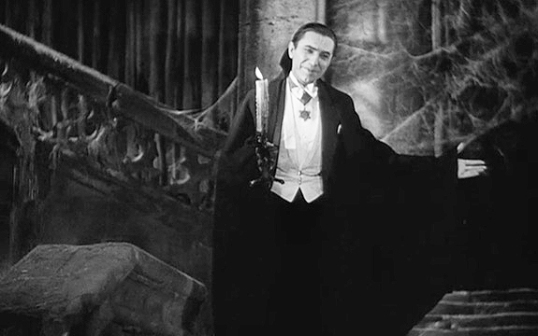
1930 — 1931: Bela Lugosi Is Not Nominated For Best Actor For Dracula

Admittedly, the 1931 version of Dracula is a bit of a creaky affair, one that feels quite stagey to modern audiences.  But Bela Lugosi’s performance in the title role holds up well, despite the number of times that it has been parodied.  Unfortunately, from the start, the Academy was hesitant about honoring the horror genre.

Frankenstein (1931, dir by James Whale)

1931 — 1932: Boris Karloff Is Not Nominated For Best Actor For Frankenstein

Again, the Academy snubbed an iconic horror star.  Not only was Boris Karloff not nominated for Frankenstein but the film itself was not nominated for Best Picture, despite being infinitely better than at least one of the 8 films that were nominated.  (That film, by the way, was Bad Girl.  When is the last time that anyone watched that one?)  In fairness to the Academy, they did honor one horror film at that year’s awards.  Fredric March won Best Actor for Dr. Jekyll and Mr. Hyde.  Of course, he also tied with Wallace Beery, who was nominated for The Champ.  Obviously, the Academy still had to work out its feelings towards the horror genre, a process that continues to this very day.

1932 — 1933: King Kong Is Not Nominated For Best Picture

Oh, poor King Kong.  Film audiences loved him but the Academy totally ignored both him and his film.  Unfortunately, back in 1933, the Academy had yet to introduce a category for special effects.

1932 — 1933: Duck Soup Is Ignored By The Academy

King Kong was not the only worthy film to be ignored at the 1932-1933 Oscars.  The Marx Brothers’s greatest film also went unnominated.

1934: The Scarlet Empress Is Not Nominated For Best Picture

Josef von Sternberg’s surreal historical epic was totally ignored by the Academy.  Not only did it miss out on being nominated for Best Picture but the sterling work of Marlene Dietrich and Sam Jaffe was ignored as well.  How was the opulent set design ignored?  How did it not even pick up a nomination for costume design?  My guess is that Paramount chose to promote Cleopatra at expense of The Scarlet Empress.  Either the way, the Best Picture Oscar was won by one of my favorite films, It Happened One Night.

1935: Fred Astaire and Ginger Rogers Are Not Nominated For Top Hat

Top Hat scored a best picture nomination but the film’s two stars went unnominated.

1936: My Man Godfrey Is Nominated For Everything But Best Picture

My Man Godfrey, a classic screwball comedy, was nominated for Best Actor, Best Actress, Best Supporting Actor, Best Supporting Actress, Best Director, and Best Screenplay but somehow, it was not nominated for Best Picture.  It’s a shame because My Man Godfrey, along being a very funny movie, is also a film that epitomizes an era.  Certainly, it’s far more entertaining today than the film that won Best Picture that year, The Great Ziegfeld.  (Interestingly enough, William Powell played the title role in both Godfrey and Ziegfeld.)

1937: Humphrey Bogart Is Not Nominated For Best Supporting Actor in Dead End

Dead End featured one of Bogart’s best gangster roles.  As a gangster who returns to his old neighborhood and is rejected by his own mother, Bogart was both menacing and, at times, sympathetic.  Like Cagney and Robinson, Bogart definitely deserved a nomination for his portrayal of what it was like to live a life of crime.  Unfortunately, Bogart was an actor who was taken for granted for much of his career.  It wasn’t until he played Rick Blaine in Casablanca that the Academy would finally nominate him.

The Adventures of Robin Hood (1938, dir by Michael Curtiz)

1938: Errol Flynn Is Not Nominated For Best Actor In The Adventures of Robin Hood

This is truly one of the more shocking snubs in Academy history.  Errol Flynn’s performance as Robin Hood pretty much set the standard for every actor who followed him.  Russell Crowe is undoubtedly a better actor than Flynn was but Crowe’s dour interpretation of Robin could in no way compete with the joie de vivre that Flynn brought to the role.

Agree?  Disagree?  Do you have an Oscar snub that you think is even worse than the 10 listed here?  Let us know in the comments!

Up next: 1940s, in which Hollywood joins the war effort and the snubs continue!

Dead End (1937, dir by William Wyler)

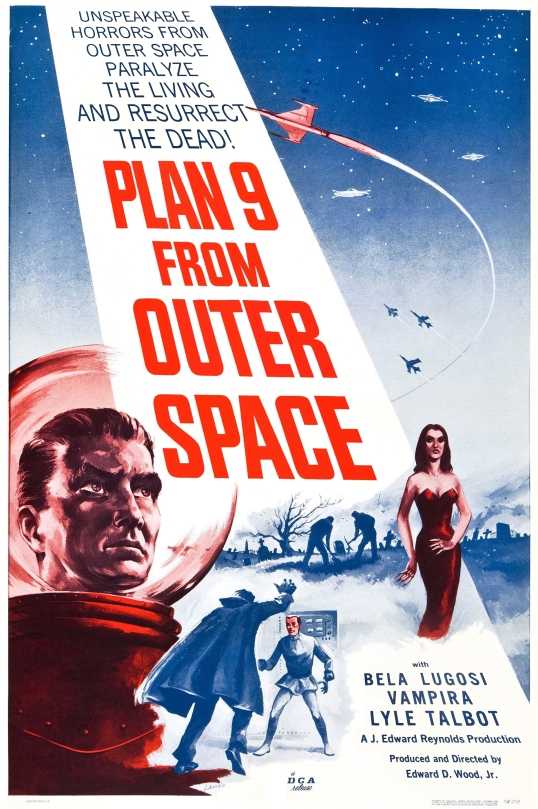
Icarus File No. 8: Plan Nine From Outer Space (dir by Edward D. Wood, Jr.)


I know, I know.

We’ve all heard the accusation.

Ed Wood’s Plan 9 From Outer Space is the worst film of all time.

Everyone says it’s true

Well, you know what? Everyone is wrong! Plan 9 From Outer Space may be a low-budget film with some …. well, awkward performances. And the script may have some odd lines. And the story might not make any sense. And yes, there’s a scene in an airplane where the doorway to the cockpit is clearly a shower curtain. And yes, the spaceships are paper plates with strings attached. And Criswell’s campy narration makes no sense. And the guy that they brought in to serve as a stand-in for Bela Lugosi was clearly too tall and too young to be credible in the role. And the whole thing about bringing the dead back to life to keep Earthlings from developing the Solarnite bomb …. well, who knows where to even start with that? And….

Wait, where was I?

Oh yeah. Plan 9 From Outer Space. It’s not that bad, I don’t care what anyone says.

Here’s the thing with Plan 9. It’s about as personal an expression of an American director’s vision as we’re ever likely to get. Ed Wood was a pacifist who wanted to end the arm races. His way of trying to spread world peace was to make a movie about aliens so concerned about mankind’s warlike tendencies that they raised the dead. Somewhat subversively, Ed Wood makes it clear that he’s on the side of the aliens from the beginning. When the alien Eros explains that humans are about to build a bomb that can blow up sunlight and destroy the universe, the humans aren’t horrified. Instead, they’re intrigued. Eros says that humans are stupid and immature. The hero of the film promptly proves Eros to be correct by punching him out.

And so, the aliens fail. Even though they brought Tor Johnson, Bela Lugosi, and Vampira back from the dead, they still fail to change the terrible path of human history. Plan 9 From Outer Space is not just a weird sci-fi film. It’s a sad-eyed plea for peace and understanding. It’s a film that possesses it’s own unique integrity, one that sets it apart from all other cheap sci-fi films.

Of course, it’s also a lot of fun to watch on Halloween. Watch it, won’t you? And remember that Ed Wood, above all else, tried his best.  Ed Wood wanted to save the world on a budget and, to do so, he made a science fiction film with his friends and he put a bunch of homemade UFOs on a string.  He also wanted to give Bela Lugosi one great role and, indeed, Plan 9 would go on to become one of Lugosi’s best-known, non-Dracula films.  Ed Wood had a lot of ambition and, in pursuing that ambition, he flew straight for the sun and dared the Solarnite bomb to take him down.  Ed may have crashed into the sea but his vision will never be forgotten.

Plan 9 From Outer Space (1956, dir by Edward D. Wood, Jr)

Previous Icarus Files:

  1. Cloud Atlas
  2. Maximum Overdrive
  3. Glass
  4. Captive State
  5. Mother!
  6. The Man Who Killed Don Quixote
  7. Last Days

Horror on the Lens: Bride of the Monster (dir by Edward D. Wood, Jr.)


Bride of The Monster (1955, dir by Ed Wood)

Since yesterday was the great man’s birthday, it seems appropriate that today’s horror film on the lens is Edward D. Wood’s 1955 epic, Bride of the Monster.

(Much like Plan 9 From Outer Space, around here, it is a tradition to watch Bride of the Monster in October.)

The film itself doesn’t feature a bride but it does feature a monster, a giant octopus who guards the mansion of the mysterious Dr. Vornoff (Bela Lugosi).  Vornoff and his hulking henchman Lobo (Tor Johnson) have been kidnapping men and using nuclear power to try to create a race of super soldiers.  Or something like that.  The plot has a make-it-up-as-you-go-along feel to it.  That’s actually a huge part of the film’s appeal.

Bride of the Monster is regularly described as being one of the worst films ever made but I think that’s rather unfair.   Appearing in his last speaking role, Lugosi actually gives a pretty good performance, bringing a wounded dignity to the role of Vornoff.  If judged solely against other movies directed by Ed Wood, this is actually one of the best films ever made.

(For a longer review, click here!)

Horror on the Lens: Plan 9 From Outer Space (dir by Edward D. Wood, Jr.)


Viewing Plan 9 From Outer Space during October is a bit of a tradition around these parts and here at the Shattered Lens, we’re all about tradition.  And since today is the 97th anniversary of the birth of Ed Wood, Jr., it just seems appropriate to watch his best-known film.

Speaking of tradition, this 1959 sci-fi/horror flick is traditionally cited as the worst film ever made but I don’t quite agree.  For one thing, the film is way too low-budget to be fairly judged against other big budget fiascoes.  If I have to watch a bad movie, I’ll always go for the low budget, independent feature as opposed to the big studio production.  To attack Ed Wood for making a bad film is to let every other bad filmmaker off the hook.  Ed Wood had his problems but he also had a lot of ambition and a lot of determination and, eventually, a lot of addictions.  One thing that is often forgotten by those who mock Ed Wood is that he drank himself to death and died living in squalor.  The least we can do is cut the tragic figure some slack.

Plan 9 From Outer Space is a ludicrous film but it’s also a surprisingly ambitious one and it’s got an anti-war, anti-military message so all of you folks who have hopped down the progressive rabbit hole over the past few years should have a new appreciation for this film.  I mean, do you want the government to blow up a Solarnite bomb?  DO YOU!?

Also, Gregory Walcott actually did a pretty good job in the lead role.  He was one of the few members of the cast to have a mainstream film career after Plan 9.

Finally, Plan 9 is a tribute to one man’s determination to bring his vision to life.  Ed Wood tried and refused to surrender and made a film with a message that he believed in and, for that, he deserves to be remembered.

Now, sit back, and enjoy a little Halloween tradition.  Take it away, Criswell!

Can you prove it didn’t happen?

WELL, CAN YOU!?

Bela Lugosi As Henry Frankenstein?


When it comes to the 1931 film version of Frankenstein, the piece of trivia that everyone seems to know is that Bela Lugosi was the original choice to play the Monster.

As the story goes, Lugosi had just finished filming Dracula and Universal’s Carl Laemmle felt that it would only make sense for Lugosi to play the lead role in Universal’s second horror adaptation.  Not only would Lugosi be firmly established as Universal’s favorite monster but it would also reunite him with Edward van Sloan and Dwight Frye, both of whom played prominent supporting roles in Dracula.  However, the story continues, Lugosi turned down the part when he saw that the monster wouldn’t have any dialogue.

Well, the story is partially right.

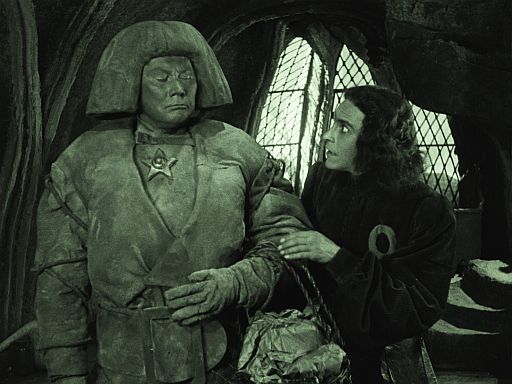
The truth of the matter is that Frankenstein was one of several books to which Universal had the rights.  And when Lugosi learned that one of the studio’s directors, Robert Florey, was interested in directing a film based on Mary Shelley’s novel, he did meet with Florey to say that he was intrigued by the idea of playing the monster.  Lugosi even did a makeup test, one in which the proposed look of Lugosi’s monster reportedly owed much to 1920’s The Golem.  As a director, Florey was heavily influenced by German expressionism so it makes sense that he would look to The Golem for inspiration.

The Golem (1920, dir by Paul Wegner and Carl Boese)

Lugosi eventually lost interest in the role, not because of the lack of dialogue but because he felt that he wouldn’t be able to give a good performance while made up to look like the Monster.  His face would be barely visible and, as an actor, Lugosi naturally wanted to be recognized.  Lugosi had no objections to the script because the script itself hadn’t been written.  When Lugosi lost interest, so did Florey.

Instead, the project was taken on by director James Whale, who specifically asked for the project because he felt it would be a change-of-pace from the war movies that he had been directing.  Universal suggested John Carradine for the role of the Monster.  Whale, however, spotted Boris Karloff sitting in the studio’s cafeteria and specifically asked him to test for the role.  Karloff, with his imposing frame but gentle manner, more aligned with Whale’s version of the Monster as essentially being a child who is easily angered but ultimately more of a victim than a victimizer.

From the start, Whale also wanted Colin Clive to play Henry Frankenstein and Mae Clarke to play Elizabeth.  The studio, who wanted at least one star in the film, tried to convince him to go with Leslie Howard as Henry and Bette Davis (who, at that time, was just starting her career) as Elizabeth.  While the studio was willing to substitute the more glamorous Clarke for Davis, they were a bit less enthusiastic about Colin Clive as Henry.  If Whale was that opposed to Leslie Howard, the studio suggested, how about Bela Lugosi instead?

As we all know, Whale held firm and he eventually got Colin Clive.  Still, it’s interesting to imagine Frankenstein with Bela Lugosi, in the role of Henry, bringing Karloff’s Monster to life.  Personally, I think Whale made the right decision.  Lugosi would have been a bit too obviously sinister for the role of Henry Frankenstein whereas Colin Clive really nailed the characterization of Henry being an essentially good man who allowed his own obsessions to get the better of him.  Still, it’s interesting to imagine a Frankenstein that not only reunited the stars of Dracula but which included Boris Karloff as well!  Not only would it have been Lugosi and Karloff’s first film together but who knows?  Perhaps if a Lugosi-Karloff version of Frankenstein had been as successful as the Clive-Karloff version, Lugosi and Karloff would never have started their rivalry and Lugosi could have escaped the Dracula typecasting that hampered the rest of his career.

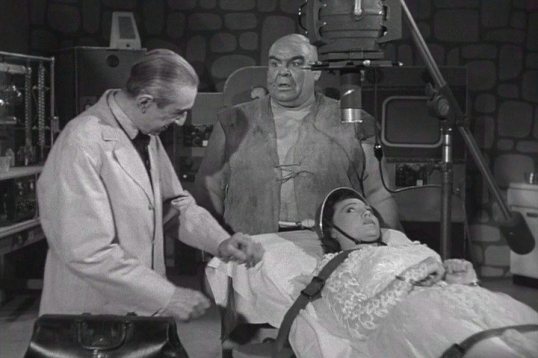
Though they didn’t share the screen in Frankenstein, Karloff and Lugosi would go on to appear in several films together.  Unfortunately, unlike the universally beloved Karloff, Lugosi’s career would be sabotaged by his own addictions and personal demons.  Lugosi would eventually get his chance to play Frankenstein’s Monster in 1943’s Frankenstein Meets The Wolf Man.  Unfortunately, that film is considered to be one of the weaker of the Universal horror films and Bela really didn’t get much of a chance to make a huge impression as the monster.  (He was right about the difficulty of being recognized under all that makeup.)

Bela Lugosi would die in 1956, at the age of 73.

Boris Karloff passed away 13 years later, at the age of 81.

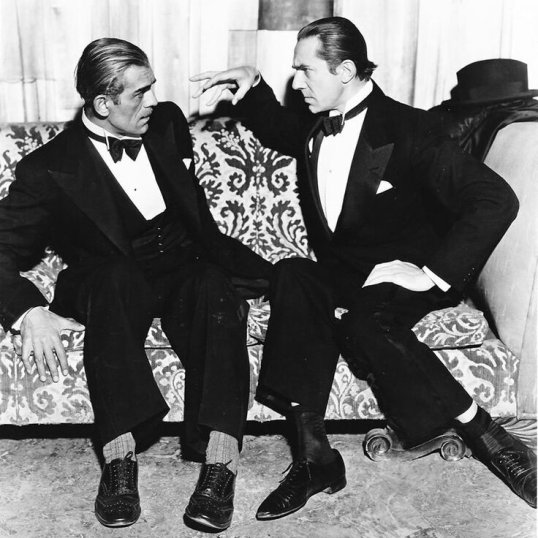
Boris and Bela

Horror Scenes That I Love: Bela Lugosi in Dracula


Seeing as how today is Bela Lugosi’ birthday, it only seems appropriate that today’s scene that I love should honor him.  This is one Bela’s best scenes from 1931’s Dracula.  Because his performance has been so widely imitated (and Bela himself appeared in a few films that poked fun at it), it’s often forgotten just how could Lugosi was in the role.

In honor of the one and only Lugosi, enjoy!