Welcome to Retro Television Reviews, a feature where we review some of our favorite and least favorite shows of the past! On Fridays, I will be reviewing St. Elsewhere, a medical show which ran on NBC from 1982 to 1988. The show can be found on Daily Motion.
This episode proves that Dr. Cavanero is the worst.
Episode 3.10 “Girls Just Want To Have Fun”
(Dir by Bruce Paltrow, originally aired on November 28th, 1984)
The struggle is real.
Seriously, I am thankful that someone uploaded St. Elsewhere to Daily Motion. With the show no longer on Hulu and Prime only having the first season available, Daily Motion is pretty much the only place where I can stream the show. That said, the sound quality is not great. The sound quality wasn’t particularly good when the show was on Hulu either but at least then I could turn on the captions. The Daily Motion uploads don’t have that option. I had to strain to hear the dialogue and, as a result, this review is not going to be as in-depth as it could be.
What I can tell you is that Dr. Cavanero is now one of the least sympathetic characters that I have ever seen on a television show. Last week, Dr. Christine Holz (Caroline McWilliams) told Cavanero that she was a lesbian. This week, Cavanero blabbed that information around the hospital, leading to a lot of homophobic comments from certain members of the stuff. (Not surprisingly, Victor Ehrlich was there to say something stupid.) Cavenero admitted to Christine that she found Christine’s lifestyle to be “unnatural.” Christine smiled sadly and left Cavanero’s apartment and left the show. Keep in mind, Dr. Holz was portrayed as being a brilliant surgeon and bone marrow expert. It probably would have been good to keep her around the hospital for a little while but nope. Sorry. Dr. Cavanero — who really hasn’t done anything of note since the first season — felt uncomfortable.
(Originally, Christine and Cavanero were supposed to have a romantic relationship but Cynthia Sikes, the actress playing Cavavero, objected to the storyline. As a result, the story was rewritten and perhaps it’s not a coincidence that Cavanero comes across as being a bit of a homophobe.)
Meanwhile, Dr. Chandler was concerned when he discovered that a neighborhood woman (Beah Richards) was practicing medicine out of her apartment. This storyline at least gave Denzel Washington more to do than usual, which was good. St. Elsewhere, at least so far, has often tended to underuse both Chandler as a character and Washington as an actor.
Jack’s friend (John Schuck) insisted on doing an experimental kidney procedure to try to save the life of his daughter (Brandy Gold) and Dr. Auschlander finally gave his approval for it to be done. I would say that was a good thing except for the fact that Jack’s storylines hardly ever have a happy ending. There’s a reason why Morrison is the most depressed resident in the hospital.
Nurse Rosenthal continued her affair with Richard Clarendon, even though Richard’s wife (Beverly Sanders) is now working at the hospital. Wow, that’s going to be awkward. In fact, I hope it’s really awkward. I’m tired of Nurse Rosenthal and her holier-than-thou attitude.
Dr. Craig testified at a city council hearing. The poor sound quality kept me from fully understanding what the hearing was about but at Dr. Craig told everyone off. It’s always fun to watch William Daniels tell people off.
Here’s hoping the sound will be a bit less muddy next week!
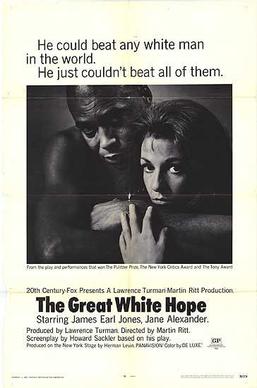
The year is 1910 and the sports world is in a panic. For the first time, a black man has won the title of the heavyweight champion of the world. Jack Jefferson (James Earl Jones) had to go to Australia because no American city would agree to host the fight but he came out of it victorious. The proud and outspoken Jefferson finds himself targeted by both the white establishment and black activists who claim that Jefferson has not done enough for his community.
It’s not just Jefferson’s success as a boxer that people find scandalous. It’s also that the married Jefferson has a white mistress, a socialite named Eleanor Brachman (Jane Alexander, in her film debut). While boxing promoters search for a “great white hope” who can take the title from Jefferson, the legal authorities attempt to arrest Jefferson for violating the Mann Act by supposedly taking Eleanor across state lines for “immoral purposes.” Jefferson and Eleanor end up fleeing abroad but even then, their relationship is as doomed as Jefferson’s reign as the heavyweight champ.
Based on a Pulitzer-winning stage play by Howard Sackler, The Great White Hope features Jones and Alexander recreating the roles for which they both won Tonys. Both Jones and Alexander would go on to receive Oscar nominations for their work in the film version. It was the first nomination for Alexander and, amazingly, it was the only nomination that Jones would receive over the course of his career. (It surprises me that he wasn’t even nominated for his work in Field Of Dreams.) Both Jones and Alexander give powerful performances, with Jones dominating every scene as the proud, defiant, and often very funny Jack Jefferson. Jones may not have had a boxer’s physique but he captured the attitude of a man who knew he was the best and who mistakenly believed that would be enough to overcome a racist culture. (Speaking of racist, legendary recluse Howard Hughes reportedly caught the film on television and was so offended by the sight of Jones kissing Alexander that he thought about buying NBC to make sure that the movie would never be aired again.) Hal Holbrook, Chester Morris, Moses Gunn, Marcel Dalio, and R.G. Armstrong all do good work in small roles.
Unfortunately, The Great White Hope still feels like a filmed stage play, despite the attempts made to open up the action. Martin Ritt was a good director of actors but the boxing scenes are never feel authentic and the middle section of the film drags. Jones and Alexander keep the film watchable but The Great White Hope is never packs as strong of a punch as its main character.
Welcome to Late Night Retro Television Reviews, a feature where we review some of our favorite and least favorite shows of the past! On Thursdays, I will be reviewing Highway to Heaven, which aired on NBC from 1984 to 1989. The entire show is currently streaming on Tubi and several other services!
This week, Jonathan and Mark fight drug dealers and promote literacy!
Episode 1.17 “As Difficult As ABC”
(Dir by Victor French, originally aired on January 30th, 1985)
Brian Baldwin (Glenn-Michael Jones) appears to have a great future ahead of him.
Growing up in a poor neighborhood, Brian was tempted to get involved in the gang life, like so many of his friends did. However, Brian turned out to be a great basketball player and was given a full scholarship to a major university. As long as he played basketball and led the team to victory after victory, Brian wouldn’t even have to worry about going to class. As he points out, he got an A in his French class even though he never stepped into the classroom.
However, one day, Brian has chest pains and passes out. When Brian goes to the doctor, he is told that he has a heart condition but that it can be managed. However, Brian will never be able to play basketball again. His coach stops returning Brian’s calls and, when Brian confronts him in the gym, the coach explains that he only cares about winning and Brian can no longer help him do that. The coach complains about wasting a scholarship on Brian.
Brian drops out of school and returns to his old neighborhood. It’s there that he tells his mom (played by Beah Richards) the secret that he’s been hiding. Brian is illiterate! Because he was such a good basketball player, the school system never worried about teaching him anything. Now, Brian has lost his scholarship and, it would appear, his future.
Fortunately, Jonathan and Mark roll into town. Mark gets a job working as a janitor at an adult literacy school. Jonathan gets a job working at the community center. Jonathan encourages Brian to both learn how to read and to date his teacher, Julie Reynolds (Deborah Lacey). (Fear not, they’re the same age.) Brian also gets a job as a neighborhood basketball coach and tries to keep all of his players from getting hooked on drugs.
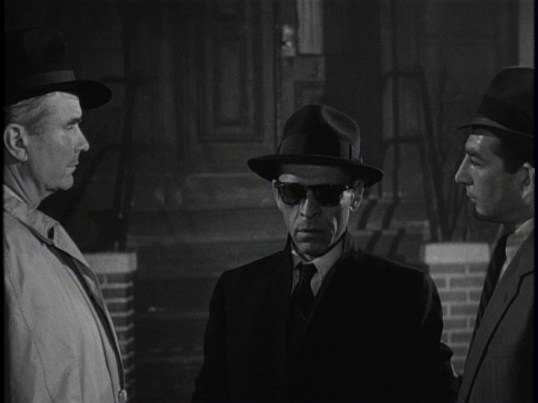
Luckily, Jonathan and Victor are able to help with the drug situation. They go undercover and, in a rather weird scene that features Jonathan in a leather jacket and Terminator-style shades, they offer to pay the local drug dealer two million dollars in return for cocaine. The dealer agrees to meet with them at the school, where he and his associates steal the briefcase with the money and make a run for it. However, they are grabbed by the cops and suddenly, all of the money in the briefcase turns into cocaine! Off the dealers go to prison. With the dealers gone and Brian reading, it’s time for Jonathan and Mark to move on.
This was one of those well-intentioned episodes that attempted to do a bit too much. Not only did the episode feature Brian learning that he could still be an important member of his community even if he couldn’t play basketball but it also featured him learning to read and trying to clean up the neighborhood. Instead of focusing on one story, this episode focuses on three and, as a result, each story feels a bit rushed and simplistic. Brian is reading in no time and the drug dealers turn out to be pretty easy to fool. This episode is optimistic but rather unconvincing.
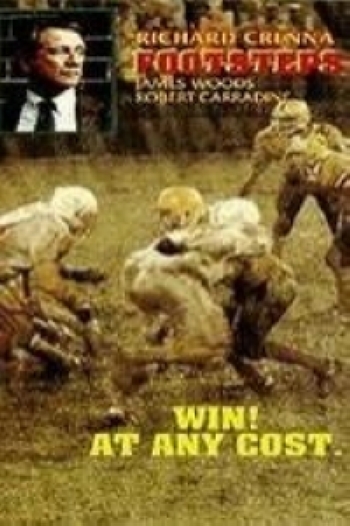
Paddy O’Connor (Richard Crenna) is a former football player-turned-coach whose record of success has been overshadowed by his own arrogance and heavy drinking. O’Connor has such a bad personal reputation that he’s found himself unemployable. Only one man is willing to give him a chance. Jonas Kane (Clu Gulager) played football with Paddy and he’s now coaches for a small college. Kane may not like O’Connor but he knows that O’Connor might be the key to turning around his team’s fortunes and, at the same time, saving Kane’s job. Kane hires O’Connor to serve as a his defensive coordinator.
At first, O’Connor’s cockiness rubs people the wrong way. It’s not until O’Connor moves offensive player J.J. Blake (Bill Overton) to defense that the team starts to win. And once the team stars to win, everyone’s problems with O’Connor disappear. Kane can only watch helplessly as O’Connor moves in on his girlfriend (Joanna Pettet), knowing that he owes his job to O’Connor remaining at the school.
However, when Blake gets a concussion, O’Connor is forced to decide whether or not to let him play. Boosters like Bradford Emmons (Forrest Tucker) want Blake to play, regardless the risk. The NFL scouts, who are looking for the next number one pick, want to see Blake on the field. Blake says he wants to play but O’Connor can tell that he’s lying about the extent of his injury. With everyone breathing down his neck and a syndicate of gamblers pressuring O’Connor to shave points so that the spread pays off, O’Connor has to decide what to do.
Though this made-for-TV movie may not be as well-known as some other films, it’s one of the best movies ever made about college football. Though it may be short (only 74 minutes), it still examines all of the issues that have always surrounded college football. Despite not getting paid for their efforts, the players risk serious and permanent injury during every game, just on the slight hope that they might someday make it to the NFL. The coaches, who are supposed to be looking after the players, are more interested in padding out their win-loss record and hopefully moving onto bigger and better-paying jobs. Meanwhile, aging alumni and boosters demand that the team win at all costs, regardless of what happens to the men on the field. Footsteps intelligently explores all of those issues and suggests that the risks are ultimately not worth the rewards.
Along with an intelligent script, Footsteps is helped by a talented cast. Crenna and especially Gulager both give excellent performance as the two rival coaches. Al Lettieri (Sollozzo from The Godfather) plays one of the gamblers. Beah Richards plays Blake’s mother, who makes the mistake of believing O’Connor when he says that he’s going to always have Blake’s best interests at heart. Ned Beatty has a small role as another assistant coach who is forced to make an important decision of his own. Keep an eye out for Robert Carradine and James Woods, both of whom have tiny roles.
As far as I know, Footsteps has never officially been released on DVD. I saw it late one night on the Fox Movie Channel.
The 1967 film, In the Heat of the Night, tells the story of two very different men.
Chief Gillespie (Rod Steiger) is the police chief of the small town of Sparta, Mississippi. In many ways, Gillespie appears to the epitome of the bigoted Southern cop. He’s overweight. He loses his temper easily. He chews a lot of gum. He knows everyone in town and automatically distrusts anyone who he hasn’t seen before, especially if that person happens to be a black man or from the north.
Virgil Tibbs (Sidney Poitier) is a black man from the north. He’s a detective with the Philadelphia Police Department and he’s as cool and controlled as Gillespie is temperamental and uncouth. Tibbs has no patience for the casual racism that is epitomized by lawmen like Chief Gillespie. When Gillespie says that Virgil is a “fancy name” for a black and asks what people call Virgil in Philadelphia, Virgil declares, “They call me Mister Tibbs!,” with an authority that leaves no doubt that he expects Gillespie to do the same.
Together …. THEY SOLVE CRIMES!
For once, that old joke is correct. When a Chicago industrialist named Phillip Colbert is discover murdered in Sparta, Chief Gillespie heads up the investigation and, assuming that the murderer must be an outsider, orders Deputy Wood (Warren Oates) to check out the train station for any suspicious characters. When Wood arrives at the station, he discovers Virgil standing on the platform. Virgil is simply waiting for his train so that he can get back home to Philadelphia. However, Wood promptly arrests him. Gilespie accuses him of murdering Colbert, just to discover that Virgil’s a police detective from Philadelphia.
Though neither wants to work with the other, that’s exactly what Gillespie and Virgil are forced to do as they investigate Colbert’s murder. Colbert was planning on building a factory in Sparta and his wife (Lee Grant) makes it clear that, if Sparta wants the factory and the money that comes with it, Virgil must be kept on the case. Over the course of the investigation, Gillespie and Virgil come to a weary understanding as both of them are forced to confront their own preconceived notions about both the murder and life in Sparta. In the end, if it’s impossible for them to truly become friends, they do develop a weary respect for each other. That is perhaps the best that one could have hoped for in 1967.
I have to admit that it took me a few viewings before I really appreciated In the Heat of the Night. Though this film won the Oscar for Best Picture of 1967, it’s always suffered when compared to some of the films that it beat. One can certainly see that the film was superior to Doctor Dolittle and Guess Who’s Coming to Dinner. But was it a better film than The Graduate or Bonnie and Clyde? Did Rod Steiger really deserve to win Best Actor over Dustin Hoffman and Warren Beatty? (Amazingly, Poitier wasn’t even nominated.)
To be honest, I still feel that In The Heat of the Night was probably the 3rd best of the 5 films nominated that year, superior to the condescending Guess Who’s Coming To Dinner but nowhere near as groundbreaking as Bonnie and Clyde or The Graduate. The first time I watched In the Heat of the Night, I thought Steiger blustered a bit too much and the film’s central mystery didn’t really hold together and, to a large extent, I still feel like that.
But, at the same time, there’s a lot to appreciate about In the Heat of the Night. On subsequent viewings, I came to better appreciate the way that director Norman Jewison, editor Hal Ashby, and cinematographer Haskwell Wexler created and maintained an atmosphere that was so thick that you can literally feel the Mississippi humidity while watching the film. I came to appreciate the supporting cast, especially Warren Oates, Lee Grant, Scott Wilson, Anthony James, and Larry Gates. (Gates especially makes an impression in his one scene, playing an outwardly genteel racist who nearly cries when Tibbs reacts to his slap by slapping him back.) I also came to appreciate the fact that, while the white cop/black cop partnership has subsequently become a bit of a cliche, it was new and even controversial concept in 1967.
And finally, I came to better appreciate Sidney Poitier’s performance as Virgil. Poitier underplays Virgil, giving a performance of tightly controlled rage. While Steiger yells his way through the film, Poitier emphasizes that Virgil is always thinking. As in the same year’s Guess Who’s Coming To Dinner, Poitier plays a dignified character but, here, that dignity is Virgil’s way of defying the demands and expectations of men like Gillespie. When Virgil does strike back, it’s a cathartic moment because we understand how many times he’s had to hold back.
In the Heat of the Night may not have been the best film of 1967 but it’s still one worth watching.
(Lisa is currently in the process of cleaning out her DVR. It’s taking her such a long time that she’s running out of cutesy ways to talk about how long it’s taking. She recorded this 1989 comedy off of Starz on May 10th.)
This is another strange one.
Homer and Eddie opens with Homer (James Belushi) standing on the corner of an isolated stretch of desert road. He is hitchhiking. When a car finally stops to pick him up, Homer is so excited! He gets in the back seat, gives the two men in the front seat a really wide smile, and innocently asks them how they’re doing.
One of the men (played by director John Waters) holds up a gun and demands all of Homer’s money. After Homer hands the money over, he is kicked out of the car. As the car drives away, Homer pulls a few dollars out of his sock and loudly yells that he fooled them and that they didn’t get all of his money.
The car abruptly stops and, going in reverse, pulls back up to Homer. Homer gives up his money and the car speeds off.
In short, Homer probably shouldn’t be hitchhiking on his own. Homer, you see, was hit in the head by a baseball when he was younger. He has the mind and the innocent outlook of a child. He is cheerful, he is religious, and he is totally unprepared to deal with real world.
Fortunately, Homer won’t be alone for too long. Homer comes across an apparently deserted car and, without money or a place to stay, he decides to use the car as shelter. However, it turns out that the car isn’t as abandoned as it looks! No, the car is being used by Eddie (Whoopi Goldberg). Eddie stole the car when she escaped from a mental institution. Why was Eddie in the mental institution? She’s a paranoid schizophrenic and she occasionally kills people. Eddie and Homer are soon taking a very strange road trip, heading up north so that Homer can see his dying father.
It’s a very disjointed film, one that switches tone from scene to scene. The two stars seem to be acting in totally different movies. Belushi gives a very broad performance, one that often crosses the line into pure goofiness. Eddie, meanwhile, is continually and constantly full of rage. You never know when she’s going to snap and kill someone. I spent a good deal of the movie waiting for her to kill Homer. Maybe that was the point but it’s still hard to laugh at scenes of Homer and Eddie waving at a school bus full of cheerleaders when you’re also waiting for Whoopi Goldberg to beat and dismember Jim Belushi.
Homer and Eddie can summed up by one lengthy sequence. Eddie takes Homer to a brothel so that he can lose his virginity. While Homer is dancing around in his underwear, Eddie is at a convenience store, shooting the clerk (played by Pruitt Taylor Vince). The clerk, who was perfectly nice to Eddie before getting shot, looks at his wound and feebly says, “Why did you do that?” before dying.
It’s a weird little movie. Usually, I love weird moves but this one is too much of a mess for even me. As I watched it, I couldn’t help but think of how much more interesting the movie would be if it was the child-like Homer killing people and schizophrenic Eddie trying to keep him calm. On a positive note, this was decades before Whoopi Goldberg gave up her edginess to co-host The View and she gives shockingly good performance. When Eddie loses control, she’s actually frightening. But, unfortunately, the film itself just doesn’t work.
For my final Netflix Noir, I watched The Mugger, a film from 1958.
The Mugger is a police procedural. Taking place in an unnamed city, it stars Kent Smith as Dr. Pete Graham. Pete’s both a psychiatrist and a cop and, needless to say, he has a lot to deal with.
For one thing, his girlfriend, Claire (Nan Martin) is also a cop. In fact, she’s apparently the only female cop on the entire force! (“Woman cops?” another detective is heard to say, “Do we really need them?”) Claire spends most her time working undercover on the dance hall circuit. Pete wants to get married. Claire wants to solve a few more cases before making that commitment. Pete says that’s okay, as long as her plans “include me, a home, and children.”
Pete has also been forcefully recruited to counsel a Jeannie (Sandra Church), the sister-in-law of a local taxi driver. As the driver explains it, Jeannie is “about 18 and is she built!” Pete replies, “You shouldn’t get excited about a kid who wants to have a good time,” which seems like an unusually progressive attitude for a cop in the 1950s. Still, Pete agrees to try to encourage Jeannie to be a little bit less rebellious. Jeannie, by the way, is my favorite character in the film because she is never in a good mood and she gets to dismiss her older sister’s concerns by saying, “Maybe she’s getting a little old, a little jealous.”
It also turns out that Jeannie’s neighbor, Nick Greco (George Maharis), has a crush on her and apparently, just hangs out in her house all day. While this seemed rather creepy to me, the film seemed to suggest that this was just normal 50s behavior. Apparently, since nobody bothered to lock their doors back then, it was also totally appropriate to just hide in someone’s house and listen in on private conversations.
Peter’s other big problem is that there’s a mugger who is robbing women and cutting their cheek with a knife. I have to give the film some credit here because it doesn’t shy away from discussing the sexual subtext to these attacks, which I imagine was quite daring for a film in the 50s. Pete comes up with a detailed profile of the attacker, the sort of thing that would make the cast of Criminal Minds jealous. Claire goes undercover to catch the mugger and there’s a great scene where a drunk sailor tries to harass her and she threatens to shoot him in the knee caps. Again, this is not the sort of thing that we typically associate with a 50s film…
Which is not to say that The Mugger is not clearly a product of its time. For one thing, just check out the police force in this city, which is all white, all middle-aged, and — with the exception of Claire — all male. As well, this is one of those old movies where any woman who walks down a street will be leered at by every guy she passes, including the film’s heroes. One of the reasons why it was so great to see Claire threaten to cripple that soldier was because it came after 50 minutes of watching Pete and every other man in the film do a double take whenever she entered a room.
Clocking in at a little over 70 minutes and obviously low-budget, The Mugger is an undeniably obscure film. Checking with the imdb, I discovered only two reviews that had been previously written for this film and one of them was in Turkish! When I went onto YouTube to look for a trailer, I found nothing. The Mugger is forgotten and hardly a lost classic but I still enjoyed watching it. What can I say? I love my history and, if nothing else, The Mugger is definitely a time capsule.
It seems like whenever film bloggers and reviewers are making out a list of the worst films of all time, somebody always mentions Hurry Sundown.
Now, don’t get me wrong. It doesn’t get mentioned as often as Battlefield Earth or Adam Sandler’s latest comedy. And, when it does get mentioned, it’s done with little of the warmth that’s given to Troll 2, The Room, or Birdemic. Instead, one gets the impression that Hurry Sundown is a film so bad that even those of us who appreciate bad films would find little to love about it.
But y’all know me. I’m the type that prefers to judge for herself and I’m also someone who rather enjoys being a contrarian. There’s a reason why one of my most read posts on this site is entitled 10 Reasons Why I Hated Avatar. Add to that, Hurry Sundown was directed by Otto Preminger who also directed one of my favorite films of all time, Anatomy of a Murder. How, I asked myself, could the man who made Anatomy of a Murder possibly also direct one of the worst films of all time? As a result, every time that I saw someone claiming that Hurry Sundown was one of the worst films of all time, I grew more and more determined to someday see the film and judge for myself.
Well, I finally got my chance this weekend. Hurry Sundown was on one of my newest favorite channels, The MOVIES! TV Network. And I proceeded to watch it. I sat through all four hours of this film (that’s including commercials and, oh my God, was I thankful for the distraction that those commercials provided). I watched Hurry Sundown and …. wow. Was it ever bad.
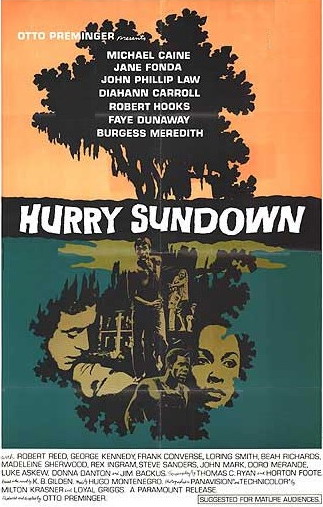
Released in 1967, Hurry Sundown was Otto Preminger’s attempt to take a look at race relations in the deep south. It’s a film full of good, liberal intentions and an apparent lack of knowledge about — well, about everything. As I watched this slow, almost formless blob of a film, I found myself wondering how the director who gave us Laura and Anatomy of a Murder could have possibly directed a film with a gigantic cast but absolutely no interesting characters. I wondered how the director who had been willing to challenge the racist assumptions of 1950s Hollywood by directing Carmen Jones could have been responsible for the corny and subtly condescending look at race relations that was Hurry Sundown.
Hurry Sundown takes place in 1946 and is set in rural Georgia. The war is over, the soldiers are coming home, and nobody in the film can maintain a convincing Southern accent for more than a line or two. (Seriously — I’ve heard a lot of really bad Southern accents in a lot of really bad films but none of those accents were as bad as what I heard in Hurry Sundown.) It’s a brand new world but the South is clinging to the old ways of racism and classism.
Preminger slowly (and clumsily) introduces us to the huge cast of characters who populate the slice of Hollywood Georgia.
There’s the sheriff (George Kennedy) who is so stupid that he can be distracted by an offer of fried chicken. Kennedy actually gives a good comedic performance but his character seems like he belongs in another movie and you have to wonder how civil rights activists in 1967 — many of whom had undoubtedly been arrested and harassed by Southern sheriffs much like this one — reacted to Kenendy’s character being presented as harmless comic relief.
There’s the racist judge (Burgess Meredith) who, much like the sheriff, is presented as being a comedic buffoon as opposed to an actual threat. The judge uses the n-word in every other sentence, which should be shocking and infuriating but, as a result of Meredith’s over-the-top delivery, instead simply comes across as being gratuitous and tasteless.
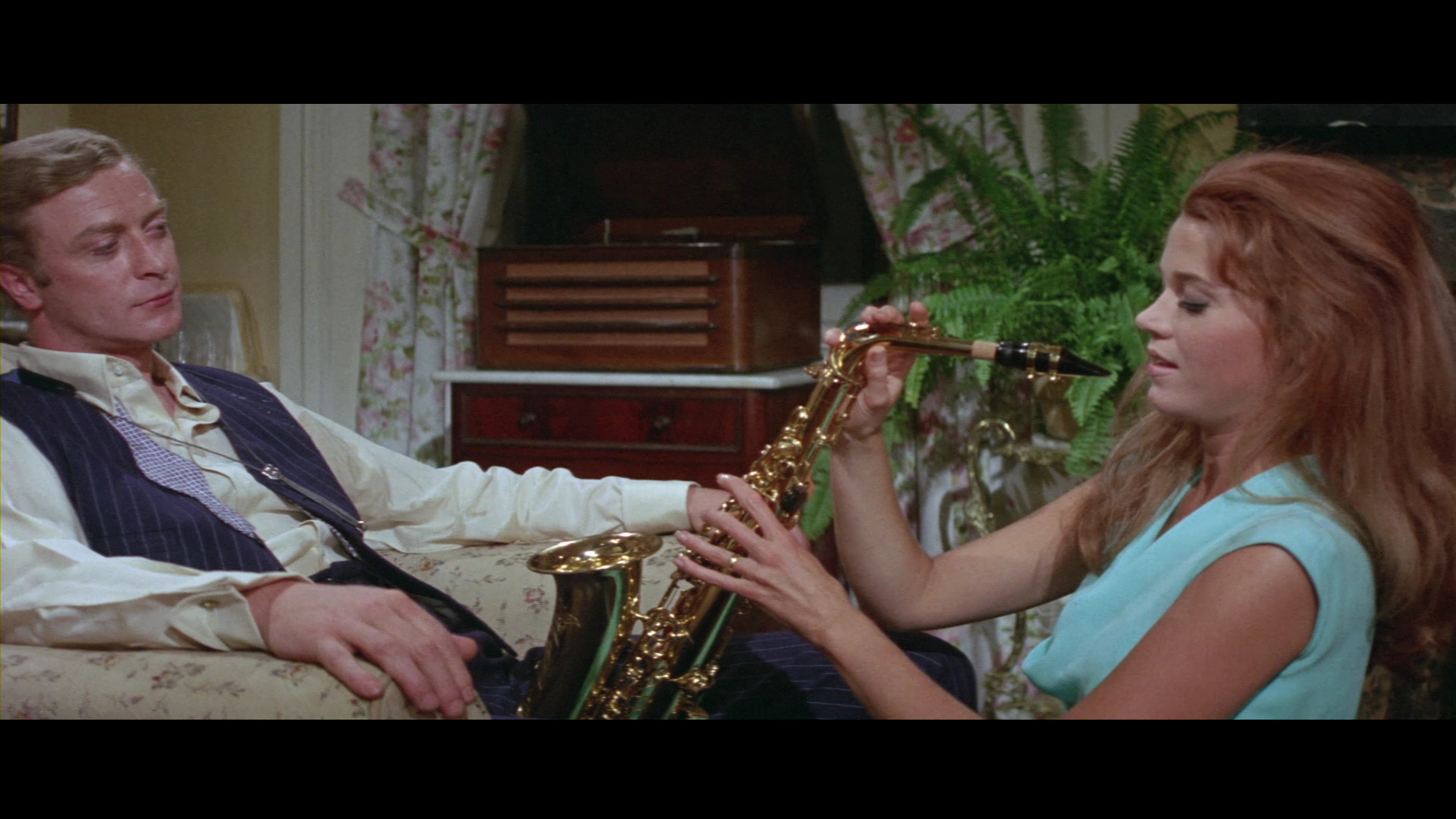
Then there’s Henry. Henry is a businessman who dodged the draft, cheats on his wife, and who has a son who literally spends the entire movie screaming at the top of his lungs. (Whenever that kid was on-screen, I imagined Preminger standing behind the camera and going, “More! More! Scream more!”) Henry is also a racist, though for some reason he loves jazz and often plays the saxophone. I kept waiting for someone in the movie to point out to him that jazz was created by black musicians but nobody did. (If Henry had appeared in Anatomy of a Murder, someone would have.)
Did I mention that Henry is played by Michael Caine? And did I also mention that Caine is the most cockney-sounding Southerner that I’ve ever heard? Because he totally is.
Henry’s wife is named Julie and is played by Jane Fonda. At one point, she suggestively blows on Henry’s saxophone. One can only imagine how audiences in the 60s reacted to that. (Actually, they probably didn’t. They probably just said, “Good thing she’s pretty because she ain’t no musician…”)
Anyway, Harry wants to buy up some farmland but half of that land is owned by Henry’s poor cousin Rad (John Phillip Law) and Rad doesn’t want to move. Rad has just returned from fighting in the war and he views Harry as being a cowardly draft dodger. Rad is married to Lou (Faye Dunaway) and wow, are they ever a boring couple! Dunaway was under a five-picture contract to Preminger when she made this film and apparently, she had such a terrible time on the set of Hurry Sundown that she sued to get out of ever having to make another movie with Otto. Dunaway’s misery comes through in every scene.
The other half of the farmland is owned by Reeve (Robert Hooks), a black farmer whose mother (played by Beah Richards) is Julie’s former mammy. Julie goes down to the farmhouse to convince Reeve to sell and Reeve’s mother responds by having the most (over)dramatic heart attack in the history of cinema. Saddened by death of his mother, Reeve is definitely not going to sell. When he’s not chastely romancing the local teacher (played by Diahann Carroll, who appears to have wandered over from a different, far more glamorous movie), Reeve is singing sprituals and working out in the fields.
One of the things that Reeve does not do — no matter how many times he gets called the n-word or is treated unfairly — is get mad. Rad gets mad. Julie gets mad. A liberal white preacher (Frank Converse) gets mad. But Reeve and the other black characters in the film are never really allowed to get mad or do anything that might make the film’s white audience feel nervous. Watching a film like Hurry Sundown, you can understand why — in just a few more years — Blaxploitation films would suddenly become so popular. It was probably the first time that black film characters were actually allowed to not only get angry over the way they were being treated but to fight back, as opposed to reacting in the Hurry Sundown-way of passive acceptance.
Anyway, Rad and Reeve come together to protect their land and Henry and the evil judge conspire to cheat them out of their land and — well, let’s just say that Hurry Sundown is one of those films that has a lot of plot and very little action. Preminger directs with a stunning lack of pace or grace, the actors deal with a poorly written script by either engaging in histrionics or going catatonic, and Michael Caine’s attempt at a Southern accent will amuse anyone who has ever been south of the Mason-Dixon.
I have to admit that I was really hoping that Hurry Sundown would turn out to be a sordid and tawdry little masterpiece, the type of overheated misfire that you love despite your better instincts. But, no. Hurry Sundown is just boring. The film is such a misfire that it doesn’t even work as a piece of history. The critics were right. Hurry Sundown sucks.
That was my reaction as I watched the 1967 Best Picture nominee Guess Who’s Coming To Dinner. While this film may have been topical and even controversial when it was first released, when watched today it seems to be rather mild and tame.
In Guess Who’s Coming To Dinner, Spencer Tracy plays Matt Drayton. Matt’s a San Francisco newspaper publisher, a respected member of the upper class establishment. His wife, Christina (Katharine Hepburn), owns a trendy art gallery and Matt spends his spare time playing golf with Monsignor Ryan (Cecil Kellaway). He’s the father of the free-spirited Joey (Katharine Houghton, who was Hepburn’s niece in real life). He’s also, as we’re told repeatedly by every other character in the film, a liberal who supports the civil rights movement.
As the film begins, Joey is returning from a vacation in Hawaii and she has big news. While in Hawaii, she met and fell in love with the widowed John Prentice, a highly succesful doctor who is literally on the verge of winning a Nobel Peace Prize. Though he’s 16 years older than her and they’ve only known each other for 10 days, Joey and Prentice are planning on getting married. While Joey thinks that she’s bringing Prentice to San Francisco just so her parents can meet their future son-in-law, Prentice has specifically come to ask Matt’s permission to marry Joey. As Prentice explains to Matt, he’ll call the marriage off if Matt doesn’t approve.
John Prentice, by the way, is played by Sidney Poitier and that is the source of the film’s conflict. Will Matt give his daughter permission to marry a polite, considerate, wealthy, saintly, world-renowned doctor despite the fact that he happens to be black?
Watching Guess Who’s Coming To Dinner was a bit of a culture shock to me, both because I’m the result of an interracial marriage myself (my mom was Spanish and my dad’s white) and because several of my friends are either in or have been a part of an interracial relationship or marriage. For people my age, it’s not a big deal. We take it for granted that if you find someone to be attractive, you can have a relationship with him regardless of whatever race he may happen to be.
While I was doing research on Guess Who’s Coming To Dinner, I was reminded that this wasn’t always the case. When Guess Who’s Coming To Dinner was first released in 1967, interracial marriage was still illegal in 17 states. In that same year, U.S. Secretary of State Dean Rusk offered to resign when his daughter married a black man. When Guess Who’s Coming To Dinner was first released, interracial marriage still a controversial subject and when Spencer Tracy struggled with his feelings about it, he stood in for countless Americans who, though they may have taken pride in how tolerant they were, still weren’t sure what they would do if a black man tried to join their family.
As you can probably guess, Guess Who’s Coming To Dinner is far more interested in teaching a lesson than telling a story. It’s perhaps not surprising that the film was directed and produced by Stanley Kramer. Kramer was one of the most prominent filmmakers of the 1960s. He specialized in making big films that dealt with big issues, the type of films that were regularly nominated for an academy award but rarely honored with an actual win. In many ways, Guess Who’s Coming To Dinner is a prototypical Kramer picture — its heart is in the right place but the film itself is so conventional and free of ambiguity that it never manages to truly challenge the status quo that it claims to be criticizing.*
In his excellent look at the 1967 nominees for best picture, Pictures At A Revolution: Five Movies And The Birth of The New Hollywood, Mark Harris provides a fascinating behind-the-scenes look at the filming of Guess Who’s Coming To Dinner. Harris quotes Kramer as explaining that the character of John Prentice had to be perfect because, if the character had any flaws, then bigots in the audience would have seized on those flaws as the reason why Prentice and Joey should not be allowed to marry. As Kramer explains it, the entire film was set up to make it clear that the only possible reason that Matt could have to object to Prentice would be the color of his skin.
To an extent, I can see Kramer’s point (and again, it’s hard to judge what was necessary to make a point in 1967 from the perspective of 2013) but, as I watched Guess Who’s Coming To Dinner, it was hard not to feel that the main problem with the film was that Prentice was just too perfect. Certainly, he was too perfect to be in love with Joey who, as played by Houghton, simply seemed to be too naive and foolish to be a good match for a man who is on the verge of winning a Nobel Prize. Even more importantly, it’s hard to escape the fact that this accomplished, confident black man still needs to get the permission of a well-meaning white liberal before he can marry the woman he claims to love.
Ultimately, despite the film’s noble intentions, it feels more than a bit condescending. At no point is Prentice allowed to show any anger or frustration at having to prove himself. There’s even a scene where Prentice criticizes his own father for being too hung up on racism. “Not until you and you’re whole lousy generation lay down and die will the weight of you be off our backs … You think of yourself as a colored man … I think of myself as a man!” Prentice tells him, as if his success was due to ignoring racism as opposed to defying it.
If Guess Who’s Coming To Dinner has dated badly as a look at race relations in the United States, it remains watchable because of the performances of Katharine Hepburn and Spencer Tracy. This was their 9th and final film together and the love that these two accomplished actors felt for each other shines through every scene. Tracy was seriously ill while making the film (and died before it was released) but he gave one of his best and most heartfelt performances here. He was nominated for a posthumous Oscar but lost to Rod Steiger, who co-starred with Poitier in the film that beat Guess Who’s Coming To Dinner for best picture, In The Heat of the Night.
In the Heat of the Night is best-remembered for the scene in which Poitier angrily declares, “They call me …. MISTER TIBBS!” This line epitomized the righteous anger that he was not allowed to display in Guess Who’s Coming To Dinner. If only Guess Who’s Coming To Dinner had its own “MISTER TIBBS” moment, it might be remembered as something other than a film that seems curiously out-of-place as a nominee for best picture.
—
* That said, Kramer’s post-Guess films were actually pretty interesting and a bit more daring. Some day, I’ll have to get around to reviewing his 1970 campus unrest film, R.P.M.




 Through the Shattered Lens