“That is known a trouble with the curve.”
He’s a jerk but I still feel bad for Bo Gentry in this scene. He’s never going to make it in the majors if he can’t hit every type of pitch.
“That is known a trouble with the curve.”
He’s a jerk but I still feel bad for Bo Gentry in this scene. He’s never going to make it in the majors if he can’t hit every type of pitch.

Monty Stratton was one of the greats.
He was a Texas farmboy who knew how to throw a baseball. Recruited by the Chicago White Sox, he spent five years in the majors. From 1934 through 1938, he compiled a 36–23 record with 196 strikeouts and a 3.71 ERA in 487.1 innings. In 1937, he won 15 games with a 2.40 ERA and five shout-outs. The next season, he won another 15 games and completed 17 of his 22 starts. For those of you who might not speak baseball, that all means that he was a really good right-handed pitcher.
When Stratton wasn’t playing baseball, you could find him down on his farm in Greenville, Texas. He lived there with his wife, Ethel. On November 27th, 1938, Monty Stratton was hunting rabbits when he accidentally shot himself in his right leg. While Stratton survived the shooting, his leg was amputated, bringing Stratton’s major league career to an end.
No longer able to play in the majors, Monty Stratton spent the next few years as a pitching coach and helping to start a semi-pro team in Greenville. With the help and encouragement of his wife, he continued to practice his pitching and he eventually trained himself to the point where he could transfer his weight effectively onto his artificial leg so that he could effectively throw a baseball. In 1947, Monty Stratton made a comeback, pitching in the minors and ending the season with an 18–8 record and a 4.17 earned run average. Stratton spent the next six years pitching in the minors before retiring from the game. He went on to start the Greenville Little League program. If you go to Greenville, you can still find Monty Stratton Field near Greenville High School.
The Stratton Story was made in 1949, shortly after Stratton’s comeback and while he was still playing in the minors. James Stewart plays Monty Stratton while June Allyson plays his wife. The movie follows Stratton from his early days on the farm through his major league career, his accident, and his eventual comeback. Though the real Monty Stratton served as a technical advisor to the film, I don’t know how historically accurate it was. The movie, for instance, seemed to condense the timeline so that it seemed like Stratton went straight from losing his leg to practicing for his comeback when it actually took ten years for Stratton to eventually get signed to a minor league team. Even if it does take some liberties from the facts, The Stratton Story is still a good movie. The baseball scenes are great and Jimmy Stewart is convincing when he’s throwing the baseball. He’s also convincing in the scenes where Stratton sinks into a dark depression after losing his leg. Stewart was so good in the role that, when Stratton finally started to practice his pitching again, I wanted to jump up and cheer.
I liked The Stratton Story. It probably helps that I love baseball but it’s also a good movie about an inspiring story.

The Phenom is a movie that really took me by surprise.
It’s about a pitcher named Hopper Gibson (Johnny Simmons), a kid just out of high school who has a 100 mile fastball and a big future in major league baseball. However, after a promising start, Hopper is struggling. He has control issues. He’s throwing wild pitches. He’s losing games. The team finally sends Hopper to see Dr. Mobley (Paul Giamatti), a sports psychologist who say that he can help Hopper regain his focus.
Hopper has a lot to deal with. He’s still just a teenager but he feels like he has the weight of the world on his shoulders. He promised his mom that he’d buy her a new house and, at the same time, the press is constantly hounding him and demanding that he give them a good quote every time that he loses a game. Meanwhile, Hopper’s father (Ethan Hawke), who has always put tremendous pressure on his son, is failed ball player himself and a drug dealer. Hopper finds himself torn between two philosophies, his father’s belief that winning is the only thing that matter and Dr. Mobley’s more gentle approach to the game. The problem is that, with everyone wanting someone from him, Hopper doesn’t know who he can trust.
The Phenom is a baseball movie and the main character is a pitcher but hardly any of the action takes place on the mound. Instead, most of the movie takes place in either Dr. Mobley’s office or in Hopper’s head. The Phenom does a good job of showing the type of daily pressure that Hopper is living under. All of his life, everyone has told Hopper that he has a special gift and now, he’s so scared of not living up to his potential that he can’t get the ball across the plate. At the same time, the film is also critical about the the emphasis that society puts on celebrities and professional athletes. While Hopper goes into the major leagues straight out of high school, his valedictorian girlfriend struggles to pay for college. Because Hopper can throw a fastball, no one has ever cared about whether or not he actually got an education. But what’s going to become of Hopper and all the professional athletes like him when they can no longer play the game? Hopper is a kid who was always told that he would never have to grow up and now, he’s expected to make adult decisions about the rest of his life.
Johnny Simmons does a really good job playing Hopper and the film really makes you think about the pressure that society puts on professional athletes to constantly win. Most people can get away with having a bad day but, if a pitcher or a quarterback does it, the whole world wants their head. The next time I want to yell at whoever’s pitching for the Rangers, I’m going to remember Hopper and this movie.
The Phenom was directed and written by Noah Buschel and it is currently streaming on Netflix.

Since I was pretty much indifferent to who won the World Series this year (Congratulations, Boston), I’ve been watching baseball movies instead. I just finished watching The Jackie Robinson Story.
The Jackie Robinson Story was made in 1950, back when Robinson was still playing second base for the Brooklyn Dodgers. The movie not only tells the story of how Jackie Robinson became the first black man to play in the major leagues but it also stars Jackie Robinson as himself!
Starting with Jackie’s childhood in Pasadena, the movie follows Jackie as he attends UCLA, serves a brief stint in the Army, and then plays baseball on an all African-American team (Jackie played for the Kansas City Monarchs but, in the movie, the team is renamed the Black Panthers!) before eventually getting signed to join the Dodgers and integrate major league baseball. While the movie skips over a lot of Jackie’s early life, it doesn’t gloss over the prejudice that he encountered at every step of the way. When he wins a scholarship to UCLA, people complain that the college has already recruited too many black athletes. Even when he’s a star player in the Negro Leagues, he still has to ask permission to enter and use the washroom in a diner. And when he joins the Dodgers, riots are threatened if he plays anywhere in the South. During one game, his wife (Ruby Dee) overhears the whites in the stands talking about how “the Lodge” is going to visit Jackie. Through it all, Jackie Robinson keeps his cool and refuses to give the racists the satisfaction of getting to him. Jackie answers every bigoted comment with the crack of his bat, leaving no doubt that he belongs in the major leagues.
Jackie Robinson was a great baseball player and a great man. He wasn’t a great actor and, in this movie, he comes across as being stiff and nervous whenever he has to play any dialogue scenes. But then he swings a bat or catches a ball and it doesn’t matter that he can’t act. Jackie Robinson was an amazing player and it’s still exciting to watch footage of him today.
The Jackie Robinson Story is a rousing, feel-good baseball movie and a condemnation of racism and bigotry, in all of its insidious forms.

Jackie Robinson
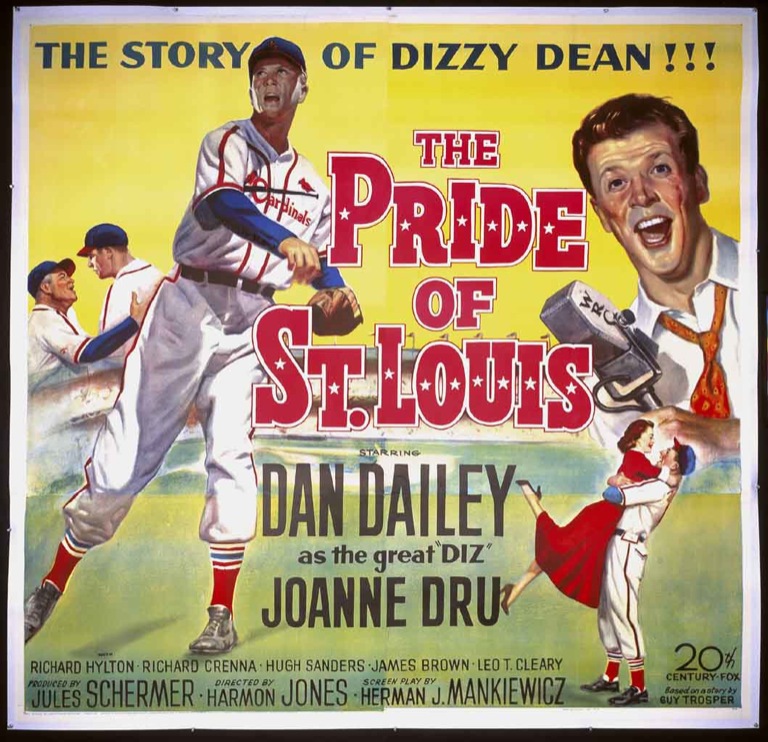
Jerome Herman “Dizzy” Dean, ace pitcher of the St. Louis Cardinals’ famed “Gashouse Gang” in the 1930’s, gets the Hollywood biopic treatment in this pleasant little film. The malaprop prone Dizzy was one of the game’s greats before an unfortunate injury, leading to him becoming a well-loved broadcaster. The film sticks fairly close to the facts, as Dean was a colorful enough character to need little embellishment.

THE PRIDE OF ST. LOUIS follows Dean’s career as he’s discovered pitching in his Arkansas hometown, through the minors, and finally to big league success with the Cardinals. Along the way he woos and wins the love of his life, Patricia. Soon his brother Paul joins the team, and the pair become as well-known for their off-field antics as for their pitching prowess.
The movie takes a turn when Dizzy is injured during an All Star Game and tries to come back too soon. His arm is ruined, but Dizzy can’t…
View original post 516 more words
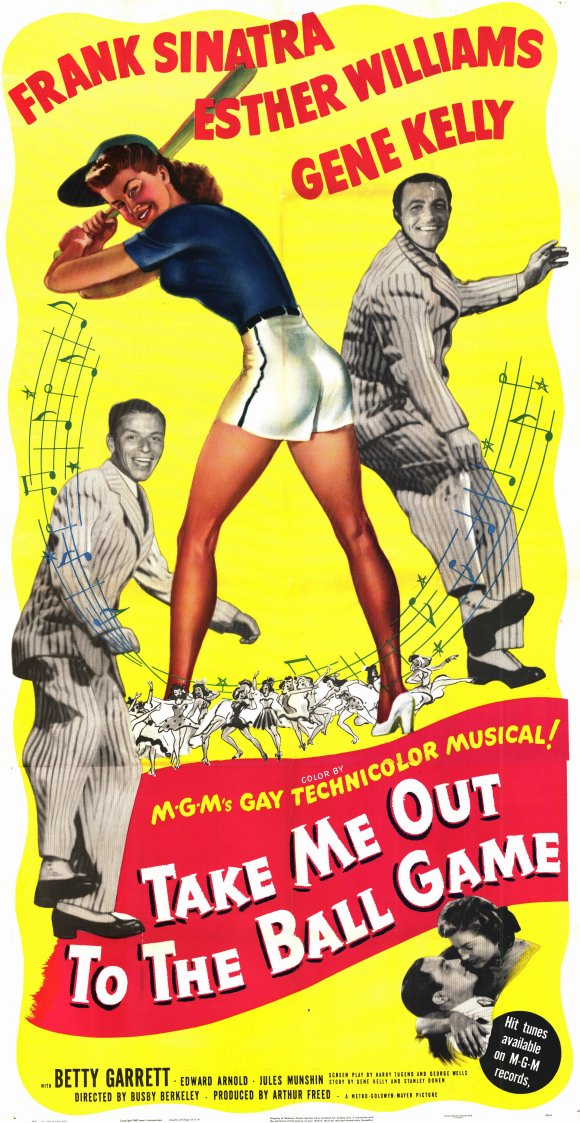
The National Pastime is just a frame for TAKE ME OUT TO THE BALL GAME to hang its picture in. That’s okay though, because producer Arthur Freed and the MGM Musical Dream Factory put together a rollicking, colorful romp with turn of the (20th) century baseball as an excuse to let Gene Kelly, Frank Sinatra , Esther Williams, Betty Garrett, and company razzle-dazzle us with plenty of songs, dancing, romancing, and comedy.
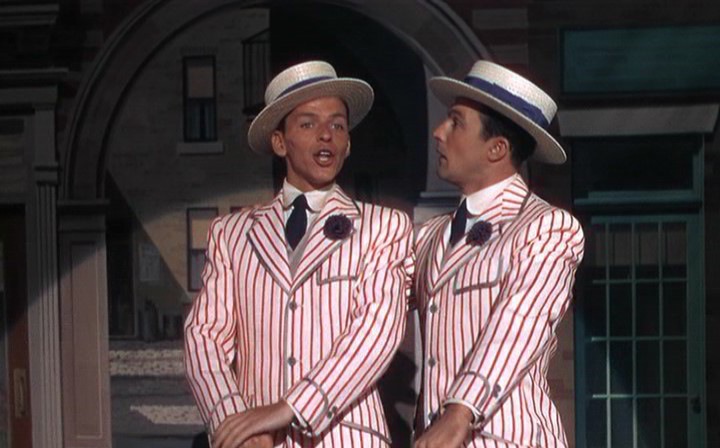
There’s not much of a plot in this outing. The World Champion Wolves are at spring training, awaiting the arrival of star diamond duo Eddie O’Brien and Denny Ryan, who’re off on a vaudeville tour. Eddie (Kelly) is a skirt chaser with Broadway dreams, while Denny’s (Sinatra) a shy, geeky guy who lives and breathes baseball. They get to camp just in time to hear the Wolves’ owner has died and left the club to his only relative, K.C. Higgins (Williams), who…
View original post 328 more words

 Through the Shattered Lens