Back to School #42: Ferris Bueller’s Day Off (dir by John Hughes)


ferris-buellers-day-off-movie

Life moves pretty fast. If you don’t stop and look around once in a while, you could miss it. — Ferris Bueller (Matthew Broderick) in Ferris Bueller’s Day Off (1986)

While I was rewatching the 1986 John Hughes comedy Ferris Bueller’s Day Off for this review, I found myself thinking about all of the days (or, to be more precise about it, half-days) that I took off back when I was in high school.  It wasn’t that I didn’t like school.  Though I certainly didn’t truly appreciate it at the time, I actually had a pretty good time in high school.  I had an interesting and diverse group of friends.  I had lots of drama and lots of comedy.  I got good grades as long as it wasn’t a Math class.  (Drama, History, and English were always my best subjects.)  My teachers liked me.  But, at the same time, I couldn’t help but resent being required to go to school.  I do not like being told that I have to do something.

So, I would skip on occasion.  For some reason, it always seemed like my favorite classes were early in the day.  So, I’d go to school, enjoy myself up until lunch, and then me and a few friends would casually walk out of the building and we would be free!  There was a Target just a few blocks down the street from our high school and sometimes we’d go down there and spend a few hours shoplifting makeup.  Eventually, we did get caught by a big scary security guy who threatened to call our parents, made us return everything that we had hidden in our purses and bras, and then told us that we were never to step foot in that Target ever again.  And you know what?  In all the years since, I have yet to step back inside of that Target.

Interestingly enough, with all of the times that we skipped school, the worst thing that ever happened to me or any of my friends is that we got banned from Target.  We all still graduated, most of us still went to college, and, as far as I know, none of us have ever been arrested for a major crime.  None of us ever regretted missing any of the classes that we skipped.  For all the talk of how skipping school was the same thing as throwing away your future, it really was not that big of a deal.
ferrris38

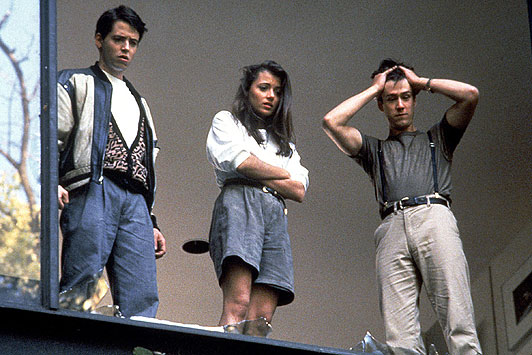
I think that’s one reason why, despite being nearly 30 years ago, Ferris Bueller’s Day Off is a film that continues to speak to audiences.  It’s a film that celebrates the fact that sometimes, you just have to take a day off and embrace life.  Technically, Ferris, Cameron (Alan Ruck), and Sloane (Mia Sara) may be breaking the law by skipping school and you could even argue that they’ve stolen Cameron’s dad’s car.

But, who cares?

You know who probably had perfect attendance in high school?  Principal Rooney (Jeffrey Jones) and seriously, who wants to grow up to be like that douchebag?

FerrisBueller_034Pyxurz

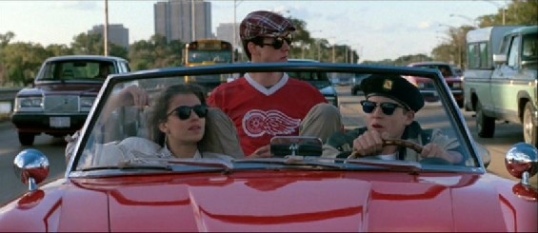
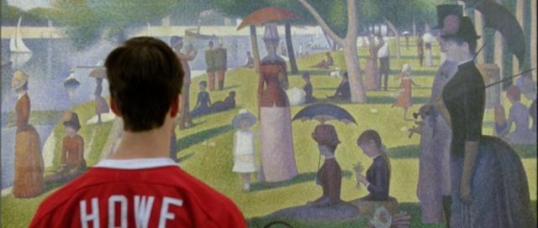
Whenever I do watch Ferris Bueller (and I’ve seen it more times than I can remember because seriously, I freaking love this movie!), I always find myself wishing that real-life could be as much fun as the movies.  As much as I may have enjoyed skipping school and shoplifting, it’s nothing compared to everything that Ferris does during his day off!  Ferris goes to a baseball game!  He takes his friends to a fancy restaurant!  He goes to an art museum!  (And, much like Sloane, my heart swoons at this point because I would have loved to have known a guy who would skip school so he could specifically go to the museum.)  Perhaps most importantly, he encourages his best friend Cameron to actually have a good time and enjoy himself.
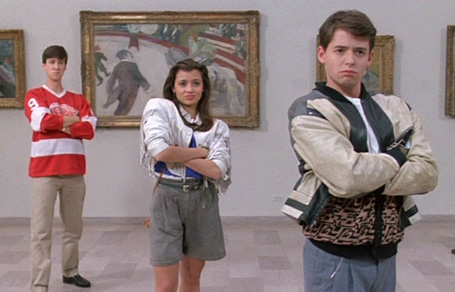
Ferris, Sloane, and Cameron

In Susannah Gora’s book You Couldn’t Ignore Me If You Tried, an entire chapter is devoted to the making of Ferris Bueller’s Day Off and, to be honest, it’s actually makes for rather melancholy reading.  Ferris Bueller was the last teen film that John Hughes directed and the book suggests that a lot of this was due to the fact that Hughes didn’t have as good a time making the film as audiences would later have watching it.  In the book, Mia Sara speculates that Hughes never bonded with the cast of Ferris Bueller in the same way that he did with the casts of Sixteen Candles and The Breakfast Club.
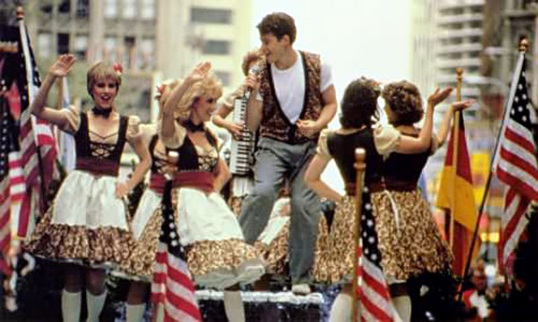
gal_ferris_bueller_02

And indeed, it’s hard to imagine either Ferris Bueller or Matthew Broderick popping up in either one of those two films.  Ferris is far too confident to relate to the angst-driven worlds of Sixteen Candles, The Breakfast Club, or Pretty in Pink.  True, he doesn’t have a car and his sister (Jennifer Grey) resents him but otherwise, Ferris’s life is pretty much care-free.  Not only does he live in a beautiful house but he’s also already come up with a definitive philosophy for how he wants to live his life.  You look at Ferris and you know that he probably grew up to be one of those people who ended up working on Wall Street and nearly bankrupted the country but you don’t care.  He’s too likable.
ferrisbuellerkj09-05-26

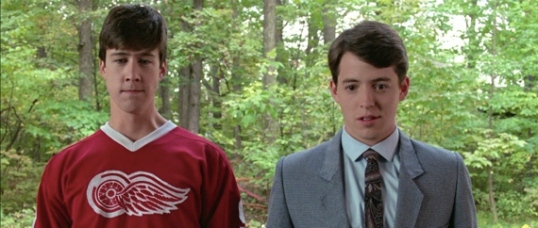
His best friend, Cameron, is far more angsty but even his overwhelming depression doesn’t seem like it would be at home in any of Hughes’s other films.  If Cameron was a member of the Breakfast Club, he’d probably just sit in the back of the library and zone out.  Regardless of how much Judd Nelson taunted him, Cameron would stay in his shell.  If Cameron was in Sixteen Candles, it’s doubtful he would have been invited to the party at Jake Ryan’s house in the first place.  His depression is too overwhelming and his angst feels too real for him to safely appear in any film other than this one.  As a character, Cameron could only appear in Ferris Bueller’s Day Off because only Ferris Bueller would be capable getting Cameron to leave his bedroom.  On the one hand, the film may seem like a well-made but standard teen comedy where a lovable rebel defeats a hateful authority figure.  But, with repeat viewings, it becomes obvious that Ferris Bueller is truly about the battle for Cameron’s damaged soul.
ferris2.preview

There’s a prominent theory out there that the entire film is supposed to be Cameron’s daydream and that Ferris either doesn’t exist or he’s just a popular student who Cameron has fantasized to be his best friend.  I can understand the theory because Cameron really is the heart of the movie.  At the same time, I hope it’s not true because, if this is all a fantasy, then that means that Sloane never said, “He’s going to marry me,” while running back home.  And that would be heart-breaking because I love that moment!

628x471

Ferris Bueller’s Day Off may have John Hughes final teen film as a director (he would go on to write and produce Some Kind of Wonderful) but at least he went out on a true high note.
FerrisBueller-532_1444534a

Back to School #41: Pretty In Pink (dir by Howard Deutch)


pretty_in_pink-2

“Blane!  That’s not a name, that’s a major appliance!” — Duckie (Jon Cryer) in Pretty In Pink (1986)

(SPOILERS!)

Blane or Duckie?  Duckie or Blane?  Which one should Andi have gone to the prom with?

That’s the question at the heart of the 1986 film Pretty In Pink.  In Susannah Gora’s excellent book You Couldn’t Ignore Me If You Tried (which, incidentally, has been an important source of information for this entire Back to School series of reviews), a good deal of space and debate is devoted to whether or not Andi (played by Molly Ringwald) should have ended up going to the prom with either Duckie (Jon Cryer) or Blane (Andrew McCarthy).  What’s interesting is just how passionate the arguments on both side of the debate get.  Those in the pro-Duckie camp, like producer Lauren Shuler Donner and director Howard Deutch, frame the debate as almost being a moral one.  Those on the pro-Blane side — people like John Hughes (who wrote the film’s script) and Andrew McCarthy — make a convincing argument that the audience wanted to see Andie with Blane.

Perhaps most importantly, Molly Ringwald — who not only played Andie but upon whom the character was largely based — makes little secret of which suitor she preferred.  Molly Ringwald is pro-Blane all the way.

Myself — well, I’m going to hold off on saying which side I come down on.

pinkdvd5

Both Blane and Duckie have their flaws and their strengths.  Blane, for instance, comes from a wealthy family and spends too much time worrying about what his loathsome friend Steff (James Spader, who gives a wonderfully evil performance that justifies why he is quoted in Gora’s book as saying, “I figure I got a lock on this whole teen asshole thing,”) thinks.  But, at the same time, Blane is obviously more sensitive than the rest of his rich friends.  There’s a soulful sincerity to McCarthy’s performance and, until he breaks Andi’s heart by giving into peer pressure, he truly is every girl’s dream boyfriend.

124139__pretty_in_pink_l

And then there’s Duckie.  As played by Jon Cryer, Duckie is the type of best friend that we all hope we’re lucky enough to have.  You never have any doubt that he’ll always be there for Andie and it just takes one look at how he’s dressed to understand that Duckie doesn’t care about peer pressure.  Duckie may be an outcast but, unlike Steff and Blane, he’s confident in himself.  And whereas Blane is always wrestling with doubt, Duckie knows that he loves Andie.  And if your heart doesn’t hurt a little when he confesses that fact to Andi, then you probably don’t have one to begin with.  Add to that, as cute and charming as Blane is, you know he’d never break out into a random dance routine.  Blane is no Duckie but, at the same time, Duckie is also no Blane.

And who Andie should take with her to the prom (or if she should even go at all) is an important question because, if anyone deserves to have the perfect prom, it’s Andie.  Not only does she work hard to support her alcoholic and depressed father (the great Harry Dean Stanton) but she has great taste in music (or, at least, she does for someone living in the 80s) and she makes her own clothes.  One reason why we love Blane is because he discovers that, even if Andie isn’t rich, she’s still the most interesting girl in the entire school.  One reason why we love Duckie is because he didn’t have to discover this.  He already knew it.

Pretty-in-Pink-pretty-in-pink-21203179-497-278

The film, of course, originally ended with Blane giving into peer pressure and canceling his date with Andie.  Andie is heart-broken but refuses to surrender.  Wearing the pink dress that she specifically made for the event, Andie still goes to the prom and, as the film ends, she shares a dance with Duckie, the one who, all along, loved her unconditionally.

As is recounted in Gora’s book, test audiences loved the movie but hated that ending.  And so, a new ending was shot.  Blane shows up at the prom without a date.  He apologizes to Andie.  He shakes Duckie’s hand.  He tells Andie that he always believed in her, he just didn’t believe in himself.  (Watching at home, Lisa says, “Oh my God!” and wipes away a tear.)  As he leaves, even Duckie realizes that Andie belongs with Blane.  Andie and Blane are reunited in the parking lot and Duckie goes off with Kristy Swanson.

And you know what?  That ending — that ending is perfect.  Because yes, Duckie did love Andie but Andie loved Blane and the prom is a time to be with someone who you think you’ll love forever.  (Little realizing, of course, that you’ll eventually only think of your former prom date as being that guy who keeps inviting you to play games on Facebook.)  Pretty in Pink is one of the most romantic high school movies ever made and one reason it works is because the ending is all about celebrating that romance.  It may not be realistic and yes, it might even be borderline immoral to allow Blane to be so easily redeemed after breaking Andie’s heart but who cares?

The wonderful thing about romance is that it doesn’t have to make sense.

It just has to be.

61SL9To9GLL._SY300_

Back to School #40: Better Off Dead (dir by Savage Steve Holland)


Better-Off-Dead

There’s something really sad about knowing that John Cusack does not like the 1985 teen comedy, Better Off Dead, despite the fact that he himself starred in the film.

Just how much he dislikes the film depends on who you talk to.  I read an interview with the film’s director — the wonderfully named Savage Steve Holland — in which he said that Cusack approached him after a screening of the film and told him that he totally hated the film and would “never trust” Holland again.  (What’s truly sad is that Holland also said that this encounter caused him to momentarily lose all interesting in film making.)  However, a few years ago, Cusack said, while answering questions on Reddit, that he didn’t hate Better Off Dead, he just felt that it could be better and that he was glad that other people still like it.  In another interview, Cusack said that the “absurdist humor” of Better Off Dead just wasn’t his thing.

John, I understand that you’re a serious actor and I’ve always had a lot of respect for the fact that you’re an outspoken liberal who is still intellectually honest enough to hold Obama up to the same standard to which you previously held Bush.  But honestly, John, maybe you should loosen up just a little.  Not all of your movies have to be The Butler!  There’s nothing wrong with enjoying yourself onscreen.  And there’s nothing wrong with entertaining an audience and leaving them happy.  Better Off Dead may be one of more lightweight films that I’m reviewing for this Back to School series but it’s a lot of fun!  It makes people smile.  And you know what?  A lot of those smiling people are going to be more willing to see you in a film like The Butler because they’ve also seen you in films like Better Off Dead.

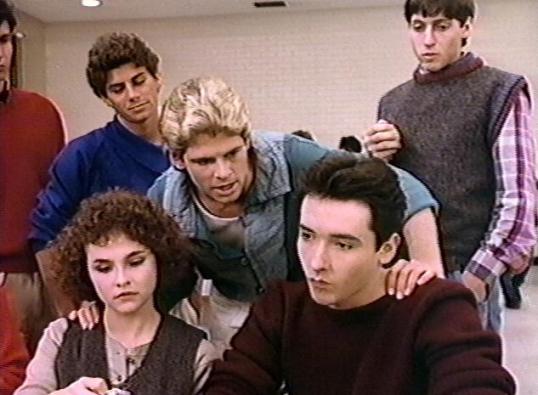
Add to that, you give a pretty good performance in Better Off Dead.  In fact, you provide the film with a much-needed center.  A lot of the comedy in Better Off Dead may be absurd but John, your performance is so likable and so grounded that you keep the film from getting too weird.  You do such a good job as Lane Myer and are so convincing as a well-meaning but dorky high school student who is trying to win back his ex-girlfriend (Amanda Wyss) by skiing down a mountain that it allows everyone else to be as weird as the film will allow.  Without your excellent performance, John, the film would be a total mess.

BOD

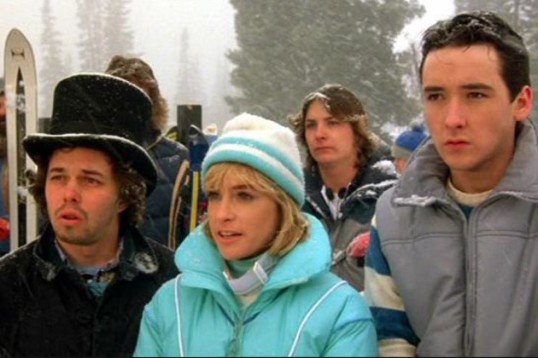
Better Off Dead is essentially a collection of skits.  There’s a plot but the plot is really only there as an excuse for the nonstop jokes.  For instance, there’s Lane’s best friend, Charles (Curtis Armstrong, essentially playing the same character he played in Risky Business) who spends the entire film looking for things to snort and who, when standing atop of snowy mountain, says, “This is pure snow!  Do you have any idea what the street value of this mountain is!?”

And then there’s Monique (Diane Franklin), the foreign exchange student who lives next door to Lane and who pretends that she can’t speak English because she’s trying to avoid being set up with creepy Ricky Smith (Daniel Schneider).

There’s Lane’s mother (Kim Darby), who cooks some of the strangest looking meals ever seen in an American film.  There’s also Lane’s younger brother, who never speaks but who knows how to build a laser gun.  Even Lane’s father (David Ogden Stiers). who seems relatively normal, still manages to destroy the garage door.

There’s the fact that Lane’s romantic rival is named Roy Stalin (Aaron Dozier).  Is that not just the perfect name for a villain?

There’s my favorite scene in the entire film, where a geometry teacher (Vincent Schiavelli) explains a complicated problem to his class and the class responds by cheering him along.  “Who wants to come up here and solve the problem?” the teacher asks.  The entire class raises their hands and goes, “Me!”

There’s quotable and memorable lines like: “I’ve been going to this high school for seven and a half years. I’m no dummy,” ” Now that’s a real shame when folks be throwin’ away a perfectly good white boy like that,” and “Gee, I’m really sorry your mom blow up, Ricky.”

And, of course, there’s that paperboy who wants his two dollars…

Seriously, John, Better Off Dead might not be your favorite movie but it’s really not that bad!

Want to see just how not bad Better Off Dead really is?  Watch it below!

Back to School #39: The Breakfast Club (dir by John Hughes)


breakfast-club-2

Dear Mr Vernon,

We accept the fact that we had to sacrifice a whole saturday in detention for whatever it was we did wrong. But we think you’re crazy to make us write an essay telling you who we think we are. You see us as you want to see us – in the simplest terms, in the most convenient definitions. But what we found out is that each one of us is a brain, and an athlete and a basket case, a princess and a criminal.

Does that answer your question?

Sincerely yours,

The Breakfast Club.

— Brian’s essay from The Breakfast Club (1985)

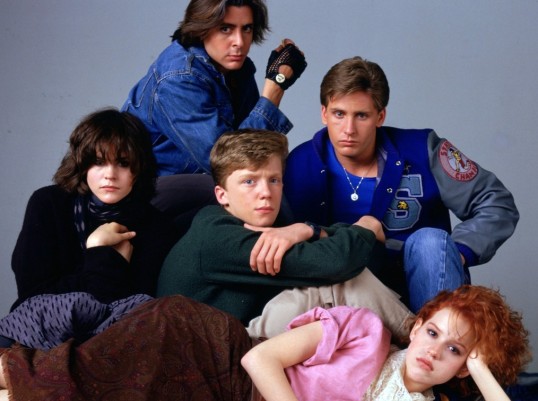
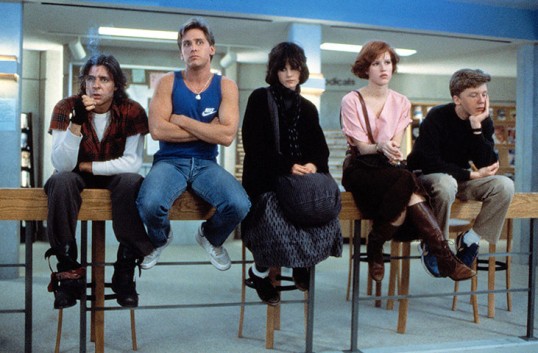
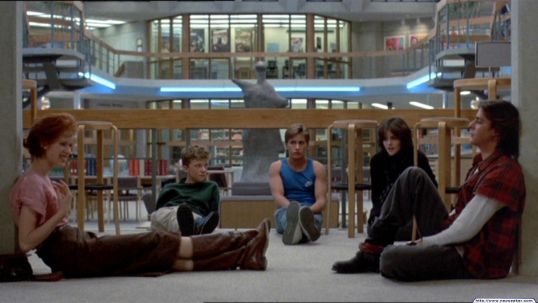
 That’s one thing that has always bothered me about The Breakfast Club.  The film, of course, is famous for being about five different high school students who are forced to spend a Saturday in detention with each other.  Over the course of the day, they start off as antagonists, separated by their own preconceived notions of who they are.  But, as the day progresses, they talk and they bond and they discover that they all have more in common than they might think.  And, at the end of the film, “basket case” Allison (Ally Sheedy) pairs off with “athlete” Andy (Emilio Estevez) and “criminal” Bender (Judd Nelson) pairs off with “princess” Claire (Molly Ringwald).  And while Claire is busy giving Allison a makeover and Bender is thinking about how iconic he’ll look when he raises his fist while leaving the school, “brain” Brian gets to write everyone’s essay.

Originally, all five of them were supposed to spend their time in detention writing individual essays about how they’re going to be better students and citizens.  But, in the end, only one essay is turned in and Brian is the one who writes it.  It’s always seemed a bit unfair to me that, while everyone else was getting to reveal a new side of his or herself, Brian was basically doing everyone’s schoolwork.  I know it can be argued that this shows that the other students finally appreciate Brian’s intelligence but everyone already knew he was smart.  In the end, Brian is the one who articulated what they all discovered during that Saturday detention but he also seems to be the one who gained the least from the experience.

The-Breakfast-Club-1985-001

But, at heart, The Breakfast Club is a deeply ambiguous movie.  That’s one reason why, despite the fact that it was initially released the same year that I was born, the film still feels relevant today and why it remains one of the most popular high school films ever made.  Everyone can relate to at least one of the five students and I imagine that when most people watch it, they wonder how they would react to an aggressive character like John Bender or how they would handle the horrific story that Andy tells when asked what he did to get sentenced to detention.  And, at the end of the film, everyone wonders if any of the new friendships and relationships would actually last longer than a weekend.  When Bender asks Claire how she’s going to act if Brian approaches her on Monday, we all know what will probably actually happen if he does.  At the end of the film, you’re happy that they got that Saturday together because you know that, once Monday comes, it’s going to be like it never happened.

the_breakfast_club_2

I’ve watched The Breakfast Club a handful of times.  Whether I relate the most to Claire or to Allison usually depends on my mood. I think that a lot of people want to relate to Allison because, for much of the movie, Claire is unapologetically selfish and spoiled.  But, if we’re honest with ourselves, we have to admit that we’re all a lot more like Claire than any of us want to admit.

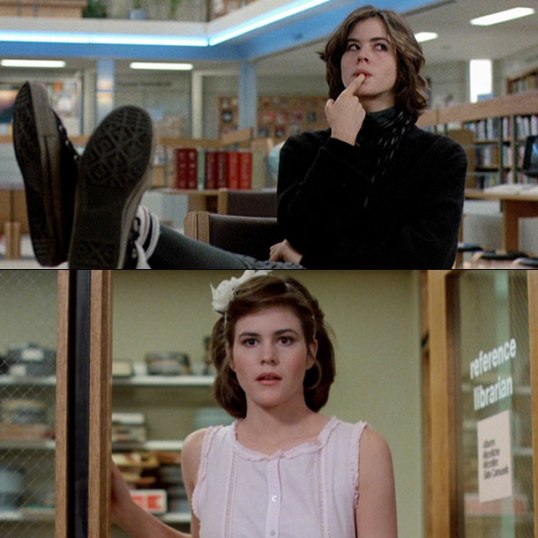
It’s also easy to relate to Allison because she’s not really a very well-drawn character.  While the other characters all come from an easily identifiable group, Allison is just there.  She’s a collection of strange quirks that don’t always have a clear motivation and, in the end, the only reason Allison works as a character is because Sheedy does such a good job playing her.  At the end of the film, Claire gives Allison a makeover and I have to admit that it always kind of breaks my heart to see how Allison goes from being strange to being very conventional.

Makeover

(In Susannah Gora’s excellent book You Couldn’t Ignore Me If You Tried, Sheedy is quoted as saying that she didn’t feel very happy about it either.  According to her — and she’s correct — the only thing that really redeems this scene is the fact that Allison doesn’t quite pull off her new look.  She’s still a little awkward and you realize that she may have just been humoring Claire.)

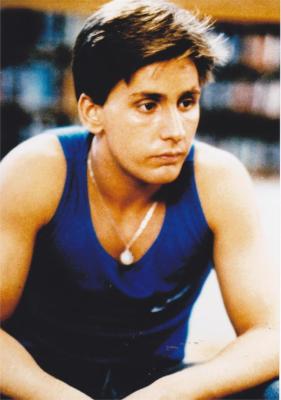
As for the males, Anthony Michael Hall gets a lot of the laughs and Judd Nelson gets the best lines but Emilio Estevez gives the best performance.  We already know that Brian is insecure despite being intelligent and we expect that Bender is angry because he’s got an abusive father.  But when Andy explains why he, an otherwise nice and likable guy, committed a horrific act of bullying, it’s an amazing scene and Estevez plays it perfectly.

Estevez

In fact,  both Estevez and Sheedy are so good that I’ve decided that Andy and Allison did stay together after detention.  Eventually they got married and, right now, they’re living in a pretty house in the suburbs of Chicago.  Bender and Claire, however — there’s no way that lasted!

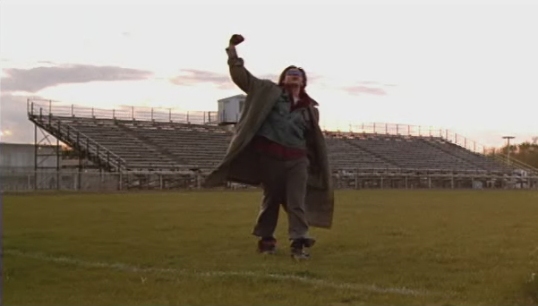
But, regardless of what happened on Monday, there’s no way your heart can’t soar a little when Bender lifts that fist above his head.

Bender and his fist

Back to School #38: Cavegirl (dir by David Oliver)


cavegirl5

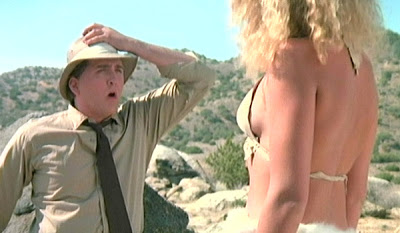
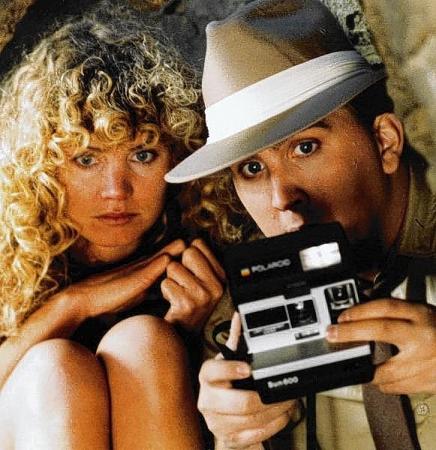
Believe it or not, Back to the Future was not the only film released in 1985 that dealt with a high school senior taking a trip through time and ending up in the distant past.  There was also Cavegirl, which tells the story of Rex (Daniel Roebuck), a nerdy science student who, during a field trip, finds himself transported back to prehistoric times.  It’s there that he meets the title character, the cheerful and friendly Eba (Cindy Ann Thompson).  Eba likes Rex and Rex like Eba.  The only problem is that Eba can’t speak a word of English and Rex can’t get a moment along with her without being interrupted by various cavemen.

Perhaps not surprisingly, this film was distributed by Crown International Pictures.

CIP_LogoOne thing that I always find interesting about the various high school films that were released by Crown International is that the schools always look so ugly.  That’s certainly the case in Cavegirl.  It’s not just that the school’s lay-out is boring.  (Apparently, nobody put much effort into designing high schools in the 70s and 80s.)  It’s just that the school itself looks dirty, as if all of the custodians are on strike.  When, at the beginning of the film, you see Rex walking through the school, you just know that the entire building probably reeks of stale air, rotting food, and decaying rodents.  (In fact, it looks like it might be the same school from The Pom Pom Girls.)  No wonder Rex doesn’t seem to mind being sent into the past!

And speaking of Rex, he’s played by Daniel Roebuck.  Roebuck actually gives a pretty good performance in this film, bringing a lot of conviction to some incredibly silly lines.  But the best thing about seeing Daniel Roebuck in this film is know that, decades later, he would play the ill-fated Leslie Arzt on Lost.  Arzt only appeared in a handful of episodes but every time he did appear, he was whining about something and petulantly demanding to be included in whatever the main characters were doing.  When they finally did allow Arzt to tag along with them, he mishandled some dynamite and blew up.  (Leading to the classic line: “You’ve got some Arzt on you…”)  Arzt may have only been created so that the creators could blow him up but Roebuck gave such a memorably fussy performance in the role that, even after exploding, he retained a following among the show’s many fans.  In Cavegirl, Roebuck gives a similarly fussy performance and, as a result, the entire film feels like it could be called “Leslie Arzt: The Early Years.”

As for Cavegirl itself, it’s definitely a crude film, in both execution and much of the content.  There’s about as much humor based on bodily fuctions as you expect to see in a film like this and there were a few such scenes that I choose to look away from until they were over with.  But, at the same time, it’s ultimately a surprisingly likable film.  That’s largely due to Daniel Roebuck and Cindy Thompson.  They both have a very likable chemistry and Thompson gives such an enthusiastic performance that you can forgive a lot of the film’s weaker moments.

Is Cavegirl as good as Back to the Future?

Well, no.

But, as far as low-budget 80s teen comedies are concerned, it works.

mc-cavegirl-jpg-20140228


Song of the Day: The Power of Love (by Huey Lewis and the News)


bttf001

I had no choice in the matter. The moment Lisa Marie posted her review of Back to the Future as part of her “Back to School” review series I had no choice but to post the latest “Song of the Day” in honor of her latest review.

The latest featured song is none other than the best-selling single from the Back to the Future soundtrack (one I owned and treasured growing up to the point I wore out that vinyl) by the S.F.-based rock band Huey Lewis and the News. The song is “The Power of Love” and I must admit that I pretty much know this song by heart and can belt it out pretty well. Give me enough alcohol and I’m more than likely request it as the next karaoke song and I’ll grab that mic stand and channel my inner Huey Lewis.

This song may not be metal, but it definitely was a sound of the 80’s and I’d be hard pressed to find anyone who lived during the 1980’s and not have heard this song.

The Power of Love

The power of love is a curious thing
make a one man weep, make another man sing
Change a hawk to a little white dove
more than a feeling, that’s the power of love

Tougher than diamonds, rich like cream
Stronger and harder than a bad girl’s dream
make a bad one good make a wrong one right
power of love that keeps you home at night

Chorus 1 :
You don’t need money, don’t take fame
Don’t need no credit card to ride this train
It’s strong and it’s sudden and it’s cruel sometimes
but it might just save your life
That’s the power of love

First time you feel it, it might make you sad
Next time you feel it it might make you mad
But you’ll be glad baby when you’ve found
that’s the power makes the world go’round

Chorus 2 :
And it don’t take money, don’t take fame
don’t need no credit card to ride this train
It’s strong and it’s sudden it can be cruel sometimes
but it might just save your life

They say that all in love is fair
yeah, but you don’t care
But you know what to do
when it gets hold of you
and with a little help from above
you feel the power of love
Can you feel it ?
Hmmm

Chorus 3 :
It don’t take money and it don’t take fame
don’t need no credit card to ride this train
Tougher than diamonds and stronger than steel
you won’t feel nothin’ till you feel
you feel the power, just FEEL the power of love
That’s the power, that’s the power of love
You feel the power of love
you feel the power of love
feel the power of love

Back to School #37: Back to the Future (dir by Robert Zemeckis)


back-to-the-future

Well, this is certainly intimidating.

Earlier today, I was sitting at my day job and I happened to glance down at my to-do list to see what I was scheduled to review next in my Back To School series and there, listed at #37, was a somewhat popular film from 1985.  The name of the film was Back To The Future and…

Oh, you’ve heard of it?  And you already know what the movie’s about because literally everyone on the planet has either seen Back to The Future or knows someone who has seen Back To The Future and loves it so much that they can tell you every little detail about the adventures of Marty McFly, Doc Brown, and that time-traveling DeLorean?

Well, just be quiet and bear with me.  I always like to give a plot synposis in my reviews.  For one thing, it’s a good way to let you know who plays who in the film.

mcfly

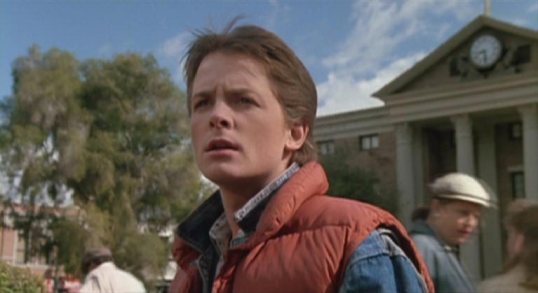
So, Marty McFly (Michael J. Fox) is, despite his somewhat embarrassing last name, a perfectly normal American teenager.  He lives in a nice, small town.  He has a pretty girlfriend (Claudia Wells).  He likes to ride his skateboard.  He likes to play guitar (though he’s deemed to be “too loud” by at least one of his teachers).  The high school’s principal (James Tolkan) often gives him a hard time for being late but other than that, Marty seems to be a pretty regular guy…

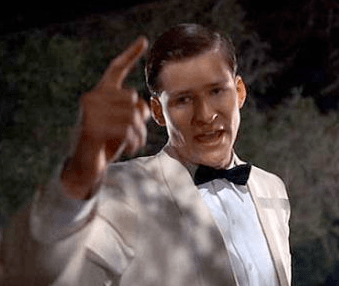
Except his family has some major issues.  His mother Lorraine (Lea Thompson) is an alcoholic who won’t stop talking about how she first met her husband George (Crispin Glover) after her father hit him with his car. George, meanwhile, is a total wimp who is continually bullied by his boss, Biff (Thomas F. Wilson).  Marty’s older siblings (Marc McClure and Wendie Jo Sperber) are both living directionless lives and Marty has every reason to fear that he might end up following them.

49663309_michaeljfox1

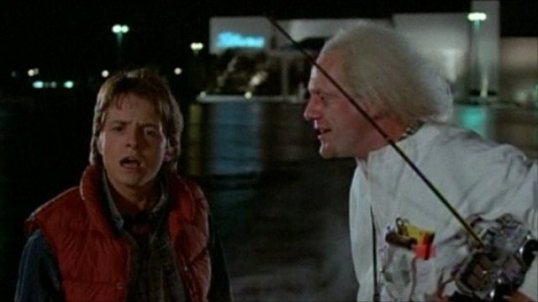
Fortunately, Marty has a best friend named Doc Brown (Christopher Lloyd) who has built a time machine inside of a luxury vehicle.  Late one night, Doc recruits Marty to help him test out the machine but what Doc didn’t mention is that in order to power his time machine, he had still plutonium from a group of terrorists.  Those terrorists show up and kill Doc.  Marty flees in the car and soon finds himself trapped in 1955.

Marty manages to track down the younger version of Doc Brown and the two of them start trying to work out how to get Marty back to the future.  (We have a title!)  Marty, of course, wants to warn Doc about what’s going to happen in 1985 but Doc insists that Marty tell him nothing about the future.  Doc also tells Marty that he has to be very careful, while in the past, not to change the future.

McFly!

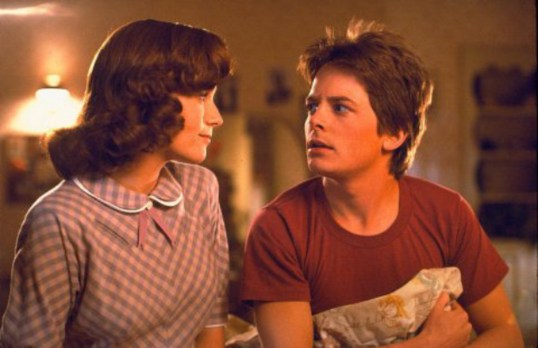
Too late!  Marty has already met teenage Lorraine.  See, Marty happened to spot George up in a tree, peeping on Lorraine as she undressed.  (“He’s a pervert!” Marty exclaims.)  When George falls out of the tree and lands in the street, Marty pushes him out of the way of an approaching car.  Marty gets hit by the car, which is being driven by his own grandfather.  So now, Marty has essentially prevented his parents from meeting and, as a result, the McFly children are slowly fading from existence.

So, before Marty can go back to 1985, he has to get George and Lorraine back together.  The main problem, of course, is that Lorraine now has a crush on her own son…

michael-j-fox-back-to-the-future-screenshot

Wow, that’s a lot of plot there.  There’s a lot going on in Back to the Future and there are times when it almost feels like a dozen different films in one.  It’s a science fiction film, with Doc and Marty spending a lot of time trying to figure out how to make a time machine work with 1955 technology and weather.  It’s an action film, with Marty fleeing terrorists in 1985 and Biff in 1955.  It’s a romance, with the always endearingly weird Crispin Glover and Lea Thompson making for an odd but cute couple.  (Thought it’s wrong on so many levels, Thompson and Fox also have a lot of chemistry and are cute together, as long as you ignore the fact that they are playing mother and son!)  It’s a frequently hilarious comedy, with the entire cast giving heartfelt performances.  It’s an anthropological study, comparing the 50s and the 80s.  It’s a satirical look at how teenager’s tend to view their parents, with Marty discovering that everything that he’s assumed at his mom was basically incorrect.  And finally, it’s a surprisingly subversive film, with Marty and Lorraine’s 1955 relationship constantly running the risk of turning into an Oedipal nightmare.

And yet the entire film flows together so perfectly that you’re never aware of just how busy it all really is.  Between director Robert Zemeckis’s sure-handed direction, the clever script by Zemeckis and Bob Gale, and a uniformly excellent cast, Back to the Future is one of those films that verges on being flawless.

And, for that reason, it can be very intimidating to review.

I just don’t know how I’m going to do it…

550w_movies_dsma_back_to_the_future_03

Back to School #36: Mischief (dir by Mel Damski)


Mischief

Have you ever noticed how, occasionally, a totally obscure film that was made several decades ago will suddenly show up on either Starz or Encore and, the next thing you know, it’s only like every other day?  That was the case a few months ago when, at times, it seemed as if the only thing playing on cable was a teen comedy from 1985 called Mischief.

After I saw it listed in the guide a few dozen times, I thought to myself, “Somebody at that station must really like that movie.”  So, one night, I actually took the time to watch it and discovered why that mysterious person loved this movie.  Mischief may not be as well-known as some of the other films in this series of Back to School reviews but it’s still a pretty good movie.

Like so many of the teen films that were released in the 70s and 80s, Mischief takes place in the 1950s.  (I assume that’s because most films about teenagers are made by adults who want to both relive and perhaps change the past.  I suppose that’s one reason why so many films released today are set in the 1990s.  In another ten years or so, all of the new high school films will be set in 2003.)  The very shy and clumsy Jonathan (Doug McKeon) has a crush on the beautiful but unattainable Marilyn (Kelly Preston).  Fortunately, Jonathan is befriended by Gene (Chris Nash) who is the prototypical rebel without a cause.  Gene wears a leather jacket.  Gene rides a motorcycle.  Gene doesn’t get along with his alcoholic, violin-playing father (Terry O’Quinn, in full asshole mode here).  Gene even stands up to the school bully (D.W. Brown) and starts dating the bully’s ex-girlfriend, Bunny (Catherine Mary Stewart).  Most importantly, Gene helps Jonathan finally develop the confidence necessary to ask Marilyn out.

And, for a while, Gene & Bunny and Jonathan & Marilyn make for the perfect foursome.  But, as we all know, perfection can never last in a coming-of-age story.  Jonathan starts to discover that he and Marilyn are not quite as compatible as he originally assumed that they were.  As for Gene, he has to deal with his increasingly violent and drunken father…

That last paragraph probably makes Mischief sound a lot more dramatic than it actually is.  Make no mistake about it — while Mischief does deal with some serious issues — it is primarily a comedy and a pretty good one at that.  McKeon is endearingly clumsy in his initial attempts to get Marilyn to notice him and Nash — even though he’s playing a very familiar character — is likable as well.  Perhaps the smartest thing that Mischief did is that it made Gene cool but it didn’t make him too cool.  The film’s best scenes are the ones where Gene momentarily surrenders his rebel facade and reveals that he’s just as confused as everyone else.  Catherine Mary Stewart and Kelly Preston are well-cast as well, with Preston especially doing a good job at making a potentially unsympathetic character likable.

In many ways, Mischief is a pretty predictable film.  I think it features probably every single cinematic cliché that one would expect to see in a film about the 50s.  But the film itself is so likable and good-natured that it doesn’t matter if it’s predictable.  It’s just a good, enjoyable movie and what’s wrong with that?

(Incidentally, the screenplay for Mischief was written by Noel Black, who also directed the previously reviewed Private School.)

1327550371_1447726

Back to School #35: Sixteen Candles (dir by John Hughes)


11171951_800

The 80s are often considered to be the golden age of teen films and that’s largely due to the work of one man, John Hughes. A  former advertising copywriter and a contributor to National Lampoon, Hughes went on to direct and write some of the most influential films of all time.  By deftly mixing comedy with themes of alienation, rebellion, and youthful disillusionment, Hughes changed the way that teenagers were portrayed onscreen and his influence is still felt today, in everything from Juno to Superbad to Easy A to … well, just about any other recent film starring Michael Cera.

(Okay, I know Michael Cera was not in Easy A but it really seems like he should have been…)

Hughes made his directorial debut in 1984 with Sixteen Candles, a comedy about love, birthdays, and weddings set in an upper class suburb of Chicago.  (I have to admit that, much like with My Tutor, one reason that I like this film is because I like seeing where everyone lives.)  As the film opens, Samantha Baker (Molly Ringwald) is not having a particularly good time.  For one thing, everyone is so wrapped up in her older sister’s wedding that they’ve forgotten about Sam’s sixteenth birthday.  Her house is full of wacky grandparents (and one foreign exchange student named Long Duk Dong).  At school, Sam is in the unenviable position of being neither popular enough nor unpopular enough to actually be noticed by anyone.  Instead, she’s just there.  She has a crush on Jake Ryan (Michael Schoeffling) but is convinced that Jake doesn’t even know that she’s alive.  (Of course, she’s wrong.)  She’s also being pursued by a character who is occasionally referred to as being “Farmer Ted” but is listed in the end credits as simply being “The Geek.”  (I’m going to refer to him as “The Geek” because Farmer Ted makes him sound like he should be killing people in a SyFy original movie.)  As played by Anthony Michael Hall, The Geek isn’t your typical high movie nerd.  Instead, he’s the outspoken and confident king of the nerds and he’s proud of it.  The Geek is madly pursuing Sam and has made a bet with his friends (including John Cusack) that he’ll not only have sex with her but he’ll prove it by bringing them her panties.  (BAD GEEK! — but fortunately, Anthony Michael Hall gives such an energetic and likable performance that you can forgive him.)

There are parts of Sixteen Candles that have not aged well.  And, by that, I’m mostly referring to the character of Long Duk Dong, who is so well-played by Gedde Watanabe that it’s tempting to ignore just how racist the portrayal of his character really is.  As well, I know that a lot of my more erudite friends would probably only briefly look away from their copy of Thomas Piketty’s Capital In The 21st Century, just long enough to pronounce that Sixteen Candles is essentially a film about “first world problems.”

Well, maybe it is.  But I don’t care.  I like it.  John Hughes’s script is full of classic lines and funny characters, Anthony Michael Hall is likable as the Geek, and, as played by Michael Schoeffling, Jake Ryan is the epitome of the perfect guy.  If your heart doesn’t melt a little when he says that he’s looking for true love, it can only be because you don’t have a heart.  And finally, Sam remains a character that we can all relate to.  As played by Molly Ringwald, she’s the perfect sullen everygirl.

Of course, an undeniable part of the charm of Sixteen Candles comes from the fact that it really is a film that could not be made today.  Sixteen Candles may take place in an entirely different world from films like The Pom Pom Girls and Suburbia, but it’s still just as much of a time capsule.

First off, there’s about a thousand apps out there that will make sure that you never forget anyone’s birthday.  If the film was made today, Sam’s parents would have checked their e-mail and found a message from Facebook telling them that “Samantha Baker has a birthday this week!”  They could have just written “Happy birthday to a wonderful daughter!” on her wall and half of Sam’s problems would have been solved.

Secondly, it’s doubtful that, if the film was made today, the Geek would be able to get away with just showing everyone’s Sam’s panties.  Instead, they would have demanded nude pics, which would have then been posted on the internet for the entire world to see.  And let’s be honest: “Can I send my friends naked pics of you?” doesn’t quite have the same ring to it as “Can I borrow your underpants for ten minutes?”

hero_EB19840101REVIEWS401010384AR

—–

*And, no, I haven’t read Piketty’s tome.  I have a life to live and movies to see.


Back to School #34: Suburbia (dir by Penelope Spheeris)


tlc_spheeris_suburbia_poster

I’ve been reviewing film on this site for over four years now and one theme that I find myself returning to, time-after-time, is that I love movies that serve as time capsules.  I love movies that were made specifically to capitalize on specific trends, culture, and fashion.  Many people dismiss these films as being dated but that’s precisely why I enjoy them.  I just love seeing how the world once looked and how life was once lived.

The 1984 film Suburbia definitely falls into that category.  Produced by the legendary Roger Corman and directed by documentary filmmaker Penelope Spheeris, Suburbia tells the tale of The Rejected, a group of teenage runaways and other outcasts who, having both rejected and been rejected from conventional society, now illegally live in an abandoned house in the middle of the suburbs.  The film focuses on two runaways — Sheila (Jennifer Clay), who was abused by her father, and Evan (Bill Coyne), who is fleeing an alcoholic mother.  Both of them — along with yet another runaway named Joe Schmoe (Wade Waltson) — are invited to live in the “T.R. House” by the group’s leader, Jack Diddley (Chris Pedersen), on the condition that all three of them allow themselves to be branded with the letters “T.R.”  In short, when you’re rejected, you’re rejected for life.

Eventually, all three of them settle into life at the house.  Joe and Sheila start a tentative relationship.  Evan brings his younger brother Ethan (Andrew Pece) to the house.  They spend their days frightening their conventional, middle class neighbors and being harassed by a group who, rather ominously, refer to themselves as “Citizens Against Crime.”  When they need food, they either steal it or they rummage through other people’s garbage.  Jack’s stepfather, a cop named Bill (Donald Allen), drops by the house and tells them that they need to leave before someone tries to make them leave.  The Rejected, however, refuse to forced out.  It all leads to both violence and tragedy…

What makes Suburbia an interesting film (even for someone like me, who would probably be spit at by the residents of the T.R. House) is that Spheeris is both clearly on the side of the Rejected but, at the same time, she also makes no attempt to idealize them.  The film does not shy away from showing that the residents of the T.R. House are, for the most part, angry, violent, and self-destructive.  However, Spheeris suggests that, in a society that continually tries to co-opt and neuter all forms of rebellion, the Rejected don’t have much of a choice but to continually go to the next extreme.  She finds a humanity and a beauty in their often hopeless existence because, even if they are doomed, at least they’re going to be doomed on their own terms.

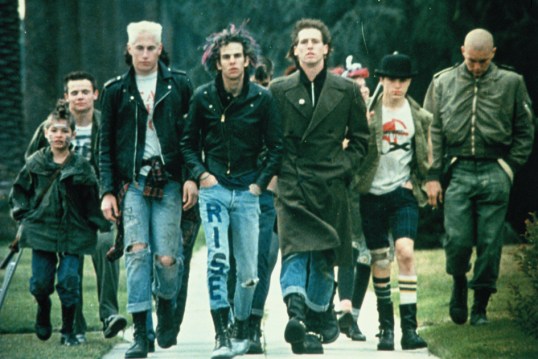
Spheeris filled the film with non-actors and local Los Angeles musicians (A very young Flea plays one of the residents of the house) and, as a result, Suburbia features some of the most wooden performances and awkward line readings that I have ever seen or heard.  But, what the cast lacks in acting ability, they make up for with the right attitude and the right look.  And you can see that in perhaps the film’s best and most iconic scene, the infamous punk parade.

And you can watch that parade below!