When renowned radio psychiatrist George Matlin (Charles Grodin) has a nervous breakdown, he takes a trip to Europe with his wife (Mary Gross) to both recover and also work on his marriage. (Matlin’s breakdown was the result of an extramarital affair.) Needing someone to host Dr. Matlin’s radio show, his producers call Dr. Lawrence Baird (David Clennon), who oversees a mental facility in Chicago. They assume that Dr. Baird is just dumb enough that they won’t have to worry about him overshadowing Dr. Matlin while he’s guest-hosting. However, when they call, Dr. Baird is out of his office and the phone is answered by John Burns (Dan Aykroyd), a con artist who has been pretending to be insane so that he can avoid serving time in prison. Pretending to be Baird, Burns accepts their offer and then escapes from the asylum and heads to Beverly Hills. The real Dr. Baird, not knowing about the offer, goes on vacation in Europe. Though Burns had originally only been planning on doing the radio job long enough to get paid enough money to head to Mexico, he soon becomes a celebrity with his non-nonsense, blunt advice.
There’s a lot of talented people in TheCouchTrip, including Walter Matthau as a former priest-turned-kleptomaniac and Aykryod’s wife, Donna Dixon, as Matlin’s colleague and Burns’s eventual love interest. Director Michael Ritchie was responsible for some of the best films of the 70s and radio psychiatry is certainly a ripe subject for satire. Why, then does, The Couch Trip fall flat? Some of it is because the movie never seems to know if it wants to be wacky farce or a dramedy about a criminal who finds a new life helping people. The other big problem is that the talented Dan Aykroyd is miscast as the type of unapologetic smartass that Bill Murray could play in his sleep. (In a version where Murray played John Burns, Aykroyd would have been perfect casting as George Matlin.)
Aykroyd was one of the most talented members of the original Not Ready For Prime Time Players. (His impersonations of Nixon and Jimmy Carter were second-to-none.) Sadly, Hollywood has never figured out what to do with his off-center talent. The Couch Trip is a prime example of that.
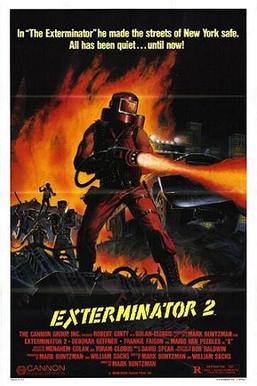
Four years after the end of the first Exterminator, the man they drove too far is driven too far again….
As you may remember, the first Exterminatorended with the CIA shooting vigilante John Eastland (Robert Ginty) because Eastland’s anti-crime activities were somehow making the President look bad. The wounded Eastland fell into the Hudson River. “Washington will be pleased,” the CIA agent said to the gunman. However, the film’s final shot revealed that Eastland had survived his plunge.
1984’s Exterminator 2 opens with Eastland returning to New York City. He’s got a small apartment and a police scanner and when he hears a report that an elderly couple is being menaced by a group of thugs, he puts on a welding mask and uses his flame thrower to set the criminals on fire. Of course, he doesn’t actually arrive in time to save the old couple from getting shot and killed. Just because Eastland has decided to become a vigilante, that doesn’t mean that he’s particularly good at it.
The first Exterminator was a grim and gritty thriller that took itself very seriously. In fact, one could argue that it took itself a bit too seriously. Exterminator 2, which was produced by Cannon Films, takes a slightly different approach. This is obvious as soon as Mario Van Peebles shows up as X, a cult leader who is looking to take over the New York drug trade. Van Peebles, with his model good looks and his quick smile, is not exactly the most intimidating of villains. And X is not exactly the most brilliant of bad guys. For one thing, he drives a car with a big red X spray painted on one of the doors, which doesn’t seem to be the smartest thing to do when you have both the police and crazed vigilante hunting for you.
Fortunately, for X, John Eastland is easily distracted. After he sets a few people on fire, he seems to lose interest in actually being a vigilante and instead, a large portion of the film is taken up with him getting a job collecting garbage with his friend, Be Gee (Frankie Fasion). (Much like the previous film’s Michael Jefferson, Be Gree served with Eastland in Nam.) Eastland also meets and falls in love with a dancer named Caroline (Deborah Geffner). Unfortunately, a trip to Central Park leads to Caroline getting attacked by a bunch of X’s followers. With Caroline in a wheelchair, Eastland has little choice but to pick up his flame thrower and transform his garbage truck into a tank of destruction….
Exterminator 2‘s production was a troubled one. Director Mark Buntzman was one of the producers of the first Exterminator and apparently, Cannon disliked his first cut of Exterminator 2. Director William Sachs (who was Cannon’s resident “film doctor”) was brought in to do extensive reshoots in Los Angeles. Unfortunately, by the time Sachs was brought in, Robert Ginty had already moved on to another project and Sachs was forced to use his stunt double for any scenes involving Eastland. (This is one reason why Eastland spends much of the film wearing a welder’s mask.) Also because of Ginty’s absence, Sachs ended up adding a lot of scenes that focused on Van Peebles’s performance as X, with the end result being that the film often seems to be more about X and his gang than it is about Eastland and his hunt for revenge. (Unfortunately, this also led to a lot of unresolved subplots, including one in which X orders one of his roller skating henchman to kidnap a woman off the street so she can be used to test a new batch of heroin.) Many of the scenes featuring Ginty have a totally different feel to them from the scenes featuring Van Peebles and Ginty’s stunt double.
The end result is a film that really doesn’t have any sort of narrative momentum. One is never really sure what either X or Eastland is hoping to accomplish. Instead, they just kind of wander around until they have their final confrontation. Along the way, there’s a few poorly edited fights but there’s also a lot of scenes that are just included to serve as filler. As I already mentioned, Van Peebles is not a particularly menacing villain but Ginty also isn’t a particularly compelling hero. Ginty’s goofy screen presence was nicely subverted by the grime and grit of the first Exterminator but, in the second film, he just comes across as being petulant and even a bit whiny.
The first Exterminator famously ended with the lines, “Washington will be pleased.” I don’t think anyone would particularly be pleased with Exterminator 2. As a final note, I will admit that I was so bored with this film that, when I watched it, I barely noticed when it ended and Tubi segued into showing a film called Executioner 2. That pretty much sums up the entire Exterminator 2 experience.
2012’s Atlas Shrugged: Part II picks up where Part I left off.
The time is still the near future. (Part I specifically set the story as taking place five years into the future. Part II declines to use a specific date but it does feature some news personalities playing themselves so it’s still clearly only meant to be a few years from 2012.) The economy has gotten even worse. The poor are only getting poorer while the rich are getting richer. Under the direction of Head of State Thompson (Ray Wise) and his main economic advisor, Wesley Mouch (Paul McCrane), the government has nationalized nearly every business. Halfway through the film, Thompson declares a national emergency and uses the Fair Share Law to invoke Directive 10-289. All inventors, businessmen, and other creative people are required to sign their patents over to the government and to stop trying to develop now techniques. Wages are frozen. No one can be fired and no one can be hired. Creative thinking is discouraged. Asking questions or expressing doubt is forbidden. People are encouraged to snitch on anyone not following the Directive. Thompson and Mouch insist that it’s for the “good of the people,” and anyone who disagrees runs the risk of being dragged into court and sent to prison for ten years. Meanwhile, gas now costs $42.00 a gallon. One of the funnier moments of the film features someone paying $865.72 to fill up a truck.
Dagny Taggart (Samantha Mathis), the Vice President of Taggart Transcontinental Railways, is still trying to discover who invented an experimental motor that she found hidden away in a mine. The motor could potentially change the way that goods are transported but it appears to be missing one component. Unfortunately, all of the great scientists and inventors have been vanishing, with many of them leaving behind notes that ask, “Who is John Galt?” Meanwhile, Dagny’s lover, Hank Rearden (Jason Beghe), fights to protect Rearden Metal from being taken over by the government and Dagny’s brother, James (Patrick Fabian), sells out to Wesley Mouch with the end result being that there’s no one left at Taggart Transcontinental with the intelligence or the experience necessary to keep two trains from colliding in a tunnel.
Given that Ayn Rand herself was an atheist who wrote very critically of religion, it’s interesting how much of Atlas Shrugged: Part II feels like one of those evangelical films where the Rapture comes and the entire world falls apart because all of the believers have suddenly vanished. In the case of Atlas Shrugged, the world falls apart because all of the creatives and all of the leaders of industry and all of the innovative thinkers have abandoned it so that they can create a new community with John Galt. (They’ve “stopped the motor of the world.”) In many ways, this is the ultimate in wish fulfillment, a way of declaring, “They’ll miss me when I’m gone!” Indeed, the majority of people who keep a copy of Rand’s novel displayed on their bookcase do so because they believe that they would be one of the lucky ones who was approached by Galt. No one expects that they’ll be the person left behind to try to run the railroad. It’s a bit like how like the most strident Marxist activists always assume they’ll be the ones organizing the workers as opposed to being a worker themselves.
Not surprisingly, the same critics who attacked Part I didn’t care much for Atlas Shrugged Part II. When I first saw it, I thought the film was a bit too long and I was annoyed that, with the exception of a few minutes at the end, the film didn’t really seem to move the story forward. At the same time, just as with the first film, I appreciated the fact that the second film was proudly contrarian in its portrayal of the government as being inherently incompetent. After all, this was 2012, back in the “good government” era, when a lot of people still reflexively assumed that the government was staffed only by hyper-competent policy wonks who knew what they were doing and who were only concerned with making sure that “the trains ran on time,” to borrow an old expression.
Rewatching the film this weekend, I have to say that I actually appreciated Atlas Shrugged Part II a bit more than the first time I watched it. Yes, Part II was still a bit too long and the domestic drama between Hank and his wife fell flat but Part II is still a marked improvement on the first film. Some of that is because Part II had a higher budget than Part I and, as a result, it didn’t look as cheap as the first film. The corporate offices looked like actual corporate offices and the factories looked like real factories. Secondly, the second film had an entirely different cast from the first film. Samantha Mathis, Jason Beghe, and especially Patrick Fabian were clear improvements on the actors who previously played their roles. That’s especially important when it comes to Mathis and Beghe because, as opposed to the first film, Part II convinces the viewer that Dagny and Hank actually are as important as they think they are. When the trains collide in the tunnel, the viewer never doubts that Mathis’s Dagny could have prevented the disaster if not for the government’s attempts to force her out of her own company. As well, the viewer never doubts that Beghe’s Hank would fight to the end to protect his business, even if it means prison. One wouldn’t have necessarily believed that while watching the first film.
Finally, having lived through the COVID era, the film’s portrait of government overreach and incompetence feels a lot more plausible when watched today. One doesn’t have to be a fan of Rand’s philosophy or agree with her solutions to see the parallels between Directive 10-289 and the policies that led to children being kept out of schools and numerous small business having to shut their doors. In an era when most people’s faith in governmental institutions has been broken to such an extent that it might never be fixed in our lifetime, Atlas Shrugged Part II resonates. Whereas the film once felt subversive, now it feels downright prophetic.
If you have ever wonder why Burt Reynolds, despite receiving an Oscar nomination for Boogie Nights and being a favorite of so many of the up-and-coming directors of the 90s and early 2000s, never made a real comeback, you only have to watch Big City Blues.
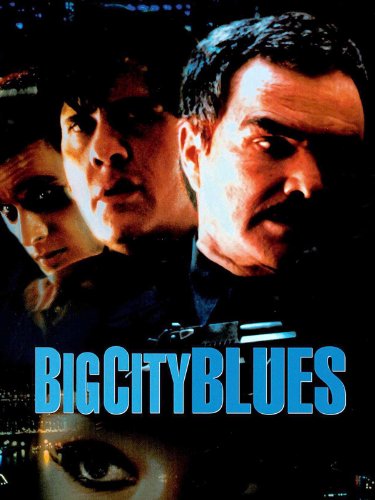
In Big City Blues, Burt plays a hitman who loves to watch and talk about old movies. Over the course of one very long night, Burt and his partner (played by William Forsythe) drive through the city. In between doing violent jobs for their boss, they talk. Burt talks about movies. Forsythe talks about how he doesn’t understand Burt’s love of the movies. They talk nonstop and if this is making you think of Pulp Fiction, it’s probably intentional. Today, I think people forget just how many Pulp Fiction rip-offs were released throughout the 90s, all featuring talkative criminals who were obsessed with pop culture. Burt Reynolds and William Forsythe have got the equivalent of the roles played by John Travolta and Samuel L. Jackson. Unfortunately, Reynolds and Forsythe don’t have the same chemistry as Travolta and Jackson. You believed that Travolta and Jackson had been working together for years and, when they talked, that they were having an actual conversation. Despite both of them being credited as executive producers on the film, Reynolds and Forsythe come across as being two talented actors who are phoning it in for a paycheck.
When the film isn’t focused on Reynolds and Forsythe, it follows two trans women (played by Giancarlo Esposito and Ayre Gross) as they walk around the city and debate whether or not Esposito should get sex reassignment surgery. When it’s not following Esposito and Gross, it’s focusing on a sex worker (Georgina Cates) who wants to be a movie star and who keeps seeing evidence that she has a doppelganger who is living the respectable life that she craves. Cates searches for her doppelganger while also servicing her clients, who are all typical middle-aged pervs. (One gets off from listening to Cates sing Ol’ McDonald Had a Farm.) Eventually, the paths of all the characters cross and Reynolds talks about how life is just celestial roulette.
Big City Blues doesn’t add up to much. Like many 90s indie films, the characters are all talkative to the point of feeling like parodies. (When the movie isn’t trying to rip-off Quentin Tarantino, it feels like a half-baked imitation of Richard Linklater.) Even the likable performances of Cates, Esposito, and Gross can’t overcome how overwritten and derivative the script feels. Beyond the script, the film just looks bad. All of the scenes take place at night and the lighting is often so dark that it’s impossible to see what’s actually happening from scene to scene. It feels amateurish.
So why was Burt Reynolds in this? This was the first film that Reynolds made after the filming of Boogie Nights. Probably thinking that Boogie Nights would flop, Reynolds signed up to appear in this Pulp Fiction knock-off, which is something that many former stars did in the 90s. Instead of flopping, Boogie Nights turned out to be the film that reminded everyone that Reynolds could be a very good actor with the right material. Unfortunately, Reynolds himself didn’t think much of the film and, perhaps even worse as far as Hollywood was concerned, he was open about not thinking much of the film. As a result, even with that Oscar nomination, Reynolds didn’t get the type of career resurrection that John Travolta got from Pulp Fiction and Robert Forster and Pam Grier got from Jackie Brown. That’s too bad. Burt Reynolds deserved better.
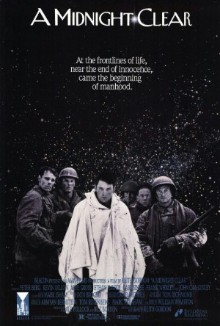
In December of 1944, with the world at war and Christmas approaching, a small U.S. Army Intelligence squad is sent to a deserted chateau near the German lines. The squad, which was decimated during the Battle of the Bulge, is made up of six young soldiers who all have genius IQs. They’ve been hardened by war but they’re still young enough to have some hope for the future. Leading them is “Mother” Wilkinson (Gary Sinise), an officer who cares about his men but who has been mentally struggling with not only the war but also with the recent death of a child back home.
At first, the chateau seems like a perfect sanctuary, a place to wait for the war to end. But then the Americans discover that there is a regiment of German soldiers nearby. The Germans are just as young as the Americans and when the two groups meet each other, they don’t fire their guns but instead have a snowball fight. The Germans say that they know the war is about to end and that they want to surrender before the Russians arrive. However, the Germans are worried about their families back home and what will happen when word gets back that they’ve surrendered. They request a staged fight so that it will appear that they were captured in combat. Almost everyone is down with the plan but it turns out that it’s not easy to fake a war in the middle of a real one.
Based on a novel by William Wharton, A Midnight Clear is one of the best Christmas films that hardly anyone seems to have heard of. It’s a war film that is more concerned with the men who fight the wars than with the battles. Along with Sinise, the ensemble cast includes Ethan Hawke, Peter Berg, Kevin Dillon, Ayre Gross, Frank Whaley, and John C. McGinley and all of them make an impression, bringing their characters to life. By the end of the movie, you feel like you know each member of the squad and their individual fates hit you hard. Some of them make it to the next Christmas and tragically, some of them don’t. The film starts out almost gently and all of the soldiers are so intent on just letting the war end while they hide out at the chateau that you find yourself believing that it could actually happen. When reality intrudes, it’s tragic and poignant. Intelligently directed by Keith Gordon (making his directorial debut), A Midnight Clear is an unforgettable anti-war story that has an amazing final shot. A Midnight Clear makes an impression on Christmas and every other day.
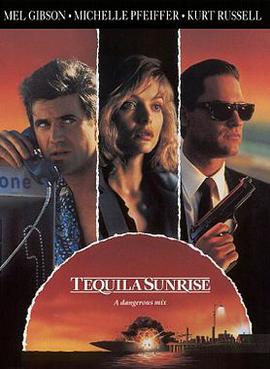
Mac (Mel Gibson) and Nick (Kurt Russell) are old friends who are on opposite sides of the law. Mac was once a legendary drug dealer though he says that he’s now retired. Nick is a narcotics detective with the Los Angeles County Sheriff’s Department. Early on, Nick warns Mac that, if he is dealing again, he’s going to have to arrest him. Mac says that he has no interest in getting back into the business but no one believes him.
Mac is actually more interested in Jo Ann Valleneri, who owns his favorite restaurant. Since Jo Ann is played by Michelle Pfeiffer, who can blame him?. After tracks Mac to the restaurant, he becomes attracted to Jo Ann too and again, it’s impossible to blame him. Soon, Jo Ann and Nick are a couple but is Nick just using her to find out about Mac’s relationship with a mysterious drug lord named Carlos? And when Mac moves in and starts his own relationship with Jo Ann, does he really love her or is he using her to throw Nick off of his trail?
Tequila Sunrise should be a great film but instead, it’s only a good one. It has all the elements of greatness — Michelle Pfeiffer at her sultriest, Kurt Russell at his coolest, and Mel Gibson before he lost his mind. It also has a good supporting cast, including Raul Julia, J.T. Walsh, and Arliss Howard. Ultimately, it doesn’t really come together because the film’s director and screenwriter, Robert Towne, doesn’t seem to be sure what type of story he wants to tell. Tequila Sunrise could have either been a great crime thriller or a steamy love story but, by trying to be both, it gets bogged down in its own convoluted plot. That probably won’t matter to most viewers, though. Not when Russell, Gibson, and Pfeiffer are all on screen together at the same time. Tequila Sunrise tries to be many things but it works best as a celebration of movie star charisma.
One final note: The film looks great. Visually, this is one of the ultimate California films. Cinematographer Conrad Hall received an Oscar nomination for his work on this film and it was more than deserved.
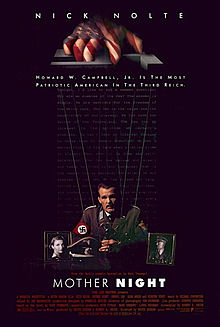
Four years after she played the mysterious (and dead) Laura Palmer in Twin Peaks, Sheryl Lee starred as another mysterious (and possibly dead) woman in Mother Night.
Lee is cast as Helga Noth, the German wife of American expatriate Harold W. Campbell (Nick Nolte). Harold is a playwright, living in Berlin and doing propaganda broadcasts for the Nazis. Working with Frank Wirtanen (John Goodman), a military intelligence officer, Campbell has developed a series of verbal tics that are meant to secretly deliver information to the Allied Forces. It is never clear whether Harold’s information serves any real purpose just as it is left ambiguous as to whether Harold believes any of the anti-Semitic propaganda that he broadcasts over the airwaves. Working as both a propagandist and a double agent, Harold serves both the Allies and the Axis.
In the final days of the war, Helga is reportedly killed on the Eastern Front and Harold is captured by the Americans. Frank arranges for Harold to be quietly sent to New York City but tells him that the government will never admit that they used him as a double agent.
Harold spends the next fifteen years living an isolated life in New York. His only friend is an elderly painter, Kraft (Alan Arkin), with whom he plays chess. Eventually, Harold opens up to the painter and talks about his past. Kraft, for his own shady reasons, reveals Harold’s identity to a group of neo-Nazis. Though Harold initially wants nothing to do with them, this changes when they reveal that they have Helga.
Or do they? Almost no one in Mother Night is who they claim or what they seem to be, especially not Harold.
Based on a novel by Kurt Vonnegut, Mother Night suffers from the same uneven quality that seems to afflict most films based on Vonnegut’s work. It is easy to go overboard when it comes to bringing Vonnegut’s unique mix of drama and satire to the screen and Mother Night does that in a few scenes, especially once Harold reaches New York. It is still an intriguing and thought-provoking film, though. Nick Nolte gives one of his best performances as Harold and Sheryl Lee does a good job in a difficult role.
The pinnacle of Vonnegut films remains George Roy Hill’s version of Slaughterhouse-Five but Mother Night is still superior to something like Alan Rudolph’s adaptation of Breakfast of Champions.
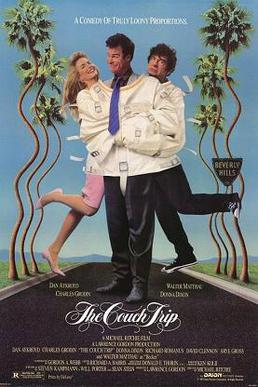 When renowned radio psychiatrist George Matlin (Charles Grodin) has a nervous breakdown, he takes a trip to Europe with his wife (Mary Gross) to both recover and also work on his marriage. (Matlin’s breakdown was the result of an extramarital affair.) Needing someone to host Dr. Matlin’s radio show, his producers call Dr. Lawrence Baird (David Clennon), who oversees a mental facility in Chicago. They assume that Dr. Baird is just dumb enough that they won’t have to worry about him overshadowing Dr. Matlin while he’s guest-hosting. However, when they call, Dr. Baird is out of his office and the phone is answered by John Burns (Dan Aykroyd), a con artist who has been pretending to be insane so that he can avoid serving time in prison. Pretending to be Baird, Burns accepts their offer and then escapes from the asylum and heads to Beverly Hills. The real Dr. Baird, not knowing about the offer, goes on vacation in Europe. Though Burns had originally only been planning on doing the radio job long enough to get paid enough money to head to Mexico, he soon becomes a celebrity with his non-nonsense, blunt advice.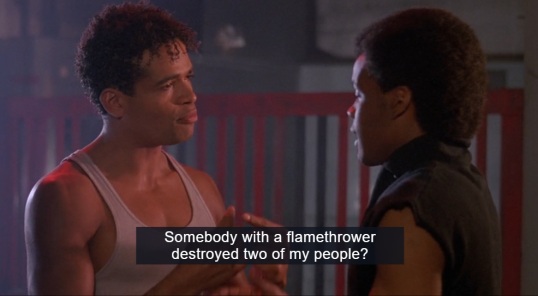

 Four years after she played the mysterious (and dead) Laura Palmer in Twin Peaks, Sheryl Lee starred as another mysterious (and possibly dead) woman in Mother Night.
 Through the Shattered Lens