8 Shots From 8 Films: Special Robert Evans Edition


4 Or More Shots From 4 Or More Films is just what it says it is, 4 shots from 4 of our favorite films. As opposed to the reviews and recaps that we usually post, 4 Shots From 4 Films lets the visuals do the talking!

95 years ago today, Robert Evans was born in New York City.  He started out working in his brother’s clothing business but a chance meeting with actress Norma Shearer led to him becoming an actor.  And while Evans, by his own account, was not a particularly good actor, he did prove himself to be very skilled at playing the games of Hollywood.  Evans eventually moved from acting to production, first as an executive at Paramount and then as an independent producer.

He lived a life as glamorous and tumultuous as the stars of his pictures and his memoir, The Kid Stays In The Picture, is considered to be one of the classic show biz autobiographies.  He hung out with cinematic rebels like Jack Nicholson and Robert Towne and counted Secretary of State Henry Kissinger as a friend.  He suggested that Francis Ford Coppola should direct The Godfather and, when Paramount put pressure on Coppola to cut the film down to two hours, it was Evans who famously announced that a two-hour Godfather was nothing more than a trailer.  He lost Ali MacGraw to Steve McQueen and, again by own account, he lost a lot of potentially productive years to cocaine.  (The Cotton Club scandal is one of the wildest in the history of Hollywood, though it should be noted that Evans himself was never charged with any wrongdoing.)  But, for all that he lost, Evans continues to gain admirers as being the epitome of the producer who was willing to take chances.  For all of his flamboyance, Evans had an eye for good material and the willingness to protect his directors.  In many ways, he was as important to the cinematic revolution of the 70s as the directors that he hired.  When Evans passed away in 2019, it was truly the end of an era.

Here, in honor of the birth and legacy of Robert Evans, are 8 Shots from 8 Films that Evans produced, either as studio chief at Paramount or as an independent producer.

8 Shots From 8 Robert Evans Films

Rosemary’s Baby (1968, dir by Romnn Polanski, DP: William A. Fraker)

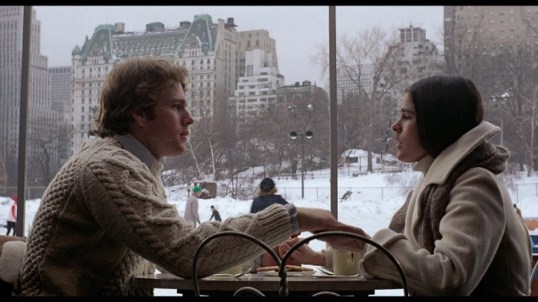
Love Story (1970, dir by Arthur Hiller, DP: Richard Kratina)

The Godfather (1972, dir by Francis Ford Coppola, Cinematography by Gordon Willis)
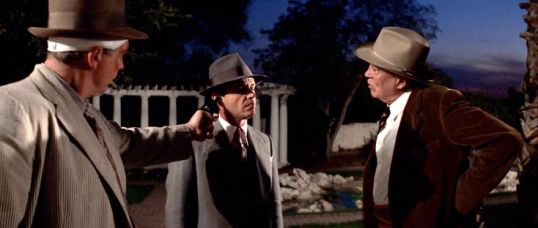
Chinatown (1974, dir by Roman Polanski, DP: John A. Alonzo)

Marathon Man (1976, dir by John Schlesinger, DP: Conrad Hall)

The Cotton Club (1984, dir by Francis Ford Coppola, DP: Stephen Goldblatt)
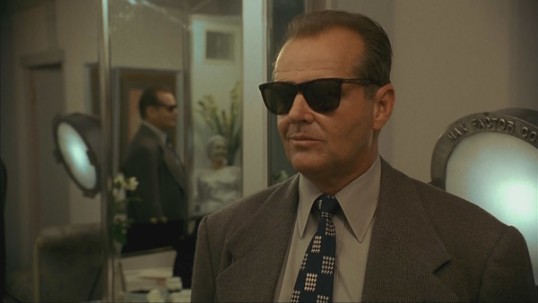
The Two Jakes (1990, dir by Jack Nicholson, DP: Vilmos Zsigmond)

Sliver (1993, dir by Phillip Noyce, DP: Vilmos Zsigmond)

4 Shots From 4 Films: Special “Love” Edition


4 (or more) Shots From 4 (or more) Films is just what it says it is, 4 (or more) shots from 4 (or more) of our favorite films. As opposed to the reviews and recaps that we usually post, 4 (or more) Shots From 4 (or more) Films lets the visuals do the talking.

Valentine’s Day is right around the corner!  Let’s get a head start!

4 Shots From 4 “Love”ly Films

Love Story (1970, dir by Arthur Hiller, DP: Richard Kratina)

The Spy Who Loved Me (1977, dir by Lewis Gilbert, DP: Claude Renoir)

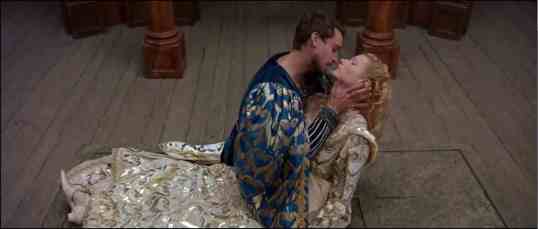
Shakespeare In Love (1998, dir by John Madden, DP: Richard Greatrex)

Only Lovers Left Alive (2013, dir by Jim Jarmusch, DP: Yorick Le Saux)

Film Review: The Man In The Glass Booth (dir by Arthur Hiller)


Who is Arthur Goldman?

That’s the question at the heart of the 1975 film, The Man In The Glass Booth.

When we first meet Arthur Goldman (Maximilian Schell), he is a wealthy businessman who lives in a Manhattan high-rise and who appears to rarely leave the safety of his penthouse.  He is waited on by two assistants, Jack (Henry Brown) and Charlie (Lawrence Pressman), both of whom he talks to and treats as if they are members of his own family.  His most frequent visitor is his psychiatrist, Dr. Weissburger (Robert H. Harris), who frequently stops by and asks Arthur if he’s been taking his medication.

Arthur Goldman is a man who loves to talk.  Indeed, the first hour of the film feels almost like a nonstop monologue on the part of Goldman, with just occasional interjections from the other characters.  Goldman was born in Germany.  He talks about how, when he was young, he and his family were sent to a concentration camp and it was there that he witnessed the murder of his father by the camp’s sadistic commandant, Dorff.  Dorff is one of the many Nazis who disappeared to South America at the end of the war.

When Goldman spots a car that always seems to be parked across the street from his building, he becomes paranoid.  He says that he’s being watched and even suggests that Dorff has come to capture him.  Instead, it turns out that Mossad come for him.  As the agents explain it to Charlie, dental records prove that Arthur Goldman is actually Commandant Dorff.  Goldman/Dorff is taken back to Israel to stand trial for his crimes.

Are Arthur Goldman and Dorff the same man?  Once in Israel, Goldman tells anyone who will listen that he is Dorff and that he feels no guilt for his actions.  He insists on being allowed to wear his SS uniform during the trial.  Because of threats to his safety, a booth made of bullet-proof glass has been placed in the courtroom.  As the trial commences, The Man in the Glass Booth continues to rant and rave and declare his guilt.  However, the prosecutor (Lois Nettleton) comes to doubt that the man is who he says he is.

The Man In The Glass Booth is based on a novel and play by Robert Shaw.  (The same year that The Man In The Glass Booth was released, Shaw played Quint in Jaws.)  The film was produced as a part of an experiment called American Film Theatre, in which well-known plays would be adapted to film and then would be shown at 500 participating movie theaters in America.  Each production would only be shown four times at each theater and subscriptions were sold for an entire “season” of films.  It sounds like an interesting experiment and the type of thing that I would have enjoyed if I had been around back then.  Today, of course, these productions would have just premiered on a streaming service.

The Man In The Glass Booth is a film that very much feels like a filmed play.  There are only three locations — Goldman’s penthouse, his cell, and the courtroom where he is put on trial.  The three act structure is very easy to spot.  Maximilian Schell’s performance is also very theatrical.  In fact, it’s so theatrical that, for the first hour or so, I found myself wishing that he would just stop talking for a few second or two.  He was so dramatic and so flamboyant and so intentionally over-the-top that he became somewhat exhausting.  But, during the second hour, I came to see that all of that “overacting” was actually setting up the film’s final act.  Schell talks so much that, when he finally does find himself unable to explain himself, it’s a shocking moment and one that perfectly captures not just the evil of the Nazis and the Holocaust but also how the legacy of that evil lives on after the fall of the Third Reich and the deaths of the majority of the Holocaust’s perpetrators.  At that moment, I realized that The Man In The Glass Booth never stopped speaking because silence would force him to confront the horrors of the past and the trauma, guilt, and uncertainty lurking in his subconscious.  Maximilian Schell was nominated for an Oscar for his performance here and, by the end of the film, I totally understood why.

The Man In The Glass Booth requires some patience.  Actually, it requires a lot of patience.  However, those who stick with it will discover an intelligent and thought-provoking film about not only the horror of the past but also how those in the present deal with and rationalize those horrors.  Though the film is a bit too stagey for its own good, it’s also one that sticks with you even after the curtain falls and the end credits roll.

8 Shots From 8 Films: Special Robert Evans Edition


4 Or More Shots From 4 Or More Films is just what it says it is, 4 shots from 4 of our favorite films. As opposed to the reviews and recaps that we usually post, 4 Shots From 4 Films lets the visuals do the talking!

92 years ago today, Robert Evans was born in New York City.  He started out working in his brother’s clothing business but a chance meeting with actress Norma Shearer led to him becoming an actor.  And while Evans, by his own account, was not a particularly good actor, he did prove himself to be very skilled at playing the games of Hollywood.  Evans eventually moved from acting to production, first as an executive at Paramount and then as an independent producer.

He lived a life as glamorous and tumultuous as the stars of his pictures and his memoir, The Kid Stays In The Picture, is considered to be one of the classic show biz autobiographies.  He hung out with cinematic rebels like Jack Nicholson and Robert Towne and counted Secretary of State Henry Kissinger as a friend.  He suggested that Francis Ford Coppola should direct The Godfather and, when Paramount put pressure on Coppola to cut the film down to two hours, it was Evans who famously announced that a two-hour Godfather was nothing more than a trailer.  He lost Ali MacGraw to Steve McQueen and, again by own account, he lost a lot of potentially productive years to cocaine.  (The Cotton Club scandal is one of the wildest in the history of Hollywood, though it should be noted that Evans himself was never charged with any wrongdoing.)  But, for all that he lost, Evans continues to gain admirers as being the epitome of the producer who was willing to take chances.  For all of his flamboyance, Evans had an eye for good material and the willingness to protect his directors.  In many ways, he was as important to the cinematic revolution of the 70s as the directors that he hired.  When Evans passed away in 2019, it was truly the end of an era.

Here, in honor of the birth and legacy of Robert Evans, are 8 Shots from 8 Films that Evans produced, either as studio chief at Paramount or as an independent producer.

8 Shots From 8 Robert Evans Films

Rosemary’s Baby (1968, dir by Romnn Polanski, DP: William A. Fraker)

Love Story (1970, dir by Arthur Hiller, DP: Richard Kratina)

The Godfather (1972, dir by Francis Ford Coppola, Cinematography by Gordon Willis)

Chinatown (1974, dir by Roman Polanski, DP: John A. Alonzo)

Marathon Man (1976, dir by John Schlesinger, DP: Conrad Hall)

The Cotton Club (1984, dir by Francis Ford Coppola, DP: Stephen Goldblatt)

The Two Jakes (1990, dir by Jack Nicholson, DP: Vilmos Zsigmond)

Sliver (1993, dir by Phillip Noyce, DP: Vilmos Zsigmond)
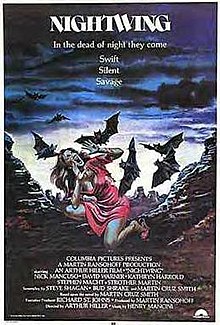
Nightwing (1979, directed by Arthur Hiller)


Cattle and humans are dying in New Mexico at an alarming rate.  Scientist Phillip Payne (David Warner) thinks that the local bat population has become infected with the plague.  Deputy Youngman Duran (Nick Mancuso) thinks that the bats may be attacking because of a curse that was cast by a Hopi medicine man.  Meanwhile, the corrupt tribal chief (Stephen Macht) just wants to sell the land to an evil land developer (Ben Piazza) and be done with it.  Dr. Anne Dillion (Kathryn Harrold) tries to spread the word about the bats but the authorities don’t want the bad publicity.  They’ve never seen Jaws.  And, finally, a group of missionaries camp in the desert with no idea what’s about to swoop down on them.

I don’t know about you but I would never think of missing an Arthur Hiller horror movie!  While many directors in the 70s proudly wore the auteur and rebel label, Arthur Hiller went the opposite route.  He oversw conventional, Hollywood productions, the best known of which was Love Story.  Arthur Hiller was so mainstream that he eventually served as President of the Academy.  This is all to say that Arthur Hiller directed some good films and he directed some bad films but, with his total lack of any sort of personal vision, he was absolutely the wrong director to do a horror movie.  Hiller’s direction is flat.  He’s not mean-spirited enough to enjoy the bat attacks and instead, he focuses on the debate over whether white developers should be buying native land, as if the people watching this movie are going to be watching for the human drama.  By the end of the film, the bats have almost been abandoned and the movie turns into an action film, with a group of survivors fighting off Stephen Macht’s security force.

The most interesting thing about Nightwing is catching Strother Martin, the veteran western actor who memorably talked about a failure to communicate in Cool Hand Luke, as an ex-missionary.  Otherwise, the film pales in comparison to The Birds and Wolfen, the two films which it must resembles in theme and action.

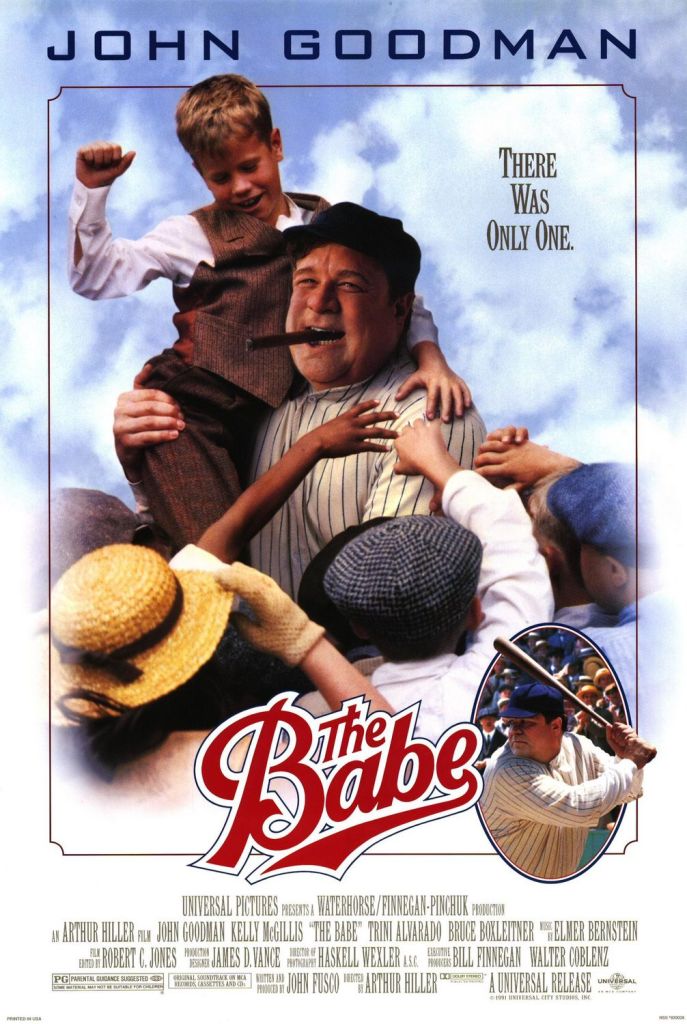
The Babe (1992, dir. by Arthur Hiller)


John Goodman. He’s a good actor but not a very convincing baseball player.

Last night, I watched The Babe, which starred John Goodman as Babe Ruth. Babe Ruth was one of the greatest baseball players of all time, the first of the great sluggers, and the holder of the career home run record from 1935 to 1974. He was the type of player that I wish The Rangers had right now because we’ve got a 22-27 records right now and the only bright spot is that we’re doing better than the Angels.

The Babe starts in 1902, with George Herman Ruth getting dropped off at reform school and learning how play baseball from Brother Matthias (James Cromwell) and then follows Ruth through his career, his first failed marriage, his attempts to become a manager, and his eventual retirement from the game. At first, everyone makes fun of the Babe because he’s not very sophisticated and all he wants to do is hit the ball. Then he shuts them all up by knocking ball after ball out of the park. Babe Ruth was a big man, like John Goodman. But he was also a great athlete. Goodman looked like he was in pain every time he had to swing the bat. Maybe that explains why Goodman plays the Babe as if he never actually enjoyed one minute of playing baseball.

The Babe is like a highlight reel of famous anecdotes. Babe Ruth hits his first home run in the Big Leagues. Babe Ruth promises a sick child that he’ll hit two home runs. Babe Ruth calls his shot. Babe Ruth hits three homers during his final game. In real life, Babe Ruth retired after he injured his knee. In the movie, he retires after he hears an owner talking about how having Babe on the team is only good for selling tickets to the rubes. All the famous Babe Ruth stories are here, along with all of the drinking and the womanizing. The movie never digs too deep into what made Babe tick or what it was like to be the most famous and popular athlete in America. It never even really explores how Babe Ruth changed the sport of baseball. Watching The Babe, you would never know that home runs weren’t even considered to be an important part of the game until Ruth established himself as someone who could hit one ball after another out of the park. The best baseball movies make you feel like you’re either out on the field with the player or you’re in the stands with the fans and they make you want to stand-up and cheer with every hit and every run across home plate. The Babe never does that. There’s no love of the game in The Babe.

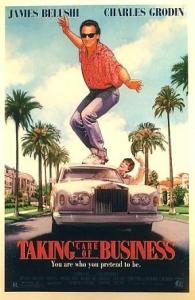
A Movie A Day #250: Taking Care of Business (1990, directed by Arthur Hiller)


Jimmy Dworski (Jim Belushi) is a convicted car thief who only has a few days left in his criminal sentence but still decides to break out of prison so he can go see the Cubs play in the World Series.  Spencer Barnes (Charles Grodin) is an uptight ad executive who needs to learn how to relax and have a good time.  When Spencer loses his organizer, Jimmy finds it.  Before you can say “The prince and the pauper,” Jimmy has access to all of Spencer’s money and the mansion that Spencer is supposed to be staying at over the weekend.  While Spencer tries to survive on the streets and track down his organizer, Jimmy is living it up, spending money, impressing a Japanese businessman (Mako), romancing the boss’s daughter, and taking care of business.
Made in the uncertain period between the end of the culture of 80s materialism and the start of the 90s indie boom, Taking Care of Business is a rip-off of Trading Places that came out six years too late to be effective.  Everything that needs to be known about Jimmy and Spencer is apparentl from the minute that Charles Grodin’s and Jim Belushi’s names appear in the credits.  Grodin was usually the best when it came to playing uptight yuppies but he seems bored in Taking Care of Business.  Belushi mugs through his role, overplaying his character’s blue collar roots.  The movie builds up to a huge confrontation between Belushi and Grodin but it never really delivers, instead devolving into a predictable buddy comedy, complete with a trip to Wrigley Field and an elaborate plan to sneak Belushi back into prison before the warden (Hector Elizondo) discovers that he’s been gone for the weekend.  Taking Care of Business has a few laughs but it’s never as good as the BTO song.

Horror on TV: Thriller 1.1 “The Twisted Image”


Tonight’s excursion into televised horror is the very first episode of Boris Karloff’s Thriller!

Thriller was an anthology series that lasted from 1960 to 1962.  Each episode presented a new story of horror and/or suspense.  What makes this series especially memorable is that each episode was introduced by none other than Boris Karloff!  I’ve seen a few episodes of Thriller (the entire series is on YouTube) and, to be honest, it’s kind of a hit-or-miss show.  But Karloff and that mischievous twinkle in his eye makes it all worth it!

This episode originally aired on September 13th, 1960.  It’s called The Twisted Image and stars Leslie Neilsen as a man being stalked by two mentally disturbed individuals.  This episode was well-directed by Arthur Hiller and, if it’s more of a suspense story than a horror story, it still has its creepy moments.

Enjoy!

Arthur Hiller: An Appreciation


gary loggins's avatarcracked rear viewer

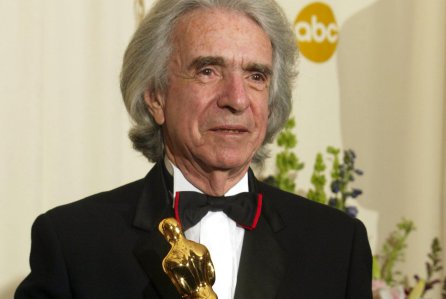
Mandatory Credit: Photo by Peter Brooker/REX/Shutterstock (379086do) ARTHUR HILLER OSCARS / ACADEMY AWARDS AT THE KODAK THEATRE, LOS ANGELES, AMERICA - 24 MAR 2002

The name Arthur Hiller doesn’t really spring to mind when I think about great directors. However, when I heard the news he passed away last night at age 92, I looked him up on the IMDb. Much to my surprise, Arthur Hiller was responsible for some of my favorite funny films. Hiller wasn’t a distinct stylist or auteur, just a skillful handler of actors with a deft touch for comedy. In remembrance of the man, here are a few of my favorite Hiller-directed films, in chronological order:

hiller1

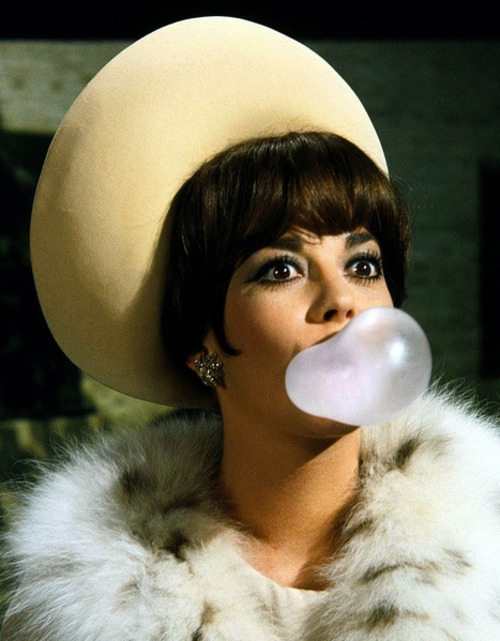
PENELOPE (1966): I covered this movie in-depth at this link about a year ago. It’s a silly, saucy comedy starring Natalie Wood as a neglected housewife who robs a bank. A quintessentially 60’s flick with comic support from Peter Falk, Dick Shawn, Jonathan Winters, and a good turn by Arlene Golonka as a hooker. It’s definitely worth your time if you haven’t discovered it yet.

View original post 301 more words

Lisa Marie Laughs and Cries Over Love Story (dir. Arthur Hiller)


They are so freaking pretty!

I’ve discovered something as I’ve pursued my mission to see every single film ever nominated for best picture.  Quite a few of the nominees (perhaps the majority of them) are no longer impressive because they’ve simply become dated by the passage of time.  We can still watch these films and understand (and believe) that they were probably quite groundbreaking and impressive when initially released.

And then there’s the films like the 1970 best picture nominee, Love Story.  These are the nominees that you quickly realize were never good.  These are the films that were nominated because they either dominated the box office or perhaps they just lucked out and were released in a bad year for cinema in general.  At least that’s what we tell ourselves.  In all honesty, the circumstances of how they came to be nominated are often enigmatic and shrouded in mystery.  I have yet to read a single critic — from either 1970 or the present day — who has had a single kind thing to say about Love Story and, after sitting through it last night, I can say that for once, me and the critical establishment are in agreement.

The plot of Love Story is pretty simple and I’m going to go ahead and include the entire story here because quite frankly, it’s impossible to spoil something this predictable.  Oliver (Ryan O’Neal) meets Jenny (Ali MacGraw).  Oliver is a rich jock who is attending Harvard.  Jenny is a poor music student.  Upon first meeting her, Oliver calls Jenny a “bitch.”  Jenny calls Oliver “a dumb jock.”  Oliver falls in love with Jenny.  Jenny calls Oliver “a dumb jock.”  Oliver and Jenny get married.  Oliver’s father (Ray Milland) disapproves.  Jenny’s father (John Marley) is just kind of confused.  Cut off from the family fortune, Oliver struggles to provide for Jenny.  (Apparently, the 70s were a tough time to be a graduate of Harvard Law School.)  Jenny and Oliver have a fight.  Oliver cries.  Jenny says, “Love means never having to say you’re sorry,” which seems to be an underhanded way of admitting that most guys aren’t ever going to say that anyways.  Oliver is happy.  Jenny comes down with a never-named terminal illness and dies.  The end.

I know that I’m supposed to watch a movie like Love Story and just shrug my shoulders and go, “Oh well, it’s not very good but I’m a girl so I’ll love it unconditionally.”  And God knows, I tried my best,  I tried so very hard to just shut down my mind and give control over to my heart.  Because, believe it or not, I’m just a dorky, asthmatic romantic.  I’m the type of girl who gets all giggly and excited when she gets flowers, despite all of my allergies.  I can remember every sunset I’ve ever watched.  The rare times we actually do have a winter down here in Texas, I’m all about the snowball fights that end with a long, passionate kiss.  I love Valentine’s Day and I remember anniversaries.  I still have every gift that I’ve ever been given, even the really cheap and ugly things that I wouldn’t be caught dead wearing in public.  Every trinket, every stuffed animal, every card, every piece of jewelery, every note, every article of lingerie, every movie ticket — if it’s an artifact of a past or current relationship, I have it all safely stored in a place of honor. 

Yes, I adore everything that Love Story was selling and yet, as I watched Love Story, I felt myself growing more and more cynical with each passing moment.  Fortunately, the movie only last 99 minutes because if it had gone on for a few 120, I probably would have ended up “an old maid…closing up the library!” like Donna Reed in It’s a Wonderful Life.  The problem with Love Story isn’t that it’s not romantic; it’s that it takes the standard clichés of romance and embraces them to such an extent that I didn’t feel as if I was being manipulated by the film as much as I felt like I was being brutally violated by it.

Seriously, the entire time I was watching, I felt like the film was screaming at me, “Look at how beautiful they are!  Look at that sunset!  Listen to that music!  Cry, damn you, cry!”  Never mind the fact that MacGraw and O’Neal — pretty as they are to look at — generate close to zero chemistry.  Never mind that  MacGraw responds to being terminally ill by laying in bed with her hair artfully spread on the pillow behind her while director Arthur Hiller practically bathes her in a warm, saintly glow.  Never mind that “Love means never having to say you’re sorry,” doesn’t make any freaking sense at all.  Trust me, if you love me and yet you still insist on acting like an asshole, you sure as Hell have to apologize to me. 

On the plus side, the film’s got one of those overdone, lush soundtracks; the type that can make you cry as long as you don’t pay attention to what’s happening on-screen.  (That said, Taylor Swift is nowhere to be found.)  Ryan O’Neal is surprisingly likable as Oliver but Ali MacGraw — oh my God, where do I begin?  Actually, I don’t think I will because there’s simply no way I can explain just how bad of a performance she gives here.  Instead, I’ll just point out that Love Story also features the film debut of Tommy Lee Jones.  He’s credited as Tom Lee Jones here and he plays Oliver’s roommate.  He’s an on-screen for about 12 seconds and he delivers exactly one line. 

Needless to say, he pretty much steals the entire film.