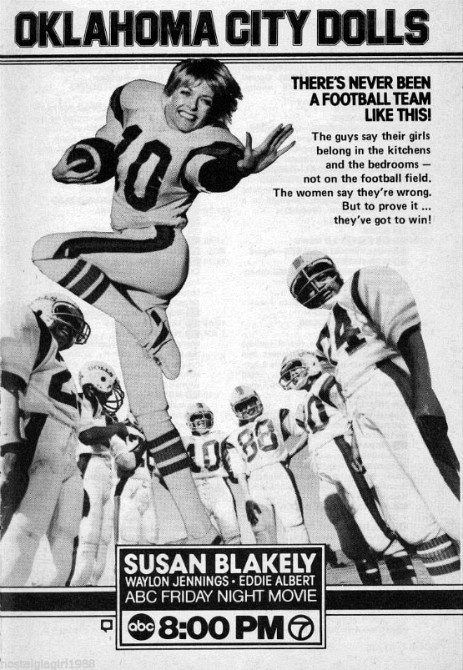
The Oklahoma City Dolls (1981, directed by E.W. Swackhamer)


At an Oklahoma manufacturing plant, the women are always expected to put in extra hours while their male co-workers practice as a part of the company’s football team.  Shop steward Sally Jo (Susan Blakely) files a complaint with the EEOC.  John Miller (Robert Hooks) pays a visit to the plant and says that the women have to be given the same opportunities and benefits as the man, including recreation time.  The plant’s foreman, J.D. Hines (David Huddleston), agrees.  The woman can have recreation time as long as they’re doing what the men are doing and that’s playing football.  Determined to show up Hines and all of her sexist co-workers (and her boyfriend, played by Waylon Jennings), Sally Jo puts together a football team and even gets a broken-down former NFL coach (Eddie Albert) to serve as their trainer.

There actually was a woman’s football team called The Oklahoma City Dolls.  They played in the National Women’s Football League and they won the league’s championship three times.  However, they don’t appear to have anything to do with this movie, which is as much about Sally Jo trying to get a fair treatment for the workers as it is about hitting the field and running it in for a touchdown.  There are some parts of the movie that work.  I liked Eddie Albert’s performance as the alcoholic coach and the scene where he discovered that his community service would include coaching a group of women who had never played football before.  Folk singer Ronee Blakley was good as the team’s emotionally fragile wide receiver.  I even liked that the women didn’t all automatically become the world’s best football players.  The movie’s main weakness was that Susan Blakely just wasn’t believable as someone who lived in a trailer park, used “ain’t” in every sentence, and spent her time organizing a union.  She was too glamorous for the role and her scenes with Waylon Jennings all felt overwritten and overacted.  The story couldn’t decide if it wanted to be a drama about working in a factory or a football comedy and it was pretty uneven as a result.  The good thing is that the movie’s heart was in the right place, even if it didn’t always score a touchdown.

As for the real life Oklahoma City Dolls, they were active from 1976 to 1979.  An attempt to revive the team in 1982 failed when their financial backers pulled out at the last seconds.  The National Women’s Football League folded in 1988.

That’s Blaxploitation! 13: BLACK CAESAR (AIP 1973)


gary loggins's avatarcracked rear viewer

1972’s blockbuster smash THE GODFATHER began an onslaught of gangster movies released to your neighborhood theaters and drive-ins trying to capitalize on that film’s success. American-International Pictures was right in the thick of it, and since Blaxploitation was all the rage at the time, why not combine the two hottest genres? Producer/director/genius Larry Cohen already had a script written for Sammy Davis Jr., but when Sammy backed out, AIP Boss of Bosses Samuel Z. Arkoff signed Fred “The Hammer” Williamson to star as the Godfather of Harlem, BLACK CAESAR.

BLACK CAESAR is a semi-remake of the 1932 classic LITTLE CAESAR starring Edward G. Robinson, updated for the Blaxploitation/Grindhouse crowd and spun around on it’s head by Larry Cohen. You already know how much I enjoy Cohen’s work, and the auteur doesn’t fail to deliver the goods with this one. Casting the charismatic former NFL star Williamson was a bonus, and…

View original post 358 more words

The Conquering Hero: Baby Blue Marine (1976, directed by John D. Hancock)


The year is 1943 and America is at war.  All young men are expected to join the Marines and fight for their country but the Corps is not willing to accept just anyone.  Marion (Jan-Michael Vincent) wants to continue a family tradition of service but, as his drill sergeant (Michael Conrad) puts it, Marion just is not pissed off enough to be a Marine.  Marion is kicked out basic training and told to go home.  He is given a blue uniform to wear on his jury so that anyone who sees him will know that he couldn’t cut it.

Ashamed of his failure and in no hurry to confront his family, Marion takes the long route home.   While having a drink in California, he meets a Marine (Richard Gere) who did not get kicked out of basic training.  Though not yet 30, this shell-shocked Marine already has a head of gray hair, which he says he got from the horrors of war.  The Marine is due to return to the fighting in Europe but, upon meeting Marion, he sees a way out. When Marion gets drunk, the Marine knocks him out, switches uniforms with him, and goes AWOL.

When Marion comes to, he discovers that everyone that he meets now judges him by his new uniform.  Strangers buy him drinks.  Other servicemen try to pick fights with him.  When he stops off in a small Colorado town, a local waitress (Glynnis O’Connor) falls in love with him and nearly everyone that he meets assumes that he must be a hero.  Marion doesn’t exactly lie about his past.  Instead, he simply allows people to believe whatever they want to believe about him.  It seems like an idyllic situation until three prisoners from a nearby Japanese internment camp escape and the towns people expect Marion to help capture them.

Loosely plotted and sentimental, Baby Blue Marine is a dramatic version of Preston Sturges’s Hail The Conquering Hero.  Though the film has a gentle anti-war message, it’s actually more about nostalgia for a simpler and more innocent time.  If the film had been made at height of the Vietnam War, it might have been more angrier and more cynical.  But, instead, this is one of the many post-Watergate films that wistfully looked back upon the past.  When Marion settles into the town, he finds what appears to be a perfect and friendly home.  Only the nearby internment camp and the town’s hysteria over the escape prisoners serve as reminders that things are never as ideal as they seem.  Jan-Michael Vincent gives one of his best performances as the well-meaning Marion and actors like Richard Gere, Bert Remsen, Katherine Helmond, Dana Elcar, Michael Conrad, Bruno Kirby, and Art Lund all make strong impressions in small roles.

One of the few films to be produced by television mogul Aaron Spelling, Baby Blue Marine is not easy to find but worth the search.

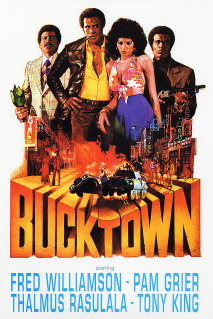
The TSL’s Grindhouse: Bucktown (dir by Arthur Marks)


Welcome to the town of Buchanan!

It’s a small Southern town, popularly known as Bucktown.  It’s a town where you can literally get anything, as long as you know who to pay off.  Upon arriving, don’t be surprised if a little kid approaches you and asks you what you’re looking for.  He can get it for you.  That kid had connections!

The population of Buchanan is almost entirely African-American but all of the cops are white.  Under the leadership of the redneck police chief (Art Lund), the cops have turned Buchanan into their own private kingdom.  If you want to do anything in Buchanan, you have to be ready to pay the cops for protection.  Refuse and you’ll get arrested.  Continue to refuse and you’ll probably end up getting shot.

Obviously, someone needs to clean up Buchanan?  But who!?

How about Duke Johnson (Fred Williamson)?  Duke’s brother owned the hottest nightclub in Bucktown, Club Alabama.  Or, at least he did until he announced he wasn’t going to pay anymore protection and he ended up getting gunned down by the cops.  When Duke arrives in town, he thinks that he’s just going to stay long enough to attend the funeral and sell his brother’s bar.  However, when Duke find out that he has to wait 60 days until he can sell the bar, he decides to stick around.  Not only does he move in with his brother’s former lover, Aretha (Pam Grier), but also reopens the Club Alabama.

Soon, the cops are coming around and demanding their share.  However, they quickly discover that no one tells Duke Johnson what to do.  Like all good action heroes, Duke has friends all over the country.  He places a call to Roy (Thalmus Rasulala) and soon, Roy, TJ (Tony King), and Hambone (Carl Weathers) show up in Bucktown.  They quickly wipe out the corrupt police force.  The local citizens are so happy that they make Roy the new police chief and his men the new police force.

Unfortunately, that turns out to be a mistake.  Apparently, giving some totally random dude complete and total authority to enforce the law in whatever he sees fit isn’t always the best way to handle things.  Roy and his men quickly become just as corrupt as the old redneck policemen.  The only thing protecting Duke is his friendship with Roy but even that is endangered when T.J. decides that he wants Aretha for himself.  T.J. decides to turn Roy and Duke against each other.  It all eventually leads to an epic fist fight, with the winner earning the right to remain in Bucktown…

(Of course, you may be wondering why anyone would want to remain in Bucktown as the place is kind of a dump, regardless of who’s in charge.)

Released in 1975, Bucktown is a pretty basic action film but I liked it because it appealed to all of my anti-authoritarian impulses.  There have been so many movies about what it takes to clean up a town but there haven’t been many made about what actually happens after all of the corrupt cops and greedy businessmen have been kicked out.  Thalmus Rusulala was great as the charismatic but dangerous Roy and Tony King, a favorite of Italian exploitation fans everywhere, was an effective villain.  Pam Grier doesn’t get to do much but she does the best with what she’s provided.  Of course, the entire film is dominated by Fred Williamson, who may not have been a great actor but who had an undeniable screen presence.  Williamson struts through the film like the hero of stylish Spaghetti western.

Bucktown is an entertaining 70s action film.  Though it doesn’t deeply explore any of the issues that it raises, it still deserves some credit for raising them.  If nothing else, it’s a film that shows why Fred Williamson retains a cult following to this day.

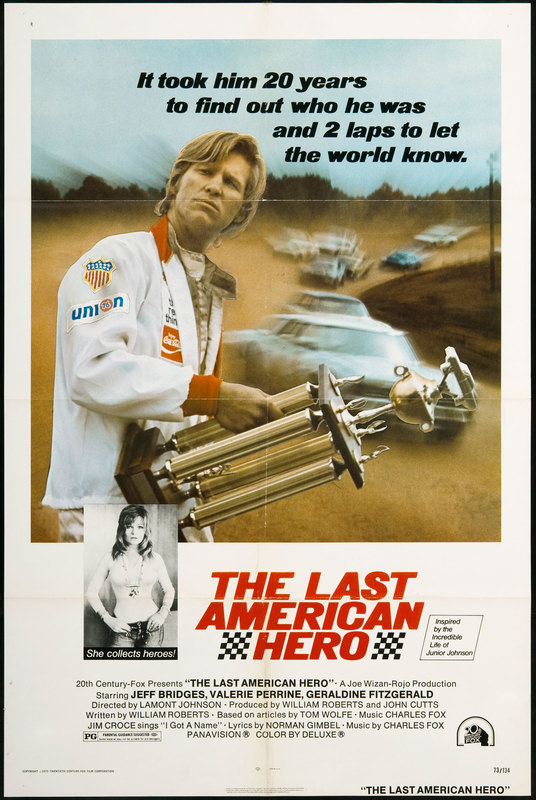
Cheers for THE LAST AMERICAN HERO (20th Century Fox 1973)


gary loggins's avatarcracked rear viewer

lah1

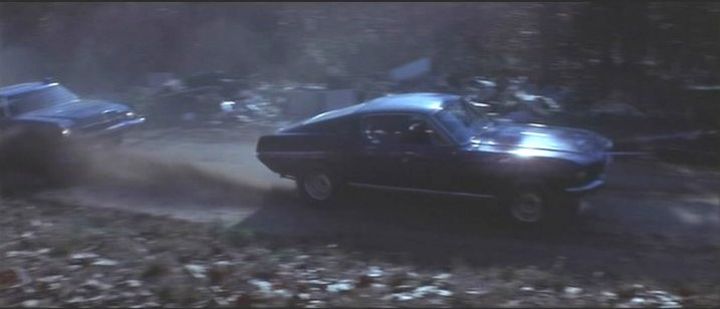
The world of NASCAR racing takes center stage in THE LAST AMERICAN HERO, a fictionalized biopic of legendary driver Junior Johnson. But this isn’t just a film about stock cars; it’s an extraordinary character study of a young man from the backwoods of North Carolina who discovers himself and what’s important to him. Jeff Bridges is outstanding in his first full-fledged starring role, demonstrating at age 24 the acting chops that have carried him to a long and prosperous film career.

lah2

Junior Jackson hauls moonshine for his Daddy on the winding backroads of  the Carolina hills, his tactics eluding the cops at every turn. He’s cocky and confident, and pisses the local law off so much they bust up Daddy’s still and send him back to prison. Junior decides to use his only marketable skill to raise money for the family while Daddy’s away – driving. He enters a demolition derby…

View original post 408 more words