Horror On TV: Dead of Night (dir by Dan Curtis)


For today’s horror on television, we’re very happy to present to you, Dead of Night!

From 1977, this television film is a horror anthology, made up of three stories directed by Dan Curtis and written by Richard Matheson.  In the first story, a youngish Ed Begley, Jr. travels through time.  In the 2nd story, Patrick Macnee plays a man whose wife is apparently being menaced by a vampire.  And in the third story, Joan Hackett plays a mother who brings her dead son back to life, just to discover that sometimes it’s best to just let sleeping corpses lies.

The entire anthology is good, though the third story is clearly the best and the most frightening.  Not only is it scary but it’s got a great twist ending.

Enjoy!

Horror Film Review: It! The Terror From Beyond Space (dir by Edward L. Cahn)


“Another name for Mars is …. DEATH!”

The 1958 sci-fi/horror hybrid, It!  The Terror From Beyond Space, opens with a NASA press conference.  The assembled reporters are reminded that, earlier in the year, America’s first manned mission to Mars was presumed to have been lost.  However, a second mission was sent to Mars and they discovered that the commander of the first mission, Edward L. Carruthers (Marshall Thompson), was still alive.

Unfortunately, all of Carruthers’s crewmates were dead.  Carruthers claimed that the murders were committed by a monster.  The commander of the second mission, Col. Van Heusen (Kim Spalding), instead suspected that Carruthers killed his crewmates when he realized they were stranded on Mars.  The ship had enough provisions to last the entire crew for one year or ten years for just one man.

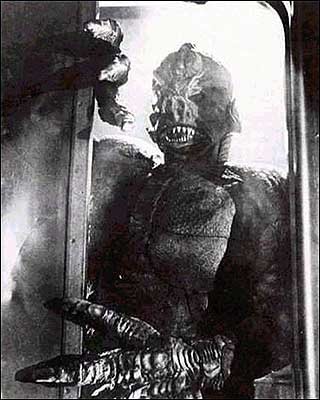
The second mission is now on their way back to Earth, with Carruthers under house arrest.  While one crewman does believe that Carruthers’s story could be true, the others are convinced that Carruthers is a murderer.  What they don’t know is that the monster from Carruthers’s story is not only real but that it also snuck onto their ship during lift-off.  Tall and scaly with huge claws and a permanently angry face, the Monster — It, for lack of a more formal name — is lurking in the lower levels of the ship and hunting for food.

To state what is probably already obvious, It! is not a film that worries much about being scientifically accurate.  While it does explain how living on the surface of Mars caused It to develop into the predator that it is, this is also a science fiction film from 1958.  It’s a film where, instead of going to the Moon, the first manned spaceflight is to Mars.  It’s also a film where there’s no weightlessness in space, the two women on the ship serve everyone coffee, and a nuclear reactor is casually unshielded at one point in an attempt to destroy It.  Bullets are fired on the spaceship.  Grenades are tossed.  Airlocks are rather casually opened.

Fortunately, none of that matters.  Clocking in at a mere 69 minutes, It! is a surprisingly suspenseful horror film, one that makes good use of its claustrophobic locations (a lot of the action takes place in an air duct) and which features a surprisingly convincing and, at times, even scary monster.  It may be a man in a rubber suit but that doesn’t make it any less shocking when its claw bursts out of an an open hatch and starts trying to grab everything nearby.  The cast of It! are all convincing in their roles.  Watching them, you really do believe that they are a crew who have seen a lot together and it makes the subsequent deaths all the more effective,

It! was a troubled production,  The monster was played by veteran stuntman Ray Corrigan, who reportedly showed up drunk a few times and also managed to damage the monster suit.  Many members of the cast were not happy about being cast in a B-movie.  (Fortunately, their resentment probably helped their performances as the similarly resentful crew of the second mission to Mars.)  Marshall Thompson, who played Carruthers, was one of the few cast members who enjoyed making It! and, perhaps not surprisingly, he also gives the best performance in the film.

Troubled production or not, It! was not only a box office success but, along with Mario Bava’s Planet of the Vampires, it was later cited as one of the inspiration for Alien.  At its best, It! has the same sort of claustrophobic feel as Alien.  The scene where one of the crewman is found in an air duct brings to mind the fate of Tom Skerritt’s character in Alien.

It! is still a very effective work of sci-fi horror.  Remember, another name for Mars is …. DEATH!

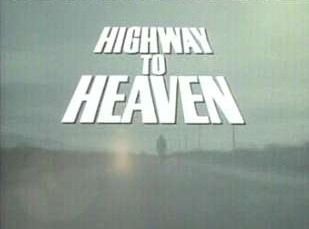
Late Night Retro Television Review: Highway to Heaven 2.11 “The Monster Part II)


Welcome to Late Night Retro Television Reviews, a feature where we review some of our favorite and least favorite shows of the past!  On Thursdays, I will be reviewing Highway to Heaven, which aired on NBC from 1984 to 1989.  The entire show is currently streaming on Freevee and several other services!

This week, the story of Julian and Scotty continues!

Episode 2.11 “The Monster Part II”

(Dir by Victor French, originally aired on December 11th, 1985)

This week’s episode of Highway to Heaven begins where last week’s episode ended.

Julian (Jeff Kober) has been charged with attempting to murder Rachel McCullough (Annabella Price) and the whole town is ready to convict him because he has a birthmark on his face and a bratty kid named Ridley (Peter Billingsley) claims that he saw Julian push Rachel.  Rachel, having hit her head, is in a coma and not expected to survive.  Julian is pressured to accept a plea bargain but he protests that he’s innocent and that he loves Rachel.  He would never had hurt her, no matter what the ignorant townspeople believe.

Only Jonathan and Scotty (James Troesch) believe that Julian is innocent.  After Jonathan saves the depressed Scotty from drowning in his swimming pool, Scotty agrees to put off suicide so that he can defend Julian at his trial.  Scotty does so from his motorized wheelchair and, as he explains to the jury, he knows what its like to be treated a certain way because you look different.  With ease, Scotty demolishes Ridley’s testimony and puts the smug prosecutor in his place.  All of the reporters in the courtroom are shocked when Julian is acquitted but the prosecution really didn’t have a case, beyond Julian having a birthmark on his face.  Scotty gets back together with his wife (Margie Impert) and Rachel not only wakes up but she wakes up with her sight restored.  Despite Julian’s fear, Rachel loves him even more when she can see his face.

Awwwwwww!

(Where is Mark during all this?  He doesn’t show up until the final few minutes, probably because Victor French was busy directing this episode.)

Even if one sets aside that this episode is nearly 40 years old, it still feels old-fashioned.  This is the type of courtroom drama where the trial watchers gasp at each piece of testimony.  As far a courtroom procedurals go, this episode went more for melodrama than realism but that’s to expected with this show.  It was heartfelt and earnest and Jeff Kober gave a touching performance as Julian.

Probably the most interesting thing about this episode was the number of times Jonathan got mad at people.  He got mad at Julian’s original lawyer.  He got mad at Scotty for trying to drown himself.  He called Scotty’s wife a “jerk” to her face.  He gave the prosecutor a dirty look during the latter’s opening statement.  He even got annoyed with Julian’s overly protective mother (Ann Doran).  Jonathan may be an angel but this episode suggests that even angels lose their patience.

Late Night Retro Television Review: Highway to Heaven 2.10 “The Monster: Part One”


Welcome to Late Night Retro Television Reviews, a feature where we review some of our favorite and least favorite shows of the past!  On Thursdays, I will be reviewing Highway to Heaven, which aired on NBC from 1984 to 1989.  The entire show is currently streaming on Freevee and several other services!

Scottie returns!  Unfortunately, he’s a drunk now.

Episode 2.10 “The Monster: Part One”

(Dir by Victor French, originally aired on December 4th, 1985)

It’s another week and another visit to a small town for Jonathan and Mark.

This time, Mark thinks that they are only in town to visit his cousin, Diane (Margie Impert), and her husband, Scottie (James Troesch), the quadriplegic attorney who appeared in a few episodes during the first season.  Mark tells Jonathan that, when he last spoke to Diane, she said that she had something important to talk to him about.  Mark assumes that Diane is pregnant but actually, it turns out that Diane and Scottie’s marriage is in trouble.  Scottie may be an attorney but he has no clients and Diane has gone back to work to help pay the bills.  Feeling like a failure, Scottie has taken to drinking.

While Mark deals with Diane and Scottie, Jonathan has an assignment.  He working as a handyman for Ella McCullough (Barbara Townsend) and her blind daughter, Rachel (Annabella Price).  At first, Rachel is bitter and stand-offish but Jonathan wins her over by encouraging her to leave her little cottage and explore the world.  While relaxing at a nearby creek, Rachel meets a man (Jeff Kober) who is out for a walk.  Rachel tells the man that he startled her and then mentions that the neighborhood kids talk about a monster named Julian.  Julian lives in the woods and drags off bad kids.

“My name’s Clark,” the man lies.

Actually, the man’s name is Julian but you can understand why he might not want to admit that after listening to Rachel describe him as being a monster.  Julian is not a monster, of course.  He’s a sensitive sculptor who just happens to have a very large birthmark covering half of his face and neck.  Having been ridiculed all of his life, Julian lives with his mom (Ann Doran) and rarely talks to anyone.  Still, Julian falls in love with Rachel and Rachel falls in love with …. Clark.

Julian finally finds the strength to visit Rachel at her cottage.  However, when she tells him that she will be having an operation to resort her sight, Clark yells that he’s Julian and then he runs back into the woods.  Rachel chases after him.  When she trips and hits her head on a rock, Julian runs over to her and tries to help.  Unfortunately, that’s when the police arrives and promptly arrest Julian for assault.

Julian’s going to court!  Hey, does anyone know an attorney who needs a shot of confidence and who has a unique understanding of what it’s like to be an outsider?  We’ll find out next week because this is a two-part episode!

Reviewing a two-parter is always difficult.  Tonight’s episode ends with the story nowhere close to being finished.  I can’t judge the overall story but I can say that Jeff Kober gave a touching performance as Julian and he was the best thing about the first part of The Monster.  As for Scottie, he needs to stop blaming everyone else for his own lack of confidence.  Hopefully, that’s a lesson he’ll learn during the second part of this episode.

We’ll find out next week!

Retro Television Reviews: Fantasy Island 1.11 “Reunion/Anniversary”


Welcome to Retro Television Reviews, a feature where we review some of our favorite and least favorite shows of the past!  On Tuesdays, I will be reviewing the original Fantasy Island, which ran on ABC from 1977 to 1986.  The entire show is currently streaming on Tubi!

This week, Fantasy Island is all about confronting the mistakes of the past.

Episode 1.11 “Reunion/Anniversary”

(Dir by Allen Baron and John Newland, originally aired on April 29th, 1978)

Before I talk about the two fantasies in this episode, here’s a bit of trivia.  This episode was originally intended to be the first episode of the series.  That perhaps explains why it has a tone that is more similar to the original TV movie than to the more light-hearted episodes that followed.  Just as in the made-for-TV movie, Mr. Roarke is a bit of an enigma in this episode, one who has little trouble manipulating his guests in order to get the results that he wants.  This episode even ends with Tattoo saying, “Thank God,” and Mr. Roarke replying with a mysterious half-smile.  Roarke isn’t quite as sinister as he was in the TV movie but he’s also not quite the cheery host that he would become in later episodes.  Roarke, at one point, also mentions that he has people who research everyone’s fantasy before choosing whether to grant it.  That’s certainly different from later episodes, in which the fantasies are apparently available to anyone who can pay or who has been lucky enough to win Roarke’s sympathy.

Of course, when it came time to air the first season of Fantasy Island, this episode got pushed back and it aired as the eleventh episode.  As a result, it presents a bit of a change-of-pace from the episodes that aired the weeks before.  One can only imagine how someone who decided to start watching the show because of the fantasy where Don Knotts played a private eye reacted to this episode, in which four guests were stalked by a murderer who wore giallo-style black gloves.

The guests being stalked by the murderer are Agnes (Pamela Franklin), Hannah (Hilarie Thompson), Carol (Michele Lee), and Jill (Sue Loyon).  They are all members of the Honeybees, a group of former high school cheerleaders who are having a ten-year reunion.  Their fantasy is to spend the weekend at a recreation of the Beehive, a cabin where they used to hang out while in high school.  Of course, every one of them has a dark secret and, after one of the Honeybees is apparently blown up in a nearby barn, the three remaining Honeybees have to solve the mystery.  It all gets fairly dark and sordid but, fear not!  Mr. Roarke shows up and even takes part in some hand-to-hand combat before revealing the truth about what is going on at the Beehive.

(Again, this is not something that we would normally expect from Mr. Roarke.)

Meanwhile, troubled couple Toni (Lucie Arnaz) and Tom Elgin (Ronny Cox, looking slightly embarrassed) come to the island for their anniversary!  Toni wants to relive the weekend that they got married, when they were still happy and before Tom became a drunk.  All of their old friends are invited to the island and soon, Tom is flirting with another woman while Toni is flirting with another man.  Mr. Roarke even invites Rev. Allen (Stuart Nisbet), the man who performed the original wedding ceremony.  The reverend explains that, due to a mix-up at the licensing office, he wasn’t actually legally allowed to perform marriages when Toni and Tom get married so it turns out that Tom and Toni have been living in sin all this time!  Now, Tom and Toni have to decide whether to get married for real or to go their separate ways.

I vote for separate ways, just because they really do seem to be miserable together.  However, it turns out that Mr. Roarke has a plan to keep this awful couple together.

The decision to move this episode from the start of the season to the latter half was definitely a good one.  It was probably a bit too dark and dramatic to really work as the premiere episode but, as the 11th episode, it provides a nice change-of-pace.  After several comedic and somewhat shallow episodes, this episode emphasizes the dramatic side of Fantasy Island.  In this episode, the ultimate lesson appears to be that fantasies are fun but that it’s far more important to deal with the real world.  In other words, Fantasy Island is a nice place to visit but only Mr. Roarke and Tattoo should live there.


Horror On The Lens: Dead of Night (dir by Dan Curtis)


For today’s horror on the lens, we’re very happy to present to you, Dead of Night!
From 1977, this television film is a horror anthology, made up of three stories directed by Dan Curtis and written by Richard Matheson.  In the first story, a youngish Ed Begley, Jr. travels through time.  In the 2nd story, Patrick Macnee plays a man whose wife is apparently being menaced by a vampire.  And in the third story, Joan Hackett plays a mother who brings her dead son back to life, just to discover that sometimes it’s best to just let sleeping corpses lies.

The entire anthology is good, though the third story is clearly the best and the most frightening.  Not only is it scary but it’s got a great twist ending.

Enjoy!

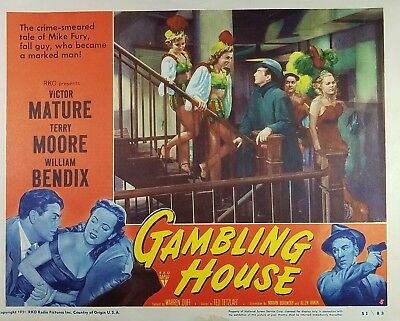
An Offer You Can Refuse #10: Gambling House (dir by Ted Tetzlaff)


The 1950 film noir, Gambling House, begins with the aftermath of a murder.

A man’s been gunned down in an illegal gambling house.  The murderer is gangster named Joe Farrow (William Bendix) but Farrow has no intention of going to prison.  Fortunately, another gambler was wounded during the shoot out.  Marc Fury (Victor Mature) will survive his injury but he might not survive being a witness.  However, Farrow sends his gunmen to make Fury an offer.  If Fury agrees to take the rap for the shooting, he’ll not only live but Farrow will pay him a good deal of money.  Fury agrees because …. well, what else is he going to do?

Fury is arrested for the murder.  He pleads self-defense and he’s acquitted at the trial.  So far, so good, right?  However, there’s always a complication.  First off, there’s the fact that Farrow wasn’t exactly being honest when he promised to pay Fury.  Farrow has no intention of giving Fury any money.  In fact, now that Fury has been acquitted and the case is officially closed, it might be more convenient just to have Fury killed.

The other problem is that Fury’s trial brings him to the attention of the Immigration and Naturalization Service.  The INS takes a look at Fury’s record and they discover that he’s not Marc Fury at all!  (I know, it’s a shock.  Who would think that a name like Marc Fury would be fake?)  It turns out that his original name was Marc Furiotta and he was born in Italy.  His family came to the U.S. when Marc was a child.  Marc always assumed that he was a citizen but it turns out that his parents were never naturalized and therefore, Marc is in the country illegally!  INS wants to deport him.  Marc wants to stay in the United States.

Fortunately, Marc will have a chance to try to convince a judge to let him stay in the United States, despite his lengthy criminal record.  Until his hearing (or until he makes bail), he’ll be detained at Ellis Island.  Marc soon finds himself stuck on Ellis Island, presumably right underneath the base of the Statue of Liberty.  (I know the Statue of Liberty isn’t actually on Ellis Island but the imagery just got stuck in my head while I was writing this review and I’ll be damned if I’m going to take it out.)  He’s surrounded by earnest immigrants who can’t wait to become American citizens and that awakens his own patriotic feelings.  He also meets a social worker named Lynn (Terry Moore) and he falls in love with her.  When he appears before the judge, he explains that he can’t put into words why he wants to stay in America.  He just know that he does.   Awwww, what a wonderful story …. oh wait.  He’s still got Joe Farrow trying to kill him, doesn’t he?

Gambling House is an odd film.  Actually, it’s something like three different films at once.  On the one hand, it’s a low-budget film noir, with menacing tough guys and a morally ambiguous hero and an outwardly respectable villain who is actually a member of the mob.  On the other hand, it’s an earnest legal drama about an immigrant who comes to love his adoptive country.  And then, on the other hand (that’s right, this movie has three hands), it’s a romcom where cynical Marc ends up falling for idealistic Lynn.

That’s a lot for one, low-budget 90-minute film to carry on its shoulder and sadly, Gambling House struggles to balance all of its different elements.  It gets off to a good start, with Victor Mature delivering all of his lines with a scornful disdainful for anyone who looks at him.  And the scenes with William Bendix as the mob boss are effective.  But none of those scenes seem to belong in the same movie with Marc waiting on Ellis Island and Lynn explaining why she wants to help people become citizens.  In the end, this is a film about many things but none of those things are really explored in that much depth.

Though this is a adequately directed and acted film and this is one scene, in which Marc looks at the New York skyline from the holding cell in Ellis Island, that achieves a certain visual poetry, this is still an offer that you can refuse.

Previous Offers You Can’t (or Can) Refuse:

  1. The Public Enemy
  2. Scarface
  3. The Purple Gang
  4. The Gang That Could’t Shoot Straight
  5. The Happening
  6. King of the Roaring Twenties: The Story of Arnold Rothstein 
  7. The Roaring Twenties
  8. Force of Evil
  9. Rob the Mob

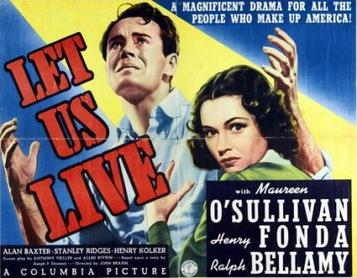
Cleaning Out The DVR: Let Us Live! (dir by John Brahm)


In the 1939 film, Let Us Live!, Henry Fonda plays Brick Tennant.  Brick is a poor but honest taxi driver who has always lived a law-abiding life and who is looking forward to marrying waitress named Mary Roberts (Maureen O’Sullivan).  However, when a taxi is used as a getaway car in a violent robbery that leaves a policeman dead, Brick finds that he’s a suspect.

At first, Brick isn’t too worried.  It turns out that every taxi driver in Boston is apparently being considered a suspect.  Brick is just 1 out of 120.  However, when the police bring Brick in to take part in a lineup, one of the witnesses insists that Brick and his friend, Joe Linden (Alan Baxter), were involved in the robbery.  Despite the fact that Brick and Mary were at a church, planning their wedding, during the robbery, Brick and Joe are arrested and put on trial for murder.  Despite Brick’s initial faith in the system, he and Joe are convicted and sentenced to die.

On death row, Brick faces the inhumane reality of American justice.  He watches as other prisoners slowly lose their mind as a result of neglect and abuse.  He watches as another prisoner drops dead in front of him, to the indifference of the guards.  Even when Mary tells him that she’s still looking for evidence that will exonerate him, Brick says that he no longer cares.  The state of Massachusetts is determined to kill him and he doesn’t believe that there’s any way stop them.  As Mary puts it, Brick is now dead inside.

Still, Mary continued to investigate.  Helping her is a police detective named Everett (Ralph Bellamy).  Everett comes to realize that two innocent men are sitting on Death Row but will he and Mary be able to find the real culprits before the state executes Brick and Joe?

While watching Let Us Live, I found it impossible not to compare the film to The Wrong Man, another film in which Henry Fonda played an innocent man being railroaded by the system.  Both The Wrong Man and Let Us Live were based on a true stories, though Let Us Live takes considerably more liberty with its source material than The Wong Man does.  Whereas The Wrong Man is a docudrama that’s full of moody atmosphere courtesy of director Alfred Hitchcock, Let Us Live is much more of a fast-paced, melodramatic B-move.

That said, Let Us Live! is still a definitely effective look at how an innocent man can be railroaded by a system that’s often more concerned with getting a quick conviction than actually searching for the truth.  Sadly, the issues that Let Us Live deals with are just as relevant today as they were in 1939.  The film’s power comes from Henry Fonda’s performance as Brick.  It’s truly heart-breaking to watch Brick go from being a cheerful optimist to a man who has been so broken down by American justice that he can’t even bring himself to celebrate the news that he might be released.  The film ends on a grim note, a reminder that some damage cannot be undone.

Let Us Live! is another good but obscure film that I discovered through TCM.  Keep an eye out for it!

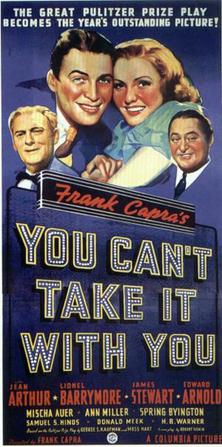
Lisa Reviews An Oscar Winner: You Can’t Take It With You (dir by Frank Capra)


(With the Oscars scheduled to be awarded on March 4th, I have decided to review at least one Oscar-nominated film a day.  These films could be nominees or they could be winners.  They could be from this year’s Oscars or they could be a previous year’s nominee!  We’ll see how things play out.  Today, I take a look at the 1938 best picture winner, You Can’t Take It With You!)

“You can’t take it with you.”

If there’s any one belief that defines the worldview of Martin Vanderhof (Lionel Barrymore), it’s this.  It doesn’t matter how much money you make in your life.  It doesn’t matter how successful you are at business or anything else.  The fact of the matter is that, when your time is up, you won’t be able to take any of that stuff with you.  Instead, Grandpa Vanderhof (as he’s called by his large family) believes that the most important thing to do during your lifetime is to make friends and pursue what you’re truly interested in.

Vanderhof has another belief, one that particularly appealed to be me.  He has never paid income tax.  He doesn’t see the point of giving money to the government when he doesn’t feel that they’ll make good use of it.  When an outraged IRS agent (Charles Lane) stops by Vanderhof’s sprawling house and demands that Vanderhof pay his taxes, Vanderhof refuses.  When the IRS man argues that the income tax is necessary to pay for the Presidency, the Congress, and the Supreme Court, Vanderhof offers to give him five dollars.  “Hell yeah!” I shouted at the TV.  With an attitude like that, Vanderhof should have moved down here to Texas.  We would have elected him governor.

Grandpa Vanderhof is the head of a large and cheerfully eccentric family, all of whom live together under the same roof.  Penny (Spring Byington) writes novels because, years ago, a typewriter was accidentally delivered to the house.  Her husband, Paul (Samuel S. Hinds), has a basement full of fireworks.  Essie (Ann Miller) loves to dance and spends almost the entire movie twirling from room to room.  Her husband, Ed (Dub Taylor), is a xylophone player.

Of course, it’s not just family living in the Vanderhof House.  There’s also Potap Kolenkhov (Mischa Auer), a Russian who is “teaching” Essie how to dance.  There’s Rheba the maid (Lillian Yarbo) and Donald (Eddie Anderson) the handyman.  Actually, the house appears to be open to just about anyone who wants to stay.

And then there’s Penny’s daughter, Alice (Jean Arthur).  Alice is the most “normal” member of the family.  She has just become engaged to Tony Kirby (James Stewart) and she is still trying to figure out how to introduce Tony’s stuffy parents (Edward Arnold and Mary Forbes) to her eccentric family.  What she and Tony don’t know is that Mr. Kirby is currently trying to buy up all the houses that are near a competitor’s factory.  Only one homeowner has refused to sell.  The name of that homeowner?  Martin “Grandpa” Vanderhof.

It all leads, of course, to one chaotic dinner party, one lively night in jail, and a huge fireworks display.  It also leads to true love, which is nice.  Jimmy Stewart and Jean Arthur are even more adorable here than they were in Mr. Smith Goes To Washington.

Based on a Pulitzer-winning play by George S. Kaufman, You Can’t Take It With You was the second comedy to win the Oscar for Best Picture.  The first comedy to win was 1934’s It Happened One Night.  It’s probably not coincidence that both of these films were directed by Frank Capra.

Seen today, You Can’t Take It With You seems a bit slight for an Oscar winner.  Grandpa Vanerhof is a lovable eccentric.  Tony’s father is a stuffy businessman.  Hmmm … I wonder whose philosophy is going to be victorious at the end of the movie?  Still, predictability aside, it’s a delightfully enjoyable film.  While it never quite escape its stage origins, it features wonderful performances from all the usual members of the Capra stock company.  James Stewart and Jean Arthur are a charming couple while Lionel Barrymore gives a performance that is so warmly likable that it’s hard to imagine that, just 9 years later, he would be so perfectly cast as the heartless Mr. Potter in It’s A Wonderful Life.  Of course, my favorite member of the member was Essie, mostly because I also like to dance from room to room.  While it’s hard to justify awarding it Best Picture over The Adventures of Robin Hood and Grand Illusion, You Can’t Take It With You is still a wonderfully fun movie.

It’ll make you smile and laugh.  Who can’t appreciate that?

http://www.youtube.com/watch?v=0WY9RAroTS0


Halloween Havoc!: Boris Karloff in THE MAN THEY COULD NOT HANG (Columbia 1939)


gary loggins's avatarcracked rear viewer

maddoc1

Bela Lugosi ( see yesterday’s post ) wasn’t the only horror icon who starred in a series of low-budget shockers. Boris Karloff signed a five picture deal with Columbia Pictures that was later dubbed the “Mad Doctor” series and, while several notches above Lugosi’s “Monogram Nine”, they were cookie-cutter flicks intended for the lower half of double feature bills. The first of these was THE MAN THEY COULD NOT HANG, which sets the tone for the films to follow.

maddoc2

Karloff plays Dr. Henry Savaard, inventor of a new surgical technique that requires the patient to die, then reviving him with a mechanical heart after performing the operation. This later became standard operating procedure during open-heart surgery, but back in 1939 was considered science fiction! Anyway, Savaard’s young assistant Bob agrees to go through the experimental procedure, but his girlfriend freaks out and calls the cops, claiming Savaard is about to murder…

View original post 519 more words