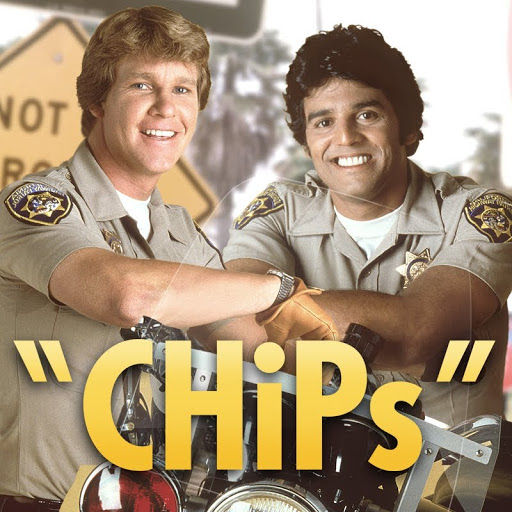
Welcome to Late Night Retro Television Reviews, a feature where we review some of our favorite and least favorite shows of the past! On Mondays, I will be reviewing CHiPs, which ran on NBC from 1977 to 1983. The entire show is currently streaming on Prime!
This week, Ponch continues to train Melanie and Paula.
Episode 4.15 “Ponch’s Angels: Part Two”
(Dir by John Florea, originally aired on March 1st, 1981)
We pick up where we stopped last week. A man and his girlfriend are stealing purses and wallets at the marina. Three escaped convicts are in a deserted house and digging for buried treasure. Ponch and Jon are having to train two new motorcycle cops, Paula (Barbara Stock) and Melanie (Trisha Townsend). When last we checked in, Ponch was kissing Melanie. This episode opens with Ponch telling Melanie that they can never kiss again.
Ponch and Baker continue to train Paula and Melanie. Ponch decides to switch with Baker. He trains Paula while Baker works with Melanie. But then almost the entire highway patrol comes down with the flu and, when Baker is put in charge while Getraer recovers at home, Ponch finds himself to work with both Paula and Melanie. Once again, it’s all on Ponch because it’s The Ponch Show!
It’s all a bit exhausting to try to keep up with, to be honest. Ponch and Baker spend this episode wondering whether or not women actually could handle being motorcycle cops. Baker especially seems to be confused at the idea of a woman driving a motorcycle. One gets the feeling that Ponch is just mad because he knows he’ll get fired if he tries to make a move on either woman. Almost this entire episode is made up of Ponch trying to keep track of who is riding with who.
Luckily, Paula and Melanie prove themselves by catching the purse snatchers and also helping to catch the escaped convicts. Good for them! At the end of the opposite, they toss their motorcycle helmets in the air and leap for joy. The picture freezes while Ponch and Baker have a good laugh.
I was not surprised to read that this episode was meant to be a backdoor pilot for a Paula/Melanie show. Stock and Townsend were both likable and they acted well opposite each other so I could actually imagine them starring in a fairly entertaining series. It didn’t happen, though. Maybe the network felt that Ponch and Jon didn’t need the competition.
Welcome to Late Night Retro Television Reviews, a feature where we review some of our favorite and least favorite shows of the past! On Mondays, I will be reviewing CHiPs, which ran on NBC from 1977 to 1983. The entire show is currently streaming on Prime!
This week, Ponch protests having to do his job.
Episode 4.14 “Ponch’s Angels: Part 1”
(Dir by John Florea, originally aired on February 28th, 1981)
It’s a busy week for the Highway Patrol! The marina is full of tourists and carnival-goers. A group of escaped convicts are trying to get out of town. A man and his partner are stealing purses. But all of that pales in comparison to what Jon and Ponch are having to do.
Jon and Ponch are having to train rookies!
Even worse, from their perspective …. the rookies are women!
Ponch protests when he’s given the assignment to train enthusiastic and blonde Melanie Mitchell (Trisha Townsend). He tells Getraer that Melanie is attractive and that Getraer knows what happens when Ponch gets around attractive women. Getraer replies that he wants Ponch to train Melanie precisely because Ponch has so many girlfriends. A man with many girlfriends will be less likely to be tempted. Okay, Getraer, that’s interesting logic….
And it turns out that Getraer doesn’t know what he’s talking about because this episode ends with Ponch and Melania passionately locking lips. “TO BE CONTINUED” flashes on the screen so I guess we’ll get to the disciplinary hearing and the subsequent lawsuit next week.
As for Jon, he trains Paula Woods (Barbara Stock), who is as cool and reasonable as Melanie is enthusiastic and impulsive. Paula tries to flirt with Jon but Jon keeps it all business because Jon is capable of actually doing his job in a professional manner.
What’s odd about this episode is that it’s called Ponch’s Angels, even though Ponch is only training one of the new motorcycle cops. This season, even the episode titles were all about erasing Jon Baker!
Anyway, as I mentioned, this is the first part of a two-parter. Apparently, this episode was actually a backdoor pilot for a series that would have focused on Melanie and Paula and it’s easy to see that Melanie was created to be another Ponch while Paula was created to be a female Jon. Next week, we’ll see if Paula and Melanie can make use of the lessons they were taught by Jon and Ponch.
Welcome to Late Night Retro Television Reviews, a feature where we review some of our favorite and least favorite shows of the past! On Mondays, I will be reviewing CHiPs, which ran on NBC from 1977 to 1983. The entire show is currently streaming on Prime!
Tonight’s episode is weird.
Episode 3.6 “Counterfeit”
(Dir by John Florea, originally aired on October 20th, 1979)
Ponch is shocked to discover that he’s carrying several counterfeit twenties. He turns the money into the Treasure Department, hoping that it will mean receiving an monetary award. Instead, he’s told that his reward is helping the government crack down on the bad guys. Ha! Take that, Ponch!
That said, you better believe that Ponch is there to help arrest the counterfeiters, who turn out to be a bunch of phony preachers working out of a church. I know that sounds like the sort of thing that could be interesting. But, for the most part, these guys are still just generic CHiPs bad guys, even if one of them is played by veteran screen tough guy Ralph Meeker.
Meanwhile, Ponch goes on a date with a woman and is upset when it appears that she’s shallow and doesn’t want to talk about anything that is the least bit intellectual. That’s our, Ponch! He’s never shallow! Fortunately, it turns out that his date isn’t shallow either. She was just pretending to be shallow to test whether or not Ponch was shallow. And now, it’s time to dance! Wait, what? That doesn’t make any sense. Ponch — when are you going to settle down? Disco isn’t going to last forever.
While that’s going on, architect James O’Hara (played by veteran dwarf actor Billy Barty) becomes frustrated with people assuming that he can’t drive because of his size. He gets tired of all the dumb jokes and the condescending remarks. As a result, he keeps getting into minor accident whenever he drives on the highway. This was a strange storyline, largely because O’Hara’s scenes made up over half the episode despite the fact that he had never appeared on the show before and he barely interacted with the members of the Highway Patrol. A part of me wonders if maybe this episode was meant to be a backdoor pilot for a series about James O’Hara. The other weird thing about this episode is that O’Hara’s frustration over people making fun of his height was often played for laughs. The whole thing just felt well-intentioned but oddly tone deaf.
If you’re keeping track, this episode had two Ponch storylines and a storyline about a guy we had never seen before. Sorry, Baker! If we had any doubts about who was the favored partner as far as this show goes, this episode erased them.
This whole episode just felt weird. On the plus side, there was a lot of nice California scenery and there were quite a few accidents, which is the main reason why most people would have been watching the show in the first place. But this episode really is an example of how a show can get bogged down with a character that we’ve never seen before and that we’ll probably never see again. The episode just never comes together.
Welcome to Retro Television Reviews, a feature where we review some of our favorite and least favorite shows of the past! On Sundays, I will be reviewing the made-for-television movies that used to be a primetime mainstay. Today’s film is 1977’s The Hunted Lady! It can be viewed on YouTube.
Detective Susan Reilly (Donna Mills) reluctantly teams up with a chauvinistic cop named Sgt. Arizzio (Alan Feinstein) to investigate a United States senator who has presidential ambitions. Arizzio believes that the senator is being back by the Mafia and that it would be disastrous for the country if a mob-connected politician ended up in the White House. (Being mob-connected didn’t seem to hurt John F. Kennedy but still….)
Now, Detective Reilly and Sgt. Arizzio working together to take down a corrupt senator sounds like an intriguing premise for a movie, right? Well, oddly enough, that’s not what this movie is actually about. Instead, it’s about Susan going on the run after she’s framed for Arizzio’s murder. She escapes from police custody with the help of her father. Though she’s still recovering from being shot earlier in the film, Susan makes her way to Reno and attempts to hide out from both the cops and the Mafia assassin that has been sent to kill her.
Susan hiding out in Reno. Hmmm …. sound like an intriguing premise for a movie, right? Well, don’t get to attached to Susan pretending to be a professional gambler because it turns out that bullet wound was more serious than she realized and she ends up passing out from blood loss. When she awakens, she’s in a free clinic that is run by Dr. Arthur Sills (Robert Reed). Dr. Sills doesn’t ask Susan too many questions about her past and even hires Susan on as a nurse. Susan and Dr. Sills fall in love and try to clear the name of a Native American who has been accused of blowing stuff up.
Doing some research, I was not surprised to discover that The Hunted Lady was originally developed as a possible television show. The show would have played out like a combination of Charlie’s Angels and TheFugitive, with Susan moving from town to town and getting involved with a new set of guest stars each week. With both the police and the mob trying to track her down, Susan would try to clear her name while also helping out strangers. Unfortunately, The Hunted Lady wasn’t exactly a hit in the ratings and Susan’s further adventures went untold.
The main problem with The Hunted Lady is an obvious one. The idea of the Mafia trying to install one of their guys in the White House is considerably more intriguing that Susan falling in love with Dr. Sills while working at a free clinic. The whole time that Susan was helping the doctor’s patients, I was thinking, “But what about the senator?” Donna Mills was surprisingly convincing as a tough cop but she had next to no chemistry with Robert Reed. If anything, Reed looked annoyed at just having to be there.
Anyway, here’s hoping that Susan cleared her name eventually. You can only run for so long.
Welcome to Late Night Retro Television Reviews, a feature where we review some of our favorite and least favorite shows of the past! On Thursdays, I will be reviewing Highway to Heaven, which aired on NBC from 1984 to 1989. The entire show is currently streaming on Freevee and several other services!
This week, Jonathan encourages everyone to violate federal law.
Episode 1.22 “An Investment In Caring”
(Dir by Michael Landon, originally aired on March 13th, 1985)
Helen Spencer (Eileen Heckart) is an annoying old busy body who lives in one of those charming city neighborhoods that are only found on shows like Highway to Heaven. Even since her husband died, she has kept herself active by working as a cleaning lady at the Halstead Corporation, which is the same company that wants to not only tear down her neighborhood but also turn the local cemetery into a condo subdivision.
Fortunately, Helen’s new boarders just happen to be Jonathan Smith and Mark Gordon. Jonathan encourages Helen to rally the neighbors to take a stand against Halstead. He also encourages Paul Tarsten (Dane Clark), who was recently laid off from Halstead for being too old, to help Helen out. With Jonathan’s guidance, Helen goes through the trash at Halstead, finds some stock reports that really should have been put through a shredder, and then use that insider information to buy and sell a bunch of stock until soon, she and her friends are the majority stockholders.
“Only in America,” Ms. Zabenko (Elsa Raven) exclaims not once but five times, just in case you were wondering how heavy-handed this episode was.
Helen is able to save her neighborhood, save the cemetery where her husband is buried, and also take over the company. She also finds hints of romance with Paul, who is himself a widower. Their mission accomplished, Jonathan and Mark leave town….
…. which is good because I don’t see anyway that Paul, Helen, and Ms. Zabenko aren’t eventually going to end up in federal prison. Just about every piece of advice that Jonathan gave Helen led to her doing something illegal, from insider trading to corporate espionage to stealing from the office. Only in America, Ms. Zabenko? In America, we have laws against stock market manipulation.
This episode just irked me. Whenever people talk about Highway to Heaven being an unrealistic and cheesy show, this is the type of episode that they’re thinking of. It takes a lot to make a heartless corporation sympathetic but the overacted and rather smug neighborhood activists in this episode managed to do just that. In previous episodes, Jonathan and Mark have appealed to businessmen to get them to change their ways. In this episode, the head of Halstead isn’t given that opportunity. Instead, Jonathan — acting on authority from GOD — encourages a bunch of people with no business experience and no way of knowing any better to commit a bunch of federal crimes. Helen takes over the company but what does Helen know about running a company? When Halstead goes bankrupt, a lot of people who had nothing to do with the former CEO’s plans will end up losing their jobs. Way to go, God.
Finally, I should note that this episode begins with Helen’s former boarder telling her that he’s moving out because a voice in his head told him to move to Alaska. It’s only because he leaves that Helen has the room to rent to Jonathan and Mark. So, basically, promoting insider trading wasn’t enough for Jonathan. He also had to ruin some poor schmuck’s life by telling him to move to a state that he knows nothing about. Not since the Book of Enoch has an angel behaved so unethically.
Welcome to Retro Television Reviews, a feature where we review some of our favorite and least favorite shows of the past! On Sundays, I will be reviewing the made-for-television movies that used to be a primetime mainstay. Today’s film is 1974’s The Last Angry Man! It can be viewed on YouTube.
During the Great Depression, Dr. Sam Abelman (Pat Hingle) is a doctor who works in the slums of Brooklyn. Dr. Abelman can be gruff. Dr. Abelman can be crotchety. Dr. Abelman can be, as the title suggests, a little bit angry. He can’t help but get annoyed at how difficult it is to get his patients to pay him. He gets easily annoyed with red tape and bureaucracy. Dr. Abelman is an angry man. In his eyes, he’s the last angry man.
But that doesn’t mean that Dr. Abelman doesn’t care about his patients or the community in which he lives. Underneath his gruff exterior, Dr. Abelman is truly a man who wants to make the world a better place. Sam Abelman is especially angry at the doctors who have abandoned the neighborhood that once supported them and who now work at hospitals that have little room for the poor.
The film focuses on Dr. Abelman’s attempts to help Frankie Parelli (Michael Margotta), a troubled teenager who has a reputation for being a bully and a petty criminal. When Frankie starts to suffer from frequent seizures, Dr. Abelman comes to be convinced that Frankie is suffering from a brain tumor. Dr. Abelman wants to get Frankie seen by a specialist and a surgeon but it’s difficult because of Frankie’s own bad reputation and also the fact that Frankie’s family doesn’t have much money. Dr. Abelman uses a combination of shaming and outrage to finally get Frankie examined. But, when it become apparent that Frankie is going to need an operation, is Dr. Abelman going to be able to get him under the knife?
The Last Angry Man was loosely based on a novel by Gerald Green. The novel was previously adapted into a 1959 film, which starred the great actor Paul Muni in his final role. (Muni received an Oscar nomination for his performance.) If the novel and the 1959 film emphasized the grittiness of the neighborhood in which Dr. Abelman worked, the 1974 made-for-TV version takes place in a remarkably clean version of Brooklyn. It’s a very pleasant slum. There’s no trash to be seen. The apartment buildings and the streets have the crisp look that only comes from shooting on a studio backlot. Everyone in the neighborhood is remarkably friendly. Even Frankie is a rather mild-mannered delinquent. Dr. Abelman may be angry but everyone’s so nice that it sometimes seems like he’s going a little bit overboard.
The Last Angry Man was clearly meant to be a pilot for a television series and, as such, the movie’s action doesn’t really seem to build up to any sort of grand climax. Instead, the film is more about introducing Dr. Abelman and all the quirky people in the neighborhood. Pat Hingle was a good actor but, as Dr. Abelman, he’s all bluster with little depth. It’s hard not to feel that both the film and the potential show would have been well-served by having Pat Hingle and Sorrell Brooke (who plays Abelman’s best friend, Dr. Vogel) switch roles. When Sorrell Brooke gets annoyed and angry in this film, you have no doubt that the feeling is genuine.
Unfortunately, The Last Angry Man just isn’t angry enough.
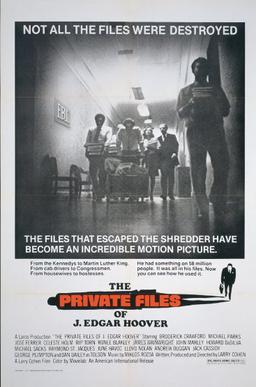
The 1977 film, The Private Files of J. Edgar Hoover, opens in 1972.
J. Edgar Hoover, the much-feared and long-serving director of the FBI, has just been found dead at his home and it seems like the entire city of Washington, D.C. is scrambling. Not only are people jockeying for Hoover’s job but they’re also wondering what might be found in his secret files. As quickly becomes apparent, Hoover had a file on everyone. While Presidents lauded him and the press portrayed him as hero, Hoover spent nearly 50 years building up a surveillance state. Hoover said it was to fight criminals and subversives but mostly, it was just to hold onto his own power. Even President Nixon is heard, in the Oval Office, ordering his men to get those files.
Hoover may have known everyone’s secrets but, the film suggests, very few people knew his. The film is narrated by a former FBI agent named Dwight Webb (Rip Torn). Dwight talks about how he was kicked out of the FBI because it was discovered that he not only smoked but that he was having an adulterous affair with a secretary. “You know how Hoover was about that sex stuff,” he says, his tone suggesting that there’s more to the story than just Hoover being a bit of a puritan.
We flash back to the 1920s. We see a young Hoover (James Wainwright) as a part of the infamous Palmer Raids, an early effort by the Justice Department to track down and deport communist subversives. Though Hoover disagrees with the legality of the Palmer Raids, he still plays his part and that loyalty is enough to eventually get him appointed, at the age of 29, to be the head of the agency that would eventually become the FBI. Hoover may start out as a relatively idealistic man but it doesn’t take long for the fame and the power to go to his head.
Hoover (now played by Broderick Crawford) serves a number of Presidents, each one worse the one who proceeded him. Franklin Delano Roosevelt (Howard Da Silva) is an avuncular despot while the Kennedy brothers (William Jordan as John and Michael Parks as Bobby) are two rich brats who think that they can control Hoover but who soon discover that Hoover is far more clever than they realize. Hoover finds himself a man out-of-place in the 60s and the 70s, Suddenly, he’s no longer everyone’s hero and people are starting to view the FBI as being not a force for law enforcement but instead an instrument of oppression.
Through it all, Hoover remains an enigma. He demands a lot of from his agents but he resents them if they’re too successful. Melvin Purvis (Michael Sacks) might find fame for leading the manhunt that took down Dillinger but he’s driven to suicide by Hoover’s cruel treatment. Unlike Clint Eastwood’s film about Hoover, The Private Files of J. Edgar Hoover suggests that Hoover was not gay but that instead, that he was so repressed that he was essentially asexual. When one woman throws herself at him, he accuses her of being a subversive and demands to know how anyone could find him attractive. He’s closest to his mother and when she dies, he shuts off his emotions. His own power, for better and worse, becomes the one thing that he loves. He’s married to the FBI and he often behaves like an abusive spouse.
The Private Files of J. Edgar Hoover is an interesting film. It’s an attempt to do a huge American epic on a less than epic budget. At the start of the film, the low budget is undeniably distracting. The 1920s are essentially represented by a back lot and two old cars. The scenes of the FBI dealing with gangsters like Dillinger and Creepy Karpis feel awkward and slapdash. But, as the film’s timeline gets closer to what was then the modern era, the film’s story tightens up and so does Larry Cohen’s direction. (One get the feeling that Cohen was, perhaps understandably, more interested in the Hoover of the 60s and the 70s than the Hoover of the 20s and 30s. There’s a sharpness to the second half of the movie that is just missing from the first half.) Broderick Crawford gives a chilling performance as a man who is determined to hold onto his power, just for the sake of having it. The scenes were Hoover and Bobby Kennedy snap at each other have a charge that’s missing from the first half of the film. Michael Parks does a great job portraying RFK as basically being a spoiled jerk while Crawford seems to relish the chance to play up the resentful, bitter old man aspects of Hoover’s personality. The film ultimately suggests that whether the audience previously admired RFK or whether they previously admired Hoover, they were all essentially duped.
Though the film never quite overcomes the limits of its low budget, it works well as a secret history of the United States. In 1977, it undoubtedly took guts to make a film that portrayed Roosevelt and Kennedy as being as bad as Nixon and Johnson. (It would probably even take guts today. One need only rewatch something like The Butleror Hyde Park on Hudson to see the ludicrous lengths Hollywood will go to idealize presidents like Kennedy and dictators like FDR.) While this film certainly doesn’t defend J. Edgar Hoover’s excesses, it often suggests that the president he served under were just as bad, if not even worse. In the end, it becomes a portrait of not only how power corrupts but also why things don’t change, regardless of who is nominally in charge. In the end the film’s villain is not J. Edgar Hoover. Instead, the film’s villain is the system that created and then enabled him. The man may be dead but the system remains.
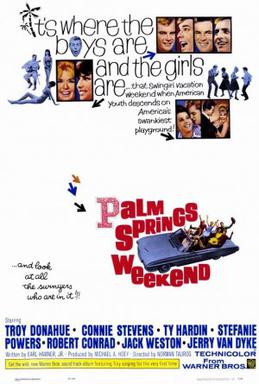
The 1963 film Palm Springs Weekend asks the question, “When is a beach film not a beach film?”
When it takes place in the freaking desert!
That’s right, Palm Springs Weekend takes place in the middle of the California desert. There’s no ocean in sight nor are there any beaches on which to frolic. Instead, there’s just a cheap motel and a swimming pool. That said, Palm Springs Weekend pretty much follows the same formula as all of the beach films that were released in the early 60s. A group of college students hop on a bus and head off for the weekend. One student is wacky. One student is rich, wild, and dangerous to know. And, of course, one student is clean-cut, responsible, boring, asexual, and studious and all about doing the right thing.
Troy Donahue, the blandest teen idol of all time, plays the clean-cut student. His name is Jim and he’s a college basketball star. Even when he’s on the bus traveling to Palm Springs, he’s still got a book to study. Jim’s the type who wears a suit and a tie to the pool. He ends up falling in love with Bunny Dixon (Stefanie Powers) and the two of them spend a lot of time talking about sex in the most chaste way possible. Bunny’s father (played by Andrew Duggan) is the chief of police and he doesn’t want any crazy college kids causing trouble in his town! Well, it’s a pretty good thing that all he has to worry about is Troy Donaue asking his daughter if she wants to take a moonlight stroll in the middle of the desert.
(Trust me. I’ve spent enough time in the desert to know that the last thing you want to do when you live near rattlesnakes is take a moonlight stroll.)
Jim’s best friend is Biff (Jerry Van Dyke). Biff is the wacky college student, which means that he plays the ukulele and he gets all the comedic moments. In this film, that amounts to getting babysitting an annoying boy and, at one point, falling into an extremely sudsy pool. Luckily, Jim’s there to deliver CPR, which leads to soap bubbles floating out of Biff’s mouth and …. you know what? I’m tired of writing about Biff.
Anyway, Biff and Jim really aren’t that important. The entire film pretty much belongs to Robert Conrad and Connie Stevens, largely because they’re the only two actors who are allowed to break out of the trap of always either being bumbling and innocent or dramatic and self-righteous. Robert Conrad plays Eric Dean, who is a spoiled rich kid who owns an expensive and fast car and who is basically a fun-loving sociopath. Meanwhile, Connie Stevens plays Gail, who is a high senior and who is pretending to be a college student. And while the film insists that we should somehow be disappointed in Gail because she’s acting wild and breaking curfew and doing more than just talking about whether or not it’s appropriate to kiss on the first date, she’s actually the most compelling character in the film because, at the very least, she’s actually setting her own rules and making her own decisions. Since Palm Springs Weekend was made in 1963, it ultimately feels the need to try to punish Gail for thinking for herself but that doesn’t change the fact that she’s still a far more interesting character than the blandly innocent Bunny. Gail’s a rebel. Gail’s the future. All hail Gail!
Anyway, Palm Springs Weekend is pretty forgettable and it’s never as much fun as any of AIP’s old Beach Party films. That said, I’d still recommend it if you’re a history nerd like me. It’s definitely a film of its time, a time capsule of an era.
Firefighter Shelly Forsythe (Richard Roundtree) has just been assigned to a new firehouse and, from the minute he shows up, it’s trouble. Not only is he resented for taking the place of a popular (if now dead) firefighter but he’s also the first black to have ever been assigned to that firehouse. Led by angry racist Skip Ryerson (Vince Edwards), the other firemen immediately distrust Forsythe and subject him to a grueling hazing. However, Forsythe is determined to prove that he’s just as good as any white firefighter and refuses to be driven out. While the firehouse simmers with racial tensions, a gang of arsonists is setting buildings on fire.
Firehouse does not have much of a plot but what little it does have, it deals with in a brisk 72 minutes. Forsythe shows up for his first day. Everyone hazes him. Forsythe gets mad. There’s a big fire. And then the movie ends, without resolving much. Ryerson is still a racist and Forsythe is still mad at almost everyone in the firehouse. The characters are all paper thin and most of the fire fighting scenes are made up of grainy stock footage. What does make the film interesting is the way that it handles the causal racism of almost every white character. Ryerson, for instance, comes across as being an unrepentant racist but the film suggests that this is mostly due to him being too stubborn to change his ways and that Ryerson’s not that bad once you get to know him. When Andrew Duggan’s fire chief instructs Forsythe not to take any of the constant racial remarks personally, Firehouse portrays it as if Duggan is giving good and reasonable advice. The mentality was typical for 1973 but wouldn’t fly today.
One reason why Firehouse ends so abruptly is because it was a pilot for a television series. At the time Firehouse aired, it had been only two years since Roundtree starred as John Shaft and NBC hoped that to recapture that magic on a weekly basis. However, it would take another year before the Firehouse television series went into production and, by that time, Roundtree had left the project. In fact, with the exception of Richard Jaeckel, no one who appeared in the pilot went on to appear in the short-lived TV series.
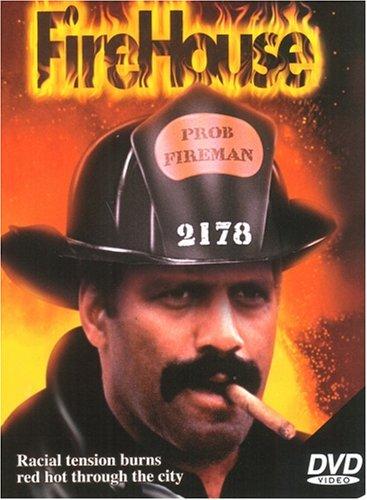
The DVD of Firehouse is infamous for featuring a picture of Fred Williamson on the cover, in which Williamson is smoking a cigar and wearing a fireman’s helmet. Williamson does not appear anywhere in Firehouse and I can only imagine how many people have sat through Firehouse expecting to see a Fred Williamson blaxploitation film, just to discover that it was actually a Richard Roundtree television pilot. Firehouse probably would have been better if it had starred Fred Williamson. Roundtree’s good but sometimes, you just need The Hammer.
Now, I have to be honest. I’m not really sure what the point of Labor Day is. I have no idea what we’re supposed to be celebrating today. I’ve got the day off, which seems kind of unfair when you consider that people who have far worse jobs than me — i.e., the actual laborers — are having to work.
Like many Americans, I spent this weekend hanging out with my extended family. On Sunday, I did a poll of every cousin, aunt, uncle, sister, niece, and nephew that I could find and almost every single one of them agreed with me that Labor Day sounded like something tedious that Jesse Myerson would come up with and then demand that everyone celebrate. In short, it sounded communistic.
So, with that in mind, I think the best way to start out Labor Day would be by watching this educational film from 1962. In Red Nightmare, Jerry Donavon (Jack Kelly) takes his freedom for granted. So, Jack Webb shows up and casts a magic spell, which causes Jerry to have a dream about what it would be like to live in a communist society. In fact, you could even say that Jack Webb gives Jerry a red nightmare!
So, there’s two ways to review a film like Red Nightmare. We can either debate the film’s politics and get into a big discussion about economics and policy and all that crap and OH MY GOD, doesn’t that just sound perfectly tedious? Or, we can simply enjoy Red Nightmare for what it is, a histrionic but sincere time capsule of what was going on in the psyche of 1962 America.
Red Nightmare! Watch it before getting brainwashed by Labor Day!




 Through the Shattered Lens