Review: Oblivion (dir. by Joseph Kosinski)


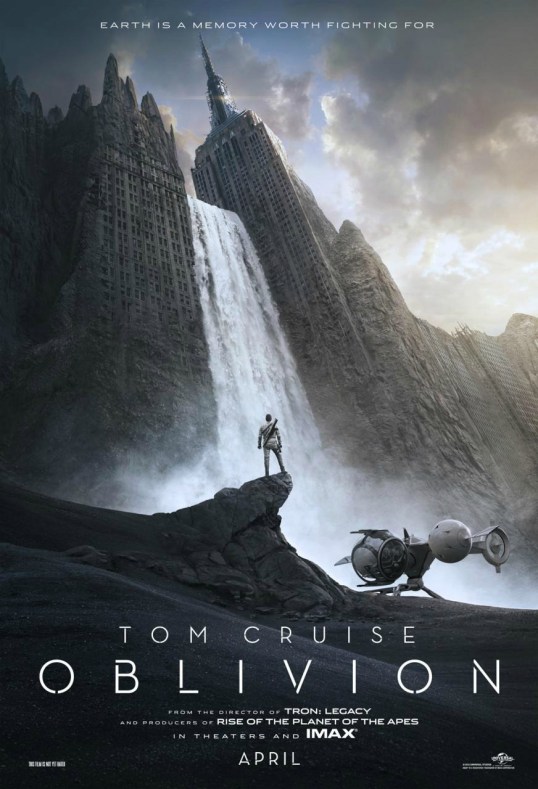
Oblivion-Movie-Poster

Good science-fiction films tend to be far and few between. Most of the time the ideas and ambition to make a good or great science-fiction film are right there on paper, but loses much once people actually have to create it for others to see. This puts the latest sci-fi film from Tron: Legacy filmmaker Joseph Kosinski in a weird position. His follow-up to the underwhelming sequel to the classic sci-fi film Tron is called Oblivion and it manages to be thought-provoking and entertaining, yet also have a sense of a been there and done that to the whole proceeding.

Oblivion quickly gets the introductions to the film’s backstory out of the way. Earth was attacked 60 years ago by aliens who were called “Scavengers” (Scavs for short) who destroyed the moon thus causing massive tectonic upheaval and gigantic tsunamis to ravage the planet. Humanity in its desperation would fight back with the only weapons it had left once the aliens began landing troops and that would be the nuclear kind. The planet is now devastated with the surviving population leaving Earth for a new colony on Saturn’s moon of Titan and in a massive tetrahedron space station orbiting Earth simply called “The Tet”.

It’s the story of the technician pair left behind to provide support for the array of armed drones who patrol Earth for any remaining Scavs and protect the reclamation factories that has been removing the remaining resources that the planet has to be used as an energy source for the Titan colony. This pair of technician are Jack (Tom Cruise) and Victoria (Andrea Riseborough) who live in a towering base above the clouds. Jack does the dirty work by flying patrols in the area that encompasses what used to be the East Coast of the United States while Victoria (who also happens to be Jack’s lover) provides comm and technical support back at their base.
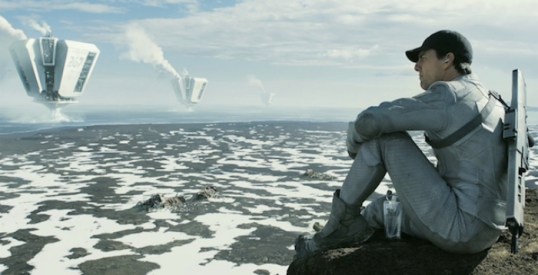
Oblivion01

Victoria can’t wait to finish their five-year stint on Earth and with two weeks left before they can rejoin the rest of humanity on Titan her dream is coming closer. Yet, Jack doesn’t seem to want to leave Earth behind. He has begun to dream about Earth before the war that he should have no memory of. First they’re dreams while he’s asleep but as the film shows it soon begins to invade and distract his waking hours as well.

It’s during one such mission where he comes across the a sudden arrival of a human spacecraft with surviving humans aboard that his dreams become reality. A woman he has dreamed off that he’s never met is one of the survivors (played by Olga Kurylenko) and she becomes the key to unlocking the secret that’s been kept from him about the true nature of the war that devastated Earth sixty years past and why he continues to have flashes of memories that he should never have had.

Oblivion sounds like it’s original at first glance, but as the story moves along we begin to see influences (at times outright plot point lifts) from past innovative sci-fi films such as Moon and The Matrix. While Kosinski (who co-wrote the film as well as directed it) does put his own spin on these ideas it’s not enough to fully distinguish the film from past sci-fi films which did them better. Oblivion is not bad by any means, but it fails to stretch beyond it’s influences that would’ve made it a great film instead of just being a good one. It doesn’t help that the script lags behind Kosinski’s talent for creating some beautiful images and vistas. The world-building he does with art director Kevin Ishioka manages to make a devastated Earth look serenely beautiful which when paired with cinematographer Claudio Miranda’s panoramic sweeps of the Icelandic location shoot make Oblivion one of the best looking film of 2013.

Yet, the script tries too hard to explore some heavy themes such as the nature of memory and identity. The film doesn’t explore them enough to make this film come off as something heavy sci-fi like Solaris. It just teases the audience enough to start a spark that could lead to conversations afterwards. The action that does punctuate the more introspective sections of the film does come off quite well despite coming only few at a time and not for any extended length.

Oblivion02

What seems to hold the film together outside of it’s visuals would be the performance of the cast which sees Tom Cruise doing a very workman-like performance as Jack. We’ve seen him do this sort of performance time and time again that it seems to be second-nature to him by now and something audiences come to expect now. Even Morgan Freeman as an aged resistance fighter lends a bit of serious gravitas to the film whenever he’s on-screen. But it’s the performances of the two female leads that sells the film despite it’s flaws. Olga Kurylenko has less to work with in the role of Jack’s mystery woman Julia. What she does get she does so with a level of empathy that instantly sells the notion that Jack and her were destined to be together despite the vast gulf of time and space.

The stand-out performance comes from Andrea Riseborough as Jack’s lover and partner Victoria. Where Jack comes off as restrained chaotic glee who marvels at the sight he sees every day he’s out on patrol the opposite is Victoria. Her organized and reserved demeanor comes off as sexy in a cold and calculated way, yet just behind that British reserve we see glimpses of her hanging on by a thread at the chaos she sees in Jack. Andrea Riseborough plays Victoria so well that every scene she’s in she steals it from Cruise. Her performance was all about slight changes to her body movement, a quick glance that speaks volumes of what she’s thinking. While this film may not make Riseborough an outright star it will get her noticed by other filmmakers soon enough.

With the summer blockbuster season of 2013 coming closer like a freight train with the approach of Iron Man 3 it’s a good thing that Oblivion was released weeks before this hectic season. For despite it’s flaws in it’s script and the lack of originality in it’s premise the film does succeed in being entertaining and thought-provoking enough that people should see it on the big-screen. Plus, nothing but the massive screen (especially IMAX) does full justice to some of the vistas shot of Iceland that doubles as devastated Earth. So, while Oblivion may not be the slam-dunk hit for Kosinki after failing with Tron: Legacy it is still a film worth checking out.

Disconnected From Disconnect


Disconnect, the feature film directing debut of award-winning documentarian Henry-Alex Rubin, has been getting some fairly positive reviews.  According to Rotten Tomatoes, the film has a critical score of 71 while audiences have been even more impressed.  The last time I checked, it had an audience score of 83%.  If you’ve seen any of the commercials for this film then you’ve undoubtedly heard it referred to as being “the best film of the year.”

That’s high praise for a film that’s essentially Crash with better acting.

Much like Crash (which, incidentally, I consider to be the worst film to have ever won the Oscar for Best Picture), Disconnect is an ensemble film that tells several different stories.  For whatever reason, first-time directors seem to have a weakness for movies with ensemble casts and multiple-story lines.  When done well, an ensemble film can say something profound about the way that people in a society relate to one another.  When done poorly (like in Crash or Disconnect), they just feel trendy.  Watching Disconnect, I felt as if the filmmakers couldn’t come up with a way to tell one compelling story from beginning to end so, instead, they just tossed together fragments of three separate stories and then desperately tried to come up with a theme to connect them all.

That theme, by the way, is that our reliance of modern technology has created a society where people are Disconnected from one another.

Gee, you think?

Disconnect tells three separate, inter-connected stories.  In one story, Paula Patton and Alexander Skarsgard are a married couple who are struggling to deal with the recent death of their child.  Skarsgard deals with his grief by going on long business trips and getting addicted to online gambling.  Meanwhile, Patton joins an online support group and finds herself tempted to have affair another member (Michael Nyqvist).  Patton’s activities leads to identity theft and bankruptcy.  With the help of a sleazy private investigator (Frank Grillo), Patton and Skarsgard try to track down the man who stole their identity.  This story falls apart once Patton and Skarsgard find the man and both characters suddenly start acting in the most inconsistent ways conceivable.  It really should be impossible t0 make charismatic performers like Alexander Skarsgard and Paula Patton seem  bland and boring but somehow, Disconnect manages to do it.

In the film’s best storyline, Grillo’s teenage son (Colin Ford) catfishes and cyber-bullies an alienated classmate (Jonah Bobo).  When Bobo hangs himself as a result, Ford is wracked with both guilt and fear.  Ford’s attempts to cover-up his involvement leads to him meeting and briefly befriending Bobo’s father (Jason Bateman), who has no idea what led to his son attempting suicide.  In this story, Bateman proves that he’s as good with drama as he is with comedy and Ford’s complex and multi-layered performance is more than award-worthy.  This was probably the most powerful part of the film and, if the filmmakers had simply concentrated on this story (as opposed to diluting it by making only one part of a multi-part film), Disconnect would fully deserve the high-praise that it’s currently receiving.

In the film’s third (and most flamboyant) storyline, Andrea Riseborough is a cynical and opportunistic reporter who does a story about a cocky teenager (Max Thieriot) who performs on an adults-only site and who recruits other teenagers for a manipulative pimp (played by none other than Marc Jacobs).  Riseborough finds herself charmed by the teenager (and who can blame her because, after all, he’s played by Max Thieriot) and soon she’s having an affair with him.  However, her news story captures the attention of the F.B.I. and soon both Thieriot and Riseborough find themselves in danger.

At first, I thought I was going to enjoy this storyline because I love Max Thieriot.  He’s ideally cast here and he gives a good, sympathetic performance. For that matter, so does Andrea Riseborough and even Marc Jacobs brings a certain reptilian charm to his role.  However, this story falls apart as it quickly becomes obvious that the filmmakers, having set up a potentially interesting situation, have no idea what to do with it.  Instead, much as with the characters played by Skarsgard and Patton, Riseborough ceases to behave with anything resembling logic or consistency.  Both she and Thieriot go from being interesting, well-rounded characters to being mere plot devices.

That, ultimately, is the main reason why Disconnect fails.  With the exception of the characters played by Bateman and Ford, nobody in this film feels real and, again with the notable exception of Bateman and Ford’s storyline, very little that happens feels genuine.  The film is watchable because of the talented cast but, otherwise, it’s a melodramatic and predictable mess that seems to think that it’s a lot smarter than it actually is.

Perhaps that’s why so many people over on the imdb have been praising this film as “the best of the year.”

Some people will always enjoy feeling like they’re thinking without actually having to do it.

Trailer: Oblivion (Official)


Oblivion-Movie-Poster

Every year always has a couple of big genre films that seem to continually fly under the radar. This is surprising since people tend to think that films with huge budgets and a cast headlined by one of the biggest names in Hollywood tend to be overhyped before they even reached the big-screen. While I’ve heard of the upcoming scifi and post-apocalyptic film Oblivion for almost two years now it’s still a film that doesn’t generate much talk.

We know several things about Oblivion that came out before the release of the film’s first trailer: 1. it stars Tom Cruise and 2. it’s the follow-up film for Tron: Legacy director Joseph Kosinski. The second part may be one thing that has kept this film from being one of the biggest anticipated films of 2013. Kosinski’s underwhelming sequel to Tron didn’t make many genre fans excited as to what he might come up with next.

The trailer looks to erase some of those doubts as we get to see Oblivion as a very beautifully-shot film. We get see some great looking art direction for the film if the trailer show’s us anything about Oblivion. Plus, it has Morgan Freeman all decked out like one of David Lynch’s Fremen from Dune.

Oblivion is set for an April 12, 2013 release date.

Source: Apple

A Quickie With Lisa Marie: Brighton Rock (dir. by Rowan Joffe)


Brighton Rock is a British film noir that’s currently both playing in limited release and which is also available via video-on-demand.  Based on a novel by Graham Greene, Brighton Rock is the story of Pinkie (Sam Riley), a sociopathic gangster who murders a gambler.  The chase leading up to the murder is witnessed by a mousey waitress named Rose (Andrea Riseborough) who doesn’t realize what she’s actually seen.  In order to keep her quiet, Pinkie marries Rose.  Rose, however, works for Ida (Helen Mirren) and Ida just happens to have been friends with the murdered gangster.  Realizing that Rose is in danger, Ida takes it upon herself to expose Pinkie for the murderer he is.

Brighton Rock is a visually striking film and it has a handful of good performances but it never quite comes together.  Before making his feature film directing debut here, Rowan Joffe wrote the script for last year’s The American and, much like The American, Brighton Rock has an abundance of style and is full of references to the classic crime films of the 60s and 70s.  Also, much like The American, the style — too often — seems to exist separately from any larger vision.  As a result, the film ultimately feels like several disconnected — if pretty scenes — strung together by convenience.  The film has an intriguing-enough plot but the narrative lacks any sort of forward momentum.  Interestingly enough, Greene used the story of Pinkie, Rose, and Ida to examine larger theological issues within the Catholic church.  With the exception of a scene where Pinkie prays, an over-the-top sequence featuring a judgmental nun, and a few inserts of crucifixes artfully hanging on grimy walls, Joffe pretty much jettisons the story’s religious angle but without it, Pinkie and Rose’s actions make a lot less sense. 

Joffe’s decision to cast Sam Riley, whom I’ve had a crush on ever since I first saw Control, in the lead role of Pinkie is problematic.  It’s not that Riley gives a bad performance because he doesn’t.  He makes a convincing psychopath and if he’s never quite charming enough to be a true anti-hero, he’s still makes Pinkie into a compelling figure.  Unfortunately, Riley is still totally miscast in the film.  In Graham Greene’s original novel, Pinkie was only 17 years old.  Sam Riley is 31 and looks even older.  Unfortunately, all of the other characters in the film continually refer to him as “the kid.”  John Hurt, at one point, gives a monologue in which he wonders how someone so young could be so evil.  But Riley isn’t young and as a result, I found myself wondering just how old someone had to be before they were considered to be an adult in 1960s England.

Still, if nothing else, Joffe gets some good performances from his supporting cast.  Andrea Riseborough manages to be both poignant and annoying as Rose while Andy Serkis appears to be having a lot of fun playing a slightly ludicrous gangster.  Not surprisingly, Helen Mirren commands every scene she appears in and she and John Hurt have got a great chemistry.  Regardless of how you might feel about the film as whole, it’s impossible not to enjoy their scenes together.  They’re final scene together made me squeal with delight and, in the end, that has to count for something.