October True Crime: Stolen Innocence (dir by Bill L. Norton)


1995’s Stolen Innocence opens with 18 year-old Stacy Sapp (Tracey Gold) trying to sneak back into her house after a long night of drinking and partying.  Unfortunately for her, Stacey isn’t very good at sneaking around and she’s caught by her mother (Bess Armstrong) and her father (Nick Searcy).

“I’m 18!” Stacy argues.

“You’re going to end up pregnant!” her mother yells.

Stacy says that that her mother is just scared that she’s going to end up a loser “like you!”  Well …. yeah, Stacy, that’s kind of the point.  If your mother has experience with the life decisions necessary to become a loser, maybe you should listen to her warnings.

Anyway, Stacy runs away with a friend of her’s.  After her friend decides to go back home, Stacy hitches a ride with a trucker.  When the trucker stops off at a truck stop so he can get his brakes looked at, Stacy meets Richard Brown (Thomas Calabro, wearing a really bad wig).  Richard is long-haired and has got a tough guy beard and a cheesy tattoo of a heart on his scrawny forearm.  Stacy, of course, is totally smitten and she goes off with Richard and his “friend,” Eddie (Matt Letscher).

It doesn’t take long for us to figure out what Richard is bad news.  He carries a gun.  He’s financing his trip through stolen checks.  He might not even own the truck that he’s driving.  He and Eddie have a bizarre relationship in which Richard continually abuses Eddie but Eddie refuses to leave.  Richard is obviously a bad guy and we can all see it.  When Stacy finally calls her parents from the road, they immediately figure out that Stacy is in trouble.  However, it takes Stacy forever to figure it out because Stacy’s kind of an idiot.

I cringed a lot while watching Stolen Innocence, not so much because of the film’s depiction of Richard’s criminal lifestyle but because I used to have a definite weakness for bad boys and I could kind of understand what was going through Stacy’s mind when she first met Richard.  That said, I’m pretty sure that I would have figured things out a lot quicker than Stacy did.  Stacy quickly goes from being a somewhat sympathetic rebellious teenager to being someone who you really start to get annoyed with.  Oh, he’s threatening you with a gun?  Okay, that’s when you leave!  That’s when you start plotting your escape.  You don’t make excuses for him.  He’s financing his trip with stolen checks?  I’m sorry, is that not a red flag?  Add to that, as played by a miscast Thomas Calabro, it’s not like Richard is some boiling cauldron of charisma.  From the first minute we see him, with his long hair and his cowboy hat and his tattoo, the guy seems like a joke.

Eventually, Stacy does figure out the truth but, by that point, Richard and her are holed up in a motel room and Richard is exchanging gunfire with the FBI.  The film ends with a title card, reminding us that this was a true story.  “He’s not a bad person!” Stacy wails to the police.  I guess some people really are that stupid.
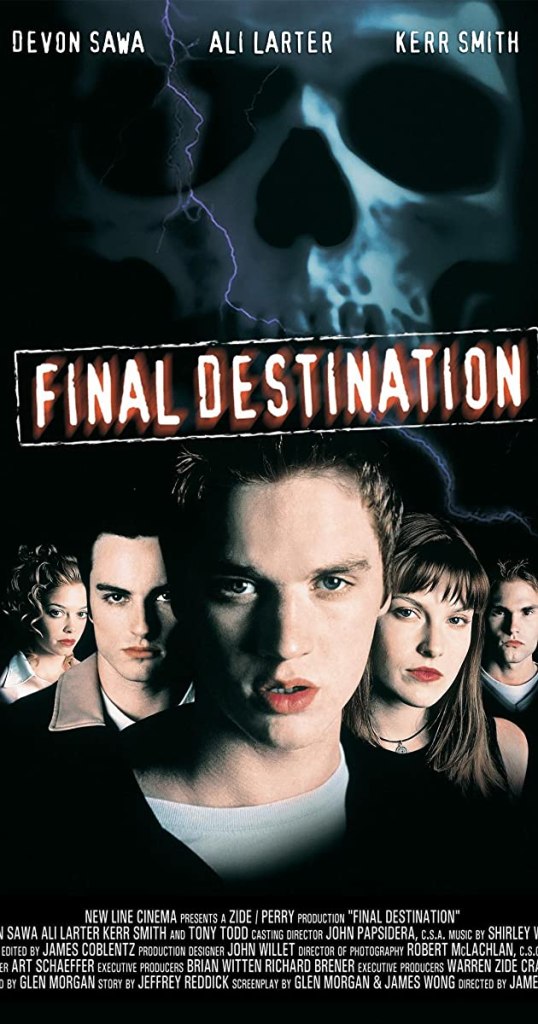
Horror Film Review: Final Destination (dir by James Wong)


I was recently rewatching the 2000 film, Final Destination, and a few things occurred to me.

Number one, no one ever really thanks Devon Sawa for getting them off that plane before it explodes.  Final Destination opens with a group of high school students boarding a plane so that they can go on their senior class trip to Paris.  (I wish I had gone to their high school.  Our senior class trip was to …. well, we didn’t get one.)  When Alex Browning (Devon Sawa) has a vision of the plane exploding, he freaks out and he, his teacher, and a few other students are kicked off the plane.  Needless to say, everyone’s pretty upset with Alex but then, just a few minutes after taking off, the plane does explode.  Alex was right.  He saved everyone’s lives.

And yet, no one ever says, “Thank you, Alex!”  Instead, everyone is still like, “Hey, that’s the weirdo that ruined our trip to Paris!”  No, the plane exploding is what ruined your trip to Paris.  Alex saved your life!  Poor Alex.  And yet, it kind of makes sense.  In the face of inexplicable tragedy, people need someone to blame and Alex is a convenient scapegoat.

That scapegoating continues once the survivors of the flight start to mysteriously die.  No one wants Alex near them, even though Alex has managed to figure out that Death is stalking them because they messed up its plans by getting off of that plane.  Then again, Alex doesn’t always come across as if he’s the most stable person in the world.  Gaunt and hallow-eyed, Sawa portrays Alex as someone who haunted by survivor’s guilt even before it became obvious that he and his former friends were being targeted.  Sawa, it should be said, gives a remarkably good performance in Final Destination.

Another thing that occurred to me as I rewatched Final Destination is that, in this film, Death doesn’t have much of a sense of humor.  The Final Destination sequels are notorious for their elaborate and often ironic death scenes, the majority of which seem to indicate that Death might be a little bit too clever and precocious for its own good.  However, in the first Final Destination, Death is a lot more direct and, in some ways, a lot more sadistic.  Terry Chaney (Amanda Detmer) steps out in the street and gets run over by a bus.  Goofy Billy Hitchcock (Seann William Scott — why two n’s Seann!?) makes the mistake of standing too close to the railroad tracks and he loses the top half of his head.  Death really only get creative when it comes to taking out Todd Waggner (Chad E. Donella) and Ms. Lewton (Kristen Cloke) and, even then, it’s methods are nowhere near as elaborate as they would eventually become.

The final thing that I noticed is that Final Destination holds up really well.  It’s hard to remember now but, when Final Destination first came out, a lot of critics dismissed it as just being a slasher film with a slightly clever twist.  But actually, that twist is far more than just “slightly” clever and the film really does a lot more with the idea than it’s often given credit for.  Final Destination is a film full of thrills and chills — I still freak out at some of those death scenes — but it’s also a film that always makes me think about mortality.  Has our destiny already been written?  Can we defeat death?  Or are we just pawns with our fates predetermined?  In the end, that’s what makes Final Destination so effective.  We all know that we can’t escape death, both in real life and in the movies.  The one thing that everyone has in common is that death is eventually going to come for all of us.  It’s the one enemy that we can’t defeat or laugh away.  Instead, all we can do is try to hold it off for a while.  Final Destination taps into the fears that we all have.

The plot is clever.  The script is frequently witty.  I liked the fact the characters were all named after horror movie icons.  Plus, you got Tony Todd dominating the entire film with just a brief role.  Final Destination is a classic.

4 Film Reviews: Bridge To Silence, The Chocolate War, Kiss The Bride, Wedding Daze


Last week, I watched six films on This TV.

Which TV?  No, This TV!  It’s one of my favorite channels.  It’s not just that they show a lot of movies.  It’s also that they frequently show movies that are new to me.  For instance, last week, This TV introduced me to both Prison Planet and Cherry 2000.

Here are four other films, two good and two not so good, that This TV introduced to me last week.

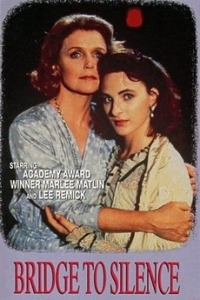
First up, we have 1989’s Bridge to Silence.

Directed by Karen Arthur, Bridge To Silence was a made-for-TV movie.  Lee Remick plays Marge Duffield, who has a strained relationship with her deaf daughter, Peggy (Marlee Matlin).  After Peggy’s husband is killed in a traffic accident, Peggy has a nervous breakdown.  Marge and her husband, Al (Josef Sommer) take care of Peggy’s daughter, Lisa, while Peggy is recovering.  However, even as Peggy gets better, Marge still doesn’t feel that she can raise her daughter so Marge files a lawsuit to be named Lisa’s legal guardian.  While all of this is going on, Peggy is starring in a college production of The Glass Menagerie and pursuing a tentative romance with the play’s director (Michael O’Keefe).

Bridge to Silence is one of those overwritten but heartfelt melodramas that just doesn’t work.  With the exception of Marlee Matlin, the cast struggles with the overwrought script.  (Michael O’Keefe, in particular, appears to be miserable.)  The film’s biggest mistake is that it relies too much on that production of The Glass Menagerie, which is Tennessee Williams’s worst play and tends to be annoying even when it’s merely used as a plot device.  There’s only so many times that you can hear the play’s director refer to Peggy as being “Blue Roses” before you just want rip your hair out.

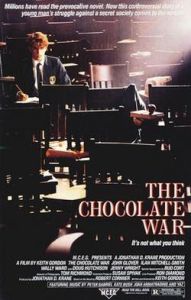
Far more enjoyable was 1988’s The Chocolate War.

Directed by Keith Gordon, The Chocolate War is a satirical look at conformity, popularity, rebellion, and chocolate at a Catholic boys school.  After the manipulative Brother Leon accidentally purchases too much chocolate for the school’s annual sale, he appeals to one of his students, Archie Costello (Wallace Langham), to help him make the money back.  Archie, who is just as manipulative as Leon, is the leader of a secret society known as the Vigils.  However, Archie and Leon’s attempt to manipulate the students runs into a roadblack when a new student, Jerry Renault (Illan Mitchell-Smith) refuses to sell any chocolates at all.  From there, things get progressively more complicated as Archie tries to break Jerry, Jerry continues to stand up for his freedom, and Leon … well, who knows what Leon is thinking?

The Chocolate War was an enjoyable and stylish film, one that featured a great soundtrack and a subtext about rebellion and conformity that still feels relevant.  John Glover and Wallace Langham both gave great performances as two master manipulators.

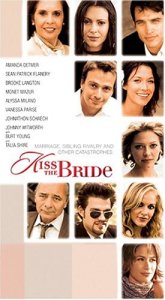
I also enjoyed the 2002 film, Kiss The Bride.

Kiss The Bride tells the story of a big Italian family, four sisters, and a wedding.  Everyone brings their own personal drama to the big day but ultimately, what matters is that family sticks together.  Directed by Vanessa Parise, Kiss The Bride featured believable and naturalistic performances from Amanda Detmer, Talia Shire, Burt Young, Brooke Langton, Monet Mazur, and Parise herself.

I have to admit that one reason why I liked this film is because it was about a big Italian family and it featured four sisters.  I’m the youngest of four sisters and, watching the film, I was reminded of my own big Irish-Italian family.  The movie just got everything right.

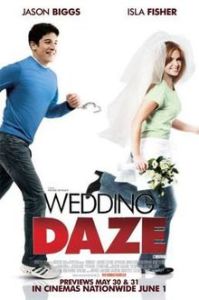
And then finally, there was 2006’s Wedding Daze.

Wedding Daze is a romantic “comedy.”  Anderson (Jason Biggs) asks his girlfriend to marry him, just to have her drop dead from shock.  Anderson’s best friend is afraid that Anderson will never get over his dead girlfriend and begs Anderson to not give up on love.  Anderson attempts to humor his friend by asking a complete stranger, a waitress named Katie (Isla Fisher), to marry him.  To everyone’s shock, Katie says yes.

From the get go, there are some obvious problems with this film’s problem.  Even if you accept that idea that Katie would say yes to Anderson, you also have to be willing to accept the idea that Anderson wouldn’t just say, “No, I was just joking.”  That said, the idea does have some comic potential.  You could imagine an actor like Cary Grant doing wonders with this premise in the 30s.  Unfortunately, Jason Biggs is no Cary Grant and the film’s director, comedian Michael Ian Black, is no Leo McCarey.  In the end, the entire film is such a misjudged failure that you can’t help but feel that Anderson’s ex was lucky to die before getting too involved in any of it.

What Lisa Watched Last Night #128: Lethal Seduction (dir by Nancy Leopardi)


Last night, I watched the latest Lifetime original film, Lethal Seduction!

dina-meyer-at-lethal-seduction-2015-stills_3

Why Was I Watching It?

Because it was on Lifetime, of course!  Plus, with a name like Lethal Seduction, you knew it had to be good.  It’s not quite as great a title as A Deadly Adoption or Babysitter’s Black Book but it’s close.

What Was It About?

Mark Richards (Caleb Ruminer) seems like he has a great future ahead of him.  He’s a high school senior who has invented a new app and who is going to be attending Princeton in the fall.  Sweet Melanie (Tessa Harnetiaux) has a crush on him.  His best friend, Walter (Sam Lerner), is so desperately uncool that he makes Mark look really hot by comparison.  His widowed mother, Tanya (Amanda Detmer), is extremely overprotective but, fortunately, she’s being distracted by her new boyfriend, Randy (Brian Smith).

(Randy and Tanya work at the local aquarium and the entire film is full of oddly pensive close-ups of sharks and jellyfish swimming around.  They don’t have anything to do with the plot but they are pretty to look at.)

One day, while at the hardware store, Mark meets Carissa (Dina Meyer).  Carissa invites Mark home with her and soon, Mark is showering with Carissa, swimming naked with Carissa, having sex with Carissa, and getting handcuffed by Carissa.  (And why not?  App developers are sexy!)  Walter is jealous.  Melanie is scared.  And Tanya does not approve, especially after Carissa starts to encourage Mark to skip college and instead, move in with her.

That’s right, Carissa is an obsessive and homicidal cougar!  And, just in case you needed any reminded that she’s crazy, the film is called Lethal Seduction

What Worked?

This film was a lot of fun.  Frequent TSL commenter Doc Zeke and I had a lot of fun live tweeting it over on twitter.  The film is totally melodramatic, over the top, and ridiculous in that wonderful Lifetime fashion.  It was all very silly but it was a lot of fun as well.

Plus, Dina Meyer fully committed herself to playing the murderous Carissa.  She gleefully attacked the role with almost as much energy that Carissa devoted to attacking anyone who dared to stand between her and Mark.

What Did Not Work?

The film is full of close-ups of sharks and yet the sharks themselves are never really relevant to the plot.  Don’t introduce a shark unless someone’s going to end up getting eaten by the end of the film.

“OMG!  Just like me!” Moments

I related to Melanie.  It’s unfortunate that neither Mark nor fate treated her better.

Lessons Learned

All of Mark’s troubles could have been avoided if he had just listened to his mother and done exactly what she said.  That’s actually a pretty common Lifetime lesson.