Film Review: Becky (dir by Jonathan Milott and Cary Murnion)


Becky is a fairly intense thriller, featuring two actors who you normally wouldn’t expect to appear in a film about a 13 year-old girl savagely attacking and killing a group of criminals in the woods.

For example, Kevin James is best-known for starring in The King of Queens and for playing Paul Blart: Mall Cop.  He’s a member of the Adam Sandler stock company and almost his entire career has involved playing goofy but lovable manchildren.  In Becky, he plays Dominick, a member of the Aryan Brotherhood who has escaped from prison and, along with a group of other fugitives, is desperately searching for a key that will apparently unlock something that will lead to a race war.  Over the course of the film, Dominick murders several people.  He orders his associates to kill children.  He tortures a man with a branding iron and he taunts an interracial couple.  He has a big bushy beard and a swastika tattooed on the back of his saved head.  In other words, this isn’t the Kevin James movie to show your grandma.

And then you have Joel McHale.  Joel McHale is best-known for hosting The Soup and playing Jeff Winger on Community.  In Becky, McHale plays another character named Jeff.  This Jeff is the father of an angry 13 year-old girl named Becky (played by Lulu Wilson).  Jeff wants to have a nice weekend up at the lake with Becky and he’s hoping that he can get Becky to accept the fact that Kayla (Amanda Brugel) is going to be her new stepmother.  Needless to say the weekend does not go well.  Not only does Becky resent Kayla but Dominick and his crew show up at Jeff’s cabin, searching that key.

While Dominick is holding her family hostage, Becky is hiding in the woods and picking Dominick’s men off one-by-one.  As Kayla explains it, Becky is unstoppable because she’s “a vindictive 13 year-old girl.”  The majority of the film is taken up with scenes of Becky coming up with creative ways to kill people who are a lot bigger than her.  It turns out that everything from an art pencil to a ruler can be turned into a deadly weapon.  (Of course, sometimes, a lawn mower works just as well.)  Becky is the type who will scream over the corpse of someone who she has just killed.  It’s not because she’s upset over what she’s done.  It’s because she’s so pissed off.  And believe me, I could relate.  I was a pissed off 13 year-old too.  Luckily, I never had to kill anyone with my art supplies so let’s all be happy about that.

Becky is a bit of throwback to the grindhouse films of the past.  There’s even a scene that plays a very obvious homage to the ending of the original I Spit On Your Grave.  There’s a lot of violence.  There’s a huge amount of gore.  If you’ve ever wanted to see what an eye looks like when it’s literally hanging out of its socket, this is the film for you.  There are some moments of very dark humor as well.  Lulu Wilson gives a fierce performance as Becky and, In general, the film’s well-directed.  The first 20 minutes of the movie are actually rather brilliant, with scenes of Becky dealing with school bullies alternating with scenes of Dominick killing people in prison.

That said, the film itself runs out of gas long before the final scene.  A huge part of the problem is that Domenick and his associates are all way too stupid to really be a legitimate threat to Becky and, as a result, there’s not much suspense as to whether or not Becky will be able to kill them.  (It was hard not to unfavorably compare the buffoonish, easily outwitted Neo-Nazis in this film with the legitimately terrifying ones that appeared in Green Room.)  As well, for all the film’s violence and it’s homages to the grindhouse, it oddly allows two characters to survive the film despite the fact that there was no reason for the film’s villains to keep them around.  Their survival reminds you that you’re just watching a movie and it takes you out of the moment.  You realize that if the movie doesn’t have the guts to kill the two of them, then it’s probably not going to have the guts to really surprise us further down the road.

I have to admit, I really wanted to like this film, if just because I was intrigued by the against-type casting of Kevin James and Joel McHale.  I may not care for the majority of Kevin James’s films but I’ve always felt that he was a good actor.  Joel McHale, as well, has always been a personal favorite of mine and, like James, he’s a better actor than he’s often given credit for being.  I was hoping that both of them would get a chance to shock viewers by brilliantly playing against type.  But McHale is stuck playing a character who is just too wimpy to be sympathetic and Kevin James, bless him, often seems to be trying too hard to project menace.  True menace has to feel natural.  Once it becomes obvious that you’re trying to be menacing, then you’re not.  Dominick is a Sid Haig role being played by Kevin James.  Despite (or perhaps because of) the goofy appeal of such an idea, it just doesn’t work.

Despite its flaws, Becky is a well-shot, quickly paced film and it has enough entertaining moments to be watchable if not entirely satisfying.  If you’re looking gore, this film has what you’re looking for and, as any horror fan can tell you, there’s certainly nothing wrong with that.  The film doesn’t quite work but still, directors Jonathan Milott and Cary Murnion do a good enough job that I look forward to seeing where they do next.


Lisa Cleans Out Her DVR: Sometimes The Good Kill (dir by Philippe Gagnon)


(Hi!  I’m currently in the process of cleaning out my DVR!  Hopefully, I’ll be done before the next Congressional special election but it’s going to be a close one!  Anyway, I recorded Sometimes The Good Kill off of Lifetime on May 13th!)

I have to admit that when I saw the title of this one, my first thought was, “Since when is Lifetime doing Spaghetti westerns?”  I mean seriously, Sometimes The Good Kill is one of those titles that would be perfect for a Franco Nero or a Tomas Milian (or maybe even a Terrence Hill) film.

But no, it turns out I was wrong.

Sometimes The Good Kill takes a look at the sordid things that happen behind the scenes at a convent, a question that has apparently obsessed audiences since the first time they heard Hamlet order Ophelia to “get thee to a nunnery!”  Someone is killing nuns, but why?  Things get off to a start when the old Mother Superior is found underneath a ladder.  Then another is found drowned in a bathtub.  The new Mother Superior (Allison Hossack) wants the murders to remain a secret because the convent is struggling financially.  So, instead of calling the police, she just puts the bodies in a freezer.  Fortunately, the newest arrival at the convent — Sister Talia (Susie Abrometi) — has a mysterious past.  She knows the streets.  She knows the darkest aspects of human nature.  Mother Superior wants Talia to solve these murders and she even hands her a gun to make the job easier.

Wow, that sounds like a lot of fun, doesn’t it?  It does but, once you get over the novelty of nuns hiding guns and solving murders, Sometimes The Good Kill settles down to be a fairly typical Lifetime movie.  The film moves at a rather stately pace and its full of scenes of nuns gossiping in low voices and sometimes, I found myself straining to understand what everyone was saying.  Speaking as someone who comes from an Irish/Italian/Spanish Catholic background, this is a film that I wanted to enjoy more than I actually did.

That said, here are a few words of praise.  While the film’s pacing may have been off, it was relatively well-performed.  My favorite suspect was Sister Jean (Deborah Grover), because she didn’t trust anyone and had no fear of letting people know that.  Even when told that “we’re all Gods creatures,” Sister Jean responded by rolling her eyes. We’ve all known a Sister Jean.  And then there was skittish Sister Mai (Lisa Troung), who was freaked out by the poor people who regularly showed up to ask for food.  Both Grover and Troung did very well in their roles.

Finally, I liked the look of the film.  Sometimes The Good Kill was full of visual atmosphere and took full advantage of its gothic setting.  The film had a visual moodiness, one that kept me watching even when the story itself was lacking.

That said, my favorite gun-carrying nun remains Ms. 45.

Playing Catch-Up: Room (dir by Lenny Abrahamson)


Room_Poster

Have you seen Room yet?

I ask because I’m debating how much information I should share in this review.  Room came out a few months ago and I’ve been late in reviewing it because watching the film was such an emotionally overwhelmingly experience that I wasn’t sure where to begin.  Now, all of this time has passed and I’m in a hurry to review this film because it’s obviously going to be nominated for some Oscars on Thursday morning and I’m wondering how much I can reveal without spoiling the movie.

It’s always tempting to say “Spoilers be damned!” but I’m not going to do that this time.  Room is a great film and it’s one that deserves to be discovered with a fresh mind.  I imagine that many people who missed the film the first time will see it once Brie Larson has been nominated for Best Actress.  Out of respect for those people, I am going to hold off from going into too much detail about the film’s plot.

Of course, this means that, if you haven’t seen the film, you’re going to have to have a little bit of faith in me.  You’re going to have to trust me.  When I tell you that this is an amazing film that will take you by surprise, you’re just going to believe me.  Because if I ruin those surprises … well, then they won’t be surprises anymore, will they?

When I first heard all the Oscar talk swirling around Room, my initial instinct was to make a joke about Tommy Wiseau finally getting the credit he deserves.  But then I saw Room and, within a few minutes of the film, I was in tears.  It’s hard for me to think of any other film this year that made me cry as much as Room.

Room is narrated by Jack (Jacob Tremblay), a 5 year-old boy whose hair is so long that he is frequently mistaken for being a girl.  Jack lives in a filthy room with Ma (Brie Larson).  The tiny room has only a toilet, a sink, a bed, a small kitchen area, and a cheap television.  There’s also the small closet where Jack sleeps and a skylight in the ceiling.  As quickly becomes apparent from his narration, Jack has never been outside of the room.  All he knows about the outside world comes from TV and the stories told to him by Ma.

Occasionally, a nervous man named Old Nick (Sean Bridgers) enters the room.  Whenever Old Nick shows up, Ma orders Jack to hide in the closet.  However, even in the closet, Jack listens to Ma and Nick talking in the room.  Ma talks about how Nick kidnapped her when she was 17.  Nick talks about how he has recently lost his job and may not be able to continue to take care of his two prisoners.  Fearful for her life, Ma humors the self-pitying Nick.  Nick, meanwhile, plays the victim and complains about how difficult it is to keep her and Jack prisoner.  It quickly becomes apparent that Jack is Nick’s child.

Now that Jack is five, Ma knows that he’s old enough that she can tell him about her plan to escape from Nick.  However, escaping means exposing Jack to a world that he’s never experienced and that Ma fears she no longer remembers.

Meanwhile, Ma’s parents wonder what has happened to their missing daughter.  (It’s from her parents that we learn that, much like a character played by fellow Oscar contender Jennifer Lawrence, Ma’s name is Joy.)  Ma’s mother, Nancy (Joan Allen), is now divorced from Joy’s emotionally repressed father (William H. Macy).  Nancy is now married to the kind and appealingly disheveled Leo (Tom McCamus).  However, still hoping that her daughter will someday return, Nancy hasn’t even touched Joy’s old bedroom.

Finally, the opportunity comes for Ma and Jack to escape and…

…and that’s all I can tell you without spoiling the film.  Room is an emotionally exhausting film, one that will make you cry but which will also leave feeling strangely hopeful for the future.  Brie Larson gives a courageously vulnerable and emotionally raw performance as Joy while Jacob Tremblay is perfectly cast as Jack.  Since Larson and Tremblay are both getting a lot of attention as possible Oscar nominees, I want to take a few minute to single out one member of the cast who, so far, has been overshadowed.  Tom McCamus doesn’t have a lot of screen time but he makes the most of every second he gets, turning Leo into the ideal father figure.

Room made me cry and cry and I can’t wait to see it again.

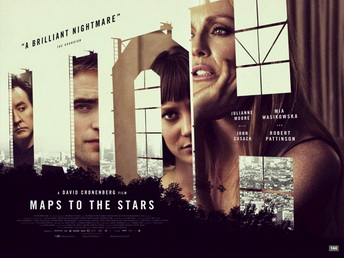
Embracing the Melodrama #124: Maps to the Stars (dir by David Cronenberg)


Maps_to_the_Stars_posterI have to admit that, for the most petty of reasons, I was dreading the 2014 release of David Cronenberg’s Maps to the Stars.  

This was despite the fact that I happen to be a big fan of just about everyone in the cast and David Cronenberg as a director.  (I still say that Cosmopolis is one of the best films of the decade and I don’t care who disagrees.)

My initial issue with Maps to the Stars — and again, I admit this is really petty — was that Sasha Stone, over the Awards Daily web site, was so damn fanatical about singing the film’s praises.  I have a theory that Sasha tends to overpraise certain films specifically so she can have an excuse to get angry and go off on a rant when they don’t receive any Oscar nominations.  Ever since Sasha went batshit crazy over The King’s Speech beating The Social Network, Awards Daily has pretty much gone from being a site about the Oscars to being a site about Sasha screaming in the wilderness like a biblical prophet (and not one of the interesting biblical prophets, like Elijah.  We’re talking about Haggai here.)  From what I had read about Maps To The Stars and judging from the response that it got at Cannes (where, despite mixed reviews, it did win an award when Julianne Moore was named best actress), this film seemed like the epitome of another deliberate lost cause.

Fortunately, the release date of Maps To The Stars was moved to 2015 and civilization was spared from having to deal with a thousand “If Cronenberg doesn’t get an Oscar, society is doomed!” rants.  Instead, we had to deal with a thousand “If Hillary Swank doesn’t win for The Homesman, society is doomed!” rants.

“Okay,” you’re saying, “that’s great Lisa.  Thank you for whatever all that was.  But what about the movie itself!?  Is it any good?”

Eh … I guess.

I mean, Maps to The Stars isn’t a bad movie.  It’s not bad at all.  It’s just maddeningly uneven.

One of my favorite up-and-coming stars, Mia Wasikowska, has a great role in it.  She plays a schizophrenic, named Agatha, who comes to Hollywood.  Agatha’s arms and the back of her neck are covered with burn scars and she is always taking pills.  She is also obsessed with a vile teen star named Benjie Weiss (Evan Bird).  There’s more to her obsession than you might originally think.

Benjie, meanwhile, has just gotten out of rehab and he is literally one of the worst characters ever.  The film does try to build up some sympathy for him by revealing just how fucked up his home life is.  His fragile mother (Olivia Williams) always seems to be on the verge of collapse.  His father (John Cusack) is a glib and shallow psychologist.  Benjie serves as a stand-in for every child star who has been destroyed by Hollywood.  Unfortunately, the film devotes so much time to Benjie being a monster that it never really allows us to see why Benjie’s a star in the first place.  Evan Bird gives such a boring, uninteresting, and flat performance that you never really buy the idea of Benjie could be a success.  (Say what you will about Justin Bieber, he does at least have a cute smile.  Evan Bird can’t even claim that.)

Agatha meets a lot of people in Hollywood, including a limo driver (Robert Pattinson) who is an aspiring screenwriter.  She eventually gets a job working for actress Havana Segrand (Julianne Moore).  Havana, herself the daughter of a legendary and self-destructive actress, is a monster but — unlike, Benjie — she’s a sympathetic monster.  She’s a talented actress who grew up in Hollywood and now, because she’s no longer in her 20s, is being discarded by Hollywood.  Havana is as much a victim as a victimizer.

Anyway, the film kinda wanders about.  Along with all the other stuff going on, the characters are regularly visited by ghosts.  Secrets are revealed.  Hearts are broken.  Lives are lost.  And yes, relevant points about Hollywood are made but … well, so what?   There’s nothing in Maps to the Stars that you couldn’t learn from rewatching Sunset Boulevard and Sunset Boulevard is a lot less pretentious.  Plus, William Holden was a much better actor than Evan Bird.

As for Cronenberg’s direction — well, Maps to the Stars is definitely David Cronenberg on autopilot.  It’s filled with identifiable Cronenberg touches.  The emphasis placed on Agatha’s scars, for instance, is trademark Cronenberg.  But still, Cronenberg’s direction often just seems to be going through the motions.  Unlike his work in the far more interesting and challenging Cosmopolis (not to mention Eastern Promises), Cronenberg doesn’t really seem to care that much about the story that he’s telling.

Maps to the Stars is worth watching for the performances of Julianne Moore and Mia Wasikowska.  Otherwise, it’s just another well-made but only occasionally interesting Hollywood melodrama.