Musical Film Review: National Lampoon’s Lemmings (directed by Michael Keady)


“Welcome to the Woodchuck Music Festival, three days of peace, love, and death.”

Your emcee is a bearded John Belushi and, in between warning the audience about spiked drugs and encouraging the people climbing the sound tower to jump off from the high spot possible, he introduces several musical acts.  Christopher Guest appears as Bob Dylan, repeatedly walking to and then retreating from the stage until Belushi produces enough money to convince him to perform a song called Positively Wall Street.  Introduced as the ultimate “bummer” by Belushi, Joan Baez (Rhonda Coullet) comes out on stage with a baby and rambles about her imprisoned husband David (whose hunger strike was so successful that he and the inmates of Cell Block 11 have all starved to death) before singing a protest song with a title that I can’t repeat.  Joe Cocker (Belushi) sings while shaking on stage.  James Taylor (Christopher Guest) attempts to perform but his band (including Belushi and Chevy Chase) are too zoned out on heroin to play their instruments.  The owner of Yasser’s Farm (played by Christopher Guest) comes out to praise everyone in the audience who has already died.  Finally, a heavy metal group called Megadeath (no, not that Megadeth!) come out on stage and turn up their amplifiers so loud that the entire audience dies at the end of their song.

An Off-Broadway production that premiered in 1973 and ran for over 300 performance, National Lampoon’s Lemmings has achieved legendary status amongst comedy nerds.  It’s rare that you read any history of Saturday Night Live, Second City, or This Is Spinal Tap without coming across a reference to Lemmings.  Along with satirizing Woodstock and the 60s counterculture in a way that probably few would have the guts to do today, the production features Belushi, Chase, and Guest before any of them became (however briefly) stars.  Fortunately, HBO — which started broadcasting a year before the premiere of Lemmings — filmed one of the stage shows.

Viewed today, Lemmings still carries a strong satiric bite.  Though Lemmings was clearly a 70s production, much of its humor still feels relevant today.  The vapid political posturing, the greed disguised as altruism, the audience blindly following their idols, there was little in Lemmings that one can’t see today just by spending a few minutes on social media.  Beyond the humor, though, Lemmings is a chance to see Belushi, Chase, and Guest as youngish men who had their entire lives ahead of them.  Chase is surprisingly likable, playing up his goofy physical comedy.  Guest disappears into each role that he plays, with his impersonation of Dylan being the clear highlight.  That said, Belushi is the clear star of the show, delivering the most absurd of lines with an engaging sincerity.  As I watched Lemmings, it was hard not to wonder what type of roles John Belushi would be playing today.  Would he still be doing comedy?  Would he have faded away?  Or, like Bill Murray (or, for that matter, Jim Belushi), would he now be appearing in a mix of comedic and serious roles?

We’ll never know.  But we’ll always have his performance as Joe Cocker.

Late Night Retro Television Review: Monsters 3.24 “The Moving Finger”


Welcome to Late Night Retro Television Reviews, a feature where we review some of our favorite and least favorite shows of the past! On Wednesdays, I will be reviewing Monsters, which aired in syndication from 1988 to 1991. The entire series is streaming on YouTube.

This week, Monsters comes to its conclusion.

Episode 3.24 “The Moving Finger”

(Dir by Kenny Myers, originally aired on April 26th, 1991)

Monsters comes to a close with an adaptation of a Stephen King short story.

Nerdy Howard (Tom Noonan) is shocked to discover that, every time he goes to any of the various drains in his house, a bony finger pokes out.  Howard’s wife can’t see the finger but Howard becomes obsessed with it, attacking it with a corrosive liquid and eventually a hedge trimmer.  No matter how much damage Howard does to it, the finger comes back, longer and stronger….

Despite the Stephen King pedigree and the presence of the usually reliable Tom Noonan, The Moving Finger makes for a disappointing conclusion to Monsters.  King’s style, and this is especially true of his short stories, often doesn’t translate well into visual adaptations.  The signature inner monologues and the building sense of dread can be difficult to recreate visually.  (One reason why The Shining is the best King adaptation is because Stanley Kubrick made the material his own and didn’t worry about trying to recreate all of King’s trademark  bullshit literary flourishes.)  Tom Noonan doesn’t have much of a character to play and the finger itself becomes less effective as the episode drags on.

Oh well!  Monsters was a generally uneven show so it’s perhaps appropriate that it ended on an unsteady note.  It’s the curse of the anthology format.  When Monsters was good, it was really, really good.  When it was bad, it was kind of boring.  There were a lot of good episodes that aired during the final season but, sadly, there were a few bad ones as well.  That said, the good Monsters episodes to outweigh the bad and forgettable ones.

That’s it for Monsters!  Next week, something new will premiere in this time slot.  What will it be?  I have no idea but I look forward to finding my next show!

Film Review: Ladybug Ladybug (dir by Frank Perry)


Long before he played the long-suffering Mr. Feeney on Boy Meets World, William Daniels made his film debut as another school principal in the 1963 film, Ladybug Ladybug.

In Ladybug Ladybug, Daniels plays Mr. Calkins and he’s got a lot more to worry about than just some unstable student with an unhealthy fixation on a girl that he’s gaslighted into loving him.  No, Mr. Calkins has to deal with the very real possibility that a nuclear war might break out at any second.  One day, when an imminent nuclear attack warning signal goes off, no one can be sure whether or not it’s real or if it was an accident.  However, Mr. Calkins takes no chances.  He dismisses school for the day and tells all of the students to go home.

However, there’s a problem.  The school is in a rural area and most of the students live several miles away.  Because it’s early in the day, there aren’t any school buses running.  The children will have to walk home.  To make sure that the kids get to safety, they’re divided into groups.  A teacher is assigned to each group, tasked with keeping the children calm and making sure they reach their houses.

It’s a long walk and the countryside is deathly quiet.  Some of the children talk about what’s going to happen if there really is a war.  Others, being too young to understand the seriousness of the situation, treat it all like a game.  As each child reaches their house, they have to deal with parents who are more concerned about why their child has come home early than the fact that there might be a war about to break out.

Back at the school, Mr. Calkins and a few remains teachers wait.  One teacher tries to clean up her classroom, all the while realizing that there’s a chance that the classroom will never be used again.

And we, the viewers, keep waiting for a bomb to drop or, at the very least, some sort of clarification about what’s really happening.  We wait in vain.  The film’s ending is harrowing but, at the same time, ambiguous.  Is the world ending or are the children going to wake up in the morning and head back to school?  It all depends on how you interpret the film’s final few moments.

Of course, by the time we reach that ending, a group of children has already taken cover in a bomb shelter.  Unfortunately, their self-appointed leader has decided that there’s not room for all the children, which means that one girl ends up getting kicked out.  Wandering around outside, she finds an old refrigerator to hide in.  Your heart sinks as you watch her climb in and close the door behind her….

Ladbybug Ladybug is a grim film.  At times, it runs the risk of being a bit too grim.  The film definitely gets across its point but it’s so relentlessly depressing that it’s a bit difficult to sit through.  Of course, Ladybug Ladybug was filmed around the same time as the Cuban Missile Crisis so, for many viewers in 1963, the film was less an allegory and more just a record of the feelings and fears that they had to deal with every single day.  Towards the end of the film, when one of the children desperately starts to yell, “Stop!  Stop!  STOP!,” he was undoubtedly speaking for an entire generation that grew up under the shadow of mutually assured destruction.

Ladybug Ladybug was one of the many nuclear war-themed films to be released in the early 60s.  One could easily imagine it as being a companion piece to Fail Safe.  While President Henry Fonda is debating whether or not to sacrifice New York, the children are simply trying to get home.

This Is What A Mountain Of Coke And A Deal With HBO Will Get You: Disco Beaver From Outer Space (dir by Joshua White)


So, this happened:

Every Saturday, I get together with my friends in the Late Night Movie Gang and we watch a movie.  I’m usually the one who picks the movie.  I usually try to pick something fun and kinda silly.  For instance, every Christmas, we watch Santa Claus Conquers The Martians.  Last week, we watched Tobor The Great.  And this week, I selected a 51-minute program from 1978.  The name of that program?

Disco Beaver From Outer Space.

Now, I have to admit that this was one of the rare instances where I didn’t actually bother to watch the entire movie before selecting it.  I did watch the first five minutes on YouTube.  It featured someone in a beaver costume walking around New York City and eating stuff while disco music played in the background.  That was all I needed to see.

An alien beaver eating New York!?  I thought, Disco music!?  How could this possibly go wrong!?

Add to that, the movie only had 51 minute run time.  Even if it’s terrible, I thought, at least it won’t be long!

However, once the film started, I discovered that 51 minutes can be a very long time indeed.  Unfortunately, it turned out that the beaver wasn’t actually in much of the film.  He showed up at the start of the movie and then he popped up in the middle and finally, he showed up again at the end.  That the beaver was cute and came with his own disco song made it all the more regretful that he wasn’t in more of the film.

Anyway, it turned out that the film itself was a collection of vaguely connected sketches.  The idea was that a husband and wife were looking for something to watch and , as a result, they kept changing the channel.  One channel featured a country western singer.  Another channel was showing Masterpiece Theater.  And then there was this movie about a vampire called Dragula.

The joke about Dragula was that he was gay and … well, that was pretty much it.  Dragula was gay and everyone he bit turned gay and eventually Lynn Redgrave showed up as Dr. Vanessa Van Helsing and she managed to destroy Dragula.  If you think this sounds homophobic … well, it was.  When the humor wasn’t homophobic, it was misogynistic.  I’ve always been proud of the fact that I’m not easily offended and I’ve never been the type to need a safe space but I have to admit that I spent the majority of Disco Beaver cringing.  Of course, the problem wasn’t that the humor was politically incorrect.  The problem was that the majority of it just wasn’t that funny.

Disco Beaver was produced, for HBO, by National Lampoon.  In fact, HBO was only 6 years old when it broadcast Diso Beaver so I’m going to assume that this may have been one of the first original programs ever specifically made for the network.  Perhaps that explains why the entire production has a sort of “look how naughty we can be on cable!” feel to it.  “We just dropped the F bomb!  Here’s a whole skit about breasts!  And now, here’s a  skit about how to spot a homosexual.  We’re so daring!”

From the minute that Disco Beaver started, I felt as if I could literally hear the coke being cut backstage.  How many lines of cocaine were snorted over the course of the making of Disco Beaver?  Remember that scene at the end of Scarface where Al Pacino had a mountain of white powder on his desk?  I imagine that’s what the Disco Beaver production office looked like.

Anyway, we survived Disco Beaver and, at the end of it, we swore that we would never speak of it again.  And I learned a very valuable lesson!  Always watch the entire movie!

Boobs, Music, and Sci-Fi: Heavy Metal (1981, directed by Gerald Potterton)


Heavy MetalI think I was twelve when I first saw Heavy Metal.  It came on HBO one night and I loved it.  So did all of my friends.  Can you blame us?  It had everything that a twelve year-old boy (especially a 12 year-old boy who was more than a little on the nerdy side) could want out of a movie: boobs, loud music, and sci-fi violence.  It was a tour of our secret fantasies.  The fact that it was animated made it all the better.  Animated films were not supposed to feature stuff like this.  When my friends and I watched Heavy Metal, we felt like we were getting away with something.
Based on stories from the adults-only Heavy Metal Magazine, Heavy Metal was divided into 8 separate segments:

Soft Landing (directed by Jimmy T. Murakami and John Bruno, written by Dan O’Bannon)

Heavy Metal opens brilliantly with a Corvette being released from a space shuttle and then flying down to Earth, surviving reentry without a scratch.  Who, after watching this, has not wanted a Space Corvette of his very own?

http://www.youtube.com/watch?v=DWMPe3wF9jQ

Grimaldi (directed by Harold Whitaker)

On Earth, a terrified young girl listens a glowing green meteorite called the Loc-Nar tells her that it is the source of all evil in the universe.  This sets up the rest of the film, which is made up of stories that the Loc-Nar tells about its influence.  The Loc-Nar is the film’s MacGuffin and, seen today, one of Heavy Metal’s biggest problems is that it has to find a way to force the Loc-Nar into every story, even if it meant sacrificing any sort of consistency about what the Loc-Nar was capable of doing.  Even when I was twelve, I realized that the Loc-Nar was not really that important.

Harry Canyon (directed by Pino Van Lamsweerde, written by Daniel Goldberg)

In this neo-noir tale, futuristic cabby Harry Canyon (voiced by Richard Romanus) is enlisted to help an unnamed girl (voiced by Susan Roman) to find the Loc-Nar.  Slow and predictable, Harry Canyon does feature the voice of John Candy as a police sergeant who attempts to charge Harry for police work.

den_1268427864Den (directed by Jack Stokes, written by Richard Corben)

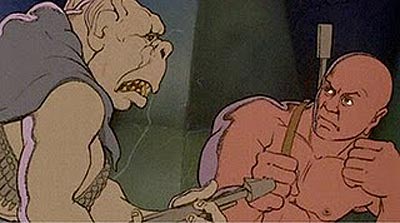
Nerdy teenager David (voiced by John Candy) finds a piece of the Loc-Nar and is transported to the world of Neverwhere, where he is transformed into Den, a muscular, bald warrior.  As Den, David gets to live out the fantasies of Heavy Metal‘s target audience.  On his new planet, Den rescues an Earth woman from being sacrificed, overthrows an evil queen and a sorcerer, and gets laid.  A lot.  Den is the best segment in Heavy Metal, largely because of the endearing contrast between the action onscreen and John Candy’s enthusiastic narration.

Captain Sternn (directed by Paul Sebella and Julian Harris, written by Bernie Wrightson)

heavy-metal_captain-sternOn a space station orbiting the Earth, Captain Lincoln F. Sternn is on trail for a countless number of offenses.  Though guilty, Captain Sternn expects to be acquitted because he has bribed the prosecution’s star witness, Hanover Fiste.  However, Hanover is holding the Loc-Nar in his hand and it causes him to tell the truth about Captain Sternn and eventually turn into a bloodthirsty giant. Captain Sternn saves the day by tricking Hanover into getting sucked out of an air lock.
Captain Sternn was a reoccurring character in Heavy Metal Magazine and his segment is one of the best.  Eugene Levy voices Captain Sternn while Joe Flaherty voices his lawyer and Dean Wormer himself, John Vernon, is the prosecutor.  Even National Lampoon co-founder Douglas Kenney provided a voice.

 B-17 (directed by Barrie Nelson, written by Dan O’Bannon)

After the Loc-Nar enters Earth’s atmosphere, it crashes into a bullet-riddled World War II bomber, causing the dead crewmen within to reanimate as zombies.  Scored to Don Felder’s Heavy Metal (Takin’ a Ride), B-17 is one of the shorter segments and its dark and moody animation holds up extremely well.

http://www.youtube.com/watch?v=ELUP-oZQKM4

So Beautiful and So Dangerous (directed by John Halas, written by Angus McKie)

Nubile Pentagon secretary Gloria is beamed aboard a spaceship that looks like a giant smiley face.  While she has sex with the ship’s robot captain, the two crew members (voiced by Harold Ramis and Eugene Levy) pour out a long line of cocaine and shout “Nosedive!” before snorting up every flake.  So Beautiful and So Dangerous is so juvenile and so ridiculous that it is actually all kinds of awesome.

Taarna

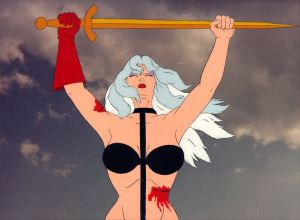
SacrificedIn the film’s final and most famous segment, Taarna, the blond warrior was featured on Heavy Metal‘s poster, rides a pterodactyl across a volcanic planet, killing barbarians, and finally confronting the Loc-Nar.  She sacrifices herself to defeat the Loc-Nar but no worries!  We return to Earth where, for some reason, the Loc-Nar explodes and the girl from the beginning of the film is revealed to be Taarna reborn.  She even gets to fly away on her pterodactyl.  Taarna was really great when I was twelve but today, it is impossible to watch it without flashing back to the Major Boobage episode of South Park.
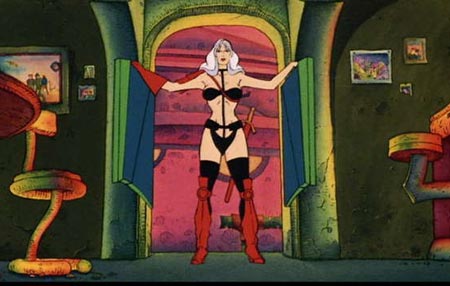
Much like Taarna, Heavy Metal seems pretty silly when I watch it today.  But when I was twelve, it was the greatest thing ever.

Taarna_Heavy_Metal