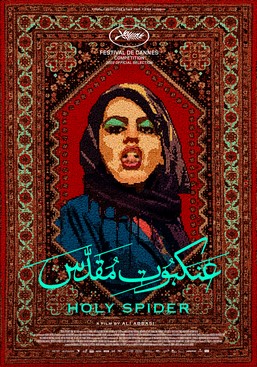
2022’s Holy Spider opens in the Iranian city of Mashahd. We follow a woman as she spend her night as a sex worker, standing on a street corners, going off with any man who stops for her, and hiding in the shadows whenever the infamous morality police are nearby. There’s nothing glamorous about her work. The men who pick her up are brutes who treat her like property and there’s little about the city that is beautiful or aesthetically pleasing. If anything, it looks bombed-out, as if no one could be bothered to repair any of the obvious cracks that are stretching across the city ancient’s facade. Towards the end of the night, the woman is picked up by a man who, in a harrowing scene, proceeds to choke her to death.
Journalist Arezoo Rahimi (Zar Amir Ebrahimi) arrives in the city to investigate the recent murders of several sex workers and immediately discovers that the authorities have no interest in discussing the case. When she pushes them, they taunt her about her private life and they snap at her for not properly covering her hair. Whenever she steps out into the street, she’s told that she’s going to get in trouble if she’s spotted by the Morality Police. (The attitude appears to be that it’s a greater crime for a woman to fail to fully cover her hair than for a man to kill a woman, whether her hair is properly covered or not.) Eventually, she teams up with a newspaper editor named Sharifi (Arash Ashtiani). Sharifi has been receiving letters from the murderer, ones in which he explains that he is cleansing the city in the name of Imam Reza, the eighth Shia Imam.
The murderer is a construction worker named Saeed Azimi (Mehdi Bajestani), a middle-aged man who previously served in the Iraq-Iran War and who it is suggested might be suffering from PTSD. On the outside, Saeed seems almost normal. He has friends. He has a family. He is very religious. To the outside viewer, he might not look like a killer. But, every night, he prowls the streets and he searches for potential victims. When Rahimi goes undercover as a sex worker, she comes close to becoming one of them.
More than just a recreation of a serial killer’s crimes, Holy Spider examines the misogynistic attitudes that allowed Saeed that get away with so many murders. Saeed himself becomes a folk hero amongst many Iranians, who are quick to say that they agree with his mission to cleanse the city. Even when on trial, Saeed is approached by members of the government who promise him his safety, though it soon becomes clear that their promises don’t necessarily mean much. The more that his crimes are celebrated, the more smug Saeed becomes. Even when his sentence comes down, Saeed remains convinced that he will be protected. Afterall, everyone seems to agree with him that the victims, and not the murderer, are to blame for their deaths.
Dark, disturbing, and ultimately infuriating, Holy Spider is a powerful film. The film’s power can be seen in the fact that it was not only banned in Iran but that the government also announced that anyone involved in the filming would also be censured. (Russia, a longtime ally of Iran, also banned the film.) Saeed is a hateful figure but even more hateful are the misogynists who celebrated him and nearly allowed him to get away with his crimes. Holy Spider may have been banned in Iran but it can still be seen in the rest of the world.
And it should be seen.



 Through the Shattered Lens