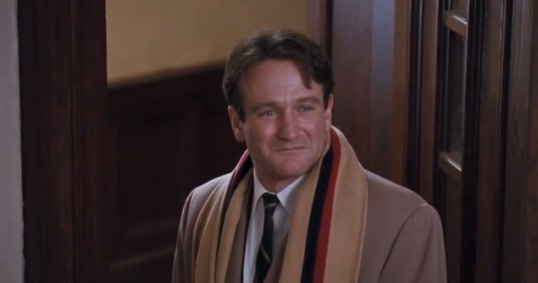
Last Monday, after I first heard that Robin Williams had committed suicide, I struggled to find the right words to express what I was feeling. Finally, I ended up posting this on Facebook:
I keep trying to write something about Robin Williams but the words aren’t coming to me. It’s all too big and strange and sudden and I can’t find the words to sum up my feelings. I feel like a part of my childhood died today. So, instead of trying to be more eloquent or wise than I actually am, I’m just going to say R.I.P., Robin WIlliams.
Finally, a little over a week later, I still don’t know what to say. How do you sum up a life in just a few words? I don’t think that they can be done for anyone. It certainly can’t be done for as iconic a figure as Robin Williams. So, instead of trying to do the impossible, I’ve spent the last few days watching and reviewing a few of Robin Williams’ films.
And, of course, one of those films had to be the 1989 best picture nominee Dead Poets Society.
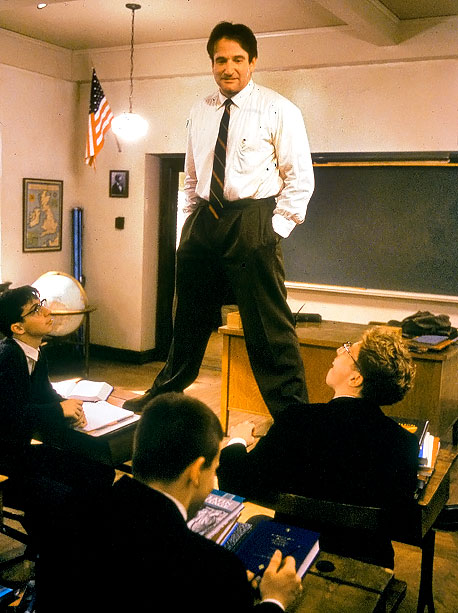
Now, a quick warning. The review below is going to contain spoilers. I’m going to talk about some very important plot points. But surely you’ve seen Dead Poets Society already. And even if you haven’t seen it, surely you’ve heard what the film is about and surely, you know what happens. After all, who doesn’t? But if you are one of those people who does not know or who has not seen the film — well, why haven’t you?
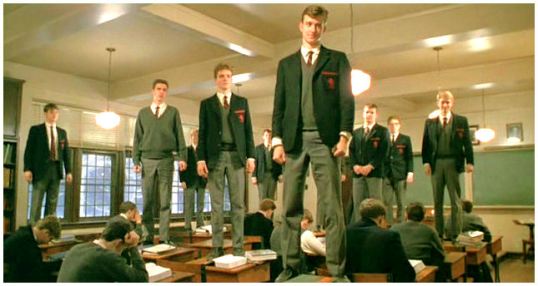
The first time I ever saw Dead Poets Society was in a high school creative writing class. Our teacher — who, it quickly became apparently, considered herself to be the real-life version of the teacher played by Robin Williams — showed it to us, over the course of three class periods, as an introduction to writing poetry. I enjoyed the film but the rest of the class absolutely loved it. Especially the guys. For the rest of the class year, I would listen to those guy as they bragged about how they were seizing the day. I remember one day, the classroom was empty except for me and one of the boys. I can’t remember what led to him doing it (and it could very well have been my suggestion that he try) but he eventually ended up standing on top of a desk just like the students at the end of the film. Unfortunately, public high school desks aren’t quite as sturdy as private school desks and my friend soon ended up crashing to the floor as the desk slipped out from underneath him.
Ah, memories.
Yes, Dead Poets Society is one of those films. It’s a film that everyone seems to have seen, loved, and found to be inspirational. And I have to admit that I’ve grown to appreciate it more over the years since I first saw it back in creative writing class. With each subsequent viewing, I find myself less critical of the film’s melodramatic and predictable moments and more willing to accept the film for what it is — a celebration of life, poetry, and teaching. Dead Poets Society, from the very moment that Robin Williams makes his first appearance sitting at the end of a line of stodgy old men and flashing an unapologetically impish smile, is a film that defies easy cynicism. It’s a film that embraces you and you have to be very hard-hearted not to embrace it back.
Dead Poets Society, of course, tells the story of a private school in the 1950s and what happens when a new teacher (Robin Williams, naturally) encourages his students to celebrate creativity, to “seize the day” as the saying goes. Not surprisingly, just about every other adult thinks that the students would be better off not seizing the day but instead preparing for a life of WASPy conformity. This leads to a few of Mr. Keating’s students forming a secret society where they can read poetry, talk about their feelings, and basically do their best to honor the memory of Walt Whitman.

There are seven members of the Dead Poets Society:
There’s Gerard Pitts, who doesn’t really make much of an impression. The main thing that I always notice about Gerard Pitts is that he looks like a young version of Sam Waterston. This made sense when I checked the end credits and I discovered that he was played by James Waterston, son of Sam.
Stephen Meeks (Allelon Ruggiero) is another one who doesn’t actually get to do much (beyond boast about the fact that he has a genius I.Q. and create a makeshift radio) but, with his cute glasses, unruly hair, and friendly manner, it’s impossible not to like him.
Of the three main villains in Dead Poets Society, none of them are quite as loathsome as Richard Cameron (Dylan Kussman). The stern headmaster (played by Norman Lloyd) and the judgmental father (played by Kurtwood Smith) at least have the excuse of being old and set-in-their-boring-ways. Cameron, however, starts out as a member of the Dead Poets Society but still has absolutely no problem betraying them. As opposed to the adults in the movie, Cameron is someone who still had a chance to be something more than a worm. That being said, Dylan Kussman makes Cameron into a memorable worm.
Then there’s Knox Overstreet (played by Josh Charles, who appears to have only aged a year or two in between this movie and the first season of The Good Wife). We know that Knox is rich because his name is Knox Overstreet. Knox has a crush on a girl who goes to the local high school. Knox’s subplot doesn’t really amount to much but it’s impossible not to like him because Josh Charles was (and is) simply adorable.
Charlie Dalton (played, quite well, by Gale Hansen) is the one who most enthusiastically embraces the idea of seizing the day. He’s the one who pretends to get a tattoo, who demands to be known by a new name, who attempts to protest the school’s out-dated traditions, and who ultimately is punished with expulsion after he physically attacks Cameron. (And, as sorry as I was to see Charlie leave the movie, Cameron totally deserved it.) For a few months in 2008, Gale Hansen was a very active participant on the IMDB message boards, answering questions, giving advice, and generally just being a very gracious guy. However, he suddenly stopped posting and, just as mysteriously, all of his previous posts were subsequently deleted. Hansen, himself, hasn’t acted since 1998 and that’s a shame because he really did do a good job as the enthusiastic, idealistic, and not-quite-as-worldly-as-he-thinks Charlie Dalton.
Neil Perry (played by Robert Sean Leonard) is the one who, inspired to seize the day, appears in a local production of A Midsummer Night’s Dream and, as a result, earns the wrath of his overbearing father. Seen now, in the shadow of Robin Williams’ tragic death, the scene where Neil commits suicide takes on a terrible poignance and it no longer feels as melodramatic as it did the first time that I saw it. Whereas, originally, it seemed hard to believe that a character played by the energetic and charismatic Leonard would end up committing suicide over a play, we now know that energy and charisma do not necessarily equal happiness.
And finally, there’s Todd Anderson (played by a very young Ethan Hawke), who is pathologically shy and who, at the end of the film, finally finds the strength to climb up on his desk. After years of seeing in him in various Richard Linklater films, it’s strange to see the usually verbose Hawke playing such an introverted character. But he does a good job, turning Todd into the film’s moral center.

And then there’s their teacher, John Keating who, quite frankly, might as well be named Robin Williams. That’s not to say that Williams doesn’t give a good performance as Keating. Indeed, Williams is the glue that holds the film’s ensemble together and his performance so dominates the entire film that, every time that I’ve seen it, I’ve always been surprised to discover just how little screen time he actually has in Dead Poets Society. As embodied by Robin Williams, John Keating becomes the type of teacher that everyone wishes they could have had just once. The power of his performance comes from the fact that he not only inspires the viewers to “seize the day” but he actually makes you believe that the day is worth holding on to. Without Robin Williams, Dead Poets Society would be easy to dismiss as just being a film about a bunch of privileged teenagers reading poetry and pretending to be rebels. With Williams, however, the film becomes a celebration of life.
Robin Williams, R.I.P.
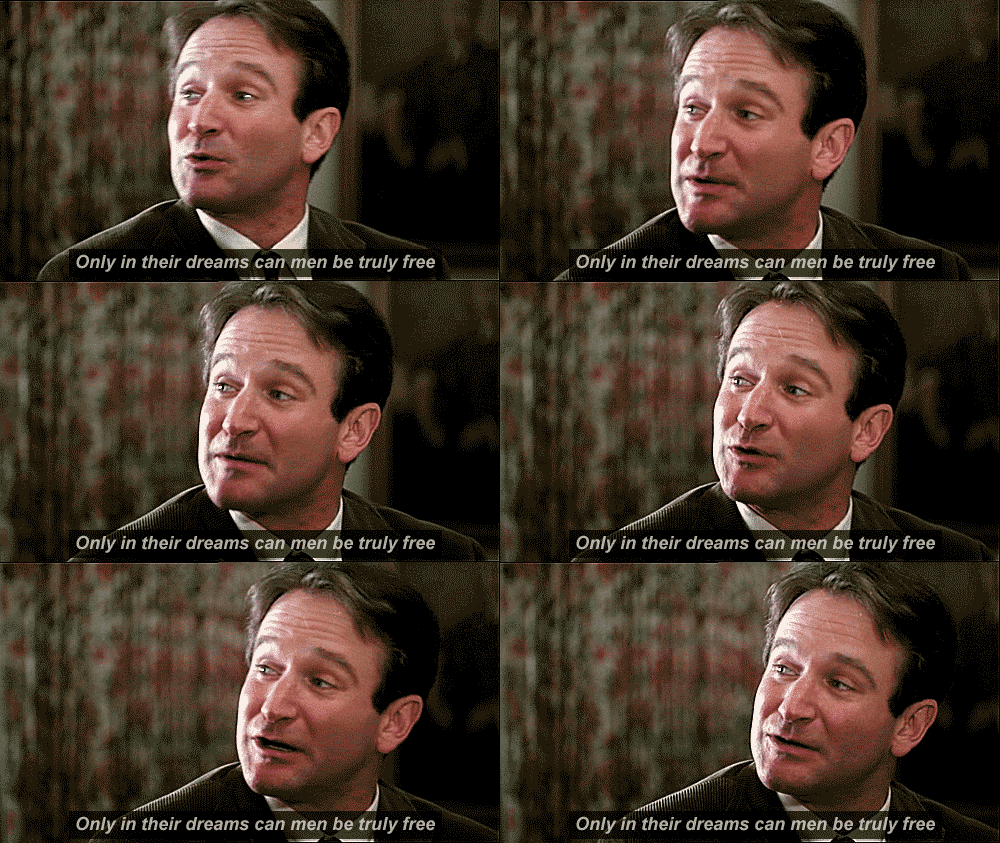
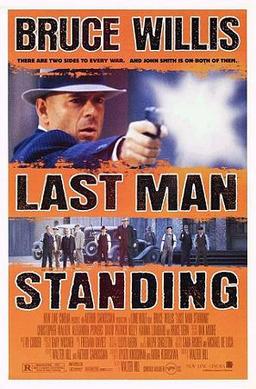 During the 1920s, at the height of prohibition, a mysterious man named John Smith (Bruce Willis) arrives in the dusty town of Jericho. Jericho sits on the border, between Texas and Mexico, and it is the site of a gang war. The Italian mob, led by Fred Strozzi (Ned Eisenberg) and Giorgio Carmote (Michael Imperioli), is trying to move in on the Irish mob, led by Doyle (David Patrick Kelly) and his fearsome gunman, Hickey (Christopher Walken). After the members of the Irish mob destroy his car and leave him stranded in town, Smith offers his services as a gunman to the Italians. Strozzi hires him but it turns out that Smith has his own agenda and soon, he is manipulating both gangs against each other.

 Through the Shattered Lens