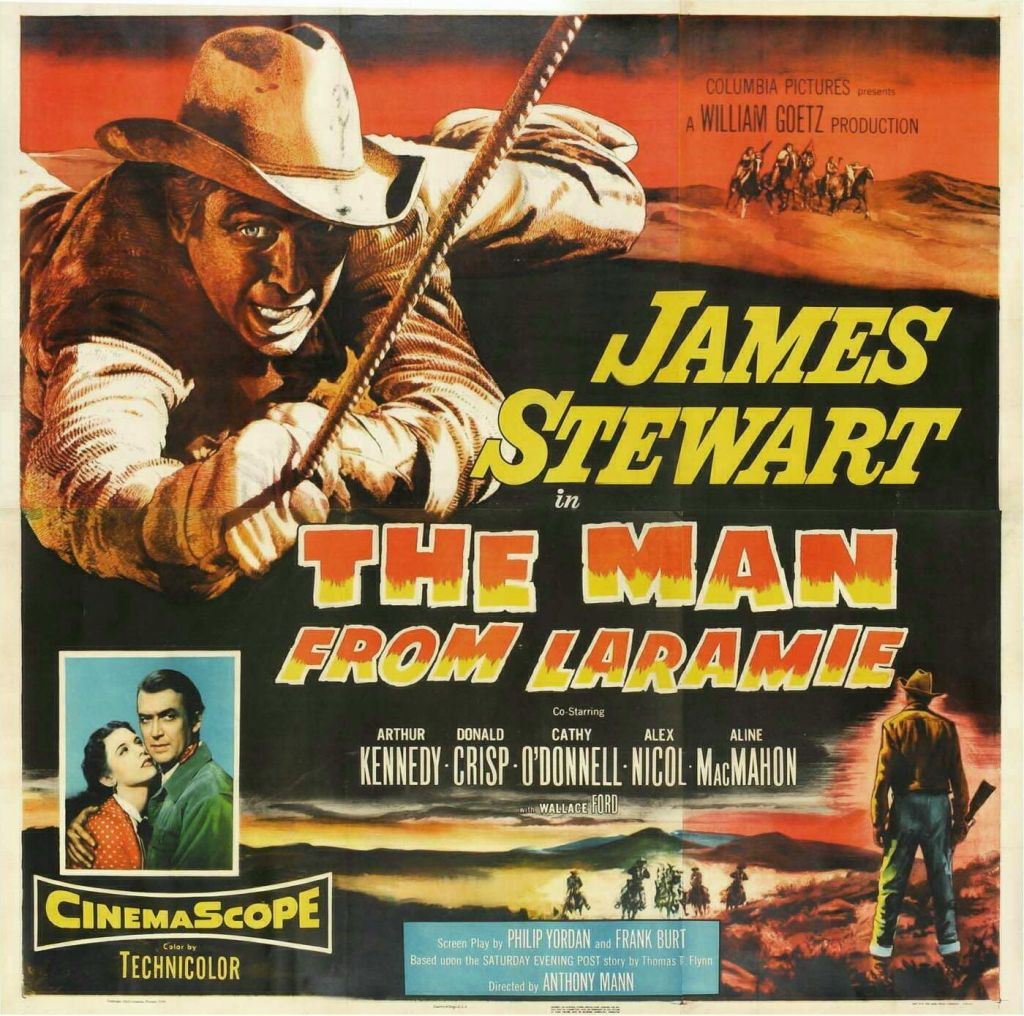
There are people in this world who only know Jimmy Stewart from his performances in movies like IT’S A WONDERFUL LIFE (1946) and REAR WINDOW (1958). Those are both great movies to be sure, but I contend that Stewart was also one of the great “cowboys,” with his string of excellent westerns with director Anthony Mann, as well as his work with other great directors like John Ford and Delmer Daves.
Stewart’s performance in THE MAN FROM LARAMIE is one of my personal favorites. In this scene, his hand is shot from point blank range by a crazy man who’s never had to pay the consequences for his actions. That changes when the man from Laramie comes to town. I couldn’t imagine a more powerful performance than Stewart’s work here. He’s incredible and truly one of the great actors of all time!
I’m celebrating Jimmy Stewart’s birthday by watching his western THE MAN FROM LARAMIE! Stewart plays Will Lockhart, a man who has run into some bad luck. His brother, a U.S. cavalryman, was recently killed in an attack by Apaches using repeating rifles outside of the town of Coronado, New Mexico. In an attempt to track down the man who sold the rifles to the Indians, Lockhart has come to Coronado from Laramie, WY, to snoop around. He’s welcomed to town by Dave Waggoman (Alex Nicol), we’ll call him “Crazy Dave,” the son of powerful local rancher Alec Waggoman (Donald Crisp). Accusing Lockhart of stealing salt off of their land, Crazy Dave proceeds to drag him with a rope, burn his wagons and shoot his mules. Before he can do even more damage to Lockhart, the foreman of the Waggoman ranch Vic Hansbro (Arthur Kennedy) comes along and stops him. Vic seems like a reasonable man, but he does ask Lockhart to move on down the trail before there’s any more trouble. Lockhart isn’t leaving until he finds out more about those rifles so he politely declines by going back into town, finding Crazy Dave, and kicking his ass. He then goes to see Alec and asks to be paid back for the wagons and mules that crazy Dave destroyed. Alec pays Lockhart back and then calls Vic in to come see him. Here’s where we start to get a feel for Waggoman family dynamics. You see, Alec loves his son no matter how crazy he is, and he expects Vic to keep him out of trouble. He even takes the cost of the destroyed wagons and dead mules out of Vic’s pay instead of Crazy Dave’s. We find out that Crazy Dave is jealous of Vic, and that Vic feels underappreciated by a man he has treated like a father for many years. Against this backdrop of family jealousy and insanity, Lockhart will continue to dig around until he finds out who sold the rifles that killed his brother. Could it be Vic or Crazy Dave?
THE MAN FROM LARAMIE is the last of five westerns that Stewart worked on under the direction of Anthony Mann. Their work is legendary, including the western classics WINCHESTER ‘73 (1950), BEND OF THE RIVER (1952), THE NAKED SPUR (1953), and THE FAR COUNTRY (1954). In my opinion, they may have saved their best for last. Jimmy Stewart gives a masterful performance in the role of Will Lockhart. Stewart was very smart in the way he played his parts in westerns. Tall and gangly, he would never have been a believable western star if he had played his roles more like a John Wayne or Gary Cooper. Rather, his character here is driven by an uncontrollable desire for revenge, so no matter what happens to him, outside of being killed, he’s going to keep on coming. In this movie, he’s dragged, beaten and even has his hand shot from point blank range, but that doesn’t stop him. And every so often he flashes that Jimmy Stewart smile and you can’t help but have complete sympathy for him. The supporting performances are good as well, especially from Donald Crisp as Alec Waggoman and Arthur Kennedy as Vic Hansbro. Neither are completely bad men, but they make bad decisions based on emotions that most of us can completely understand. They’re so good in the roles that we can’t help but kinda like them in spite of those bad decisions. One of the things I love about old westerns is the way they deal with honest emotions and universal truths. At one point in the film, after discovering that Vic has lied to him about something, Alec tells him, “Once you start lying, there’s no way to stop!” If you’ve ever lied about something before, you know that one lie always leads to another, and then to another. The drama in THE MAN FROM LARAMIE centers around what happens to the characters when the truth finally comes to light. In my opinion it’s great stuff, and produces one of my very favorite westerns!
On a side note, I love this movie so much that I demanded that my wife and I stop and eat in Laramie a couple of years ago when we were visiting family in Wyoming. Here’s a pic from that wonderful day. I wanted to make sure we got the sign in the back that said Laramie!
1958’s The Screaming Skull opens with a promise. If you die of fright while watching the climax of this movie, you will be given a free burial. It’s a nice promise, though I have my doubts as to whether or not it would still be honored 65 years after it was made. I mean, who exactly would be paying for the burial at this point? It’s probably a moot point as I don’t think anyone would die of fright while watching the climax of The Screaming Skull.
That’s not to say that The Screaming Skull is a bad movie. Though the film does not have a great reputation amongst film historians, I actually really enjoyed The Screaming Skull when I watched it a few weeks ago. It’s an atmospheric and gothic horror film, one that mixes ghosts with hints of paranoia and insanity. That said, it’s not really a frightening movie, at least not by today’s standards. I think your heart will be fine while watching The Screaming Skull.
The Screaming Skull tells the story of Jenni (Peggy Webber), who has just recently been released from a mental hospital. She had a nervous breakdown following the death of her parents in a drowning accident. The tragedy left Jenni very wealthy but also very emotionally fragile. She has just married Eric (John Hudson), a young widower whose first wife, Marion, died when she fell into a decorative pond on their estate and drowned. Jenni fears that she’ll never be able to live up to Eric’s memories of Marion and it doesn’t help that Eric’s handyman, Mickey (played by the film’s director, Alex Nicol), was apparently in love with Marion and is very protective of her memory. Marion’s portrait still hangs in the house and Jenni immediately sees that Marion looks a lot like her late mother.
Soon, Jenni thinks that she’s hearing screams in the middle of the night and she starts to see skulls almost everywhere that she looks. Eric insists that Jenni is just letting her imagination get the better of her but Mickey is just as adamant that Marion’s ghost haunts the estate. Eric even agrees to burn Marion’s portrait but doing so just reveals another skull sitting in the ashes. Is Marion’s ghost haunting Jenni or is something else happening at the estate? Who can Jenni trust?
Independently-made, The Screaming Skull is very much a horror film of the late 1950s, which means lots of tight sweaters, pointy brassieres, translucent nightgowns, and shadowy rooms, along with an important supporting character (played by Ross Conway) who just happens to be a minister and whose main job is to assure the audience that everything is going to be alright. It’s a film that creates an effectively creepy atmosphere and Peggy Webber gives a sympathetic and likable performance in the lead role. Most viewers will probably be able to guess the big twist within minutes of the film starting but no matter. This is an enjoyably simple haunted house film and suspense thriller. The Screaming Skull is not a film that exactly has a sterling reputation but I really enjoyed it.
Even more importantly, I made it through the film without having to take advantage of that free burial service! I’m proud of myself.
(Lisa is currently in the process of trying to clean out her DVR by watching and reviewing all 40 of the movies that she recorded from the start of March to the end of June. She’s trying to get it all done by July 11th! Will she make it!? Keep visiting the site to find out!)
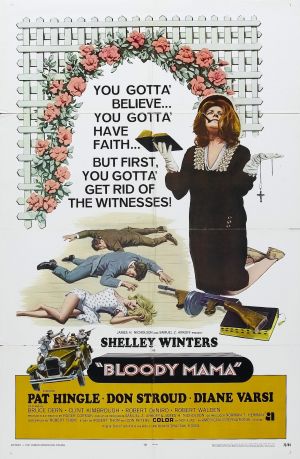
The 24th film on my DVR was the 1970 Roger Corman-directed gangster film, Bloody Mama. I recorded it off of TCM on May 27th.
Bloody Mama opens with a cheerful song that goes, “Maaaaaama…Bloody maaaaama….” and it’s such an unapolegetically over the top song that it perfectly sets the tone for what’s to follow. Bloody Mama is violent, occasionally perverse, and totally unashamed. It doesn’t pretend to be anything that it isn’t. It’s bloody and it’s about a mother and, in the best Corman tradition, it makes no apologies!
The film tells the heavily fictionalized story of the Barkers, a group of brothers who robbed banks and killed people in the 1920s and 30s. The majority of them were killed in a gunfight with the FBI. Also killed in the gunfight was their mother, Kate Barker. Always aware of the danger of bad publicity, the director of the FBI, J. Edgar Hoover, announced that Ma Barker was actually the mastermind of the Barker gang and that she was even more dangerous than her sons. Ever since, historians have debated whether Ma Barker was the criminal mastermind described by Hoover or if she was just the innocent woman described by … well, by everyone who actually knew her.
Bloody Mama, of course, leaves no doubt. From the minute that we discover that Shelley Winters will be playing Ma Barker, we know that she’s the most dangerous woman alive. As played by Winters, Ma Barker is a ruthless bank robber, one who has no fear of gunning down innocent bystanders and who never lets her love for her sons get in the way of ordering them to kill a witness. As opposed to a lot of gangster films made in the late 60s and early 70s, the film never attempts to portray its title character as being a heroic or particularly sympathetic character. Instead, what makes the character compelling is just how thoroughly Winters commits to the role. It doesn’t matter what Ma Barker is doing or saying, Shelley Winters totally sells it. When the gang is cornered by the police and one associate makes the mistake of yelling that he’s not a Barker, Ma reacts by gunning him down herself and you can’t help but appreciate the lengths that Ma will go to defend her family’s name.
As for her sons, they are an interesting group of perverts and drug addicts and they’re played some of the best character actors of the 1970s.
Herman Barker (Don Stroud) is a sadist but he’s also one of Ma’s favorites. He travels with a prostitute (played by Diane Varsi), who quickly tires of the Barkers’s violent way of life.
Arthur Barker (Clint Kimbrough) is the most practical of the Barkers and therefore, he’s also the least interesting.
Fred Barker (Robert Walden) is bisexual, which is a fact that the film handles with all the sensitivity that we’ve come to expect from a film made in 1970 (which is to say, not much at all). Fortunately, Fred’s lover is Kevin and Kevin is played by Bruce Dern and Bruce Dern is always a lot of fun to watch, especially when he’s appearing in a Corman film.
And then there’s Lloyd who sniffs glue and shoots heroin and who is played by an obscure young actor named Robert De Niro and … wait, Robert De Niro! That’s right! One of the pleasures of Bloody Mama is getting to see De Niro at the start of his career. Unfortunately, he doesn’t really get to do much, though he does occasionally flash the same unhinged smile that would later show up in Taxi Driver.
Roger Corman has repeatedly cited Bloody Mama as being one of his favorites of the many movies that he directed over the course of his long career. I don’t blame him. It’s a thoroughly shameless and totally entertaining film!
Keep an eye out for Bloody Mama!
Just remember, the real-life Ma Barker was probably innocent.


 Through the Shattered Lens