On tonight’s episode of Hammer House of Horror, a family picks up a hitchhiker. A subsequent tragedy leaves a wife wondering if her husband is actually her husband. This is a creepy and twisty episode that is guaranteed to inspire just a little paranoia.
This episode originally aired on November 29th, 1980.
Today’s episode of televised horror is The Silent Scream, the seventh episode of Hammer House of Horror. It was originally broadcast in the UK on October 25th, 1980.
A quick content warning for everyone: This episode features some scenes of animals in distress so I personally would advise viewer discretion. That said, I simply had to share this episode because it features Peter Cushing’s final performance for Hammer Studios. He plays a seemingly kindly old man who has a very dark secret. A youngish Brian Cox plays the ex-con who gets a job working for Cushing. This is a very unnerving episode with an ending that truly sticks with you.
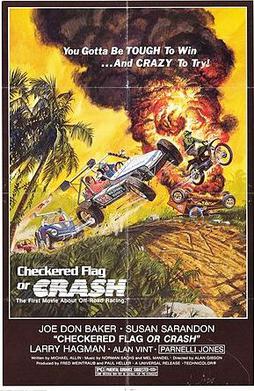
Joe Don Baker stars at “Walkaway” Madden, a race car driver who got that name because he has always managed to walk away from every crash. When Madden agrees to compete in an off-road race through the Philippines, he is not happy to discover that his sponsor has arranged for a female journalist named C.C. Wainwright (Susan Sarandon) to accompany him and record his adventures. Walkaway’s a good ol’ boy and C.C.’s an independent woman but wouldn’t you know it, they’re in love by the end of the race.
This has one of the most simple plots that I’ve ever seen. Madden and C.C. race through the jungle and there’s never really any doubt about how the race is going to end because all of the other drivers are terrible, except for Madden’s former partner, Doc Pyle (Alan Vint). A manic Larry Hagman plays Bo Cochran, the promoter who put the race together, and gets the majority of the film’s laughs. When I watched this movie, I thought it had been made to capitalize on the success of Smokey andtheBandit but then I saw that CheckeredFlag actually came out a few months before Burt Reynolds and Jackie Gleason hit the drive-in circuit. The young Susan Sarandon is a lively presence and she has a surprising amount of chemistry with Joe Don Baker, ideally cast here as a good ol’ boy who likes to drive fast. The movie doesn’t hold many surprises but the game cast keeps it watchable.
Director Alan Gibson was a Canadian filmmaker who had previously worked for Hammer films, directing the last of their Dracula films before he eventually found himself in the Philippines, working with Larry Hagman, Susan Sarandon, and Joe Don Baker.
4 Or More Shots From 4 Or More Films is just what it says it is, 4 shots from 4 of our favorite films. As opposed to the reviews and recaps that we usually post, 4 Shots From 4 Films lets the visuals do the talking!
This October, I’m going to be doing something a little bit different with my contribution to 4 (or more) Shots From 4 (or more) Films. I’m going to be taking a little chronological tour of the history of horror cinema, moving from decade to decade.
Today, we take a look at the early 70s!
8 Shots From 8 Horror Films: The Early 70s
The Bird With The Crystal Plumage (1970, dir by Dario Argento, DP: Vittorio Storaro)
House of Dark Shadows (1970, dir by Dan Curtis, DP: Arthur Ornitz)
Hatchet For The Honeymoon (1970, dir by Mario Bava, DP: Mario Bava)
The Devils (1971, directed by Ken Russell, DP: David Watkin)
Tombs of the Blind Dead (1971, dir by Amando de Ossorio, DP: Pablo Ripoll)
Children Shouldn’t Play With Dead Things (1972, dir by Bob Clark, DP: Jack McGowan)
Last House on the Left (1972, dir by Wes Craven, DP: Victor Hurwitz)
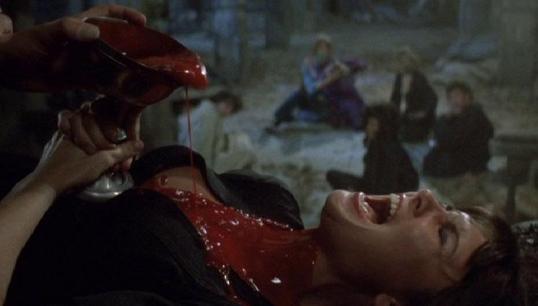
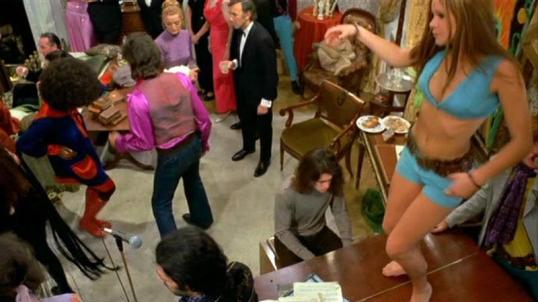
Dracula A.D. 1972 (1972, dir by Alan Gibson, DP: Dick Bush)
4 Shots From 4 Films is just what it says it is, 4 shots from 4 of our favorite films. As opposed to the reviews and recaps that we usually post, 4 Shots From 4 Films lets the visuals do the talking!
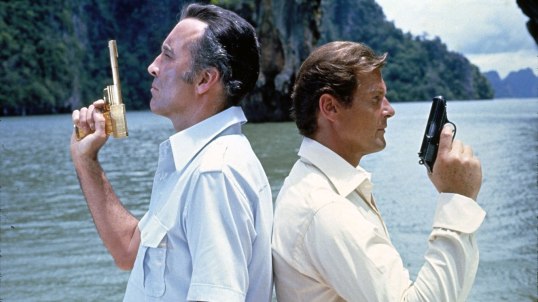
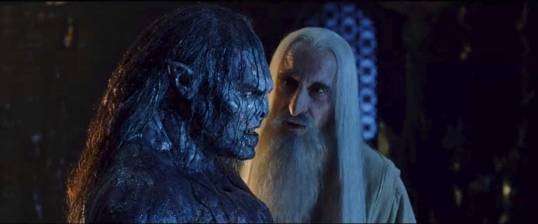
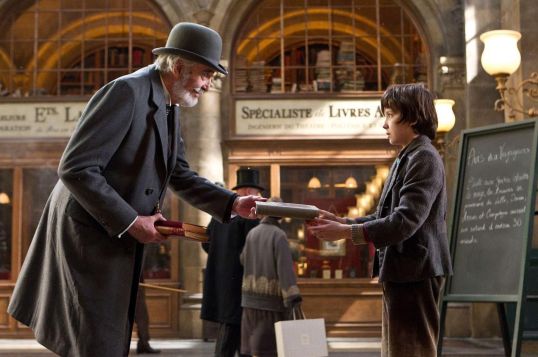
98 years ago today, the greatest actor of all time, Christopher Lee, was born in London! Today, we honor a legacy of iconic performances, in films that were both good and bad. Lee worked with everyone from Terence Fisher to Peter Jackson to Martin Scorsese to Laurence Olivier to John Huston to ….. well, if they were an important director, they probably made at least one movie with Christopher Lee! He was Dracula. He was Saruman. He was one of the best Bond villains and it’s been rumored that, during World War II, Lee was a bit of a James Bond himself.
Today, we honor a brilliant career with….
4 Shots From 4 Films
Dracula A.D. 1972 (1972, dir by Alan Gibson)
The Man With The Golden Gun (1974, dir by Guy Hamilton)
Lord of the Rings: The Fellowship of the Ring (2001, dir by Peter Jackson)
4 Shots From 4 Films is just what it says it is, 4 shots from 4 of our favorite films. As opposed to the reviews and recaps that we usually post, 4 Shots From 4 Films lets the visuals do the talking.
Today, we pay tribute to the TSL’s favorite British studio with….
4 Shots From 4 Hammer Films
The Plague of the Zombies (1966, dir by John Gilling)
Frankenstein Created Woman (1967, dir by Terence Fisher)
The Mummy’s Shroud (1967, dir by John Gilling)
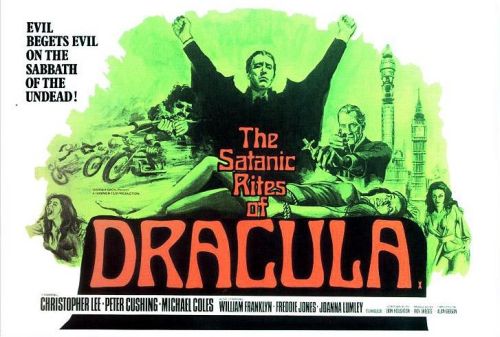
The Satanic Rites of Dracula (1973, dir by Alan Gibson)
First released in 1973 and, like Dracula A.D. 1972, set in what was then the present day, The Satanic Rites of Dracula was the 8th entry in the Hammer Dracula series. It was also the last to feature Christopher Lee in the role of Dracula and that perhaps is why, judging by some of the other reviews that I’ve read online, The Satanic Rites is one of the more reviled entries in the series.
Judging from a lot of those reviews, the attitude seems to be that The Satanic Rites of Dracula was so bad that it was the film that made Christopher Lee say, “No more!” Reportedly, Lee felt that the film itself was both poorly written and that it was too violent. And, even though the film is rather tame by the standards of today’s horror films, The Satanic Rites is still probably one of the more extreme entries in the series. The film features a graphic and drawn-out flashback in which we see a naked woman sacrificed by a Satanic cult, a scene that’s bloody even by the standards of Hammer. Later, when Jessica Van Helsing (played by Joanna Lumley, who took the role over from Dracula A.D. 1972‘s Stephanie Beacham) is menaced by a pack of female vampires, the vampires literally claw at her body like wild animals. And finally, when one of Dracula’s brides is staked, blood literally splashes across the screen.
Christopher Lee was not a fan of The Satanic Rites of Dracula and neither are a lot of critics but you know what? I think The Satanic Rites of Dracula is actually rather underrated. If nothing else, it’s certainly far more unpredictable than some of the far more critically embraced Dracula films.
Satanic Rites opens with a British secret agent (Maurice O’Connell) escaping from a country house in which he had previously been held prisoner. Though he’s fatally wounded during the escape, the agent manages to tell his superiors that, at the house, he witnessed a Satanic ritual that involved some of the most important people in the British government. Since one of the accused occultists is a government minister, the secret service passes the case on to Scotland Yard’s Inspector Murray (Michael Coles, reprising his role from Dracula A.D. 1972) and then provide him with clandestine assistance. (Or something like that. To be honest, I get the feeling that the main reason Murray was called in was to maintain some continuity between Dracula A.D. 1972 and The Satanic Rites of Dracula.) Murray suspects that vampires may be involved so he calls in Lorrimar Van Helsing (Peter Cushing).
After discovering that his old friend, scientist Julian Keeley (Freddie Jones), is a part of the cult, Van Helsing deduces that it’s all part of huge conspiracy headed by none other than Dracula himself. The plan is to release a mutated form of bubonic plague and wipe out humanity.
Why is Dracula planning on destroying humanity?
Van Helsing theorizes that this might be Dracula’s way of committing suicide. By wiping out humanity, Dracula will no longer have anyone to feed upon and his undead existence will finally end. And, if nothing else, you have to admit that is a pretty interesting motivation!
How can you not enjoy a film that’s as strange as The Satanic Rites of Dracula? It may not be a typical Hammer Dracula film and it may be a bit too obviously an attempt to revitalize a fading franchise by tossing everything that was then trendy at it but so what? This is one of those movies that could have only been made at a certain point in time by a certain group of filmmakers and, as such, it’s valuable as both history and entertainment.
Christopher Lee may have hated The Satanic Rites of Dracula but he’s being way too hard on the film. If nothing else, it provided a nice excuse for Christopher Lee and Peter Cushing to face off and how can you not appreciate that?
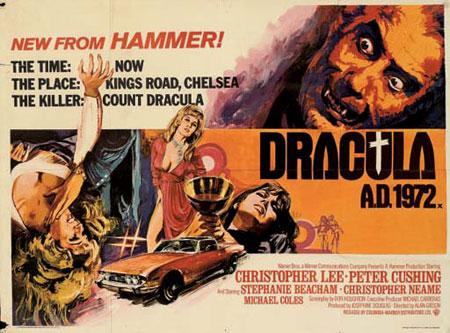
Dracula A.D. 1972 opens in 1872 with a genuinely exciting fight on a runaway carriage that ends with the death of both Count Dracula (Christopher Lee) and his nemesis, Prof. Van Helsing (Peter Cushing). However, as Van Helsing is buried, we see one of Dracula’s disciples (played by Christopher Neame, who had an appealingly off-kilter smile) burying Dracula’s ashes nearby. The camera pans up to the clear Victorian sky and, in a sudden and genuinely effective jumpcut, we suddenly see an airplane screeching across the sky.
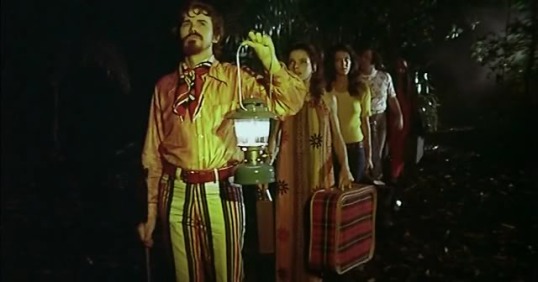
Well, it’s all pretty much downhill from there. Suddenly, we discover that a hundred years have passed and we are now in “swinging” London. The city is full of red tourist buses, hippies wearing love beads, and upright policemen who always appear to be on the verge of saying, “What’s all this, then?” We are introduced to a group of hippies that are led by a creepy guy named Johnny Alculard (also played — quite well, actually — by Christopher Neame). One of those hippies (Stephanie Beacham) just happens to be the great-great-granddaughter of Prof. Van Helsing. Apparently, she’s not really big on the family history because she doesn’t notice that Alculard spells Dracula backwards. Then again, her father (played by Peter Cushing, of course) doesn’t either until he actually writes the name down a few times on a piece of a paper.
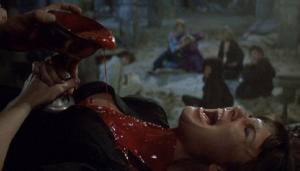
Anyway, the film meanders about a bit until finally, Alculard convinces all of his hippie friends to come take part in a black mass. “Sure, why not?” everyone replies. Well, I don’t have to tell you how things can sometimes get out-of-hand at black mass. In this case, Dracula comes back to life, kills a young Caroline Munro, and eventually turns Johnny into a vampire before then setting his sights on the modern-day Van Helsings.
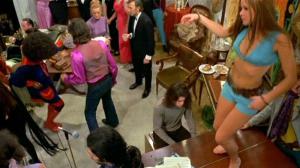
Dracula A.D. 1972 was Hammer’s attempt to breathe some new life into one of its oldest franchises and, as usually happens with a reboot, its critical and (especially) commercial failure ended up helping to end the series. Among even the most devoted and forgiving of Hammer fans, Dracula A.D. 1972 has a terrible reputation. Christopher Lee is on record as regarding it as his least favorite Dracula film. And the film definitely has some serious flaws. Once you get past the relatively exciting pre-credits sequence, the movie seriously drags. There’s a hippie party sequence that, honest to God, seems to last for about 5 hours. As for the hippies themselves, they are some of the least convincing middle-aged hippies in the history of fake hippies. You find yourself eagerly awaiting their demise, especially the awkward-looking one who — for some reason — is always dressed like a monk. (Those crazy hippies!) But yet…nothing happens. All the fake hippies simply vanish from the film. Yet, they’re so annoying in just a limited amount of screen time that the viewer is left demanding blood. Add to that, just how difficult is it to notice that Alculard is Dracula spelled backwards? I mean, seriously…
To a large extent, the charm of the old school Hammer films comes from the fact that they’re essentially very naughty but never truly decadent. At their heart, they were always very old-fashioned and actually quite conservative. The Hammer films — erudite yet campy, risqué yet repressed — mirrors the view that many of my fellow Americans have of the English. For some reason, however, that Hammer naughtiness only works when there’s the sound of hooves on cobblestone streets and when the screen is populated by actors in three-piece suits and actresses spilling out of corsets. Dracula A.D. 1972 did away with the support of the corset and as a result, the film is revealed as a formless mess with all the flab revealed to the world.
Still, the film isn’t quite as bad as you may have heard. First off, the film — with its middle-aged hippies — has a lot of camp appeal. It’s the type of film that, once its over, you’re convinced that the term “groovy” was uttered in every other scene even though it wasn’t. As with even the worst Hammer films, the film features a handful of striking images and Christopher Neame is surprisingly charismatic as Alculard.
As with the majority of the Hammer Dracula films, the film is enjoyable if just to watch the chemistry between Christopher Lee and Peter Cushing. Both of these actors — so very different in image but also so very stereotypically English — obviously loved acting opposite of each other and whenever you see them on-screen together, it’s difficult not to enjoy watching as each one tried to top the other with a smoldering glare or a melodramatic line reading. As actors, they brought out the best in each other, even when they were doing it in a film like Dracula A.D. 1972. In this film, Cushing is like the father you always you wished you had — the stern but loving one who protected you from all the world’s monsters (both real and cinematic).
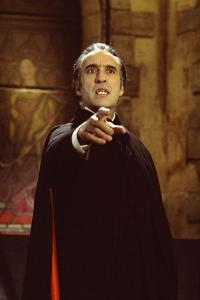
As for Lee, he’s only in six or seven scenes and he has even fewer lines but, since you spend the entire film wondering where he is, he actually dominates the entire movie. Lee apparently was quite contemptuous of the later Hammer Dracula films and, oddly enough, that obvious contempt is probably why, of all the Draculas there have been over the years, Lee’s version is the only one who was and is actually scary. F0rget all of that tortured soul and reluctant bloodsucker crap. Christopher Lee’s Dracula is obviously pissed off from the minute he first appears on-screen, the embodiment of pure destructive evil. And, for whatever odd reason, the purity of his evil brings a sexual jolt to his interpretation of Dracula that those littleTwilight vampires can only dream about. Even in a lesser films like Dracula A.D. 1972, Christopher Lee kicks some serious ass.
So, in conclusion, I really can’t call Dracula A.D. 1972 a good film nor can I really suggest that you should go out of your way to see it.. I mean, I love this stuff and I still frequently found my mind wandering whenever Cushing or Lee wasn’t on-screen. However, it’s not a terrible movie to watch if you happen to find yourself trapped in the house with 90 minutes to kill.
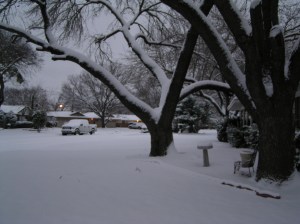
If you’re following the news then you probably heard that Dallas got hit with like a 100 inches of snow yesterday. Seriously, more snow fell yesterday than has even fallen in recorded history (or, at the very least, in my recorded history). You want to talk about Snowmageddon? Well, we had a Snowpocalypse.
The neighborhood on Friday morning (picture taken by Erin Nicole Bowman)
So, I spent most of yesterday cooped up inside with my sister and our cat and once we got over the whole fun of being able to go outside and scream, “SNOW DAY!” at the top of our lungs, there really wasn’t much to do. So, in an attempt to fight off cabin fever, I raided my DVD collection and we ended up watching one of the old Christopher Lee-as-Dracula-films from Hammer Studios. Specifically, we ended up watching Dracula A.D. 1972.
The film opens in 1872 with a genuinely exciting fight on a runaway carriage that ends with the death of both Count Dracula (Christopher Lee) and his nemesis, Prof. Van Helsing (Peter Cushing). However, as Van Helsing is buried, we see one of Dracula’s disciples (played by Christopher Neame, who had an appealingly off-kilter smile) burying Dracula’s ashes nearby. The camera pans up to the clear Victorian sky and, in a sudden and genuinely effective jumpcut, we suddenly see an airplane screeching across the sky.
Well, it’s all pretty much downhill from there. Suddenly, we discover that a hundred years have passed and we are now in “swinging” London. The city is full of red tourist buses, hippies wearing love beads, and upright policemen who always appear to be on the verge of saying, “What’s all this, then?” We are introduced to a group of hippies that are led by a creepy guy named Johnny Alculard (also played — quite well, actually — by Christopher Neame). One of those hippies (Stephanie Beacham) just happens to be the great-great-granddaughter of Prof. Van Helsing. Apparently, she’s not really big on the family history because she doesn’t notice that Alculard spells Dracula backwards. Then again, her father (played by Peter Cushing, of course) doesn’t either until he actually writes the name down a few times on a piece of a paper.
Anyway, the film meanders about a bit until finally, Alculard convinces all of his hippie friends to come take part in a black mass. “Sure, why not?” everyone replies. Well, I don’t have to tell you how things can sometimes get out-of-hand at black mass. In this case, Dracula comes back to life, kills a young Caroline Munro, and eventually turns Johnny into a vampire before then setting his sights on the modern-day Van Helsings.
Dracula A.D. 1972 was Hammer’s attempt to breathe some new life into one of its oldest franchises and, as usually happens with a reboot, its critical and (especially) commercial failure ended up helping to end the series. Among even the most devoted and forgiving of Hammer fans, Dracula A.D. 1972 has a terrible reputation. Christopher Lee is on record as regarding it as his least favorite Dracula film. And the film definitely has some serious flaws. Once you get past the relatively exciting pre-credits sequence, the movie seriously drags. There’s a hippie party sequence that, honest to God, seems to last for about 5 hours. As for the hippies themselves, they are some of the least convincing middle-aged hippies in the history of fake hippies. You find yourself eagerly awaiting their demise, especially the awkward-looking one who — for some reason — is always dressed like a monk. (Those crazy hippies!) But yet…nothing happens. All the fake hippies simply vanish from the film. Yet, they’re so annoying in just a limited amount of screen time that the viewer is left demanding blood. Add to that, just how difficult is it to notice that Alculard is Dracula spelled backwards? I mean, seriously…
To a large extent, the charm of the old school Hammer films comes from the fact that they’re essentially very naughty but never truly decadent. At their heart, they were always very old-fashioned and actually quite conservative. The Hammer films — erudite yet campy, risqué yet repressed — mirrors the view that many of my fellow Americans have of the English. For some reason, however, that Hammer naughtiness only works when there’s the sound of hooves on cobblestone streets and when the screen is populated by actors in three-piece suits and actresses spilling out of corsets. Dracula A.D. 1972 did away with the support of the corset and as a result, the film is revealed as a formless mess with all the flab revealed to the world.
Still, the film isn’t quite as bad as you may have heard. First off, the film — with its middle-aged hippies — has a lot of camp appeal. It’s the type of film that, once its over, you’re convinced that the term “groovy” was uttered in every other scene even though it wasn’t. As with even the worst Hammer films, the film features a handful of striking images and Christopher Neame is surprisingly charismatic as Alculard.
As with the majority of the Hammer Dracula films, the film is enjoyable if just to watch the chemistry between Christopher Lee and Peter Cushing. Both of these actors — so very different in image but also so very stereotypically English — obviously loved acting opposite of each other and whenever you see them on-screen together, it’s difficult not to enjoy watching as each one tried to top the other with a smoldering glare or a melodramatic line reading. As actors, they brought out the best in each other, even when they were doing it in a film like Dracula A.D. 1972. In this film, Cushing is like the father you always you wished you had — the stern but loving one who protected you from all the world’s monsters (both real and cinematic).
As for Lee, he’s only in six or seven scenes and he has even fewer lines but, since you spend the entire film wondering where he is, he actually dominates the entire movie. Lee apparently was quite contemptuous of the later Hammer Dracula films and, oddly enough, that obvious contempt is probably why, of all the Draculas there have been over the years, Lee’s version is the only one who was and is actually scary. F0rget all of that tortured soul and reluctant bloodsucker crap. Christopher Lee’s Dracula is obviously pissed off from the minute he first appears on-screen, the embodiment of pure destructive evil. And, for whatever odd reason, the purity of his evil brings a sexual jolt to his interpretation of Dracula that those little Twilight vampires can only dream about. Even in a lesser films like Dracula A.D. 1972, Christopher Lee kicks some serious ass.
So, in conclusion, I really can’t call Dracula A.D. 1972 a good film nor can I really suggest that you should track down a copy of the DVD. I mean, I love this stuff and I still frequently found my mind wandering whenever Cushing or Lee wasn’t on-screen. However, it’s not a terrible movie to watch if you happen to find yourself trapped in the house by a mountain of snow.









 Through the Shattered Lens