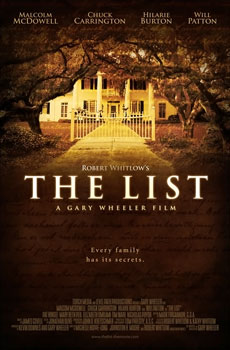
October Positivity: The List (dir by Gary Wheeler)


2007’s The List opens during the dying days of the American Civil War.

A group of wealthy plantation owners form a secret society.  They pool together their fortunes and they each sign onto a list.  Over the years, whenever a member of the Society passes away, their eldest male descendant replaces them on the List and also has access to the fortune that that the Society secretly holds.

In 2007, directionless attorney Renny Jacobsen (Chuck Carrington) is shocked when his father dies and leaves him next to no money.  As Renny tells us over and over again, he really could have used some of his father’s fortune.  However, his father does leave him a key the leads to Renny uncovering a tape that explains everything that he needs to know about the Society.  All Renny has to do is sign his name to the List.

The Society is now run by Desmond Larochette (Malcolm McDowell) and we know that he’s evil because his name is Desmond Larochette and he’s played by Malcolm McDowell.  Larochette seems to be more than happy to allow Renny to join the Society but he’s not quite as happy that another member of the group died and only left behind a female heir, Jo Johnston (Hilarie Burton).  The members of the Society are faced with quite a quandary.  Should they allow a woman to join their society?  And, if not, what should they do now that she know about the Society’s existence?

When Jo goes to the mansion for the Society’s meeting, she spots a portrait of a gray-haired gentleman and asks who he is.  Gus Eicholtz (Pat Hingle) explains that the painting is of John C. Calhoun, who served as Vice President under Andrew Jackson.  “He looks angry,” Jo says and honestly, that was a piece of historical and artistic criticism that was so simple-minded that Jo really should have been disqualified from joining the Society at that very moment.

First off, how are you going to join a Southern secret society if you don’t know how John C. Calhoun is?  Secondly, the portrait in question is actually a pretty famous one.  George Alexander Haley painted it while Calhoun was Secretary of State.  Even if you don’t know who John C. Calhoun is, chances are that you’ve seen the painting.  Finally, there’s the claim that “He looks angry.”  The painting was completed in 1845.  Everyone looked angry in 1840s!  Even the noted bon vivant Henry Clay looked angry in his 1848 State Department portrait.  (And Clay actually had his picture taken for his official portrait.  Imagine how furious he would look if someone had painted him?)

Anyway, Renny joins the society but Jo does not,  But then Renny discovers that it’s not as easy to get his hands on the money as he thought and he spends the entire movie complaining about it.  That’s pretty much it.  There is some suggestion that Desmond might have demonic powers, but it’s not really explored.  Another heir dies mysteriously and it seems like Jo is being targeted as well.  Again, it’s not really clear why.  In the end, Renny puts God before the money but it kind of comes out of nowhere.  It’s a muddled story and, by the end of the film, it’s still a struggle to figure out what it all meant.  At the very least, Malcolm McDowell seemed to be having fun, playing an evil character and speaking in an almost indecipherable accent.

Retro Television Reviews: Miami Vice 1.4 “Cool Runnin'”


Welcome to Retro Television Reviews, a feature where we review some of our favorite and least favorite shows of the past!  On Mondays, I will be reviewing Miami Vice, which ran on NBC from 1984 to 1989.  The entire show is currently streaming on Tubi!

This week, Crockett and Tubbs gain an informant!

Episode 1.4 “Cool Runnin'”

(Dir by Lee H. Katzin, originally aired on October 5th, 1984)

One of the main themes of Miami Vice was that, no matter how many drug lords that Crockett and Tubbs got off the streets, there was always someone in the wings waiting to replace them.  The drug trade was (and is) big business and there was always someone willing to step into the vacuum that was left by the downfall of any of the major players.  For all of their efforts, Crockett and Tubbs were essentially fighting a war on drugs that could not be won.

Cool Runnin’ features an early example of this.  With Calderone having fled Miami for Colombia, he’s been replaced by Desmond Maxwell (Afemo Omilami), a Jamaican who is willing to murder just about anyone who gets in his way.  When he’s first seen, he and the members of his gang are gunning down a group of rival drug dealers in a mall parking lot.  Later, Desmond kills one undercover cop and seriously wounds another.

Another major theme in Miami Vice is that Crockett (and, to a lesser extent, Tubbs) are willing to put others at risk to take down their targets.  The majority of this episode deals with Nugart Neville ‘Noogie’ Lamont (Charlie Barnett), a talkative thief and speed freak who is recruited, somewhat against his will, to be an informant.  When Crockett and Tubbs discover that Noogie served time with Desmond, they use Noogie to set up a meeting with Desmond.  When Crockett tells Desmond that he wants to buy from him and that he’ll be waiting for him at Noogie’s apartment, Tubbs points out that Crockett is putting Noogie’s life in danger without even bothering to tell Noogie beforehand.

(Crockett, it should be noted, isn’t thinking straight for most of this episode because his wife has filed for divorce and wants to take his son to Georgia.)

At first, it appears that Noogie is going to get a reprieve when a calls comes in that the man who killed the undercover cops has been arrested.  It doesn’t take long for Crockett (and the audience) to figure out that the man who has been arrested is not Jamaican (instead, he’s Haitian) and that he’s been beaten by the racist cop who arrested him.

Instead, the killers are now at Noogie’s apartment, where they are waiting for Crockett and Tubbs to show up so that they can kill both the cops and their informant.  It all leads to final shoot-out, one that is shown almost entirely in slow motion and which is surprisingly effective.

This was a good episode about the human cost of getting involved as law enforcement, whether as a cop or a criminal.  While Desmond Maxwell was not a particularly nuanced character, he was appropriately intimidating and the audience never had any doubt that he would coldly kill anyone who he viewed as being a threat.  (One of the more haunting moments of the episode features the Vice Squad listening to the tape of shooting in which Desmond gunned down two detectives.)

The episode was largely dominated by Charlie Barnett’s performance as Noogie.  Barnett was a stand-up comedian who first came to prominence performing in Central Park.  He was nearly cast on Saturday Night Live until it was discovered that he struggled with reading.  Barnett was replaced, at the last minute, by another New York comedian, Eddie Murphy.  As Noogie. Barnett never stops moving, talking, and performing.  It’s actually exhausting just watching him.  But, as the episode proceeds, Barnett starts to calm down and, by the end of it, the audience is actually happy that he wasn’t killed in the shoot-out.

Unfortunately, next week, a major character will be killed in a shootout.  Who?  Find out next Monday!