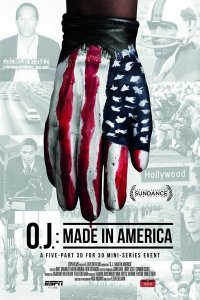
O.J.: Made in America, the best film of 2016, opens with a parole hearing in Nevada. The inmate is surprisingly friendly and affable. He talks about how he has tried to make the best use of his time in prison. He chuckles as he talks about his prison duties. For a prisoner, he seems like a really nice guy.
Then the parole commissioner asks him about the first time he was ever arrested and the prisoner’s entire demeanor changes.
“We’re going to talk about that?” he asks.
 The prisoner, of course, is former football great and actor Orenthal James Simpson and the first time that he was arrested, he was charged with murdering both his ex-wife, Nicole Brown Simpson, and Ronald Goldman. In 1995, after a long and controversial trial that both forced people to reconsider how they viewed race relations in America and also marked the beginning of what would become reality television, O.J. Simpson was acquitted. 13 years to the day of his acquittal, he was sentenced to 33 years in prison for armed robbery in Nevada.
O.J.: Made in America leaves little doubt that O.J. got away with murder, though it should be pointed out that O.J. Simpson did not respond to requests for an interview and that Johnnie Cochran, who headed the legal team that won Simpson’s acquittal, died in 2005. But with a sprawling running time of 7 and a half hours and featuring interviews with hundreds of people who either knew or were affected by O.J., O.J.: Made in America is about much more than just the trial of the century.
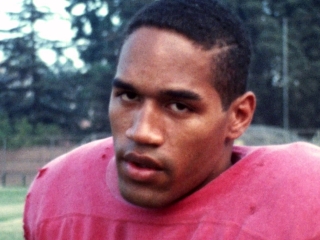
The first three hours of O.J.: Made in America deal with who O.J. was before he was charged with murder. Things open in the 1960s, with the nation torn apart by racial unrest, and O.J. Simpson winning the Heisman Trophy and setting rushing records with both the USC Trojans and the Buffalo Bills. While other black athletes, like Mohammad Ali, were putting their careers on the line and speaking out about civil rights, O.J. was deliberately apolitical. When O.J. was pressured to speak out on civil rights, he would reply, “I’m not black. I’m O.J.”
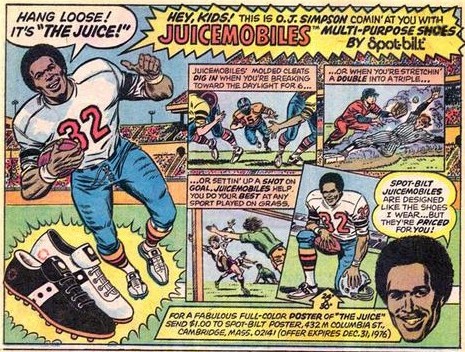
In turbulent times, O.J. emerged as a black celebrity that whites could safely embrace. O.J. made history as the first black man to be used as a spokesman in an advertising campaign, running through airports for Hertz Rent-A-Car while onlookers shouted, “Go, O.J., go!” A Hertz executive explains that, whenever they filmed a commercial, they were careful to make sure that it was only white people who were seen cheering O.J. on. Retiring from football, O.J. moved to Brentwood, an all-white enclave in Los Angeles. Surrounded by sycophants, O.J. pursued an acting career and remained silent while Los Angeles dealt with a series of racial incidents, culminating in the riots that followed after four LAPD officers was acquitted in the beating of Rodney King.
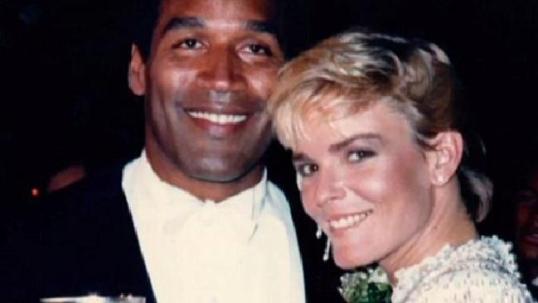
During all of this, O.J. divorced his first wife and married Nicole Brown. One of the commendable things about O.J.: Made in America is that it gives a face and a personality to Nicole, who is often the forgotten victim when people discuss the O.J. Simpson case. At the same time, O.J.: Made in America also documents how O.J. never faced any serious consequences for abusing Nicole. Even after he was charged with domestic battery, all O.J. had to do for his community service was set up a charity golf tournament. He later did an interview with Roy Firestone where the two of them joked away the charges and Firestone worried that they may have led some people to think that the Juice was a bad guy.
The next three hours deal with not only the murders of Nicole and Ronald Goldman but also with the national ramifications of the so-called “trial of the century.” The first three hours were dominated by interviews with childhood friends, business associates, and neighbors. It’s during the 2nd three hours that the familiar faces start to pop up. Gil Garcetti, Bill Hodgman, and Marcia Clark talk about prosecuting O.J. (Unfortunately, Chris Darden declined to be interviewed.) From the defense team, F. Lee Bailey, Barry Scheck, and Carl E. Douglas share their memories of how this murder trial became a national Rorschach test on how Americans viewed race, celebrity, and justice. The irony is not lost on anyone that O.J., who never made any public commitment to civil rights and who surrounded himself with rich, white people, was largely acquitted because of race.
Until I saw O.J.: Made in America, I could never understand how O.J, manages to win acquittal. His guilt has always seemed so obvious to me. But, as O.J.: Made in America made clear, reasonable doubt can mean different things to different people. A black jury in downtown Los Angeles had reason to both distrust and dislike the LAPD. When Mark Furhman is heard using racial slurs, Carl Douglas says that it confirmed everything that he had always suspected by the LAPD. Beyond that Cochran and his team put on a better show than the prosecution, who often seemed unsure how to respond and who repeatedly shot themselves in the foot with unforced errors, like asking O.J. to try on the bloody glove. (Mike Gilbert, O.J.’s agent, reveals that O.J. had stopped taking his arthritis medication during the trial, causing his fingers to swell up.) Even though the late Cochran could not be interviewed, he still easily dominates the documentary.
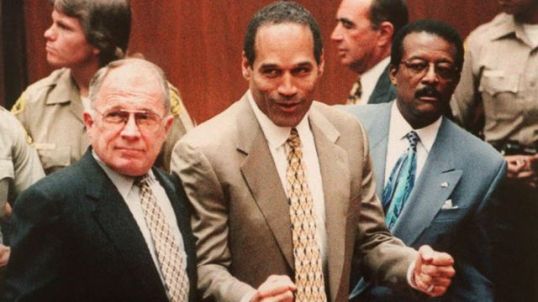
O.J.: Made in America features interviews with two of the jurors, Carrie Bess and Yolanda Crawford. When Crawford is asked if the acquittal was payback for the Rodney King verdict, she weakly protests that it was not. When ask the same question, Carrie Bess unapologetically nods in the affirmative.
With the trial over, the best part of the documentary is yet to come. The final 90 minutes deals with the decade between O.J.’s acquittal and his Nevada conviction. Freshly acquitted from murdering his wife, O.J. Simpson swore that he was going to track down the real killers, returned to his Brentwood mansion, and discovered that none of his old friends wanted to hang out with him anymore. The once popular O.J. Simpson was now a pariah. Simpson was taken to civil court by the Goldmans and the Browns and a new jury found him liable for the deaths of both Nicole and Ron. Ordered to pay $33,000,0000, a bankrupt and friendless O.J. spent ten years in the wilderness.
If things could not get any more surreal, O.J. was hired to star in a Punk’d-style TV show that would have been called Juiced. The Juiced footage would have been the strangest part of O.J.: Made in America if not for what happened in Las Vegas. Convinced that a memorabilia collector had stolen his stuff, O.J. and his entourage confronted the man in his hotel room. In a comedy of errors, O.J. grabbed everything that he felt had been stolen from him and ended up taking a lot of other things as well, with the entire encounter being audio recorded. Because a member of Simpson’s entourage had a gun on him, O.J. was charged with armed robbery.
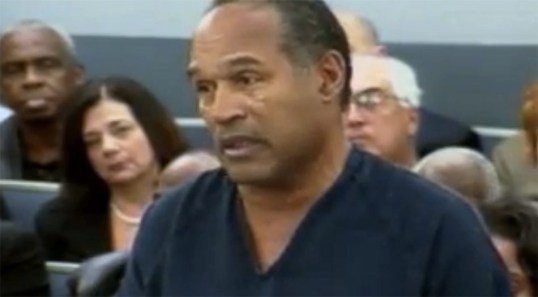
Tom Riccio, a member O.J.’s Las Vegas entourage, talks about how, in the minutes before leaving to confront the memorabilia collector, O.J. was watching the Tyra Banks Show in his hotel room. Tyra’s guest? O.J.’s goddaughter, Kim Kardashian. Kim announced that she and her family were going to be starring in a new show for E! O.J. laughed and said, “That show will never last.” Ironically, just as no one would have known (or cared) who Kim Kardashian was if not for her father’s role on O.J.’s defense team, O.J.’s murder trial also set the stage for the emergence of the reality television genre that would make stars of everyone from the Kardashian daughters to Donald Trump.
One final note about what happened in Las Vegas: O.J.’s Nevada trial was covered, for Entertainment Tonight, by Marcia Clark.
Convicted of armed robbery, O.J. was sentenced to prison. As Carl Douglas puts it, it was not a coincidence that the judge waited until a year to the day after Simpson’s previous acquittal to sentence him. And it was not a coincidence that Simpson, found liable for $33,000,000 in the civil lawsuit, was sentenced to 33 years. Douglas calls it the “fifth quarter,” the fight that happens after the fourth quarter to determine who really won the game. O.J.’s childhood friend, Joe Bell, calls it “white justice in America.”
Most people saw O.J.: Made in America when it was broadcast over five nights by ESPN. But the best way to see this documentary is the way it was originally viewed at Sundance: as a seven and a half hour movie, watched with little break or interruption. Full of candid and thought-provoking interviews and previously unseen footage, O.J.: Made in America is a powerful look at race, fame, and crime.
For tomorrow’s movie a day, it’s another documentary about a sports hero who ended up in prison, Stoked: The Rise and Fall of Gator.
 Through the Shattered Lens